Irena Klepfisz on Kadia Molodowsky
← Back to Irena Klepfisz Profile
“I turn to Kadia Molodowsky, predominantly known for her poetry, but whose stories minutely depict assimilation in America as she witnessed it in the 1940s and 1950s. All these Jewish women—Julia, Nadia, Patti, Gina, Fradel, Kadia—are my ancestors. They are mayne bobes, mumes, shvester, my grandmothers, aunts, sisters. Mir darfn zikh bakenen. We need to become acquainted.”
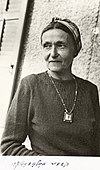
“In her often-quoted poem "Froyen lider" (Women poems), Kadia Molodowsky wrote of Jewish women who appear in her dreams: "Es veln di froyen fun undzer mishpokhe/bay nakht in khaloymes mir kumen un zogn..." ("The women in our family will come to me in my/dreams at night and say...") Written in 1920, the words are stark and unambiguous: "undzer mishpokhe"—our family—the Jewish people, clear and simple, easily identified by the language they spoke-the Yiddish speakers of Europe, of the world. Kadia was rooted in her world and its history. Her writing echoes with the richness of the Yiddish culture which she loved, but which she was also conscious erased women and women's lives. As she herself says in this poem, she was a page torn from a book whose first line is illegible. Still, when Kadia dreamed, she knew and remembered who and what she dreamed of.”
“As her reputation grew, she came to be called the "First Lady of Yiddish Poetry." Her volumes included Dzike gas (1933), Freydke (1935) and Likht fun dornboym (1965). Extremely versatile, she wrote children's literature, plays and fiction, much of which reflected her concern with 20th-century Jewish history. The play Nokhn got fun midbor (Toward the God of the desert, 1949) and the novel Baym toyer (At the gate, 1967) gave voice to her growing commitment to Zionism. Other fiction included the novel Fun Lublin biz New York (From Lublin to New York, 1942) and the collection A shtub mit zibn fenster (The house with seven windows, 1957). The latter shows Kadia's awareness of the tensions in American Jewish life. "The Lost Shabes," for example, reflects her observations of assimilation and the abandonment of Yiddish. "Oys" (Gone) describes how the Holocaust profoundly affected American Jews' sense of identity. Other stories-"Di kvin" (The Queen)-depict the materialism of American Jews. Her tendency was to romanticize European Jews who, she claims in the preface, didn't need interior decorators for their walls, just wanted to know which wall to face when praying. Still, her depiction of ordinary people is remarkable. Her characters never become bigger than life; rather they remain exactly who they are-ordinary and unaware of the large historical currents in which they are caught and which they shape.”