Link Copied!
Saul Bellow Quotes (1915-2005)
Writer




About Saul Bellow
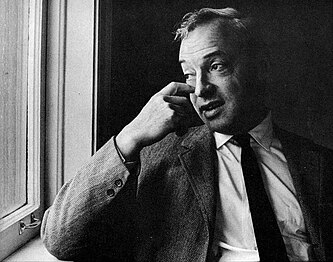
Saul Bellow (10 June 1915 – 5 April 2005) was a Canadian-born American writer. He won the Nobel Prize in Literature in 1976 and the National Medal of Arts in 1988.
Best Saul Bellow Quotes
Shortest
Earliest
Explore our curated collection of the most famous and impactful Saul Bellow quotes.

“No realistic, sane person goes around Chicago without protection.”


“Everybody needs his memories. They keep the wolf of insignificance from the door.”
“A good American makes propaganda for whatever existence has forced him to become.”


“Anxiety destroys scale, and suffering makes us lose perspective.”

“All a writer has to do to get a woman is to say he's a writer. It's an aphrodisiac.”
“A great deal of intelligence can be invested in ignorance when the need for illusion is deep.”

“California's like an artificial limb the rest of the country doesn't really need. You can quote me.”
“What is imposed on us by birth and environment is what we are called upon to overcome.”
“We take foreigners to be incomplete Americans — convinced that we must help and hasten their evolution.”
“We mustn't forget how quickly the visions of genius become the canned goods of intellectuals.”

“Once you had read the Psychopathology of Everyday Life, you knew that everyday life was psychopathology.”

“Any artist should be grateful for a naïve grace which puts him beyond the need to reason elaborately.”

“I think that New York is not the cultural center of America, but the business and administrative center of American culture.”
“There is only one way to defeat the enemy, and that is to write as well as one can. The best argument is an undeniably good book.”
“Everybody knows there is no fineness or accuracy of suppression; if you hold down one thing, you hold down the adjoining.”
“Americans must be the most sententious people in history. Far too busy to be religious, they have always felt that they sorely needed guidance.”
“There are evils, as someone has pointed out, that have the ability to survive identification and go on for ever — money, for instance, or war.”
“The book of the world, so richly studied by autodidacts, is being closed by the “learned,” who are raising walls of opinions to shut the world out.”


“We are free to withdraw (to withdraw our minds where we cannot withdraw our bodies) from situations in which our humanity or lack of it is defined for us.”
“I discovered that rejections are not altogether a bad thing. They teach a writer to rely on his own judgment and to say in his heart of hearts, "To hell with you."”
“Take our politicians: they're a bunch of yo-yos. The presidency is now a cross between a popularity contest and a high school debate, with an encyclopedia of cliches.”

“The late philosopher Morris R. Cohen of CCNY was asked by a student in the metaphysics course, “Professor Cohen, how do I know that I exist?” The keen old prof replied, “And who is asking?””
“When we read the best nineteenth- and twentieth-century novelists, we soon realize that they are trying in a variety of ways to establish a definition of human nature, to justify the continuation of life as well as the writing of novels.”
“One’s language is a spiritual location. It houses your soul. If you were born in America all essential communication, your deepest conversations with yourself, will be in English. … Your English is the principal instrument of your humanity.”


“People reserve their best thinking for their professional specialties and, next in line, for serious matters confronting the alert citizen —economics, politics, the disposal of nuclear waste, etc. The day’s work done, they want to be entertained.”


“All human accomplishment has the same origin, identically. Imagination is a force of nature. Is this not enough to make a person full of ecstasy? Imagination, imagination, imagination. It converts to actual. It sustains, it alters, it redeems!”

“Psychoanalysis pretends to investigate the Unconscious. The Unconscious by definition is what you are not conscious of. But the Analysts already know what’s in it. They should, because they put it all in beforehand. It's like an Easter Egg hunt.”
“We are all such accidents. We do not make up history and culture. We simply appear, not by our own choice. We make what we can of our condition with the means available. We must accept the mixture as we find it — the impurity of it, the tragedy of it, the hope of it.”
“There is no need to make an inventory of the times. It is demoralizing to describe ourselves to ourselves yet again. It is especially hard on us since we believe (as we have been educated to believe) that history has formed us and that we are all mini-summaries of the present age.”
“One naturally regrets not being an expert or one of those insiders who thoroughly understand. It's hell to be an amateur. A little reflection calms your sorrow, however. The experts in their own little speedboat, the rest of us floating with the rest of mankind in a great barge — that is the picture.”
“Much of junk culture has a core of crisis — shoot-outs, conflagrations, bodies weltering in blood, naked embracers or rapist-stranglers. The sounds of junk culture are heard over a ground bass of extremism. Our entertainments swarm with specters of world crisis. Nothing moderate can have any claim to our attention.”

“It seems hard for the American people to believe that anything could be more exciting than the times themselves. What we read daily and view on the TV has thrust imagined forms into the shadow. We are staggeringly rich in facts, in things, and perhaps, like the nouveau riche of other ages, we want our wealth faithfully reproduced by the artist.”
“It's hard for writers to get on with their work if they are convinced that they owe a concrete debt to experience and cannot allow themselves the privilege of ranging freely through social classes and professional specialties. A certain pride in their own experience, perhaps a sense of the property rights of others in their experience, holds them back.”

“A millennial belief in a Holy God may have the effect of deepening the soul, but it is also obviously archaic, and modern influences would presently bring me up to date and reveal how antiquated my origins were. To turn away from those origins, however, has always seemed to me an utter impossibility. It would be a treason to my first consciousness to un-Jew myself.”

“In the greatest confusion there is still an open channel to the soul. It may be difficult to find because by midlife it is overgrown, and some of the wildest thickets that surround it grow out of what we describe as our education. But the channel is always there, and it is our business to keep it open, to have access to the deepest part of ourselves.”

“Apparently the rise of consciousness is linked to certain kinds of privation. It is the bitterness of self-consciousness that we knowers know best. Critical of the illusions that sustained mankind in earlier times, this self-consciousness of ours does little to sustain us now. The question is: which is disenchanted, the world itself or the consciousness we have of it?”

“Reading Decline of the West I learned that in Spengler’s view ours was a Faustian civilization and that we, the Jews, were Magians, the survivors and representatives of an earlier type, totally incapable of comprehending the Faustian spirit that had created the great civilization of the West. … What Magians were to Faustians, Faustians might very well be to Americans.”

“In an age of enormities, the emotions are naturally weakened. We are continually called upon to have feelings — about genocide, for instance, or about famine or the blowing up of passenger planes — and we are all aware that we are incapable of reacting appropriately. A guilty consciousness of emotional inadequacy or impotence makes people doubt their own human weight.”
“As for types like my own, obscurely motivated by the conviction that our existence was worthless if we didn’t make a turning point of it, we were assigned to the humanities, to poetry, philosophy, painting — the nursery games of humankind, which had to be left behind when the age of science began. The humanities would be called upon to choose a wallpaper for the crypt, as the end drew near.”
“The principles of Western liberalism seem no longer to lend themselves to effective action. Deprived of the expressive power, we are awed by it, have a hunger for it, and are afraid of it. Thus we praise the gray dignity of our soft-spoken leaders, but in our hearts we are suckers for passionate outbursts, even when those passionate outbursts are hypocritical and falsely motivated.”
“A novel is balanced between a few true impressions and the multitude of false ones that make up most of what we call life. It tells us that for every human being there is a diversity of existences, that the single existence is itself an illusion in part, that these many existences signify something, tend to something, fulfill something; it promises us meaning, harmony, and even justice.”
“There is simply too much to think about. It is hopeless — too many kinds of special preparation are required. In electronics, in economics, in social analysis, in history, in psychology, in international politics, most of us are, given the oceanic proliferating complexity of things, paralyzed by the very suggestion that we assume responsibility for so much. This is what makes packaged opinion so attractive.”

“Can we find nothing good to say about TV? Well, yes, it brings scattered solitaries into a sort of communion. TV allows your isolated American to think that he participates in the life of the entire country. It does not actually place him in a community, but his heart is warmed with the suggestion (on the whole false) that there is a community somewhere in the vicinity and that his atomized consciousness will be drawn back toward the whole.”

“Writers are greatly respected. The intelligent public is wonderfully patient with them, continues to read them, and endures disappointment after disappointment, waiting to hear from art what it does not hear from theology, philosophy, social theory, and what it cannot hear from pure science. Out of the struggle at the center has come an immense, painful longing for a broader, more flexible, fuller, more coherent, more comprehensive account of what we human beings are, who we are and what this life is for.”

“Tocqueville predicted that in democratic countries the public would demand larger and larger doses of excitement and increasingly stronger stimulants from its writers. He probably did not expect that public to dramatize itself so extensively, to make the world scene everybody's theatre, or, in the developed countries, to take to alcohol and drugs in order to get relief from the horrors of ceaseless intensity, the torment of thrills and distractions. A great many writers have done little more than meet the mounting demand for thrills. I think that this demand has, in the language of marketing, peaked.”
“As a scholar [Allan Bloom] intends to enlighten us, and as a writer he has learned from Aristophanes and other models that enlightenment should also be enjoyable. To me, this is not the book of a professor, but that of a thinker who is willing to take the risks more frequently taken by writers. It is risky in a book of ideas to speak in one’s own voice, but it reminds us that the sources of the truest truths are inevitably profoundly personal. … Academics, even those describing themselves as existentialists, very seldom offer themselves publicly and frankly as individuals, as persons.”
“Writers, poets, painters, musicians, philosophers, political thinkers, to name only a few of the categories affected, must woo their readers, viewers, listeners, from distraction. To this we must add, for simple realism demands it, that these same writers, painters, etc., are themselves the children of distraction. As such, they are peculiarly qualified to approach the distracted multitudes. They will have experienced the seductions as well as the destructiveness of the forces we have been considering here. This is the destructive element in which we do not need to be summoned to immerse ourselves, for we were born to it.”

“Our media make crisis chatter out of news and fill our minds with anxious phantoms of the real thing — a summit in Helsinki, a treaty in Egypt, a constitutional crisis in India, a vote in the U.N., the financial collapse of New York. We can't avoid being politicized (a word as murky as the condition which it describes) because it is necessary after all to know what is going on. Worse yet, what is going on will not let us alone. Neither the facts nor the deformations, the insidious platitudes of the media (tormenting because the underlying realities are so large and so terrible), can be screened out. The study of literature itself is heavily "politicized."”

“The university, in a society ruled by public opinion, was to have been an island of intellectual freedom where all views were investigated without restriction. … But by consenting to play an active or “positive,” a participatory role in society, the university has become inundated and saturated with the backflow of society’s “problems.” Preoccupied with questions of Health, Sex, Race, War, academics make their reputations and their fortunes. … Any proposed reforms of liberal education which might bring the university into conflict with the whole of the U.S.A. are unthinkable. Increasingly, the people “inside” are identical in their appetites and motives with the people “outside” the university.”

“In the greatest confusion there is still an open channel to the soul. It may be difficult to find because by midlife it is overgrown, and some of the wildest thickets that surround it grow out of what we describe as our education. But the channel is always there, and it is our business to keep it open, to have access to the deepest part of ourselves—to that part of us which is conscious. … The independence of this consciousness, which has the strength to be immune to the noise of history and the distractions of our immediate surroundings, is what the life struggle is all about. The soul has to find and hold its ground against hostile forces, sometimes embodied in ideas which frequently deny its very existence, and which indeed often seem to be trying to annul it altogether.”

“There's something that remains barbarous in educated people, and lately I've more and more had the feeling that we are nonwondering primitives. And why is it that we no longer marvel at these technological miracles? They've become the external facts of every life. We've all been to the university, we've had introductory courses in everything, and therefore we have persuaded ourselves that if we had the time to apply ourselves to these scientific marvels, we would understand them. But of course that's an illusion. It couldn't happen. Even among people who have had careers in science. They know no more about how it all works than we do. So we are in the position of savage men who, however, have been educated into believing that they are capable of understanding everything. Not that we actually do understand, but that we have the capacity.”
“Pointless but intense excitement holds us in TV dramas. We hear threatening music. A killer with a gun steals into the bedroom of a sleeping woman. More subliminal sounds of danger, pointlessly ominous. The woman wakes and runs into the kitchen for a knife. The cops are on the case. We watch as the criminal is pursued through night streets; shots, a death; a body falls from a roof. Then time is up, another drama begins. Now we are in a church. No, we are in a lecture hall; no again — a drawer opens in a morgue. A woman is looking for her kidnapped child. Then that ends, and we are on the veld with zebras and giraffes. Then with Lenin at a mass meeting. And suddenly we flash away to a cooking school; we are shown how to stuff a turkey. Next the Berlin Wall comes down. Or flags are burning. Or a panel is worrying about the rug crisis. More and more public themes, with less and less personal consciousness. Clearly, personal consciousness is shrinking.”
Saul Bellow Quotes by Topic
Find exactly what you are looking for by browsing this categorized list of Saul Bellow quotes by topic.
Saul Bellow on Enlightenment (spiritual)
“Enlightenment should also be enjoyable.”

Saul Bellow on Libraries
Saul Bellow on California
“California's like an artificial limb the rest of the country doesn't really need. You can quote me.”

Saul Bellow on Imagination
“All human accomplishment has the same origin, identically. Imagination is a force of nature. Is this not enough to make a person full of ecstasy? Imagination, imagination, imagination. It converts to actual. It sustains, it alters, it redeems!”
Saul Bellow on Extremism
“Much of junk culture has a core of crisis — shoot-outs, conflagrations, bodies weltering in blood, naked embracers or rapist-stranglers. The sounds of junk culture are heard over a ground bass of extremism. Our entertainments swarm with specters of world crisis. Nothing moderate can have any claim to our attention.”

Quotes About Saul Bellow
Gain deeper perspective through quotes about Saul Bellow from others.
Kingsley Amis on Saul Bellow
“[John D Macdonald] is by any standards a better writer than Saul Bellow, only MacDonald writes thrillers and Bellow is a human-heart chap, so guess who wears the top-grade laurels.”

Vivian Gornick Introduction on Saul Bellow
“Saul Bellow and Philip Roth made the words Jewish and manic synonymous. "What are we doing? What are we doing?" their novels scream at us, from Augie March on.”
Barack Obama on Saul Bellow

Grace Paley on Saul Bellow

Diana Trilling Reviewing the Forties on Saul Bellow
“It is a special pleasure for a reviewer who did not admire Saul Bellow's first novel, Dangling Man, to report of his second, The Victim, that it is not only in every way a striking advance over its predecessor but also hard to match in recent fiction for brilliance, skill, and originality.”
Misattributed Quotes
Quotes mistakenly credited to Saul Bellow
“When we ask for advice, we are usually looking for an accomplice.”
“If women are expected to do the same work as men, we must teach them the same things.
• Variant: So if we are going to use men and women for the same purposes, they must be taught the same things. The Republic, trans. Desmond Lee [Penguin Classics, 2003, ], p. 161
• Variant: Then if we are to use the women for the same things as the men, we must teach them the same things. The Republic, trans. W. H. D. Rouse [Signet Classic, 1999, ], p. 249”
About Saul Bellow
Saul Bellow (10 June 1915 – 5 April 2005) was a Canadian-born American writer. He won the Nobel Prize in Literature in 1976 and the National Medal of Arts in 1988.