Link Copied!
Zoroaster Quotes (1000-)


About Zoroaster
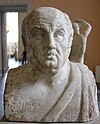
Zoroaster, also known as Zarathustra or Zartosht, was the prophet of the Zoroastrian religion. It is now thought that he lived in eastern Iran or in central Asia around 1000 BC. The Gathas are hymns held by believers to have been written by Zoroaster.
Best Zoroaster Quotes
Shortest
Earliest
Explore our curated collection of the most famous and impactful Zoroaster quotes.


“With an ill-famed man form no connection.”

“With a drunken man do not walk on the road.”

“A reflective, contented mind is the best possession.”
“Bear no improper envy, so that thy life may not become tasteless.”
“With an ignorant man thou shouldst not become a confederate and associate.”
“Commit no slander; so that infamy and wickedness may not happen unto thee. (p. 59)”
“Satisfaction linked with dishonor or with harm to others is a prison for the seeker.”
“Commit no lustfulness, so that harm and regret may not reach thee from thine own actions.”
“With a greedy man thou shouldst not be a partner, and do not trust him with the leadership.”

“In forming a store of good works thou shouldst be diligent, so that it may come to thy assistance among the spirits.”
“Practice no sloth, so that the duty and good work, which it is necessary for thee to do, may not remain undone. (p. 59)”

“Thou shouldst not become presumptuous through great connections and race; for in the end thy trust is on thine own deeds.(p. 60)”

“In the beginning there were two primal spirits,
Twins spontaneously active,
These are the Good and the Evil, in thought, and in word, and in deed.”
Twins spontaneously active,
These are the Good and the Evil, in thought, and in word, and in deed.”

“Hearken with your ears to these best counsels,
Reflect upon them with illumined judgment.
Let each one choose his creed with that freedom of choice each must have at great events.”
Reflect upon them with illumined judgment.
Let each one choose his creed with that freedom of choice each must have at great events.”
“Make thyself pure, 0 righteous man! Anyone in the world here below can win purity for himself, namely, when he cleanses himself with Good Thoughts, Good Words, and Good Deeds.”
Zoroaster Quotes by Topic
Find exactly what you are looking for by browsing this categorized list of Zoroaster quotes by topic.

Quotes About Zoroaster
Gain deeper perspective through quotes about Zoroaster from others.
Rauzat-us-Safa on Zoroaster
“News arrived from Estakhan that the fire of the chief temple of Persia, which had burned for a thousand years, had become extinguished [at the time of the birth of Muhammad].”
H. P. Blavatsky on Zoroaster 3 quotes
“If we carefully trace the terms nazar, and nazaret, throughout the best known works of ancient writers, we will meet them in connection with “Pagan” as well as Jewish adepts. Thus, Alexander Polyhistor says of Pythagoras that he was a disciple of the Assyrian Nazarrt, whom some suppose to be Ezekiel. Diogenes Laertius states most positively that Pythagoras, after being initiated into all the Mysteries of the Greeks and barbarians, “went into Egypt and afterward visited the Chaldeans and Magi;” and Apuleius maintains that it was Zoroaster who instructed Pythagoras. (p. 140)”
H.P. Blavatsky on Zoroaster 3 quotes
“Zarathustra (Zend). The great lawgiver, and the founder of the religion variously called Mazdaism, Magism, Parseeїsm, Fire-Worship, and Zoroastrianism. The age of the last Zoroaster (for it is a generic name) is not known, and perhaps for that very reason. Xanthus of Lydia, the earliest Greek writer who mentions this great lawgiver and religious reformer, places him about six hundred years before the Trojan War. But where is the historian who can now tell when the latter took place? Aristotle and also Eudoxus assign him a date of no less than 6,000 years before the days of Plato, and Aristotle was not one to make a statement without a good reason for it. Berosus makes him a king of Babylon some 2,200 years B.C.; but then, how can one tell what were the original figures of Berosus, before his MSS. passed through the hands of Eusebius, whose fingers were so deft at altering figures, whether in Egyptian synchronistic tables or in Chaldean chronology? Haug refers Zoroaster to at least 1,000 years B.C.; and Bunsen (God in History, Vol. I., Book iii., ch. vi., p. 276) finds that Zarathustra Spitama lived under the King Vistaspa about 3,000 years B.C., and describes him as “one of the mightiest intellects and one of the greatest men of all time”.”
G. Gnoli. Zoroaster’s Time on Zoroaster
““there is no evidence for thinking that the Zoroastrian message was meant for the Iranians alone. On the-contrary, history suggests that the exact opposite is likely, and there are also indisputable facts … which show clearly that Zoroaster’s teaching was addressed, earlier on at least to all men ... whether they were Iranians or not, Proto-Indoaryans or otherwise…””
William Godwin on Zoroaster
“Among the Chaldeans the most famous name is that of Zoroaster, who is held to have been the author of their religion, their civil policy, their sciences, and their magic. He taught the doctrine of two great principles, the one the author of good, the other of evil. He prohibited the use of images in the ceremonies of religion, and pronounced that nothing deserved homage but fire, and the sun, the centre and the source of fire, and these perhaps to be venerated not for themselves, but as emblematical of the principle of all good things. He taught astronomy and astrology. We may with sufficient probability infer his doctrines from those of the Magi, who were his followers. He practised enchantments, by means of which he would send a panic among the forces that were brought to make war against him, rendering the conflict by force of arms unnecessary. He prescribed the use of certain herbs as all−powerful for the production of supernatural effects. He pretended to the faculty of working miracles, and of superseding and altering the ordinary course of nature.—There was, beside the Chaldean Zoroaster, a Persian known by the same name, who is said to have been a contemporary of Darius Hystaspes.”

Colin Wilson on Zoroaster
“But Zarathustra made it clear in which direction the answer lay; it is towards the artist-psychologist, the intuitional thinker. There are very few such men in the world's literature; the great artists are not thinkers, the great thinkers are seldom artists.”

Friedrich Nietzsche on Zoroaster
“Zarathustra was the first to see in the struggle between good and evil the essential cycle in the working of things. The translation of morality into the realm of metaphysics, as force, cause, as end in itself, is his work. But the very question presents its own answer. Zarathustra created this most fateful of all errors—morality; therefore he must be the first to recognize it.”

About Zoroaster
Zoroaster, also known as Zarathustra or Zartosht, was the prophet of the Zoroastrian religion. It is now thought that he lived in eastern Iran or in central Asia around 1000 BC. The Gathas are hymns held by believers to have been written by Zoroaster.