Link Copied!
Willard van Orman Quine Quotes (1908-2000)
Philosopher
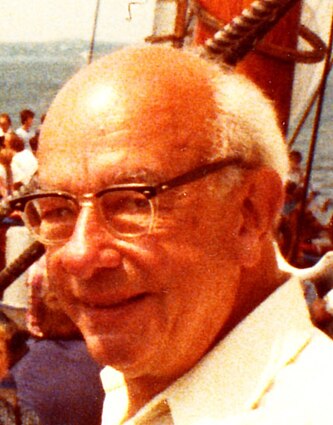

About Willard van Orman Quine
Willard Van Orman Quine (25 June 1908 – 25 December 2000) was an influential 20th Century American philosopher and logician.
Best Willard van Orman Quine Quotes
Shortest
Earliest
Explore our curated collection of the most famous and impactful Willard van Orman Quine quotes.
“A fancifully fancyless medium of unvarnished news.”
“Possibly, but my concern is that there not be more things in my philosophy than are in heaven and earth.”
“It is within science itself, and not in some prior philosophy, that reality is to be identified and described.”

“Wyman's overpopulated universe is in many ways unlovely. It offends the aesthetic sense of us who have a taste for desert landscapes.”
“Creatures inveterately wrong in their inductions have a pathetic but praiseworthy tendency to die before reproducing their kind.”
“At root what is needed for scientific inquiry is just receptivity to data, skill in reasoning, and yearning for truth. Admittedly, ingenuity can help too.”
“The word 'definition' has come to have a dangerously reassuring sound, owing no doubt to its frequent occurrence in logical and mathematical writings.”

“No particular experiences are linked with any particular statements in the interior of the field, except indirectly through considerations of equilibrium affecting the field as a whole.”


“We cannot stem linguistic change, but we can drag our feet. If each of us were to defy Alexander Pope and be the last to lay the old aside, it might not be a better world, but it would be a lovelier language.”
“Tactically, conceptualism is no doubt the strongest position of the three; for the tired nominalist can lapse into conceptualism and still allay his puritanic conscience with the reflection that he has not quite taken to eating lotus with the Platonists.”
“How are we to adjudicate among rival ontologies? Certainly the answer is not provided by the semantical formula "To be is to be the value of a variable"; this formula serves rather, conversely, in testing the conformity of a given remark or doctrine to a prior ontological standard.”
“Nonbeing must in some sense be, otherwise what is it that there is not? This tangled doctrine might be nicknamed Plato's beard; historically it has proved tough, frequently dulling the edge of Occam's razor.”
“The issue over there being classes seems more a question of convenient conceptual scheme; the issue over there being centaurs, or brick houses on Elm Street, seems more a question of fact. But I have been urging that this difference is only one of degree, and that it turns upon our vaguely pragmatic inclination to adjust one strand of the fabric of science rather than another in accommodating some particular recalcitrant experience. Conservatism figures in such choices, and so does the quest for simplicity.”

“Even a statement very close to the periphery can be held true in the face of recalcitrant experience by pleading hallucination or by amending certain statements of the kind called logical laws. Conversely, by the same token, no statement is immune to revision. Revision even of the logical law of the excluded middle has been proposed as a means of simplifying quantum mechanics; and what difference is there in principle between such a shift and the shift whereby Kepler superseded Ptolemy, or Einstein Newton, or Darwin Aristotle?”
“Modern empiricism has been conditioned in large part by two dogmas. One is a belief in some fundamental cleavage between truths which are analytic, or grounded in meanings independently of matters of fact, and truths which are synthetic, or grounded in fact. The other dogma is reductionism: the belief that each meaningful statement is equivalent to some logical construct upon terms which refer to immediate experience. Both dogmas, I shall argue, are ill-founded. One effect of abandoning them is, as we shall see, a blurring of the supposed boundary between speculative metaphysics and natural science. Another effect is a shift toward pragmatism.”
“As an empiricist I continue to think of the conceptual scheme of science as a tool, ultimately, for predicting future experience in the light of past experience. Physical objects are conceptually imported into the situation as convenient intermediaries—not by definition in terms of experience, but simply as irreducible posits comparable, epistemologically, to the gods of Homer. For my part I do, qua lay physicist, believe in physical objects and not in Homer's gods; and I consider it a scientific error to believe otherwise. But in point of epistemological footing the physical objects and the gods differ only in degree and not in kind. Both sorts of entities enter our conception only as cultural posits. The myth of physical objects is epistemologically superior to most in that it has proved more efficacious than other myths as a device for working a manageable structure into the flux of experience.”

Willard van Orman Quine Quotes by Topic
Find exactly what you are looking for by browsing this categorized list of Willard van Orman Quine quotes by topic.
Willard van Orman Quine on Empiricism 2 quotes
“Our argument is not flatly circular, but something like it. It has the form, figuratively speaking, of a closed curve in space.”

Willard van Orman Quine on Naturalism (philosophy) 2 quotes
“If I saw indirect explanatory benefit in positing sensibilia, possibilia, spirits, a Creator, I would joyfully accord them scientific status too, on a par with such avowedly scientific posits as quarks and black holes. What then have I banned under the name of prior philosophy?”

Willard van Orman Quine on Fancies
“One man's observation is another man's closed book or flight of fancy.”
Willard van Orman Quine on Observation
“One man's observation is another man's closed book or flight of fancy.”

Willard van Orman Quine on Necessity
Willard van Orman Quine on Meaning of life
Willard van Orman Quine on Logic
“Logic and mathematics seem to be the only domains where self-evidence manages to rise above triviality; and this it does, in those domains, by a linking of self-evidence on to self-evidence in the chain reaction known as proof.”

Willard van Orman Quine on Ontology
“How are we to adjudicate among rival ontologies? Certainly the answer is not provided by the semantical formula "To be is to be the value of a variable"; this formula serves rather, conversely, in testing the conformity of a given remark or doctrine to a prior ontological standard.”

What Willard van Orman Quine Said About Others
Discover personal opinions Willard van Orman Quine shared regarding contemporaries.
Quotes About Willard van Orman Quine
Gain deeper perspective through quotes about Willard van Orman Quine from others.
Friedrich Hayek on Willard van Orman Quine
“I regard Quine as one of our most stimulating philosophers.”

Hilary Putnam on Willard van Orman Quine
“I do not agree with Quine, that there is no analytic-synthetic distinction to be drawn at all. But I do believe that his emphasis on the monolithic character of our conceptual system and his negative emphasis on the silliness of regarding mathematics as consisting in some sense of 'rules of language', represent exceedingly important theoretical insights in philosophy. I think that what we have to do now is to settle the relatively trivial question concerning analytic statements properly so called ('All bachelors are unmarried'). We have to take a fresh look at the framework principles so much discussed by philosophers, disabusing ourselves of the idea that they are 'rules of language' in any literal or lexicographic sense; and above all, we have to take a fresh look at the nature of logical and mathematical truths. With Quine's contribution, we have to face two choices: We can ignore it and go on talking about the 'logic' of individual words. In that direction lies sterility and more, much more, of what we have already read. The other alternative is to face and explore the insight achieved by Quine, trying to reconcile the fact that Quine is overwhelmingly right in his critique of what other philosophers have done with the analytic-synthetic distinction with the fact that Quine is wrong in his literal thesis, namely, that the distinction itself does not exist at all. In the latter direction lies philosophic progress. For philosophic progress is nothing if it is not the discovery of new areas for dialectical exploration.”

About Willard van Orman Quine
Willard Van Orman Quine (25 June 1908 – 25 December 2000) was an influential 20th Century American philosopher and logician.