W. W. Rouse Ball on Niels Henrik Abel
← Back to W. W. Rouse Ball Profile
“The name of Abelian function has been given to the higher transcendents of multiple periodicity which were first discussed by Abel. The Abelian functions connected with a curve f(x,y) are if the form int u,dx, where u is a rational function of x and y. The theory of Abelian functions has been studied by a very large number of modern writers.”
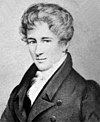
“Abel criticised the use of infinite series, and discovered the well-known theorem which furnishes a test for the validity of the result obtained by multiplying one infinite series by another. He also proved the binomial theorem for the expansion of (1 + x)^n when x and n are complex. As illustrating his fertility of ideas... notice his celebrated demonstration that it is impossible to express a root of the general quintic equation in terms of its coefficients by means of a finite number of radicals and rational functions; this theorem was the more important since it definitely limited a field of mathematics which had previously attracted numerous writers. ...this theorem had been enunciated as early as 1798 by Paolo Ruffini... but I believe that the proof he gave was lacking in generality.”
“His memoirs on elliptic functions, originally published in Crelle's Journal (of which he was one of the founders), treat the subject from the point of view of the theory of equations and algebraic forms, a treatment to which his researches naturally led him. The important and very general result known as Abel's theorem, which was subsequently applied by Riemann to the theory of transcendental functions, was sent to the French Academy in 1826, but was not printed until 1841: its publication then was due to inquiries made by Jacobi, in consequence of a statement on the subject by B. Holmboe in his edition of Abel's works issued in 1839. ...Abel's theorem ...may be described as a theorem for evaluating the sum of a number of integrals which have the same integrand, but different limits—these limits being the roots of an algebraic equation. The theorem gives the sum of the integrals in terms of the constants occurring in this equation and in the integrand. We may regard the inverse of the integral of this integrand as a new transcendental function, and if so the theorem furnishes a property of this function. For instance, if Abel's theorem be applied to the integrand (1 - x^2)^frac{-1}{2} it gives the addition theorem for the circular (or trigonometrical) functions.”