Link Copied!
Vinayak Damodar Savarkar Quotes (1883-1966)
Writer, Poet, Activist
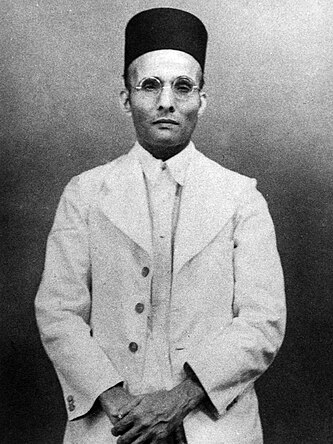

About Vinayak Damodar Savarkar
Vinayak Damodar Savarkar (May 28, 1883 – February 26, 1966) was an Indian freedom fighter, pro-independence activist, politician as well as a poet, writer and playwright. He advocated dismantling the system of caste in Hindu culture, and reconversion of the converted Hindus back to Hindu religion. Savarkar coined the term Hindutva (Hinduness) to create a collective "Hindu" identity as an "imagined nation". His political philosophy had the elements of Utilitarianism, Rationalism and Positivism, Humanism and Universalism, Pragmatism and Realism.
Best Vinayak Damodar Savarkar Quotes
Shortest
Earliest
Explore our curated collection of the most famous and impactful Vinayak Damodar Savarkar quotes.


“The epitaph of an RSS man will be: he was born, went to shakha, and died.”
“Blessed am I, blessed am I, I know of no duty now; Blessed am I, blessed am I, I have fulfilled what I wished to achieve.”
“So of us are Brahmins and some Namashudras or Panchamas; but Brahmins or Chandalas, we are all Hindus and own a common blood.”

“We yield to none in our love, admiration and respect for the Buddha-the Dharma-the Sangha. They are all ours. Their glories are ours and ours their failures.”

“Mohammedan or Christian communities possess all the essential qualifications of Hindutva but one and all that is that they do not look upon India as their holyland.”



“There is no reason to suppose that Hitler must be a human monster because he passes off as a Nazi or Churchill is a demi-God because he calls himself a Democrat. Nazism proved undeniably the saviour of Germany under the set of circumstances Germany was placed in…”

“‘By annihilating the wicked I lightened the great weight on the globe. I delivered the country by establishing Swarajya and by saving religion. I betook myself to shake off the great exhaustion which had come upon me. I was asleep, why then, did you my darlings awaken me?’”
“Come, Death! If really thou hast started already to come—welcome!
These flowers may tremble to fade away,
These juicy grapes to wither,
But why should I fear Thee?
I have but these wines of tears that fill my cup to offer Thee
And which I thought over-drinking cannot exhaust;
Come if that be acceptable to Thee!”
These flowers may tremble to fade away,
These juicy grapes to wither,
But why should I fear Thee?
I have but these wines of tears that fill my cup to offer Thee
And which I thought over-drinking cannot exhaust;
Come if that be acceptable to Thee!”
“The practice of untouchability is a sin, a blot on humanity, and nothing can justify it. Consider only that untouchable which is injurious to one’s health, not fellow human beings. Unshackling this one foolish fetter would bring crores of our Hindu brethren into the mainstream. They would serve the country in various capacities and defend her honour.”
“Every person is a Hindu who regards and owns this Bharat Bhumi, this land from the Indus to the seas, as his Fatherland as well as Holyland, i.e. the land of the origin of his religion (…) Consequently the so-called aboriginal or hill tribes also are Hindus: because India is their Fatherland as well as their Holyland of whatever form of religion or worship they follow.”

“Hindutva is not a word but a history. Not only the spiritual or religious history of our people as at times it is mistaken to be by being confounded with the other cognate term Hinduism, but a history in full. Hinduism is only a derivative, a fraction, a part of Hindutva. … Hindutva embraces all the departments of thoughts and activity of the whole Being of our Hindu race.”
“Our Gods spoke in Sanskrit; our sages thought in Sanskrit, our poets wrote in Sanskrit. All that is best in us—the best thoughts, the best ideas, the best lines—seeks instinctively to clothe itself in Sanskrit. To millions it is still the language of their Gods; to others it is the language of their ancestors; to all it is the language par excellence; a common inheritance, a common treasure that enriches all the family of our sister languages. 46”
“Religion is a mighty motive force. So is rapine. But where religion in goaded on by rapine and rapine serves as a handmaid to religion, the propelling force that is generated by these together is only equalled by the profundity of human misery and devastation they leave behind them in their march. Heaven and Hell making a common case - such were the forces, overwhelmingly furious, that took India by surprise the day that Mahmud Ghaznavi crossed the Indus and invaded her.”
“Who are we to dictate to Germany, Japan or Russia or Italy to choose a particular form of policy of government simply because we woo it out of academical attraction? Surely Hitler knows better than Pandit Nehru does what suits Germany best. The very fact that Germany or Italy has so wonderfully recovered and grown so powerful as never before at the touch of Nazi or Fascist magical wand is enough to prove that those political "Isms" were the most congenial tonics their health demanded.”
“After winning the final battle, when the Muslims rushed violently, like a stormy wind, through Sindh, they went on beheading these Buddhists even more ruthlessly than they did the Vedic Hindus. For, the Vedic Hindus were fighting in groups or individually at every place and so they struck at least a little awe and terror in the minds of the Muslims. But as there was no armed opposition in Buddhist Vihars and Buddhist localities, the Muslims cut them down as easily as they would cut vegetable.”
“After all there is throughout this world so far as man is concerned but a single race - the human race, kept alive by one common blood, the human blood. All other talk is at best provisional, a makeshift and only relatively true. (...) Even as it is, not even the aborigines of the Andamans are without some sprinkling of the so-called Aryan blood in their veins and vice-versa. Truly speaking all that one can claim is that one has the blood of all mankind in one’s veins. The fundamental unity of man from pole to pole is true, all else only relatively so.”

Vinayak Damodar Savarkar Quotes by Topic
Find exactly what you are looking for by browsing this categorized list of Vinayak Damodar Savarkar quotes by topic.
Vinayak Damodar Savarkar on Buddhism and Hinduism
“We yield to none in our love, admiration and respect for the Buddha-the Dharma-the Sangha. They are all ours. Their glories are ours and ours their failures.”

Vinayak Damodar Savarkar on Hindutva
“Hindutva is not a word but a history. Not only the spiritual or religious history of our people as at times it is mistaken to be by being confounded with the other cognate term Hinduism, but a history in full. Hinduism is only a derivative, a fraction, a part of Hindutva. … Hindutva embraces all the departments of thoughts and activity of the whole Being of our Hindu race.”
Quotes About Vinayak Damodar Savarkar
Gain deeper perspective through quotes about Vinayak Damodar Savarkar from others.
Ambedkar on Vinayak Damodar Savarkar
“"Strange as it may appear, Mr. Savarkar and Mr. Jinnah, instead of being opposed to each other on the one nation versus two nations issue, are in complete agreement about it. Both agree, not only agree but insist, that there are two nations in India—one the Muslim nation and the other the Hindu nation. They differ only as regards the terms and conditions on which the two nations should live. Mr. Jinnah says India should be cut up into two, Pakistan and Hindustan, the Muslim nation to occupy Pakistan and the Hindu nation to occupy Hindustan. Mr. Savarkar on the other hand insists that, although there are two nations in India, India shall not be divided into two parts, one for Muslims and the other for the Hindus; that the two nations shall dwell in one country and shall live under the mantle of one single constitution; that the constitution shall be such that the Hindu nation will be enabled to occupy a predominant position that is due to it and the Muslim nation made to live in the position of subordinate co-operation with the Hindu nation."”
Nirmal Chandra Chatterjee on Vinayak Damodar Savarkar
“Our main plank is Veer Savarkar’s message which he preached at the Calcutta session: ‘Equal rights for all citizens and protection of the culture and religion of every minority’.”
Manohar Malgonkar on Vinayak Damodar Savarkar
“Here, Godse denies once more that Savarkar had played a role in the assassination. Approver Digamber Badge kept on making this very allegation, possibly because he or the investigating police officers expected some reward from Pandit Nehru in exchange for catching such a big fish. HMS leader and Godse’s lawyer L.B. Bhopatkar revealed several years later, in Manohar Malgonkar’s The Men Who Killed Gandhi.., that Dr Ambedkar, the Law Minister in Nehru’s Cabinet at that time, met him secretly to inform him that Nehru was personally interested in involving Savarkar, though there was no evidence to prove Savarkar’s complicity. His mere imprisonment was successful enough in eliminating him from politics. Manohar Malgonkar, in The Men Who Killed Gandhi writes ‘The strain of the trial, and the year spent in prison while it lasted, wrecked Savarkar’s health and finished him as a force in India’s politics.’ At any rate, the prosecutor could not produce the slightest evidence connecting Savarkar with the murder. In August 1974, Badge admitted to an interviewer that his testimony against Savarkar had been false. Ever since, journalists reluctant to give up the polemical advantage of connecting the main Hindutva ideologue with the murder, glibly introduce him as ‘a co-accused in the Mahatma murder trial.’ In Nehruvian ‘secularism’, superficiality of thought is compensated for by thoroughness in dishonesty.”
Elst on Vinayak Damodar Savarkar
“Most secularists pretend not to know [the] unambiguous position of Savarkar’s (in many cases, they really don’t know, for Hindu-baiting is usually done without reference to primary sources). Likewise, Savarkar’s plea for caste intermarriage to promote the oneness of Hindu society is usually ignored in order to keep up the pretence that he was a reactionary on caste, an “upper-caste racist” (as Gyan Pandey puts it), and what not. There are no limits to secularist dishonesty... [It] is just another case of secularist justice: Hindu are damned if they do, damned if they don’t.”
Elst K on Vinayak Damodar Savarkar
“In parenthesis, and with due respect, it strikes the modern reader that Savarkar’s writing is full of superlatives. In publications of lesser Hindutva writers, the situation is often much worse: they sound almost as emotional as Syed Shahabuddin’s diatribes. After all that Rishis and Tirthankaras and Buddhas have taught about the value of dispassionate observation, it is disappointing to find that Hindu writers cannot keep their cool and go off on an emotional tangent of either bombastic glorification or sterile self-pity.”
David Frawley on Vinayak Damodar Savarkar
“Veer Savarkar was another Indian leader senior to Gandhi who was a firebrand revolutionary like those of Europe with whom he associated. He had a strong vision of Indian nationalism and was also not adverse tot using force to remove the British. He was a deep thinker and a yogi in his later years. Unfortunately his work was denigrated and distorted by leftist opponents. There was a concerted effort to malign him a Nazi because of his anti-leftist views, even though he was an opponent of Hitler and wanted India to join the war on the British side! Through Savarkar I gained a different idea of India's independence movement, which clearly was much more than the Gandhian images which is all that people in the West really know.”

Jeevan Lal Kapur Commission on Vinayak Damodar Savarkar
“All these facts taken together were destructive of any theory other than the conspiracy to murder (of Gandhiji) by Savarkar and his group.”
Janaki Bakhle quoted on Vinayak Damodar Savarkar
“Hindutva was a political argument made in a poetic register. It was an argument with and against an unnamed Gandhi at an opportune moment when he seemed finished with politics. Hindutva was also a political cry from behind prison walls, reminding the larger world outside that even if Gandhi was no longer on the political scene, Savarkar was back. He was still a leader, a politician capable of pulling together a nationalist community. But unlike Gandhi, he was offering a sense of Hindu-ness that could be the basis for a more genuine and, in the end, more effective nationalism than that of the Mahatma. The startling change for its time was Savarkar’s assertion that it was not religion that made Hindus Hindu. If Gandhi had officiated at the marriage of religion and politics, and Khilafat leaders were using the symbols of religion to forge a community, Savarkar argued that name and place were what bound the Hindu community, not religion . . . The fundamental (negative) contribution of Hindutva was to install a new term for nationalist discourse, one that was both modern and secular, if open to a secular understanding of religious identity. In place of religion qua religion, he secularized a plethora of Hindu religious leaders. In so doing, he did not create a sterilely secular nationalism. He did quite the opposite. He enchanted a secular nationalism by placing a mythic community into a magical land .”
Source on Vinayak Damodar Savarkar 10 quotes
“I was to slowly discover that Savarkar was a bundle of contradictions and a historian’s enigma. He simultaneously means many things to many people. An alleged atheist and a staunch rationalist who strongly opposed orthodox Hindu beliefs and the caste system and dismissed cow worship as mere superstition, Savarkar was also the most vocal political voice for the Hindu community through the entire course of the Indian freedom struggle.... A feted revolutionary who created an intellectual corpus of literature that inspired the revolutionary movement in India for decades, Savarkar was also a passionate and sensitive poet, a prolific writer and playwright, and a fiery orator. ...The social reformer in him strove to dismantle the scourges of untouchability and caste hierarchies, and advocated a unification of Hindu society.”
About Vinayak Damodar Savarkar
Vinayak Damodar Savarkar (May 28, 1883 – February 26, 1966) was an Indian freedom fighter, pro-independence activist, politician as well as a poet, writer and playwright. He advocated dismantling the system of caste in Hindu culture, and reconversion of the converted Hindus back to Hindu religion. Savarkar coined the term Hindutva (Hinduness) to create a collective "Hindu" identity as an "imagined nation". His political philosophy had the elements of Utilitarianism, Rationalism and Positivism, Humanism and Universalism, Pragmatism and Realism.