Link Copied!
Ulysses S. Grant Quotes (1822-1885)
President

























About Ulysses S. Grant
Ulysses S. Grant (27 April 1822 – 23 July 1885), born as Hiram Ulysses Grant, was the 18th president of the United States of America, from 1869 to 1877. As the Commanding General of the U.S. Army, Grant worked closely with U.S. President Abraham Lincoln to lead the U.S. Army to victory over the Confederacy in the American Civil War. He implemented Congressional Reconstruction, often at odds with Lincoln's successor, Andrew Johnson. Twice elected to the presidency, Grant led the Republicans in their effort to remove the vestiges of Confederate nationalism and slavery, protect the citizenship of African-Americans, and support U.S. economic prosperity.
Best Ulysses S. Grant Quotes
Shortest
Earliest
Explore our curated collection of the most famous and impactful Ulysses S. Grant quotes.



“No terms except an unconditional and immediate surrender can be accepted.”

“You must take it; I cannot live with anything in my possession that is not mine.”


“Labor disgraces no man; unfortunately you occasionally find men disgrace labor.”
“I never wanted to get out of a place as much as I did to get out of the presidency.”

“We are responsible for these things in his race. It is not fair to visit our faults upon him, let him alone.”
“Let no guilty man escape, if it can be avoided. No personal considerations should stand in the way of performing a public duty.”
“[A] measure of grander importance than any other one act of the kind from the foundation of our free government to the present day.”


“No terms except an unconditional and immediate surrender can be accepted. I propose to move immediately upon your works.”
Ulysses S. Grant Quotes by Topic
Find exactly what you are looking for by browsing this categorized list of Ulysses S. Grant quotes by topic.
Ulysses S. Grant on American Civil War 21 quotes
View all 21 quotes on American Civil War →Ulysses S. Grant on United States 11 quotes
“I would protect the law-abiding citizen, whether of native or foreign birth, wherever his rights are jeopardized or the flag of our country floats.”

Ulysses S. Grant on War 6 quotes
“Wars produce many stories of fiction, some of which are told until they are believed to be true.”

Ulysses S. Grant on Mexican–American War 5 quotes
“The Southern rebellion was largely the outgrowth of the Mexican war. Nations, like individuals, are punished for their transgressions. We got our punishment in the most sanguinary and expensive war of modern times.”

Ulysses S. Grant on Slavery 4 quotes
“Slavery in Cuba is a principal cause of the lamentable condition of the island.”

Ulysses S. Grant on Mexico 4 quotes
“The Southern rebellion was largely the outgrowth of the Mexican war. Nations, like individuals, are punished for their transgressions. We got our punishment in the most sanguinary and expensive war of modern times.”

Ulysses S. Grant on Republican Party (United States) 4 quotes
“I am a Republican for many other reasons. The Republican party assures protection to life and property, the public credit and the payment of the debts of the Government, State, county, or municipality so far as it can control. The Democratic party does not promise this; if it does, it has broken its promises to the extent of hundreds of millions, as many Northern Democrats can testify to their sorrow.”

Ulysses S. Grant on Fighting 2 quotes
View all 2 quotes on Fighting →Ulysses S. Grant on Cuba 2 quotes
“The existence of African slavery in Cuba is a principal cause of the lamentable condition of the island.”

Ulysses S. Grant on United States Navy 2 quotes
“Under our Republic we support an army less than that of any European power of any standing and a navy less than that of either of at least five of them.”

Ulysses S. Grant on Education in the United States 2 quotes
“I would therefore call upon Congress to take all the means within their constitutional powers to promote and encourage popular education throughout the country, and upon the people everywhere to see to it that all who possess and exercise political rights shall have the opportunity to acquire the knowledge which will make their share in the Government a blessing and not a danger. By such means only can the benefits contemplated by this amendment to the Constitution be secured.”

What Ulysses S. Grant Said About Others
Discover personal opinions Ulysses S. Grant shared regarding contemporaries.
Ulysses S. Grant on Robert E. Lee 3 quotes
“Oh, I am heartily tired of hearing about what Lee is going to do. Some of you always seem to think he is suddenly going to turn a double somersault, and land in our rear and on both of our flanks at the same time. Go back to your command, and try to think what we are going to do ourselves, instead of what Lee is going to do.”

Ulysses S. Grant on Mexicans 2 quotes
“With an able general the Mexicans would make a good fight, for they are a courageous people.”

Ulysses S. Grant on John S. Mosby 2 quotes
“Since the close of the war I have come to know Colonel Mosby personally, and somewhat intimately. He is a different man entirely from what I had supposed. He is slender, not tall, wiry, and looks as if he could endure any amount of physical exercise. He is able, and thoroughly honest and truthful. There were probably but few men in the South who could have commanded successfully a separate detachment in the rear of an opposing army, and so near the border of hostilities, as long as he did without losing his entire command.”
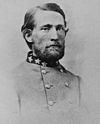
Ulysses S. Grant on James Longstreet
“You must take it; I cannot live with anything in my possession that is not mine... Pete, let us have another game of brag, to recall the days that were so pleasant.”

Ulysses S. Grant on Napoleon
Ulysses S. Grant on Napoleon III
Ulysses S. Grant on Swiss people
“There is no more beautiful scenery or climate for summer travel than Switzerland presents. The people are industrious and honest, simple and frugal in their habits, and would be very poor with all this, if it were not from the travel through their country. I wish their suprlus population would emigrate to the United States.”

Ulysses S. Grant on Alexander H. Stephens
“Mr. Lincoln... asked me if I had seen that overcoat of Stephens's. I replied that I had. "Well," said he, "did you see him take it off?" I said yes. "Well," said he, "didn't you think it was the biggest shuck and the littlest ear that ever you did see?" Long afterwards I told this story to the Confederate General J. B. Gordon, at the time a member of the Senate. He repeated it to Stephens, and, as I heard afterwards, Stephens laughed immoderately at the simile of Mr. Lincoln.”

Quotes About Ulysses S. Grant
Gain deeper perspective through quotes about Ulysses S. Grant from others.
Joel Achenbach on Ulysses S. Grant
“That’s what the Union would need in the painful spring and summer of 1864, which Gallagher calls the low point of the war for the U.S. government because civilian morale had plummeted. All eyes were on the coming presidential election. The Democrats were angling to nominate Maj. Gen. George B. McClellan, who ran as a War Democrat but whose party’s platform called for a negotiated peace with the Confederacy that could permit the survival of slavery. Against this backdrop, the Confederacy didn’t need to defeat the Union forces; it needed merely to hang on. The Union’s will to fight might well succumb to exhaustion. Lincoln and Grant both understood this. Grant had planned to return to the West, but the public was clamoring for him to face Lee head-on. Half a dozen Union offensives in Virginia had already failed, and although from a purely military perspective the war in the West was just as important, the Eastern theater produced the greatest political reverberations... The key moment came early in the campaign. As soon as Grant’s army had crossed the river, and as his men moved through a forest dense with underbrush known as the Wilderness, Lee pressed the attack. Lee was outnumbered nearly 2-1 and did not want to let the battle get onto open ground. The rebels charged and the woods quickly filled with smoke. Wounded men were immolated as fire swept through the forest. The Battle of the Wilderness proved to be a ghastly two-day affair that prefigured more horrors to come. At the end of the battle, the Army of the Potomac had 18,000 casualties, and it looked like another defeat in Virginia. But when Grant rode his horse to a crossroads, he turned south, not north. His men let out a cheer. Grant would not retreat back toward Washington as so many other generals had done after previous battles. He pressed on, toward Spotsylvania Court House.”
Henry Brooks Adams on Ulysses S. Grant
“America had no use for Adams because he was eighteenth-century, and yet it worshipped Grant because he was archaic and should have lived in a cave and worn skins.”
Source on Ulysses S. Grant
“What worried Adams was not the commonplace; it was, as usual, his own education. Grant fretted and irritated him, like the Terebratula, as a defiance of first principles. He had no right to exist. He should have been extinct for ages. The idea that, as society grew older, it grew one-sided, upset evolution, and made of education a fraud. That, two thousand years after Alexander the Great and Julius Caesar, a man like Grant should be called — and should actually and truly be — the highest product of the most advanced evolution, made evolution ludicrous. One must be as commonplace as Grant's own commonplaces to maintain such an absurdity. The progress of evolution from President Washington to President Grant, was alone evidence enough to upset Darwin.”
Henry Adams on Ulysses S. Grant
“Simple-minded beyond the experience of Wall Street or State Street, he resorted, like most men of the same intellectual calibre, to commonplaces when at a loss for expression: "Let us have peace!" or, "The best way to treat a bad law is to execute it"; or a score of such reversible sentences generally to be gauged by their sententiousness.”

Stephen E. Ambrose on Ulysses S. Grant
“What Grant wanted, above everything else, was to sheathe his sword... The Grant administration disproved the Democratic assertion in the 1868 election that 'This is a white man's country'... Grant saw his task, as any decent man would have, as being to bring about peace and reconciliation between the north and south and to enforce the rights of citizens for blacks. He soon learned that he could not do both... For those of us who lived in the American south from World War II to the 1980s, we can only say how right Grant was... He was a great American who did far more good for our country than most generals or presidents can even approach.”
Henry Ward Beecher on Ulysses S. Grant 2 quotes
“In four years he had risen, without political favor, from the bottom to the very highest command, — not second to any living commander in all the world! His plans were large, his undiscouraged will was patient to obduracy... In all this career he never lost courage or equanimity. With a million men, for whose movements he was responsible, he yet carried a tranquil mind, neither depressed by disasters nor elated by success. Gentle of heart, familiar with all, never boasting, always modest, Grant came of the old, self-contained stock, men of a sublime force of being, which allied his genius to the great elemental forces of nature, — silent, invisible, irresistible. When his work was done, and the defeat of Confederate armies was final, this dreadful man of blood was tender toward his late adversaries as a woman toward her son. He imposed no humiliating conditions, spared the feelings of his antagonists, sent home the disbanded Southern men with food and with horses for working their crops.”
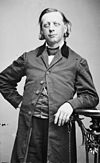
Henry William Brands on Ulysses S. Grant
“As commanding general in the Civil War, he had defeated secession and destroyed slavery, secession's cause. As President during Reconstruction he had guided the South back into the Union. By the end of his public life the Union was more secure than at any previous time in the history of the nation. And no one had done more to produce the result than he.”
Harry Bulkeley on Ulysses S. Grant
“Ulysses S. Grant demonstrated what might be called the Peter Principle in reverse: he couldn’t handle small jobs, but give him a huge task like saving the Union, and he performed marvelously well. Grant’s story is one of great abilities, hidden and undiscovered until a vast war brought them out. And not merely abilities as a general. His memoirs, completed just prior to his death, are rightly regarded as one of the best memoirs ever written by a historical figure.”
Richard N. Current on Ulysses S. Grant
“By backing Radical Reconstruction as best he could, he made a greater effort to escure the constitutional rights of blacks than did any other President between Lincoln and Lyndon B. Johnson.”
George William Curtis on Ulysses S. Grant
“On Palm Sunday, at Appomattox Court House, the spirit of feudalism, of aristocracy, of injustice in this country, surrendered, in the person of Robert E. Lee, the Virginian slave-holder, to the spirit of the Declaration of Independence and of equal rights, in the person of Ulysses S. Grant, the Illinois tanner. So closed this great campaign in the 'Good Fight of Liberty'. So the Army of the Potomac, often baffled, struck an immortal blow, and gave the right hand of heroic fellowship to their brethren of the west. So the silent captain, when all his lieutenants had secured their separate fame, put on the crown of victory and ended civil war. As fought the Lieutenant-General of the United States, so fight the United States themselves, in the 'Good Fight of Man'. With Grant's tenacity, his patience, his promptness, his tranquil faith, let us assault the new front of the old enemy. We, too, must push through the enemy's Wilderness, holding every point we gain. We, too, must charge at daybreak upon his Spottsylvania Heights. We, too, must flank his angry lines and push them steadily back. We, too, must fling ourselves against the baffling flames of Cold Harbor. We, too, outwitting him by night, must throw our whole force across swamp and river, and stand entrenched before his capital. And we, too, at last, on some soft, auspicious day of spring, loosening all our shining lines, and bursting with wild battle music and universal shout of victory over the last desperate defense, must occupy the very citadel of caste, force the old enemy to final and unconditional surrender, and bring Boston and Charleston to sing Te Deum together for the triumphant equal rights of man.”

William A. DeGregorio on Ulysses S. Grant 2 quotes
“Ironically, the man who achieved fame on the battlefield was particularly squeamish. Grant could not stomach the sight of animal blood. Rare steak nauseated him; he insisted that his meat be well done. He never touched fowl. "I cold never eat anything that went on two legs," he explained. He did not hunt, even as a boy in rural southern Ohio where shooting game was a favorite youthful pastime. Grant was modest, self-effacing, soft-spoken, and mild-mannered. One biographer, W.E. Woodward, went so far as to suggest that he was a bit effeminate. "Young Grant had a girl's primness of manner and modesty of conduct," he wrote. "There was a broad streak of the feminine in his personality. He was almost half-woman, but this strain was buried in the depths of his soul; it never came to the surface, except indirectly, and he was probably not aware of it himself." Grant was somewhat prudish. He seldom used foul language. He disliked dirty jokes. And in the field he always bathed alone, in a closed tent, never allowing even his aides to see him naked. A serious, well-disciplined soldier, Grant spurned military pomp and pageantry. He was loyal to friends. A superstitious man, he believed it bad luck to retrace one's steps. If he inadvertently walked beyond his destination, for example, he would not simply turn around and walk back down the same street, but rather would keep going further away from the place and return via another road.”
Ellen Wrenshall-Dent on Ulysses S. Grant
“I like that young man. There is something noble in him. His air and the expression of his face convince me that he has a noble heart, and that he will be a great man someday.”
Misattributed Quotes
Quotes mistakenly credited to Ulysses S. Grant
“I have no doubt in the world that the sole object is the restoration of the Union. I will say further, though, that I am a Democrat--every man in my regiment is a Democrat--and whenever I shall be convinced that this war has for its object anything else that what I have mentioned or that the Government designs using its soldiers to execute the purposes of the abolitionists, I pledge you on my honor as a man and a soldier that I will not only resign my commission, but will carry my sword to the other side.”
About Ulysses S. Grant
Ulysses S. Grant (27 April 1822 – 23 July 1885), born as Hiram Ulysses Grant, was the 18th president of the United States of America, from 1869 to 1877. As the Commanding General of the U.S. Army, Grant worked closely with U.S. President Abraham Lincoln to lead the U.S. Army to victory over the Confederacy in the American Civil War. He implemented Congressional Reconstruction, often at odds with Lincoln's successor, Andrew Johnson. Twice elected to the presidency, Grant led the Republicans in their effort to remove the vestiges of Confederate nationalism and slavery, protect the citizenship of African-Americans, and support U.S. economic prosperity.