Link Copied!
Tim O'Brien (author) Quotes (1946-)
Author, Novelist
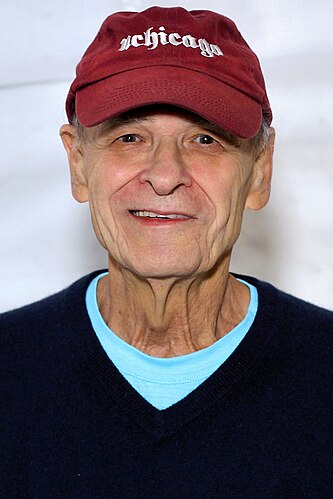
About Tim O'Brien (author)
Tim O'Brien (born October 1, 1946) is an American novelist who mainly writes about his experiences in the Vietnam War and the impact that the war had on the American soldiers who fought there.
Best Tim O'Brien (author) Quotes
Shortest
Earliest
Explore our curated collection of the most famous and impactful Tim O'Brien (author) quotes.

“You were a treasonous pussy if you had second thoughts about killing and dying for plain and simple reasons.”
“To generalize about war is like generalizing about peace. Almost everything is true. Almost nothing is true.”
“They carried the soldier's greatest fear, which was the fear of blushing. Men killed, and died, because they were embarrassed not to.”
“I would go to the war — I would kill and maybe die — because I was embarrassed not to. That was the sad thing. And so I sat in the bow of the boat and cried.”

“Right then, with the shore so close, I understood that I would not do what I should do. I would not swim away from my hometown and my country and my life. I would not be brave.”
“They carried all the emotional baggage of men who might die. Grief, terror, love, longing — these were intangibles, but the intangibles had their own mass and specific gravity, they had tangible weight.”
“Knowledge, of course, is always imperfect, but it seemed to me that when a nation goes to war it must have reasonable confidence in the justice and imperative of its cause. You can't fix your mistakes. Once people are dead, you can't make them undead.”

“Intellect had run up against emotion. My conscience told me to run, yet some irrational and powerful force was resisting, like a weight pushing me toward the war. What it came to, stupidly, was a sense of shame. Hot, stupid shame. I did not want people to think badly of me.”

“I remember opening the letter, scanning the first few lines, feeling the blood go thick behind my eyes. I remember a sound in my head. It wasn't thinking, just a silent howl. A million things all at once — I was too good for this war. Too smart, too compassionate, too everything. It couldn't happen. I was above it.”
“Any soldier will tell you, if he tells the truth, that proximity to death brings with it a corresponding proximity to life. After a firefight, there is always the immense pleasure of aliveness. The trees are alive. the grass, the soil — everything. All around you things are purely living, and you among them, and the aliveness makes you tremble.”
“For example, we've all heard this one. Four guys go down a trail. A grenade sails out. One guy jumps on it and takes the blast and saves his three buddies. Is it true? The answer matters. You'd feel cheated if it never happened. Without the grounding of reality, it's just a trite bit of puffery, pure Hollywood, untrue in the way all such stories are untrue”

“A fat little kid doing magic in front of a stand-up mirror. 'Hey, kiddo, that's a good one,' his father could've said, but for reasons unknown, reasons mysterious, the words never got spoken. He had wanted to be loved. And to be loved he had practiced deception. He had hidden the bad things. He had tricked up his own life. Only for love. Only to be loved. (pp. 242-243)”
“Maybe in the fog Kathy said, 'We could do it — right now,' and maybe Sorcerer murmured something about a pair of snakes along a trail in Pinkville, how for years and years he had wondered what would've happened if those two dumb-ass snakes had somehow managed to gobble each other up. A tired old story. If Kathy smiled, it was out of politeness. But maybe she said, 'I dare us.' (p. 300)”

“At night, when I couldn't sleep, I'd sometimes carry on silent arguments with those people. I'd be screaming at them, telling them how much I detested their blind, thoughtless, automatic acquiescence to it all, their simpleminded patriotism, their prideful ignorance, their love-it-or-leave it platitudes, how they were sending me off to fight a war they didn't understand and didn't want to understand.”
“[on the My Lai massacre and the outcome]: Who's responsible? The human beings who did this. These are war crimes. The individual human beings who put a rifle muzzle up against a baby's head and shot the brains out of that baby, nothing happened to them. Nothing! (quoted in the companion book by Geoffrey Ward and Ken Burns, p. 473)”

“A thing may happen and be a total lie; another thing may not happen and be truer than the truth. For example: Four guys go down a trail. A grenade sails out. One guy jumps on it and takes the blast, but it's a killer grenade and everybody dies anyway. Before they die, though, one of the dead guys says, "The fuck you do that for?" and the jumper says, "Story of my life, man" and other guys start to smile but he's dead. That's a true story that never happened.”
“It was the spirit world. Vietnam. Ghosts and graveyards. I arrived in-country a year after John Wade, in 1969, and walked exactly the ground he walked, in and around Pinkville, through the villages of Thuan yen and My Khe and Co Luy. I know what happened that day. I know how it happened. I know why. It was the sunlight. It was the wickedness that soaks into your blood and slowly heats up and begins to boil. Frustration, partly. Rage, partly. The enemy was invisible. They were ghosts. (p. 199)”
“We are fascinated, all of us, by the implacable otherness of others. And we wish to penetrate by hypothesis, by daydream, by scientific investigation those leaden walls that encase the human spirit, that define it and guard it and hold it forever inaccessible. ("I love you," someone says, and instantly we begin to wonder--"Well, how much?"--and when the answer comes--"With my whole heart"--we then wonder about the wholeness of a fickle heart.) Our lovers, our husbands, our wives, our farthers, our gods--they are all beyond us. (p. 101 )”
“'Well, I still don't get it,' she said. 'The way you talk, it sounds calculating or something. Too cold. Planning every tiny detail.' 'And that's bad?' 'No. Not exactly.' 'What then?' She made a shifting motion with her shoulders. 'I don't know, it just seem strange, sort of. How you've figured everything out, all the angles, except what it's for.' 'For us,' he said. 'I love you, Kath.' 'But it feels — I shouldn't say this — it feels manipulating.'... He talked about leading a good life, doing good things for the world. Yet even as he spoke, John realized he was not telling the full truth. Politics was manipulation. (p. 35)”
Quotes About Tim O'Brien (author)
Gain deeper perspective through quotes about Tim O'Brien (author) from others.
Judith Ortiz Cofer on Tim O'Brien (author)
“I feel the poet does write on memory but... Wasn't it Aristotle who said the historian keeps the factual record of mankind and the poet writes the emotional history of mankind? I think you can read a history of Vietnam and know that so many men under the age of twenty were killed, or you can read Tim O'Brien and you can "feel" those deaths. O'Brien is preserving the emotional history of Vietnam. A historian is preserving the facts.”


About Tim O'Brien (author)
Tim O'Brien (born October 1, 1946) is an American novelist who mainly writes about his experiences in the Vietnam War and the impact that the war had on the American soldiers who fought there.