Link Copied!
Thomas Hobbes Quotes (1588-1679)
Philosopher

















About Thomas Hobbes
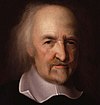
Thomas Hobbes (5 April 1588 – 4 December 1679) was an English philosopher, whose 1651 book Leviathan established the agenda for nearly all subsequent Western political philosophy.
Best Thomas Hobbes Quotes
Shortest
Earliest
Explore our curated collection of the most famous and impactful Thomas Hobbes quotes.
“...in statu naturae Mensuram juris esse Utilitatem.”


“"Understanding being nothing else, but conception caused by Speech."”
“No man is bound by the words themselves, either to kill himselfe, or any other man.”



“"For he that hath strength enough to protect all, wants not sufficiency to oppresse all."”
“Christian Kings may erre in deducing a Consequence, but who shall Judge?”


“And Beasts that have Deliberation, must necessarily also have Will.”

“And as in other things, so in men, not the seller, but the buyer determines the Price.”
“Men looke not at the greatnesse of the evill past, but the greatnesse of the good to follow.”
“To understand this for sense it is not required that a man should be a geometrician or a logician, but that he should be mad.”
“For Prudence, is but Experience; which equal time, equally bestows on all men, in those things they equally apply themselves unto.”


“Power as is really divided, and as dangerously to all purposes, by sharing with another an Indirect Power, as a Direct one.”

“But this priviledge, is allayed by another; and that is, by the priviledge of Absurdity; to which no living creature is subject, but man only.”
“"And seeing every man is presumed to do all things in order to his own benefit, no man is a fit Arbitrator in his own cause:"”
“For naturall Bloud is in like manner made of the fruits of the Earth; and circulating, nourisheth by the way, every Member of the Body of Man.”
“And when all the world is overcharged with Inhabitants, then the last remedy of all is Warre, which provideth for every man, by Victory or Death.”

“But if it bee well considered, The praise of Ancient Authors, proceeds not from the reverence of the Dead, but from the competition and mutual envy of the Living.”

“As also the great number of Corporations; which are as it were many lesser Common-wealths in the bowels of a greater, like wormes in the entrayles of a natural man.”

“As first a man cannot lay down the right of resisting them, that assault him by force, to take away his life; because he cannot be understood to ayme thereby, at any Good to himself.”
“The passion of laughter is nothing else but a sudden glory arising from sudden conception of some eminency in ourselves, by comparison with the infirmities of others, or with our own formerly...”
“And this Feare of things invisible, is the naturall Seed of that, which every one in himself calleth Religion; and in them that worship, or feare that Power otherwise than they do, Superstition.”

“For there is no such thing as perpetual Tranquility of mind, while we live here; because Life it selfe is but Motion, and can never be without Desire, nor without Feare, no more than without Sense.”
“Science is the knowledge of Consequences, and dependence of one fact upon another: by which, out of that we can presently do, we know how to do something else when we will, or the like, another time:”
“The source of every Crime, is some defect of the Understanding; or some error in Reasoning, or some sudden force of the Passions. Defect in the Understanding, is Ignorance; in Reasoning, Erroneous Opinion.”
“But yet they that have no Science, are in better, and nobler condition with their naturall Prudence; than men, that by their mis-reasoning, or by trusting them that reason wrong, fall upon false and absurd generall rules.”

“The Interpretation of the Laws of Nature in a Common-wealth, dependeth not on the books of Moral Philosophy. The Authority of writers, without the Authority of the Commonwealth, maketh not their opinions Law, be they never so true.”


“And hereby it comes to passe, that Intemperance, is naturally punished with Diseases; Rashness, with Mischance; Injustice; with Violence of Enemies; Pride, with Ruine; Cowardice, with Oppression; Negligent government of Princes, with Rebellion; and Rebellion with Slaughter.”

“If this superstitious fear of Spirits were taken away, and with it, Prognostiques from Dreams, false Prophecies, and many other things depending thereon, by which, crafty ambitious persons abuse the simple people, men would be much more fitted then they are for civill Obedience.”
“For such is the nature of men, that howsoever they may acknowledge many others to be more witty, or more eloquent, or more learned; Yet they will hardly believe there be many so wise as themselves: For they see their own wit at hand, and other men's at a distance.”
“I know not how the world will receive it, nor how it may reflect on those that shall seem to favor it. For in a way beset with those that contend, on one side for too great Liberty, and on the other side for too much Authority, 'tis hard to passe between the points of both unwounded.”
“As in the presence of the Master, the Servants are equall, and without any honour at all; So are the Subjects, in the presence of the Soveraign. And though they shine some more, some lesse, when they are out of his sight; yet in his presence, they shine no more than the Starres in presence of the Sun.”
“And if a man consider the original of this great Ecclesiastical Dominion, he will easily perceive, that the Papacy, is no other than the Ghost of the deceased Romane Empire, sitting crowned upon the grave thereof: For so did the Papacy start up on a Sudden out of the Ruines of that Heathen Power.”
“The first cause of Absurd conclusions I ascribe to the want of Method; in that they begin not their Ratiocination from Definitions; that is, from settled significations of their words: as if they could cast account, without knowing the value of the numerall words, one, two, and three.”

“Another doctrine repugnant to Civill Society, is that whatsoever a man does against his Conscience, is Sinne; and it dependeth on the presumption of making himself judge of Good and Evill. For a man's Conscience and his Judgement are the same thing, and as the Judgement, so also the Conscience may be erroneous.”
“From the same it proceedeth,that men gives different names, to one and the same thing, from the difference of their own passions: As they that approve a private opinion, call it Opinion; but they that mislike it, Haeresie: and yet haeresie signifies no more than private opinion; but has only agreater tincture of choler”

“The RIGHT OF NATURE, which Writers commonly call Jus Naturale, is the Liberty each man hath, to use his own power, as he will himself, for the preservation of his own Nature; that is to say, of his own Life; and consequently, of doing any thing, which in his own Judgement, and Reason, he shall conceive to be the aptest means thereunto.”

“But if one Subject giveth Counsell to another, to do anything contrary to the Lawes, whether that Counsell proceed from evil intention, or from ignorance onely, it is punishable by the Common-wealth; because ignorance of the Law, is no good excuse, where every man is bound to take notice of the Lawes to which he is subject.”
“And the Science of them, is the true and onely Moral Philosophy. For Moral Philosophy is nothing else but the Science of what is Good, and Evill, in the conversation, and Society of mankind. Good, and Evill, are names that signify our Appetites, and Aversions; which in different tempers, customes, and doctrines of men, are different:”
“And for Incoherent Speech, it was amongst the Gentiles taken for one sort of Prophecy, because the Prophets of their Oracles, intoxicated with a spirit, or vapor from the cave of the Pythian Oracle at Delphi, were for a time really mad, and spake like mad-men; of whoose loose words a sense might be made to fit any event, in such sort, as all bodies are said to be made of Materia prima.”
“He that is to govern a whole Nation, must read in himself, not this, or that particular man; but Mankind; which though it be hard to do, harder than to learn any Language, or Science; yet, when I shall have set down my own reading orderly, and perspicuously, the pains left another, will be only to consider, if he also find not the same in himself. For this kind of Doctrine, admitteth no other Demonstration.”

“And in these foure things, Opinion of Ghosts, Ignorance of second causes, Devotion towards what men fear, and Taking of things Casuall for Prognostics, consisteth the Natural seed of Religion; which by reason of the different Fancies, Judgements, and Passions of severall men, hath grown up into ceremonies so different, that those which are used by one man, are for the most part ridiculous to another.”

“And because the condition of Man, (as hath been declared in the precedent Chapter) is a condition of Warre of every one against everyone; in which case every one is governed by his own Reason; and there is nothing he can make use of, that may not be a help unto him, in preserving his life against his enemyes; It followeth, that in such a condition, every man has a Right to every thing; even to one anothers body.”
“And whereas many men, by accident unevitable, become unable to maintain themselves by their labour; they ought not to be left to the Charity of private persons; but to be provided for, (as far-forth as the necessities of Nature require,) by the Lawes of the Common-wealth. For as it is Unchariablenesse in any man, to neglect the impotent; so it is in the Soveraign of a Common-wealth, to expose them to the hazard of such uncertain Charity.”
“For it is not the bare Words, but the Scope of the writer that giveth true light, by which any writing is to bee interpreted; and they that insist upon single Texts, without considering the main Designe, can derive no thing from them clearly; but rather by casting atomes of Scripture, as dust before mens eyes, make everything more obscure than it is; an ordinary artifice of those who seek not the truth, but their own advantage.”
“For the Lawes of Nature (as Justice, Equity, Modesty, Mercy, and (in summe)doing to others, as wee would be done to,) of themselves, without the terrour of some Power, to cause them to be observed, are contrary to our naturall Passions, that carry us to Partiality, Pride, Revenge, and the like. And Covenants, without the Sword, are but Words, and of no strength to secure a man at all.”
“So that in the first place, I put for a general inclination of all mankind a perpetual and restless desire of Power after power, that ceaseth only in Death. And the cause of this is not always that a man hopes for a more intensive delight than he has already attained to, or that he cannot be content with a moderate power: but because he cannot assure the power and means to live well, which he hath present, without the acquisition of more.”
“"I Authorize and give up my Right of Governing my selfe, to this Man, or to his Assembly of men, on this condition, that thou that give up thy Right to him, and Authorise all his Actionsin like manner." This done, the Multitude so united in one Person, is called a COMMON-WEALTH, in latine CIVITAS. This is the Generation of that LEVIATHAN, or rather (to speake more reverently) of that Mortall God, to which we owe under the Immortal God, our peace and defence.”
“Desire, to know why, and how, CURIOSITY; such as is in no living creature but Man; so that Man is distinguished, not only by his Reason; but also by this singular Passion from other Animals; in whom the appetite of food, and other pleasures of Sense, by predominance, take away the care of knowing causes; which is a Lust of the mind, that by a perseverance of delight in the continual and indefatigable generation of Knowledge, exceedeth the short vehemence of any carnal Pleasure.”
“The doctrine of Right and Wrong, is perpetually disputed, both by Pen and the Sword: Whereas the doctrine of Lines, and Figures, is not so; because men care not, in that subject what be truth, as a thing that crosses no mans ambition, profit, or lust. For I doubt not, but if it had been a thing contrary to any mans right of dominion, or to the interest of men that have dominion, That the three Angles of a Triangle, should be equall to two Angles of a Square; that doctrine should have been, if not disputed, yet by the burning of all books of Geometry, suppressed, as far as he whom it concerned was able.”
“Felicity is a continual progress of the desire from one object to another, the attaining of the former being still but the way to the latter.The cause whereof is that the object of man's desire is not to enjoy once only, and for one instant of time, but to assure forever the way of his future desire. And therefore the voluntary actions and inclinations of all men tend not only to the procuring, but also to the assuring of a contented life, and differ only in the way, which ariseth partly from the diversity of passions in diverse men, and partly from the difference of the knowledge or opinion each one has of the causes which produce the effect desired.”
“By MANNERS, I mean not here Decency of behaviour; as how one man should salute another, or how a man should wash his mouth, or pick his teeth before company, and such other points of the Small Morals; But those qualities of mankind that concern their living together in Peace and Unity. To which end we are to consider that the Felicity of this life consisteth not in the repose of a mind satisfied. For there is no such Finis ultimus (utmost aim) nor Summum Bonum (greatest good) as is spoken of in the books of the old Moral Philosophers. Nor can a man any more live whose desires are at an end than he whose Senses and Imaginations are at a stand.”
“Whatsoever therefore is consequent to a time of Warre, where every man is Enemy to every man; the same is consequent to the time, wherein men live without other security, than what their own strength, and their own invention shall furnish them withall. In such condition, there is no place for Industry; because the fruit thereof is uncertain: and consequently no Culture of the Earth; no Navigation, nor use of the commodities that may be imported by Sea; no commodious Building; no Instruments of moving, and removing things as require much force; no Knowledge of the face of the Earth; no account of Time; no Arts; no Letters; no Society; and which is worst of all, continuall feare, and danger of violent death; And the life of man solitary, poore, nasty, brutish, and short.”
“And though this may seem to subtile a deduction of the Lawes of Nature, to be taken notice of by all men;whereof the most part are too busie in getting food, and the rest too negligent to understand; yet to leave all men unexcusable, they have been contracted into one easie sum, intelligble, even to the meanest capacity; and that is, '''''Do not that to another, which thou wouldest not have done to thyselfe'';''' which sheweth him, that he has no more to do in learning the Lawes of Nature, but, when weighing the actions of other men with his own, they seem too heavy, to put them into the other part of the balance, and his own into their place, that his own passions, and selfe love, may adde nothing to the weight; and then there is none of these Laws of Nature that will not appear unto him very reasonable.”
“The office of the sovereign, be it a monarch or an assembly, consisteth in the end for which he was trusted with the sovereign power, namely the procuration of the safety of the people, to which he is obliged by the law of nature, and to render an account thereof to God, the Author of that law, and to none but Him. But by safety here is not meant a bare preservation, but also all other contentments of life, which every man by lawful industry, without danger or hurt to the Commonwealth, shall acquire to himself.
And this is intended should be done, not by care applied to individuals, further than their protection from injuries when they shall complain; but by a general providence, contained in public instruction, both of doctrine and example; and in the making and executing of good laws to which individual persons may apply their own cases.”
And this is intended should be done, not by care applied to individuals, further than their protection from injuries when they shall complain; but by a general providence, contained in public instruction, both of doctrine and example; and in the making and executing of good laws to which individual persons may apply their own cases.”
“For as there were Plants of Corn and Wine in small quantity Dispersed in the Fields and Woods, before men knew their vertue, or made use of them for their nourishment, or planted them apart in Fields,and also there have been divers true, generall, and profitable Speculations from the beginning; as being the naturall plants of humane Reason: But they were at first but few in number; men lived upon grosse Experience; there was no Method; that is to say, no Sowing, nor Planting of Knowledge by it self, apart from the Weeds, and common Plants of Errour and Conjecture: And the cause of it being the want of leasure from procuring the necessities of life, and defending themselves against their neighbours, it was impossible, till the erecting of great Common-wealths, it should be otherwise. Leisure is the mother of Philosophy; and Common-wealth, the mother of Peace, and Leisure: Where first were great and flourishing Cities, there was first the study of Philosophy.”

“To say he hath spoken to him in a Dream, is no more then to say he dreamed that God spake to him; which is not of force to win beleef from any man, that knows dreams are for the most part naturall, and may proceed from former thoughts; and such dreams as that, from selfe conceit, and foolish arrogance, and false opinion of a mans own goodlinesse, or other vertue, by which he thinks he hath merited the favour of extraordinary Revelation. To say he hath seen a Vision, or heard a Voice, is to say, that he dreamed between sleeping and waking: for in such manner a man doth many times naturally take his dream for a vision, as not having well observed his own slumbering. To say he speaks by supernaturall Inspiration, is to say he finds an ardent desire to speak, or some strong opinion of himself, for which hee can alledge no naturall and sufficient reason. So that though God Almighty can speak to a man, by Dreams, Visions, Voice, and Inspiration; yet he obliges no man to beleeve he hath so done to him that pretends it; who (being a man) may erre, and (which is more) may lie.”
“It is not easy to fall into any absurdity, unless it be by the length of an account; wherein he may perhaps forget what went before. For all men by nature reason alike, and well, when they have good principles. For who is so stupid as both to mistake in geometry, and also to persist in it, when another detects his error to him?
By this it appears that reason is not, as sense and memory, born with us; nor gotten by experience only, as prudence is; but attained by industry: first in apt imposing of names; and secondly by getting a good and orderly method in proceeding from the elements, which are names, to assertions made by connexion of one of them to another; and so to syllogisms, which are the connexions of one assertion to another, till we come to a knowledge of all the consequences of names appertaining to the subject in hand; and that is it, men call science. And whereas sense and memory are but knowledge of fact, which is a thing past and irrevocable, science is the knowledge of consequences, and dependence of one fact upon another; by which, out of that we can presently do, we know how to do something else when we will, or the like, another time: because when we see how anything comes about, upon what causes, and by what manner; when the like causes come into our power, we see how to make it produce the like effects.
Children therefore are not endued with reason at all, till they have attained the use of speech, but are called reasonable creatures for the possibility apparent of having the use of reason in time to come.”
By this it appears that reason is not, as sense and memory, born with us; nor gotten by experience only, as prudence is; but attained by industry: first in apt imposing of names; and secondly by getting a good and orderly method in proceeding from the elements, which are names, to assertions made by connexion of one of them to another; and so to syllogisms, which are the connexions of one assertion to another, till we come to a knowledge of all the consequences of names appertaining to the subject in hand; and that is it, men call science. And whereas sense and memory are but knowledge of fact, which is a thing past and irrevocable, science is the knowledge of consequences, and dependence of one fact upon another; by which, out of that we can presently do, we know how to do something else when we will, or the like, another time: because when we see how anything comes about, upon what causes, and by what manner; when the like causes come into our power, we see how to make it produce the like effects.
Children therefore are not endued with reason at all, till they have attained the use of speech, but are called reasonable creatures for the possibility apparent of having the use of reason in time to come.”
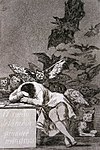
“Art goes... imitating that Rationall and most excellent worke of Nature, Man. For by Art is created that great Leviathan called a Common-Wealth or State, (in latine Civitas) which is but an Artificiall Man; though of greater stature and strength than the Naturall, for whose protection and defence it was intended; and in which the Soveraignty is an Artificiall Soul, as giving life and motion to the whole body; The Magistrates, and other Officers of Judicature and Execution, artificiall Joynts; Reward and Punishment (by which fastned to the seate of the Soveraignty, every joynt and member is moved to performe his duty) are the Nerves, that do the same in the Body Naturall; The Wealth and Riches of all the particular members, are the Strength; Salus Populi (the peoples safety) its Businesse; Counsellors, by whom all things needfull for it to know, are suggested unto it, are the Memory; Equity and Lawes, an artificiall Reason and Will; Concord, Health; Sedition, Sicknesse; and Civill war, Death. Lastly, the Pacts and Covenants, by which the parts of this Body Politique were at first made, set together, and united, resemble that Fiat, or the Let us make man, pronounced by God in the Creation.”
Thomas Hobbes Quotes by Topic
Find exactly what you are looking for by browsing this categorized list of Thomas Hobbes quotes by topic.
Thomas Hobbes on Christianity 4 quotes
“Don't you see that the appalling history of sectarianism, persecution, heresy hunting, shows you that this way of thinking about the world is intrinsically unsound?”

Thomas Hobbes on Injustice 2 quotes
“Intemperance is naturally punished with diseases; rashness, with mischance; injustice, with violence of enemies; pride, with ruin; cowardice, with oppression; and rebellion, with slaughter.”

What Thomas Hobbes Said About Others
Discover personal opinions Thomas Hobbes shared regarding contemporaries.
Thomas Hobbes on John Wallis 2 quotes
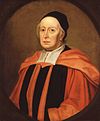
“In that part... of my book where I treat of geometry, I thought it necessary in my definitions to express those motions by which lines, superficies, solids, and figures were drawn and described, little expecting that any professor of geometry should find fault therewith, but on the contrary supposing I might thereby not only avoid the cavils of the sceptics, but also demonstrate divers propositions which on other principles are indemonstrable. And truly, if you shall find those my principles of motion made good, you shall find also that I have added something to that which was formerly extant in geometry. For first, from the seventh chapter of my book De Corpore, to the thirteenth, I have rectified and explained the principles of the science; id est, I have done that business for which Dr. Wallis receives the wages.”
Thomas Hobbes on John Ogilby
“But why without Annotations? Because I had no hope to do it better than it is already done by Mr. Ogilby.”

Thomas Hobbes on Moses
Thomas Hobbes on Nicolaus Copernicus
“The beginning of astronomy, except observations, I think is not to be derived from farther time than from Nicolaus Copernicus; who in the age next preceding the present revived the opinion of Pythagoras, Aristarchus, and Philolaus.”

Thomas Hobbes on Galileo Galilei
“The beginning of astronomy, except observations, I think is not to be derived from farther time than from Nicolaus Copernicus; who in the age next preceding the present revived the opinion of Pythagoras, Aristarchus, and Philolaus. After him, the doctrine of the motion of the earth being now received, and a difficult question thereupon arising concerning the descent of heavy bodies, Galileus in our time, striving with that difficulty, was the first that opened to us the gate of natural philosophy universal, which is the knowledge of the nature of motion. So that neither can the age of natural philosophy be reckoned higher than to him.”

Quotes About Thomas Hobbes
Gain deeper perspective through quotes about Thomas Hobbes from others.
Albert Edwin Avey on Thomas Hobbes
“The purpose of the Leviathan was to expand the basis of human government; in the course of his discussion Hobbes raised many detailed questions about the books of the Bible. In this way he participated in the development of critical Bible study.”
John Aubrey on Thomas Hobbes 2 quotes
“He was beloved by his lordship [Francis Bacon]... who was wont to have him walk in his delicate groves, where he did meditate; and when a notion darted into his mind, Mr. Hobbes was presently to write it down. And his Lordship was wont to say that he did it better than any one else about him; for that many times when he read their notes he scarce understood what they writ, because they understood it not clearly themselves.”

Edwin Arthur Burtt on Thomas Hobbes
“Our current conception of mathematics as an ideal science, of geometry in particular as dealing with an ideal space, rather than the actual space in which the universe is set, was a notion quite unformulated before Hobbes, and not taken seriously till the middle of the eighteenth century, though it was dimly felt after by a few Aristotelian opponents of Copernicus.”
Alan Bullock on Thomas Hobbes
“There are, it is true, masterpieces of political philosophy in the English language: Hobbes' Leviathan is an obvious example. But the true character of this debate has been empirical: the discussion of particular and practical issues, in the course of which a clash of principle and attitude is brought out, but in which the element of abstract thought is always kept in relation to an immediate and actual situation.”
Mary Whiton Calkins on Thomas Hobbes
“The bitterest of all quarrels was that in which Hobbes sought to defend himself against the accusations of atheistic and immoral teaching which haunted him throughout his life and persisted for decades after his death. Writers, theological and philosophical, many of them incapable of understanding Hobbes, united in these clamorous charges against him. The clergyman who wrote the "Dialogue between Philautes and Timothy" (London 1673) fairly illustrates the critics of Hobbes's own age, who believed that Hobbes had "said more for a bad life and against any other life after this than ever was pleaded by philosopher or divine to the contrary." The allusions of Locke and Berkeley to 'that atheist Hobbes' reflect the opinions of the generations following. ...Hobbes certainly teaches that there is a God, and that faith in Jesus Christ is the supreme religious duty. True, he also teaches that God is corporeal, but only in the sense in which, as he believes, men, also, are purely corporeal. However theoretically unjustified the doctrine, it is certainly compatible—as Hobbes holds it—with religious teaching. The ethics of Hobbes, also, inculcates all the practical duties of a Christian morality, though it founds them on a psychologically inadequate basis: the assumption that all men are radically selfish. In a word, Hobbes was unfairly treated; his reputation suffered unjustly; and—more unfortunate than all—the suspicion of his atheism kept people from the study of his vigorous metaphysics and his acute psychology.”













About Thomas Hobbes
Thomas Hobbes (5 April 1588 – 4 December 1679) was an English philosopher, whose 1651 book Leviathan established the agenda for nearly all subsequent Western political philosophy.