Link Copied!
Strabo Quotes (-64-24)
Philosopher
Best Strabo Quotes
Shortest
Earliest
Explore our curated collection of the most famous and impactful Strabo quotes.

“There remain of Europe, first, Macedonia and the part of Thrace that are contiguous to it and extend as far as Byzantium; secondly, Greece; and thirdly, the Islands that are close by. Macedonia, of course, is a part of Greece, yet now, since I am following the nature and shape of the place geographically, I have decided to classify it apart from the rest of Greece and to join it with that part of Thrace...”

“The Aegean sea washes Greece on two sides: first, the side that faces towards the east and stretches from Sunium, towards the north as far as the Thermaean Gulf and Thessaloniceia, a Macedonian city...; and secondly, the side that faces towards the south, I mean the Macedonian country, extending from Thessaloniceia as far as the Strymon.”
“Three classes inhabited the city (Alexandria in Egypt): first the Aegyptian or native stock of people, who were quick-tempered and not inclined to civil life; and secondly the mercenary class, who were severe and numerous and intractable...; and, third, the tribe of the Alexandrians, who also were not distinctly inclined to civil life, and for the same reasons, but still they were better than those others, for even though they were a mixed people, still they were Greeks by origin and mindful of the customs common to the Greeks.”

“The Sidonians according to tradition, are skilled in many beautiful arts, as the poet [Homer] also points out, and besides this they are philosophers in the science of astronomy and arithmetic, having begun their studies with practical calculations and with night sailings, for each of these branches of knowledge concerns the merchant and the shipowner; as for example, geometry…is believed to have come to the Greeks from the Egyptians, astronomy and arithmetic from the Phoenicians; and at present by far the greatest store of knowledge in every other branch of philosophy is to be had from these cities. And if one believes Posidonius’, (c. 135–51 BC) the greatest polymath of his time whose vast body of work has been lost, ‘the ancient dogma about atoms originated with Mochus, a Sidonian, born before the Trojan times…In my time there have been famous philosophers from Sidon.”

“An Egyptian priest named Moses, who possessed a portion of the country called the Lower Egypt, being dissatisfied with the established institutions there, left it and came to Judaea with a large body of people who worshipped the Divinity. He declared and taught that the Egyptians and Africans entertained erroneous sentiments, in representing the Divinity under the likeness of wild beasts and cattle of the field; that the Greeks also were in error in making images of their gods after the human form. For God [said he] may be this one thing which encompasses us all, land and sea, which we call heaven, or the universe, or the nature of things.... By such doctrine Moses persuaded a large body of right-minded persons to accompany him to the place where Jerusalem now stands..”
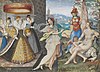
“What is now called Macedonia was in earlier times called Emathia. And it took its present name from Macedon, one of its early chieftains. And there was also a city emathia close to the sea. Now a part of this country was taken and held by certain of the Epeirotes and the Illyrians, but most of it by the Bottiaei and the Thracians. The Bottiaei came from Crete originally, so it is said, along with Botton as chieftain. As for the Thracians, the Pieres inhabited Pieria and the region about Olympus; the Paeones, the region on both sides of the Axius River, which on that account is called Amphaxitis; the Edoni and Bisaltae, the rest of the country as far as the Strymon. Of these two peoples the latter are called Bisaltae alone, whereas a part of the Edoni are called Mygdones, a part Edones, and a part Sithones. But of all these tribes the Argeadae, as they are called, established themselves as masters, and also the Chalcidians of Euboea; for the Chalcidians of Euboea also came over to the country of the Sithones and jointly peopled about thirty cities in it, although later on the majority of them were ejected and came together into one city, Olynthus; and they were named the Thracian Chalcidians.”
Strabo Quotes by Topic
Find exactly what you are looking for by browsing this categorized list of Strabo quotes by topic.
Strabo on History of India
“Generally speaking, the men who hitherto have written on the affairs of India, were a set of liars.”

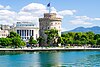
Strabo on Thessaloniki
“The Aegean sea washes Greece on two sides: first, the side that faces towards the east and stretches from Sunium, towards the north as far as the Thermaean Gulf and Thessaloniceia, a Macedonian city...; and secondly, the side that faces towards the south, I mean the Macedonian country, extending from Thessaloniceia as far as the Strymon.”
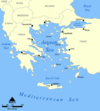
Strabo on Aegean Sea
“The Ægean Sea waters two sides of Greece; first, the eastern side, extending from the promontory Sunium to the north as far as the Thermæan Gulf, and Thessalonica, a Macedonian city, which has, at present, the largest population in these parts. Then the southern side, which is a part of Macedonia, extending from Thessalonica to the Strymon.”
Strabo on Indus River
“He [Aristobulus] says that when he was sent on some business, he saw a tract of land deserted which contained more than a thousand cities with their villages, for the Indus, having forsaken its proper channel, turned itself into another on the left much deeper, into which it burst like a cataract, so that it no longer watered the country on the right, from which it receded, for this had been raised by the inundations not only above the level of the new channel but even above that of the new inundations... ‘India is liable to earthquakes as it becomes porous from the excess of moisture and opens into fissures, whence even the course of rivers is altered’.”
Strabo on Roman aqueduct
“... the Roman prudence was more particularly employed on matters which had received but little attention from the Greeks, such as paving their roads, constructing aqueducts, and sewers, to convey the sewage of the city into the Tiber. In fact, they have paved the roads, cut through hills, and filled up valleys, so that the merchandise may be conveyed by carriage from the ports. The sewers, arched over with hewn stones, are large enough in some parts for waggons loaded with hay to pass through; while so plentiful is the supply of water from the aqueducts, that rivers may be said to flow through the city and the sewers, and almost every house is furnished with water-pipes and copious fountains.”

What Strabo Said About Others
Discover personal opinions Strabo shared regarding contemporaries.
Strabo on Moses
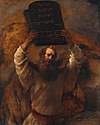
“An Egyptian priest named Moses, who possessed a portion of the country called the Lower Egypt, being dissatisfied with the established institutions there, left it and came to Judaea with a large body of people who worshipped the Divinity. He declared and taught that the Egyptians and Africans entertained erroneous sentiments, in representing the Divinity under the likeness of wild beasts and cattle of the field; that the Greeks also were in error in making images of their gods after the human form. For God [said he] may be this one thing which encompasses us all, land and sea, which we call heaven, or the universe, or the nature of things.... By such doctrine Moses persuaded a large body of right-minded persons to accompany him to the place where Jerusalem now stands..”
Quotes About Strabo
Gain deeper perspective through quotes about Strabo from others.
Walter William Rouse Ball on Strabo
“According to Strabo the Tyrians paid particular attention to the sciences of numbers, navigation, and astronomy; they had, we know, considerable commerce with their neighbours and kinsmen the Chaldaeans.”
Helen Diner on Strabo
“Strabo, traveling in North Africa ... [did not find] its women in the army but found that they ruled the country politically, while the men were still without significance in the state, occupying themselves largely with body care and hair-do, greedy for golden jewelry with which to bedeck themselves. The Berbers of our times ....[,] [n]ear the Atlas Mountains, ... have preserved a strong gynocracy. In some Tuareg tribes, the women perpetuate the old culture and know Old Libyan writing and literature. Their men wear veils and remain illiterates.”

Charles Lyell on Strabo 3 quotes
“Strabo,... enters largely, in the Second Book of his Geography, into the opinions of Eratosthenes and other Greeks on one of the most difficult problems in geology, viz., by what causes marine shells came to be plentifully buried in the earth at such great elevations and distances from the sea. He notices, amongst others, the explanation of Xanthus the Lyclian, who said that the seas had once been more extensive, and that they had afterwards been partially dried up, as in his own time many lakes, rivers, and wells in Asia had failed during a season of drought. Treating this conjecture with merited disregard, Strabo passes on to the hypothesis of Strato, the natural philosopher, who had observed that the quantity of mud brought down by rivers into the Euxine was so great, that its bed must be gradually raised, while the rivers still continued to pour in an undiminished quantity of water. He therefore conceived that, originally, when the Euxine was an inland sea, its level had by this means become so much elevated that it burst its barrier near Byzantium, and formed a communication with the Propontis, and this partial drainage had already, he supposed, converted the left side into marshy ground, and that, at last, the whole would be choked up with soil. So, it was argued, the Mediterranean had once opened a passage for itself by the Columns of Hercules into the Atlantic, and perhaps the abundance of sea-shells in Africa, near the Temple of Jupiter Ammon, might also be the deposit of some former inland sea, which had at length forced a passage and escaped.”

About Strabo
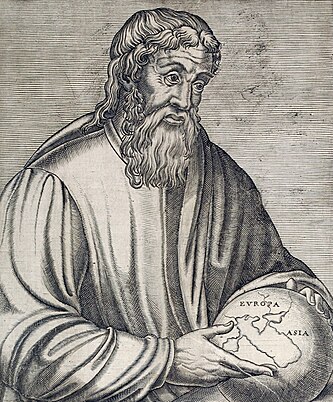
Strabo (64 BC – 24 AD) was a Greek historian, geographer and philosopher.