Link Copied!
Rose Schneiderman Quotes (1882-1972)
President, Actor, Leader
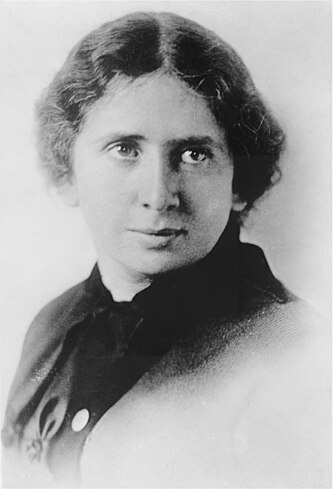


About Rose Schneiderman
Rose Schneiderman (April 6, 1882 – August 11, 1972) was a Polish-born American socialist and feminist, and one of the most prominent labor union leaders who was a woman. As a member of the New York Women's Trade Union League, she drew attention to unsafe workplace conditions, following the Triangle Shirtwaist Factory fire of 1911, and as a suffragist she helped to pass the New York state referendum of 1917 that gave women the right to vote. Schneiderman was also a founding member of the American Civil Liberties Union and served on the National Recovery Administration's Labor Advisory Board under President Franklin D. Roosevelt. She is credited with coining the phrase "Bread and Roses," to indicate a worker's right to something higher than subsistence living.
Best Rose Schneiderman Quotes
Shortest
Earliest
Explore our curated collection of the most famous and impactful Rose Schneiderman quotes.

“we must stand together to resist, for we will get what we can take-just that and no more.”
“what an absurd law, to require employees to testify against their employer before action can be taken.”
“We have in recent years experienced a tremendous awakening who have risen up and struck against conditions.”
“There are thousands of girls and men working in the textile mills of this state under conditions which are almost a guarantee for tuberculosis”

“If the women of leisure and opportunity would do as that young and extraordinary woman Carala Voerishoffer did we would more quickly get results.”
“The girls and women by their meetings and discussions come to understand and sympathize with each other, and more and more easily they act together..”
“Women have proved in the late strike that they can be faithful to an organization and to each other. The men give us the credit of winning the strike. . .”
“No amount of money is saved to break strikes and every possible means are used to continue to pay young women such wages upon which it is almost impossible for them to live.”
“When I was about five years of age my parents brought me to this country and we settled in New York. So my earliest recollections are of living in a crowded street among the East Side Jews, for we also are Jews.”

“After I had been working as a cap maker for three years it began to dawn on me that we girls needed an organization. The men had organized already, and had gained some advantages, but the bosses had lost nothing, as they took it out on us.”

“The great menace to society from home work is not so much a danger of transmitting disease, although this is constant, as it is the menace which results from exploited childhood and womanhood. It is impossible to guard children from being exploited in their homes.”
“we could report one story after another showing how the children are forced to work. Of course the moment an opportunity offers for them to enter the factory they do it, their vitality and vigor already sapped. Is this an intelligent way we have of dealing with the citizens of our Republic?”

“There are many factories and trades where women stand all day where there are even no chairs, though those are called for by the law. There are many kinds of work at which girls could sit instead of stand if the pressure of work were not so intense, if they were not speeded up to the highest point of endurance.”
“We think we have a wonderful law in New York limiting the hours to eight, but I would like to ask you if it is common sense for democracy to allow its children to wrap caramels at $3.50 a week instead of training and educating them in industrial schools so that when they are mature they may be intelligent citizens, and when they are married become intelligent mothers.”
“I was doing quite well when the factory burned down, destroying all our machines-150 of them. This was very hard on the girls who had paid for their machines. It was not so bad for me, as I had only paid a little of what I owed. The bosses got $500,000 insurance, so I heard, but they never gave the girls a cent to help them bear their losses. I think they might have given them $10, anyway.”

“But today there is no hope for any woman who is forced to labor to have any respite even in her remotest old age. It is said, of course, that her children should take care of her; but what of the woman who does not marry, or who, having married, has lost her children and husband? Or of the old mother who is too proud to be a burden upon her young son who himself is supporting his family with difficulty?”
“the suffragists have a great opportunity to lay before a group of over worked women the power of their vote; in this way an intelligent electorate would be developed who knows before it has it, what it can do with the vote, and who will use it effectively. It is as we suffragists make ourselves intelligent upon the problems which we will have to solve that the vote will be of any use to us or to the community or nation.”
“Bread and butter, shelter and clothes and adequate food are absolutely necessary to people, and more than that we need time for other things, of the spirit and mind-and, what is more, we need money for it, and when they talk of minimum wages and say that a girl can live on six or eight dollars a week they take nothing into account except bare necessities; and when they say that eight or nine hours a day is reasonable they take nothing into account except work, and they do not for one moment consider the needs of the mind and spirit and the right of every individual to have leisure for the development of the higher qualities of man.”
“I want to say to you suffragists, especially to some of you who are saying that the working women are not taking part in this great suffrage movement, and that they are not coming to the fore as they should, how can they? Working nine, ten hours a day and then on their return home attending to their home duties, where is the time for them to take active part in even a suffrage movement? Many times they have to stay in the factory and work through the evening, they cannot make engagements without the reservation that they can break them if work calls. And when these women join their union, attend their meetings and pay their dues they are doing more for social betterment than any other group that we know of. They are getting their suffrage training.”
“Woman suffrage will only accomplish the results we expect of it and hope of it if women develop into an intelligent electorate, and I would like to impress upon you the need of becoming familiar with industrial conditions so that when we get the power we can change them; and it seems to me that it is up to the women of leisure who are working in some way in the suffrage movement not to cry out or protest against the working woman's indifference to suffrage but to recognize her distinct contribution as an organized worker and to be ready to stand by her in her heavily handicapped struggle to better her conditions. Some of the leaders of the New York State have done this magnificently, but there are thousands who have not and who stand aloof and indifferent to the great struggle.”
“When you go to a factory as I have done, and see young girls in the first flush of womanhood bending their backs to the machine, or sitting crouched upon a chair putting stitches into men's hats; or standing with the stench of dead beasts in their nostrils in packing houses, putting sausages into sausage skins, standing on slime-soaked floors with wet feet; or when you see them in the laundries in steam filled rooms because there is no adequate hood over the machine, you marvel at the courage, or buoyancy of youth. And then when you see middle aged women with their drawn faces, still at the same kind of work they were doing as young girls, with evidently the life, buoyancy and hope crushed out; or when you see the old, old women who should be tenderly treated because of their age, we marvel at the tragedy of life which held such promise and gave so little fulfillment.”

“Then came a big strike. . . . About 100 girls went out. The result was a victory, which netted us-I mean the girls-$2 increase in our wages on the average. All the time our union was progressing very nicely. There were lectures to make us understand what trades unionism is and our real position in the labor movement. I read upon the subject and grew more and more interested, and after a time I became a member of the National Board, and had duties and responsibilities that kept me busy after my day's work was done. But all was not lovely by any means. . . . Soon notices... were hung in the various shops: “After the 26th of December, 1904, this shop will be run on the open shop system, the bosses having the right to engage and discharge employees as they see fit, whether the latter are union or nonunion.” Of course, we knew that this meant an attack on the union. The bosses intended gradually to get rid of us, employing in our place child labor and raw immigrant girls who would work for next to nothing.”
What Rose Schneiderman Said About Others
Discover personal opinions Rose Schneiderman shared regarding contemporaries.
Rose Schneiderman on Franklin D. Roosevelt
“Besides giving me the most interesting job I could possibly imagine, the Women's Trade League brought many wonderful friends into my life. Among them were Franklin and Eleanor Roosevelt...No words of mine can praise Franklin D. Roosevelt enough. When he was inaugurated, not only were we in the midst of the great depression with unemployment running into the millions, but we were lagging behind every important European country in providing for unemployment insurance and old-age pensions. In spite of cries of creeping socialism, he moved ahead fearlessly and imaginatively, creating the W.P.A. and establishing Social Security for millions of citizens. Without him it would have taken the country at least fifty years to accomplish the social gains he brought about in his first administration.”

Rose Schneiderman on Eleanor Roosevelt
“Besides giving me the most interesting job I could possibly imagine, the Women's Trade League brought many wonderful friends into my life. Among them were Franklin and Eleanor Roosevelt. I first met her when I was raising money for the League clubhouse. She called me her teacher, for she said I taught her all she knew about trade unionism. Always generous and understanding, she never refused me anything I asked for. This is quite a statement coming from me because, though I find it hard to ask for things for myself, I could ask for the moon if I needed it for the League. For twelve weeks during the depression, when we were having a hard time meeting our obligations, she shared her broadcasting fees with us. That $300 each week kept us going at a time when many of our supporters, hard-hit by the stock-market crash, could not help us.”
Quotes About Rose Schneiderman
Gain deeper perspective through quotes about Rose Schneiderman from others.
Joyce Antler on Rose Schneiderman
“As activists and rebels, Jewish women like Emma Goldman, Maud Nathan, Rose Schneiderman, Bella Abzug, and Betty Friedan influenced many of the key social movements of their eras suffrage, trade unionism, international peace, and the contemporary women's rights movement.”
Ellen DuBois on Rose Schneiderman
“In the first two decades of the 20th century, the suffrage movement was infused with immigrant working-class women, in which Jewish women were very prominent. Their numbers–pouring into parades and suffrage organizations–were in the tens of thousands. The two most prominent Jewish immigrant suffrage leaders were Rose Schneiderman and Clara Lemlich. Both were heroines of the Triangle Shirt Waist strike [Uprising of the 20,000] and fire. Lemlich became a communist, Schneiderman a Roosevelt Democrat. They both linked suffrage to the legislative and economic concerns of wage-earning women.”
Melanie Kaye/Kantrowitz on Rose Schneiderman
“Those who call resistance to assimilation a luxury might do well to think about calling "sexual preference" a luxury, or reproductive rights, or access to education or creative expression. None of these is bread, but "Bread and Roses" was a demand voiced by Rose Schneiderman, a union organizer and a Jew. What are the roses? As Jews we need our peoplehood, our culture, history, languages, music, calendar, tradition, literature... We need these things because they are beautiful and ours, and because the point of struggle is not bare survival but lives full of possibility. But Rose Schneiderman's metaphor flounders. Our culture is not a rose, it is our backbone.”
Sydney Weinberg on Rose Schneiderman
Source on Rose Schneiderman 3 quotes
“History knows her best for a 1912 speech in which she proclaimed, "The worker must have bread, but she must have roses, too," but that enduring turn of phrase only scratches the surface of Schneiderman's lifelong contributions to the cause of workers' rights. Another speech she gave in 1911, as the ashes of the Triangle smoldered behind her, laid bare her mission as an organizer. "Too much blood has been spilled," she said then. "I know from experience it is up to the working people to save themselves. And the only way is through a strong working-class movement."”
About Rose Schneiderman
Rose Schneiderman (April 6, 1882 – August 11, 1972) was a Polish-born American socialist and feminist, and one of the most prominent labor union leaders who was a woman. As a member of the New York Women's Trade Union League, she drew attention to unsafe workplace conditions, following the Triangle Shirtwaist Factory fire of 1911, and as a suffragist she helped to pass the New York state referendum of 1917 that gave women the right to vote. Schneiderman was also a founding member of the American Civil Liberties Union and served on the National Recovery Administration's Labor Advisory Board under President Franklin D. Roosevelt. She is credited with coining the phrase "Bread and Roses," to indicate a worker's right to something higher than subsistence living.