Link Copied!
Robert B. Laughlin Quotes (1950-)
King


About Robert B. Laughlin
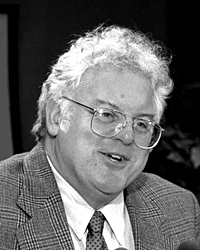
Robert Betts Laughlin (born November 1, 1950) is a professor of Physics and Applied Physics at Stanford University. Along with Horst L. Störmer of Columbia University and Daniel C. Tsui of Princeton University, he was awarded the 1998 Nobel Prize in Physics for his explanation of the fractional quantum Hall effect.
Best Robert B. Laughlin Quotes
Shortest
Earliest
Explore our curated collection of the most famous and impactful Robert B. Laughlin quotes.
“When a thing gets very, very small, you can't tell the difference between a solid and a liquid. (16:30 in video)”
“What we live in, unfortunately, is a time when we are infected by what I call quantum field theory idolatry. (39:30 in video)”
“If you think, as a Western person, that you are not affected by religious traditions, you are sadly mistaken. (22:30 in video)”

“It has been my experience that good theoretical physics is empowering, in that it enables thinking to take place that would otherwise not occur, and, in its highest form, facilitates experiments that would otherwise not be done.”
“Newton would have been laughed out of the country if Kepler hadn't done the measurement. ... The facts speak for themselves. ... History has shown that you need a little luck — and if you don't have the luck, you're out of luck. (1:00:00 to 1:01:00 in video)”
“My rule is simply to do for my students exactly what I hope someone else will do for my sons when the time comes: I teach them to have faith in themselves and in their own compass, to listen to nature to find truth, to love knowledge for the sake of itself, and to strive for greatness.”

“Real understanding of a thing comes from taking it apart oneself, not reading about it in a book or hearing about it in a classroom. To this day I always insist on working out a problem from the beginning without reading up on it first, a habit that sometimes gets me into trouble but just as often helps me see things my predecessors have missed.”

“The world is full of intelligent, well-meaning people who, for one reason or another, did not attend university but are nonetheless well-read and educated. Out there on the prairie lost opportunities of youth were the rule rather than the exception, and I slowly became disabused of the myth of the Bright Young Thing and have not believed in it since.”
“I realized that nature is filled with a limitless number of wonderful things which have causes and reasons like anything else but nonetheless cannot be forseen but must be discovered, for their subtlety and complexity transcends the present state of science. The questions worth asking, in other words, come not from other people but from nature, and are for the most part delicate things easily drowned out by the noise of everyday life.”

“Bell Labs had been a kind of holy place of solid state physics since the 1950's when it was built up by Shockley after the invention of the transistor. I had no idea at the time of the significance of this placement, but I did notice during my job talk that everybody understood what I was saying immediately — this had never happened before — and that the audience had an irresistible urge to interrupt, heckle, and argue about the subject matter loudly among themselves during the talk so as to lob hand grenades into it, just like back-benchers do in the House of Commons. Being a combative person I rather liked this and lobbed a few grenades of my own to maintain control of my seminar. I later came to understand that this heckling was a sign of respect from these people, that the ability to handle it was a test of a person's worth, and that polite silence from them was an extremely bad sign, amounting to Pauli's famous criticism that the speaker was "not even wrong."”

“Oklahoma is laid back and rather beautiful, with rolling brown hills not unlike the ones in California. The Pershing missiles, on the other hand, were not beautiful. They were horrible weapons of war — solid-fuel rockets five feet in diameter at the base, long as a moving van, and capable of throwing a tactical nuclear warhead 500 miles. They were launched from trucks and required a team of 10 men to service and fire. The most interesting thing I learned during this time was how small a nuclear warhead was. The nose cone of a Pershing is only about 18 inches in diameter at the base. I had not been interested at all in nuclear weaponry as a student, and so I had never thought through carefully about their "efficiency". It is sobering thought that these missiles were actually deployed in continental Europe in those days and that on at least one occasion, namely the 1973 Arab-Israel war, there was an alert serious enough to leave the commanding officers trembling.”
“I learned about X-ray diffraction, neutron scattering, raman scattering, infrared absorption spectroscopy, heat capacity, transport, time-dependent transport, magnetic resonance, electron diffraction, electron energy loss spectroscopy — all the experimental techniques that constitute the eyes and ears of modern solid state physics. As this occurred I slowly became disillusioned with the reductionist ideal of physics, for it was completely clear that the outcome of these experiments was almost always impossible to predict from first principles, yet was right and meaningful and certainly regulated by the same microscopic laws that work in atoms. Only many years later did I finally understand that this truth, which seems so natural to solid state physicists because they confront experiments so frequently, is actually quite alien to other branches of physics and is vigorously repudiated by many scientists on the grounds that things not amenable to reductionist thinking are not physics.”
Robert B. Laughlin Quotes by Topic
Find exactly what you are looking for by browsing this categorized list of Robert B. Laughlin quotes by topic.
Robert B. Laughlin on Experiment
“The modern concept of the vacuum of space, confirmed every day by experiment, is a relativistic ether. But we do not call it this because it is taboo.”

Robert B. Laughlin on String theory
“I have no idea whether the properties of the universe as we know it are fundamental or emergent, but I believe that the mere possibility of the latter should give the string theorists pause, for it would imply that more than one set of microscopic equations is consistent with experiment — so that we are blind to these equations until better experiments are designed — and also that the true nature of the microscopic equations is irrelevant to our world.”

Robert B. Laughlin on Spectroscopy
“I learned about X-ray diffraction, neutron scattering, raman scattering, infrared absorption spectroscopy, heat capacity, transport, time-dependent transport, magnetic resonance, electron diffraction, electron energy loss spectroscopy — all the experimental techniques that constitute the eyes and ears of modern solid state physics. As this occurred I slowly became disillusioned with the reductionist ideal of physics, for it was completely clear that the outcome of these experiments was almost always impossible to predict from first principles, yet was right and meaningful and certainly regulated by the same microscopic laws that work in atoms. Only many years later did I finally understand that this truth, which seems so natural to solid state physicists because they confront experiments so frequently, is actually quite alien to other branches of physics and is vigorously repudiated by many scientists on the grounds that things not amenable to reductionist thinking are not physics.”

About Robert B. Laughlin
Robert Betts Laughlin (born November 1, 1950) is a professor of Physics and Applied Physics at Stanford University. Along with Horst L. Störmer of Columbia University and Daniel C. Tsui of Princeton University, he was awarded the 1998 Nobel Prize in Physics for his explanation of the fractional quantum Hall effect.