Link Copied!
Ramanuja Quotes (1017-1137)
Philosopher, Theologian
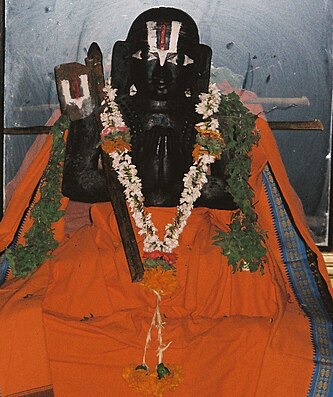


About Ramanuja
Ramanuja (traditionally, 1017–1137 CE) was a Hindu theologian, philosopher, and scriptural exegete. He is considered as the most important Hindu teacher, who followed Nathamuni and Yamunacharya, and the leading expounder of Vishishtadvaita.
Best Ramanuja Quotes
Shortest
Earliest
Explore our curated collection of the most famous and impactful Ramanuja quotes.
“What an individual pursues as a desirable end depends upon what he conceives himself to be.”
“When the food is pure the Sattva element gets purified, the memory becomes unwavering.”
“Entities other than Brahman can be objects of such cognitions of the nature of joy only to a finite extent and for limited duration. But Brahman is such that cognizing of him is an infinite and abiding joy. It is for this reason that the shruti [scripture] says, `Brahman is bliss’ (Taittitriya Upanishad II.6.) Since the form of cognition as joy is determined by its object, Brahman itself is joy.”

“Men, unacquainted with Vedanta, do not see that all things and all individual selves have Brahman as their self. They think that all terms exhaust their significance by signifying the various objects by themselves, which objects are in reality a part and not the whole of the meaning of terms. Now by the study of Vedanta, they understand that all such objects are the effects of Brahman, that Brahman is the inner ruler of them all and that they are animated by Brahman as their very soul. Therefore they come to understand that all terms signify Brahman itself having as its modes the entities, to which latter alone the terms are applied in common usage.”
“The individual self is subject to beginningless nescience, which has brought about an accumulation of karma, of the nature of both merit and demerit. The flood of such karma causes his entry into four kinds of bodies — heavenly, human, animal and plant beginning with that of Brahma downwards. This ingression into bodies produces the delusion of identity with those respective bodies (and the consequent attachments and aversions). This delusion inevitably brings about all the fears inherent in the state of worldly existence. The entire body of Vedanta aims at the annihilation of these fears. To accomplish their annihilation they teach the following:
(1) The essential nature of the individual self as transcending the body.
(2) The attributes of the individual self.
(3) The essential nature of the Supreme that is the inmost controller of both the material universe and the individual selves.
(4) The attributes of the Supreme.
(5) The devout meditation upon the Supreme.
(6) The goal to which such meditation, leads.
The Vedanta aims at making known the goal attainable through such a life of meditation, the goal being the realization, of the real nature of the individual self and after and through that realization, the direct experience of Brahman, which is of the nature of bliss infinite and perfect.”

Ramanuja Quotes by Topic
Find exactly what you are looking for by browsing this categorized list of Ramanuja quotes by topic.
Ramanuja on Bhakti 2 quotes
“A seeker must acquire a true knowledge of the individual self and the Supreme; He must devote himself to meditation, worship and the adoration of the Supreme; This knowledge with discipline leads him to the realization of the Supreme.”

Ramanuja on Brahma
“The individual self is subject to beginningless nescience, which has brought about an accumulation of karma, of the nature of both merit and demerit. The flood of such karma causes his entry into four kinds of bodies — heavenly, human, animal and plant beginning with that of Brahma downwards. This ingression into bodies produces the delusion of identity with those respective bodies (and the consequent attachments and aversions). This delusion inevitably brings about all the fears inherent in the state of worldly existence.”
What Ramanuja Said About Others
Discover personal opinions Ramanuja shared regarding contemporaries.
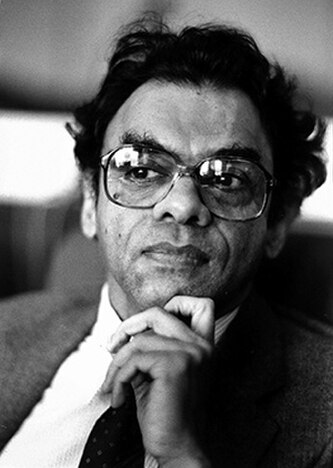
Ramanuja on A. K. Ramanujan
“Cultures may be said to have overall tendencies to idealize, and think in terms of, either the context-free or the context-sensitive kind of rules. Actual behavior may be more complex, though the rules they think with are a crucial factor in guiding the behavior. In cultures like India's, the context-sensitive kind of rule is the preferred formulation.”
Quotes About Ramanuja
Gain deeper perspective through quotes about Ramanuja from others.
Swami Adidevananda on Ramanuja
“Ramanuja wrote nine works in Sanskrit on the philosophy of Visishtadvaita. Of these, the Vedartha-Sangraha occupies a unique place in as much as this work takes the place of a commentary on the Upanishads, though not in a conventional sense or form. The work mirrors a total vision of the Upanishads, discussing all the controversial texts in a relevant, coherent manner.”
C.W. Leadbeater on Ramanuja
“It may perhaps help us to realize the human side of our Masters if we remember that many of Them in comparatively recent times have been known as historical characters... In these researches into the remote past we have frequently found the disciple Jesus, who in Palestine had the privilege of yielding up His body to the Christ. As a result of that act He received the incarnation of Apollonius of Tyana, and in the eleventh century He appeared in India as the teacher Ramanuja, who revived the devotional element in Hinduism, and raised it to so high a level.”
Source on Ramanuja 2 quotes
“Great leaders like Mahatma Gandhi and Ambedkar and saints like Ramanuja Acharya have stressed on need for social unity”
R. Nagaswamy on Ramanuja
“Ramanuja is first and last a Master of Vedic personality that is the vital breath of Indian Society from its every birth.”

About Ramanuja
Ramanuja (traditionally, 1017–1137 CE) was a Hindu theologian, philosopher, and scriptural exegete. He is considered as the most important Hindu teacher, who followed Nathamuni and Yamunacharya, and the leading expounder of Vishishtadvaita.