Link Copied!
Ramakrishna Quotes (1836-1886)
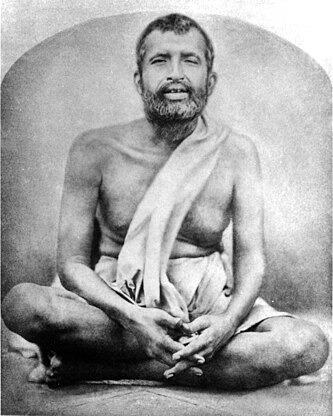













About Ramakrishna
Sri Ramakrishna Paramahamsa (18 February 1836 – 16 August 1886), born Gadadhar Chattopadhyay, was an Indian mystic, a promoter of bhakti traditions, and a teacher of the philosophy of Advaita Vedānta. His religious school of thought led to the formation of the Ramakrishna Mission by his most famous disciple Swami Vivekananda.
Best Ramakrishna Quotes
Shortest
Earliest
Explore our curated collection of the most famous and impactful Ramakrishna quotes.
“If one has faith one has everything.”

“Forgiveness is the true nature of the ascetic. (307)”


“His name is Intelligence (Chinmaya): His abode is Intelligence; and He, the Lord, is All-Intelligence. (1058)”

“As water does not enter into a stone, so religious advice produces no impression on the heart of a worldly I man.”


“With the divine Knowledge of Advaita (non-duality) in you, do whatever you wish; for then no evil can ever come out of you. (966)”

“Samadhi is the state of bliss which is experienced by a live fish which, being kept out of water for some time, is again put into it.”


“As a little boy or girl can have no idea of conjugal pleasure, even so a worldly man cannot at all comprehend the ecstasy of Divine communion. (193)”
“As 'persons living in a house infested with venomous snakes are always alert, so should men diving in the world be always vigilant against the allurement of lust and greed. (83)”
“As a toy fruit or a toy elephant reminds one of the real fruit and the living animal, so do the images that are worshipped remind one of the God who is formless and eternal.(325)”

“As persons living in a house infested by venomous snakes are always alert and cautious, so should men living in the world be always on their guard against the allurements of lust and greed.”


“On the tree of Sat-^it-dnanda there are innumerable :' ;Rlmas, Knshwas, Christ's, &c. ; one or two of them come | 'down into this world now and then, and produce mighty changes and revolutions.”
“The manifestation of the Divinity must be understood to be in greater degree in those who are honoured, respected, and obeyed by a large following, than in those who have gained no such influence.”

“Those who wish to attain God and progress in religious devotion, should particularly guard themselves against the snares of lust and wealth. Otherwise they can never attain perfection.”
“Those who wish to attain God or make progress in their devotional practices should particularly guard themselves against the snares of lust and wealth. Otherwise they will never attain perfection. (74)”
“Whether you accept Rādhā and Krishna, or not, please do accept their attraction for each other. Try to create that same yearning in your heart for God. Yearning is all you need in order to realize Him.”
“The nearer you come to God, the less you are disposed to questioning and reasoning. When you actually attain Him, when you behold Him as the reality, then all noise, all disputations, come to an end. (153)”
“Brahman is beyond mind and speech, beyond concentration and meditation, beyond the knower, the known and knowledge, beyond even the conception of the real and unreal. In short, It is beyond all relativity. (840)”

“Right discrimination is of two kinds — analytical and synthetical. The first leads one from the phenomena to the Absolute Brahman, while by the second one knows how the Absolute Brahman appears as the universe. (862)”


“A worldly man may be endowed with intellect as great as that of Ganaka, may take as much pains and trouble as a Yogin, and make as great sacrifices as an ascetic; but all these he makes and does, not for God, but for worldliness, honour, and wealth.”

“In a potter's shop there are vessels of different shapes and forms — pots, jars, dishes, plates, etc., — but all are made of the same clay. So God is one, but He is worshipped in different ages and climes under different names and aspects. (458)”

“God made me pass through the disciplines of various paths. First according to the Puranas, then according to the Tantra. I also followed the disciplines of the Vedas...I practised all sorts of Sadhana .... During my Sadhana period I had all kinds of amazing visions.”

“I had to practise each religion for a time — Hinduism, Islām, Christianity. Furthermore, I followed the paths of the Śāktas, Vaishnavas, and Vedāntists. I realized that there is only one God toward whom all are travelling; but the paths are different.”

“Imagine a limitless expanse of water: above and below, before and behind, right and left, everywhere there is water. In that water is placed a jar filled with water. There is water inside the jar and water outside, but the jar is still there. The "I" is the jar.”

“Men are like pillow-cases. The colour of one may be red, that of another blue, and that of the third black; but all contain the same cotton within. So it is with man; one is beautiful, another is ugly, a third holy, and a fourth wicked; but the Divine Being dwells in them all. (37)”
“It is very pleasant to scratch an itching ring-worm, but the sensation one gets afterwards is very painful and intolerable. In the same way the pleasures of this world are very attractive in the beginning, but their consequences are terrible to contemplate and hard to endure. (548)”
“Many people think they cannot have knowledge or understanding of God without reading books. But hearing is better than reading, and seeing is better than hearing. Hearing about Benares is different from reading about it; but seeing Benares is different from either hearing or reading.”

“Sunlight is one and the same wherever it falls; but only a bright surface like that of water, or of a mirror reflects it fully. So is the light Divine. It falls equally and impartially on all hearts, but the pure and pious hearts of holy men receive and reflect that light well. (649)”

“If you feel proud, let it be in the thought that you are the servant of God, the son of God. Great men have the nature of a child. They are always a child before Him; so they are free from pride. All their strength is of God and not their own. It belongs to Him and comes from Him. (124)”

“The snake is very venomous. It bites when any one approaches to catch it. But the person who has learnt the snake-charm can not only catch a snake, but carries about several of them like so many ornaments. Similarly, he who has acquired spiritual knowledge can never be polluted by lust and greed.”
“One can easily realize God if one is free from guile. Spiritual instruction produces quick results in a guileless heart. Such a heart is like well cultivated land from which all the stones have been removed. No sooner is the seed sown than it germinates. The fruit also appears quickly.”

“Visit not miracle-mongers and those who exhibit occult powers. These men are stragglers from the path of Truth. Their minds have become entangled in psychic powers, which are like veritable meshes in the way of the pilgrim to Brahman. Beware of these powers, and desire them not. (372)”
“Only two kinds of people can attain to self-knowledge: those who are not encumbered at all with learning, that is to say, whose minds are not over-crowded with thoughts borrowed from others; and those who, after studying all the scriptures and sciences, have come to realize that they know nothing. (162)”
“The parrot cannot be taught to sing when the vibrating membrane in its throat has hardened too much due to age. It must be taught to sing while young, before the collar line appears on its neck. So in old age it is difficult to learn how to fix the mind on God, but it can be easily learnt in youth. (234)”
“The heart of the devotee is like a dry match; and the slightest mention of the name of the Deity kindles the fire of love in his heart. But the mind of the worldly, soaked in lust and greed, is like the moist match, and can never be heated to enthusiasm, though God may be preached to him innumerable times.”
“Who may be called a paramahamsa? He who, like a swan, can take the milk from a mixture of milk and water, leaving aside the water. He who, like an ant, can take the sugar from a mixture of sugar and sand, leaving aside the sand.”
“Once someone gave me a book of the Christians. I asked him to read it to me. It talked about nothing but sin. Sin is the only thing one hears at your Brahmo Samaj too... He who says day and night, ‘I am a sinner, I am a sinner’, verily becomes a sinner... Why should one only talk about sin and hell, and such things?”
“I have heard that man can acquire superhuman powers through it and perform miracles. I saw a man who had brought a ghost under control. The ghost used to procure various things for his master. What shall I do with superhuman powers? Can one realize God through them? If God is not realized then everything becomes false.”
“When an unbaked pot is broken, the potter can use the mud to make a new one; but when a baked one is broken, he cannot do the same any longer. So when a person dies in a state of ignorance, he is born again; but when he becomes well baked in the fire of true knowledge and dies a perfect man, he is not born again. (46)”
“When the head of a goat is severed from its body, the trunk struggles for some time, still showing signs of life. Similarly, though ahamkara (egotism) is slain in the perfect man, yet enough of its vitality is left to make him carry on the functions of physical life; but it is not sufficient to bind him again into the world. (949)”

“It's enough to have faith in one aspect of God. You have faith in God without form. That is very good. But never get into your head that your faith alone is true and every other is false. Know for certain that God without form is real and that God with form is also real. Then hold fast to whichever faith appeals to you.”
“The mind steeped in affection for ‘woman and gold ’ is like the green betel-nut. So long as the betel-nut is green, its kernel remains adhering to its shell, but when it dries up shell and nut are separated, and the nut moves within if shaken. So when the affection for women and gold dries up, the soul is perieved as quite different from the body. (80)”

“It is not good for ordinary people to say, "I am He." The waves belong to the water. Does the water belong to the waves?
The upshot of the whole thing is that, no matter what path you follow, yoga is impossible unless the mind becomes quiet. The mind of a yogi is under his control; he is not under the control of his mind.”
The upshot of the whole thing is that, no matter what path you follow, yoga is impossible unless the mind becomes quiet. The mind of a yogi is under his control; he is not under the control of his mind.”

“God is directly perceived by the mind, but not by this ordinary mind. It is the pure mind that perceives God, and at that time this ordinary mind does not function. A mind that has the slightest trace of attachment to the world cannot be called pure. When all the impurities of the mind are removed, you may call that mind Pure Mind or Pure Ātman.”
“God reveals Himself to a devotee who feels drawn to Him by the combined force of these three attractions: the attraction of worldly possessions for the worldly man, the child's attraction for its mother, and the husband's attraction for the chaste wife. If one feels drawn to Him by the combined force of these three attractions, then through it one can attain Him.”
“Try to gain absolute mastery over the sexual instinct. If one succeeds in doing this, a physiological change is produced in the body by the development of a hitherto rudimentary nerve known as Medha (the function of which is to transmute the lower energies into the higher). The knowledge of the higher Self is gained after the development of this Medha nerve. (79)”
“You have been born in this world as a human being to worship God; therefore try to acquire love for His Lotus Feet. Why do you trouble yourself to know a hundred other things? What will you gain by discussing philosophy? Look here, one ounce of liquor is enough to intoxicate you. What is the use of your trying to find out how many gallons of liquor there are in the tavern?”
“By constantly repeating, "I am free, I am free", a man verily becomes free. On the other hand, by constantly repeating, "I am bound, I am bound", he certainly becomes bound to worldliness. The fool who says only, "I am a sinner, I am a sinner", verily drowns himself in worldliness. One should rather say: "I have chanted the name of God. How can I be a sinner? How can I be bound?"”
“If God is Omnipresent, why do we not see Him ? Standing by the bank of a pool thickly overspread with scum and weeds, you will say that there is no water in it. If you desire to see the water, remove the scum from the surface of the pond. With eyes covered with the film of maya you complain that you cannot see God. If you wish to see Him, remove the film of Maya from off your eyes.”
“The body was born and it will die. But for the soul there is no death. It is like the betel-nut. When the nut is ripe it does not stick to the shell. But when it is green it is difficult to separate it from the shell. After realizing God, one does not identify oneself any more with the body. Then one knows that body and soul are two different things.”

“Many are the names of God, and infinite the forms that lead us to know Him. In whatsoever name or form you desire to call Him, in that very form and name you will see Him.
• Saying 5; variant translation: More are the names of God and infinite are the forms through which He may be approached. In whatever name and form you worship Him, through them you will realize Him.”
• Saying 5; variant translation: More are the names of God and infinite are the forms through which He may be approached. In whatever name and form you worship Him, through them you will realize Him.”
“Do you, O preacher, carry the badge of authority? The humblest servant of the king, authorized by him, is heard with awe and respect, and can quell a riot by showing his badge ; so must you, O preacher, first, obtain your commission and inspiration from God Himself. So long as you do not have this badge of Divine inspiration, you may preach all your life, but it will be mere waste of breath. (168)”
“Iron, after it is converted into gold by the touch of philosopher's stone, may be kept under the ground or thrown into a rubbish heap; it will always remain gold and will not return to its former condition. Similar is the state of the man whose soul has touched, even once, the feet of the Almighty Lord. Whether he dwells in the bustle of the world, or in the solitude of the forest, nothing ever contaminates him.”

“Water and a bubble on it are one and the same. The bubble has its birth in the water, floats on it, and is ultimately resolved into it. So also the Jivatman (individual soul) and the Paramatman (supreme soul) are one and the same, the difference between them being only one of degree. For, one is finite and limited while the other is infinite; one is dependent while the other is independent. (22)”

“To drink pure water from a shallow pond one should gently take the water from the surface without disturbing the pond in the least. If it is disturbed, the sediments rise up and make the whole water muddy. If you desire to be pure, have firm faith, and slowly go on with your devotional practices, without wasting your energy in useless scriptural discussions and arguments. Your little brain will otherwise be muddled. (580)”
“A thief enters a dark room and feels the various articles therein. He lays his hands upon a table perhaps, and saying "Not this" passes on. Next he come upon some other article — a chair, perhaps — and again saying "Not this" continues his search, till, leaving article after article, he finally lays his hands on the box containing the treasure. Then he exclaims "It is here!" and there his search ends. Such, indeed is the search for Brahman. (733)”
“Direct the six passions to God. The impulse of lust should be turned into the desire to have intercourse with Atman. Feel angry at those who stand in your way to God. Feel greedy for Him. If you must have the feeling of I and mine, then associate it with God. Say, for instance, "My Rama, my Krishna." If you must have pride, then feel like Bibhishana, who said, "I have touched the feet of Rama with my head; I will not bow this head before anyone else."”
“Little children play with dolls in the outer room just as they like, without any care of fear or restraint; but as soon as their mother comes in, they throw aside their dolls and run to her crying, "Mamma, mamma." You too, are now playing in this material world, infatuated with the dolls of wealth, honour, fame, etc., If however, you once see your Divine Mother, you will not afterwards find pleasure in all these. Throwing them all aside, you will run to Her. (12)”
“Can you weep for Him with intense longing of heart? Men shed a jugful of tears for the sake of their children, for their wives, or for money. But who weeps for God? So long as the child remains engrossed with its toys, the mother looks after her cooking and other household duties. But when the child no longer relishes the toys, it throws them aside and yells for its mother. Then the mother takes the rice-pot down from the hearth, runs in haste, and takes the child in her arms.”
“When the jar is full, it does not make noise any more. So t}ie man of realization too does not talk much. But what then about Narada and others? Yes; Narada, Sukadeva and a few others like them came down several steps after the attainment of Samadhi, and out of mercy and love they taught mankind. (179)”
“Meditate upon the Knowledge and Bliss Eternal, and you will also have bliss. The Bliss indeed is eternal, only it is covered and obscured by ignorance. The less your attachment is towards the senses, the more will be your love towards God.
• Variant translation: Meditate upon the Knowledge and Bliss Eternal, and you also will have bliss. Bliss indeed is eternal, only it is covered and obscured by ignorance. The less your attachment is to the senses, the more will be your love to God.”
• Variant translation: Meditate upon the Knowledge and Bliss Eternal, and you also will have bliss. Bliss indeed is eternal, only it is covered and obscured by ignorance. The less your attachment is to the senses, the more will be your love to God.”

“A man can reach the roof of a house by stone stairs or a ladder or a rope-ladder or a rope or even by a bamboo pole. But he cannot reach the roof if he sets foot now on one and now on another. He should firmly follow one path. Likewise, in order to realize God a man must follow one path with all his strength. But you must regard other views as so many paths leading to God. You should not feel that your path is the only right path and that other paths are wrong. You mustn't bear malice toward others.”

“There are three kinds of devotees: superior, mediocre, and inferior. The inferior devotee says, "God is out there." According to him God is different from His creation. The mediocre devotee says: "God is the Antaryami, the Inner Guide. God dwells in everyone's heart." The mediocre devotee sees God in the heart. But the superior devotee sees that God alone has become everything; He alone has become the twenty-four cosmic principles. He finds that everything, above and below, is filled with God.”
“In the Kaliyuga, man, being totally dependent on food for life, cannot altogether shake off the idea that he is the body. In this state of mind it is not proper for him to say: "I am He". When a man does all sorts of worldly things, he should not say, "I am Brahman". Those who cannot give up attachment to worldly things, and who find no means to shake off the feeling of "I", should rather cherish the idea, "I am God's servant; I am His devotee."”
“Take the case of the infinite ocean. There is no limit to its water. Suppose a pot is immersed in it: there is water both inside and outside the pot. The jnani sees that both inside and outside there is nothing but Paramatman. Then what is this pot? It is "I-consciousness". Because of the pot the water appears to be divided into two parts; because of the pot you seem to perceive an inside and an outside. One feels that way as long as this pot of "I" exists. When the "I" disappears, what is remains. That cannot be described in words.”
“First purify your heart. When the mind becomes pure, the Lord Himself comes and makes it His seat. No image of God can be set up in a dirty place. The eleven bats referred to above are the eleven senses (the five organs of knowledge, the five organs of action and the mind). First dive deep within your own self and get the gems lying hidden there. After that you can have everything else. First you have to enshrine Uddhava in the heart; then you can have enough of lecturing and preaching. (1392)”
“A young plant should always be protected against goats and cows and the mischief of little urchins, by means of a fence. But when it becomes a big tree, a flock of goats or a herd of cows can freely find shelter under its spreading boughs and fill their stomachs with their leaves. So when your faith is yet in its infancy, you should protect it from the evil influences of bad company. But when you grow strong in faith, no worldliness or evil inclination will dare approach your holy presence; and many who are wicked will become godly through their holy contact with you. (387)”
“Think of Brahman, Existence-Knowledge-Bliss Absolute, as a shoreless ocean. Through the cooling influence, as it were, of the bhakta's love, the water has frozen at places into blocks of ice. In other words, God now and then assumes various forms for His lovers and reveals Himself to them as a Person. But with the rising of the sun of Knowledge, the blocks of ice melt. Then one doesn't feel any more that God is a Person, nor does one see God's forms. What He is cannot be described. Who will describe Him? He who would do so disappears. He cannot find his "I" any more.”
“With sincerity and earnestness one can realize God through all religions. The Vaishnavas will realize God, and so will the Saktas, the Vedantists and the Brahmos. The Mussalmans and the Christians will realize him too. All will certainly realize God if they are earnest and sincere.”
“My mother was the personification of rectitude and gentleness. She did not know much about the ways of the world; innocent of the art of concealment, she would say what was in her mind. People loved her for open-heartedness. My father, an orthodox brahmin, never accepted gifts from the Sudras. He spent much of his time in worship and meditation, and in repeating God's name and chanting His glories. Whenever in his daily prayers he invoked the Goddess Gayatri, his chest flushed and tears rolled down his cheeks. He spent his leisure hours making garlands for the Family Deity, Raghuvir”
“God laughs on two occasions. He laughs when the physician says to the patient's mother, "Don't be afraid, mother; I shall certainly cure your boy." God laughs, saying to Himself, "I am going to take his life, and this man says he will save it!" The physician thinks he is the master, forgetting that God is the Master. God laughs again when two brothers divide their land with a string, saying to each other, "This side is mine and that side is yours." He laughs and says to Himself, "The whole universe belongs to Me, but they say they own this portion or that portion."”
“You must know that there are different tastes. There are also different powers of digestion. God has made different religions and creeds to suit different aspirants. By no means all are fit for the Knowledge of Brahman. Therefore the worship of God with form has been provided. The mother brings home a fish for her children. She curries part of the fish, part she fries, and with another part she makes pilau. By no means all can digest the pilau. So she makes fish soup for those who have weak stomachs. Further, some want pickled or fried fish. There are different temperaments. There are differences in the capacity to comprehend.”
“Man cannot really help the world. God alone does that — He who has created the sun and the moon, who has put love for their children in parents' hearts, endowed noble souls with compassion, and holy men and devotees with divine love. The man who works for others, without any selfish motive, really does good to himself. There is gold buried in your heart, but you are not yet aware of it. It is covered with a thin layer of earth. Once you are aware of it, all these activities of yours will lessen. … Through selfless work, love of God grows in the heart. Then, through His grace, one realizes Him in course of time. God can be seen, one can talk to Him, as I am talking to you.”

“Suppose a thorn has pierced a man's foot. He picks another thorn to pull out the first one. After extracting the first thorn with the help of the second, he throws both away. One should use the thorn of knowledge to pull out the thorn of ignorance. Then one throws away both the thorns, knowledge and ignorance, and attains vijnāna. What is vijnāna? It is to know God distinctly by realizing His existence through an intuitive experience and to speak to Him intimately. That is why Sri Krishna said to Arjuna, "Go beyond the three gunas."”
“Two friends went into an orchard. One of them possessing much worldly wisdom, immediately began to count the mango trees there and the number of mangoes each tree bore, and to estimate what might be the approximate value of the whole orchard. His companion went to the owner, made friends with him, and then, quietly going into a tree, began at his host's desire to pluck the fruits and eat them. Whom do you consider to be the wiser of the two? Eat mangoes. It will satisfy your hunger. What is the good of counting the trees and leaves and making calculations? The vain man of intellect busies himself with finding out the "why" and "wherefore" of creation, while the humble man of wisdom makes friends with the Creator and enjoys His gift of supreme bliss. (164)”
“Brahman and Śakti are identical. If you accept the one, you must accept the other. It is like fire and its power to burn. If you see the fire, you must recognize its power to burn also. You cannot think of fire without its power to burn, nor can you think of the power to burn without fire. You cannot conceive of the sun's rays without the sun, nor can you conceive of the sun without its rays. You cannot think of the milk without the whiteness, and again, you cannot think of the whiteness without the milk. Thus one cannot think of Brahman without Śakti, or of Śakti without Brahman. One cannot think of the Absolute without the Relative, or of the Relative without the Absolute.”

“O Mother, I throw myself on Thy mercy; I take shelter at Thy Hallowed Feet. I do not want bodily comforts; I do not crave name and fame; I do not seek the eight occult powers. Be gracious and grant that I may have pure love for Thee, a love unsmitten by desire, untainted by any selfish ends — a love craved by the devotee for the sake of love alone. And grant me the favour, O Mother, that I may not be deluded by Thy world-bewitching māyā, that I may never be attached to the world, to "woman and gold", conjured up by Thy inscrutable māyā! O Mother, there is no one but Thee whom I mav call my own. Mother, I do not know how to worship; I am without austerity; I have neither devotion nor knowledge. Be gracious, Mother, and out of Thy infinite mercy grant me love for Thy Lotus Feet.”
“The Master said: "Everything that exists is God." The pupil understood it literally, but not in the true spirit. While he was passing through a street, he met with an elephant. The driver (mahut) shouted aloud from his high place, "Move away, move away!" The pupil argued in his mind, "Why should I move away? I am God, so is the elephant also God. What fear has God of Himself?" Thinking thus he did not move. At last the elephant took him up by his trunk, and dashed him aside. He was severely hurt, and going back to his Master, he related the whole adventure. The Master said, "All right, you are God. The elephant is God also, but God in the shape of the elephant-driver was warning you also from above. Why did you not pay heed to his warnings?"”
“The one essential thing is bhakti, loving devotion to God. Do the Theosophists seek bhakti? They are good if they do. If Theosophy makes the realization of God the goal of life, then it is good. One cannot seek God if one constantly busies oneself with the mahātmās and the lunar, solar, and stellar planes. A man should practise sādhanā and pray to God with a longing heart for love of His Lotus Feet. He should direct his mind to God alone, withdrawing it from the various objects of the world. … You may speak of the scriptures, of philosophy, of Vedanta; but you will not find God in any of those. You will never succeed in realizing God unless your soul becomes restless for Him.”
“Truth is one; only It is called by different names. All people are seeking the same Truth; the variance is due to climate, temperament, and name. A lake has many ghats. From one ghat the Hindus take water in jars and call it "jal". From another ghat the Mussalmāns take water in leather bags and call it "pāni". From a third the Christians take the same thing and call it "water". Suppose someone says that the thing is not "jal" but "pāni", or that it is not "pāni" but "water", or that it is not "water" but "jal", It would indeed be ridiculous. But this very thing is at the root of the friction among sects, their misunderstandings and quarrels. This is why people injure and kill one another, and shed blood, in the name of religion. But this is not good. Everyone is going toward God. They will all realize Him if they have sincerity and longing of heart.”
“A group of fisherwomen on their way home from a distant market held on an afternoon, were overtaken by a heavy hailstorm at nightfall in the middle of their way, and so were compelled to take shelter in a florist's house near at hand. Through the kindness of the florist they were allowed to sleep that night in one of his rooms, where some baskets of sweet-smelling flowers had been kept for supplying his customers. The atmosphere of the room was too good for the fisherwomen, and they could not, owing to it, get even a wink of sleep, till one of them suggested a remedy by saying, Let each of us keep her empty basket of fish close to her nose, and thus prevent this troublesome smell of flowers from attacking our nostrils and killing our sleep.' Every one gladly agreed to the proposal, and did accordingly ; and soon all began to snore. Such, indeed, is the power and influence of bad habits over all those who are addicted to them”

“It is said that truthfulness alone constitutes the spiritual discipline of the Kaliyuga. If a man clings tenaciously to truth he ultimately realizes God. Without this regard for truth, one gradually loses everything. If by chance I say that I will go to the pine-grove, I must go there even if there is no further need of it, lest I lose my attachment to truth. After my vision of the Divine Mother, I prayed to Her, taking a flower in my hands: "Mother, here is Thy knowledge and here is Thy ignorance. Take them both, and give me only pure love. Here is Thy holiness and here is Thy unholiness. Take them both, Mother, and give me pure love. Here is Thy good and here is Thy evil. Take them both, Mother, and give me pure love. Here is Thy righteousness and here is Thy unrighteousness. Take them both, Mother, and give me pure love." I mentioned all these, but I could not say: "Mother, here is Thy truth and here is Thy falsehood. Take them both." I gave up everything at Her feet but could not bring myself to give up truth.”
“Chant the name of God and sing his glories unceasingly; and keep holy company. Now and then one should visit holy men and devotees of God. If a man lives in the world and busies himself day and night with worldly duties and responsibilities, he cannot give his mind to God. So it's important to go into solitude from time to time, and think about God. When the plant is young, it should be fenced on all sides. Unless there's a fence around it, goats and cattle may eat it up.
When you meditate, go into the solitude of a forest, or a quiet corner, and enter into the chamber of your heart. And always keep your power of discrimination awake. God alone is real, that is to say, eternal; everything else is unreal, because it will pass away. As you discriminate in this manner, let your mind give up its attachment to the fleeting objects of this world. … Attend to all your duties but keep your mind fixed on God. Wife, son, father, mother — live with all of them and serve them, as if they were your very own. But know in your heart of hearts that they are not your own.”
When you meditate, go into the solitude of a forest, or a quiet corner, and enter into the chamber of your heart. And always keep your power of discrimination awake. God alone is real, that is to say, eternal; everything else is unreal, because it will pass away. As you discriminate in this manner, let your mind give up its attachment to the fleeting objects of this world. … Attend to all your duties but keep your mind fixed on God. Wife, son, father, mother — live with all of them and serve them, as if they were your very own. But know in your heart of hearts that they are not your own.”
“Four blind men went to see an elephant. One touched the leg of the elephant, and said, "The elephant is like a pillar." The second touched the trunk, and said, "The elephant is like a thick stick or club." The third touched the belly, and said, "The elephant is like a big jar." The fourth touched the ears, and said, "The elephant is like a winnowing basket." Thus they began to dispute amongst themselves as to the figure of the elephant. A passer-by seeing them thus quarrelling, said, "What is it that you are disputing about?" They told him everything, and asked him to arbitrate. That man said, "None of you has seen the elephant. The elephant is not like a pillar, its legs are like pillars. It is not like a big water-vessel, its belly is like a water-vessel. It is not like a winnowing basket, its ears are like winnowing baskets. It is not like a thick stick or club, but its proboscis is like that. The elephant is the combination of all these." In the same manner those quarrel who have seen one aspect only of the Deity. ... Different creeds are but different paths to reach the Almighty.”
“A certain father had two sons. When they were old enough, they were admitted to the first stage of life (Brahmacharya), and placed under the care of a religious preceptor to study the Vedas. After a long time the boys returned home, having finished their studies. Their father asked them' if they had read the Vedanta. On their replying in the affirmative, he asked, “Well, tell me what is Brahman.’ The elder son, quoting the Vedas and other scriptures, replied: “O Father, It is beyond words and thought. It is so and so. I know it all.” And to support what he said, he again quoted Vedantic texts. “So you have known Brahman” said the father,“ you may go about your business. Then he asked the younger son the same quest ion. But the boy remained silent; not a word came out of his mouth, nor did he make any attempt to speak. At this the father replied : “Yes, my boy. You are right. Nothing can be predicated of the Absolute and the Unconditioned. No sooner do you talk of It than you state the Infinite in terms of the finite, the Absolute in terms of the relative, the Unconditioned in terms of the conditioned. Your silence is more eloquent than the recitation of a. hundred verses and the quoting of a hundred authorities. (1117)”
“He is within us, in our hearts. Again, He is outside. The most advanced devotees say that He Himself has become all this — the 24 cosmic principles, the universe, and all living beings. The devotee of God wants to eat sugar, and not become sugar. (All laugh.) Do you know how a lover of God feels? His attitude is: "O God, Thou art the Master, and I am Thy servant. Thou art the Mother, and I Thy child." Or again: "Thou art my Father and Mother. Thou art the Whole, and I am a part." He does not like to say, "I am Brahman." They yogi seeks to realize the Paramatman, the Supreme Soul. His ideal is the union of the embodied soul and the Supreme Soul. He withdraws his mind from sense objects and tries to concentrate on the Paramatman. Therefore, during the first stage of his spiritual discipline, he retires into solitude and with undivided attention practices meditation in a fixed posture.
But the reality is one and the same; the difference is only in name. He who is Brahman is verily Atman, and again, He is the Bhagavan. He is Brahman to the followers of the path of knowledge, Paramatman to the yogis, and Bhagavan to the lovers of God.”
But the reality is one and the same; the difference is only in name. He who is Brahman is verily Atman, and again, He is the Bhagavan. He is Brahman to the followers of the path of knowledge, Paramatman to the yogis, and Bhagavan to the lovers of God.”
“He who is called Brahman by the jnanis is known as Atman by the yogis and as Bhagavan by the bhaktas. The same brahmin is called priest, when worshipping in the temple, and cook, when preparing a meal in the kitchen. The jnani, following the path of knowledge, always reason about the Reality saying, "not this, not this." Brahman is neither "this" nor "that"; It is neither the universe nor its living beings. Reasoning in this way, the mind becomes steady. Finally it disappears and the aspirant goes into samadhi. This is the Knowledge of Brahman. It is the unwavering conviction of the jnani that Brahman alone is real and the world is illusory. All these names and forms are illusory, like a dream. What Brahman is cannot be described. One cannot even say that Brahman is a Person. This is the opinion of the jnanis, the followers of Vedanta. But the bhaktas accept all the states of consciousness. They take the waking state to be real also. They don't think the world to be illusory, like a dream. They say that the universe is a manifestation of the God's power and glory. God has created all these — sky, stars, moon, sun, mountains, ocean, men, animals. They constitute His glory.”
Ramakrishna Quotes by Topic
Find exactly what you are looking for by browsing this categorized list of Ramakrishna quotes by topic.
Ramakrishna on Maya 7 quotes
“Prakriti and maya are similar concepts. Prakriti is the primal matter with the qualities of sattva, rajas, and tamas, whereas maya is cosmic ignorance with the triple powers of satva rajas and tamas.”
Ramakrishna on Bhakti 5 quotes
“A brAhmin without this love is no longer a brAhmin. And a pariah with the love of God is no longer a pariah. Through bhakti an untouchable becomes pure and elevated.”

Ramakrishna on Brahman 5 quotes
“In the Kaliyuga, man, being totally dependent on food for life, cannot altogether shake off the idea that he is the body. In this state of mind it is not proper for him to say: "I am He". When a man does all sorts of worldly things, he should not say, "I am Brahman". Those who cannot give up attachment to worldly things, and who find no means to shake off the feeling of "I", should rather cherish the idea, "I am God's servant; I am His devotee."”
Ramakrishna on Ego 3 quotes
“As a piece of rope, when burnt, retains its form, but cannot serve to bind, so is the ego which is burnt by the fire of supreme Knowledge.”

Ramakrishna on Atman 2 quotes
“He who is called Brahman by the jnanis is known as Atman by the yogis and as Bhagavan by the bhaktas.”
What Ramakrishna Said About Others
Discover personal opinions Ramakrishna shared regarding contemporaries.
Ramakrishna on Ram Swarup 5 quotes
“The current ideology of religious harmony emphasizes similarity—different religions are harmonious because they say the same thing; The older doctrine of multiple paths lays stress on their diversity—these paths are valid because they serve genuine different needs and answer to different natures. In short, they serve humanity not by being the same but by being different.”

Ramakrishna on Sister Nivedita 2 quotes
“I believe that India is one, indissoluble, indivisible.”

Ramakrishna on Shakti 2 quotes
“The followers of Advaita Vedanta maintain that creation, preservation, and dissolution, the individual ego, the external world, all these are manifestations of the Eternal Energy (Shakti). They also say that when these are properly analyzed, they appear as dreams, that the Absolute Brahman alone is the Reality, and all else is unreal. Even Eternal Energy (Shakti) is like a dream, unreal, but you may analyze and discriminate thousands of times, you cannot transcend the realm of Divine Energy (Shakti) unless you have reached the highest state of Samadhi or Superconsciousness.”

Quotes About Ramakrishna
Gain deeper perspective through quotes about Ramakrishna from others.
Swami Adiswarananda on Ramakrishna
“Sri Ramakrishna, as a silent force, influences the spiritual thought currents of our time. He is a figure of recent history and his life and teachings have not yet been obscured by loving legends and doubtful myths. Through his God-intoxicated life Sri Ramakrishna proved that the revelation of God takes place at all times and that God-realization is not the monopoly of any particular age, country, or people. In him, deepest spirituality and broadest catholicity stood side by side. The God-man of nineteenth-century India did not found any cult, nor did he show a new path to salvation. His message was his God-consciousness. When God-consciousness falls short, traditions become dogmatic and oppressive and religious teachings lose their transforming power. … The greatest contribution of Sri Ramakrishna to the modern world is his message of the harmony of religions. To Sri Ramakrishna all religions are the revelation of God in His diverse aspects to satisfy the manifold demands of human minds. Like different photographs of a building taken from different angles, different religions give us the pictures of one truth from different standpoints. They are not contradictory but complementary.”
Elst on Ramakrishna
“The basis of the Swami's claim is a story that Swami Vivekananda's guru Paramahansa Ramakrishna (1836-86) once, in 1866, dressed up as a Muslim and then continued his spiritual exercises until he had a vision; and likewise as a Christian in 1874. If at all true, these little experiments shouldn't be given too much weight, considering Ramakrishna's general habit of dressing up a little for devotional purposes, e.g. as a woman, to experience Krishna the lover through the eyes of His beloved Radha (not uncommon among Krishna devotees in Vrindavan); or hanging in trees to impersonate Hanuman, Rama's monkey helper. But is the story true? Ram Swarup finds that it is absent in the earliest recordings of Ramakrishna's own talks. It first appears in a biography written 25 years after Ramakrishna's death by Swami Saradananda (Sri Ramakrishna, the Great Master), who had known the Master only in the last two years of his life. Even then, mention (on just one page in a 1050-page volume) is only made of a vision of a luminous figure. The next biographer, Swami Nikhilananda, ventures to guess that the figure was 'perhaps Mohammed'... In subsequent versions, this guess became a dead certainty, and that 'vision of Mohammed' became the basis of the doctrine that he spent some time as a Muslim, and likewise as a Christian, and that he 'proved the truth' of those religions by attaining the highest yogic state on those occasions. As the alleged vision of Jesus was slightly more glorious than that of Mohammed, Ram Swarup sarcastically suggests new horizons to the 'equal truth of all religions' school: 'This difference could provide much scope for future disputants. One school may hold that while all prophets are equal, some are more equal than others.'”
S.R. Goel. How I became a Hindu on Ramakrishna
“But what brought me into an intimate and living contact with this great mystic and bhakta and shakta and advaitin, was his Kathamrita. He had not used a single abstraction nor discussed any of the problems which pass as philosophy. His talks embodied expressions of a concrete consciousness which had dropped every trace of the dirt and dross and inertia which characterise what is known as normal human consciousness. The metaphors which sprang spontaneously from this purified consciousness were matchless in their aptness and illumined in a few words the knotted problems which many voluminous works had failed to solve. I was now having my first intimations of immortality towards which Kabir and Nanak and Sri Garibdas had inclined me earlier.”
Christopher Isherwood on Ramakrishna 2 quotes
“Throughout his life Ramakrishna continued to use words and similes which struck his more sensitive hearers as shockingly crude. But even those who were shocked had to admit that in Ramakrishna's mouth, the words lost much of their offensiveness; for he used them with such innocence.”

R. W. Neufeldt on Ramakrishna
“For Ramakrishna, bhakti cannot be defined in a single word, rather, a cluster of words is necessary. … A path will do only if it is characterized by sincerity, earnestness, and single-minded devotion. Only then will we find that all paths lead to God.”

About Ramakrishna
Sri Ramakrishna Paramahamsa (18 February 1836 – 16 August 1886), born Gadadhar Chattopadhyay, was an Indian mystic, a promoter of bhakti traditions, and a teacher of the philosophy of Advaita Vedānta. His religious school of thought led to the formation of the Ramakrishna Mission by his most famous disciple Swami Vivekananda.