Link Copied!
Ramakrishna Quotes (1836-1886)
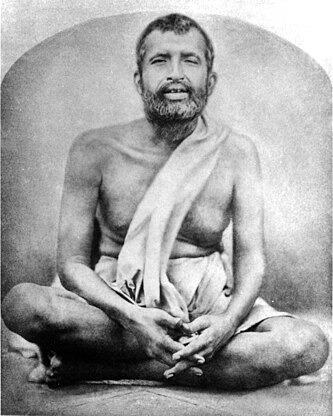












About Ramakrishna
Sri Ramakrishna Paramahamsa (18 February 1836 – 16 August 1886), born Gadadhar Chattopadhyay, was an Indian mystic, a promoter of bhakti traditions, and a teacher of the philosophy of Advaita Vedānta. His religious school of thought led to the formation of the Ramakrishna Mission by his most famous disciple Swami Vivekananda.
Best Ramakrishna Quotes
Shortest
Earliest
Explore our curated collection of the most famous and impactful Ramakrishna quotes.
“If one has faith one has everything.”

“Forgiveness is the true nature of the ascetic. (307)”


“His name is Intelligence (Chinmaya): His abode is Intelligence; and He, the Lord, is All-Intelligence. (1058)”

“As water does not enter into a stone, so religious advice produces no impression on the heart of a worldly I man.”



“With the divine Knowledge of Advaita (non-duality) in you, do whatever you wish; for then no evil can ever come out of you. (966)”

Ramakrishna Quotes by Topic
Find exactly what you are looking for by browsing this categorized list of Ramakrishna quotes by topic.
Ramakrishna on Maya 7 quotes
“Prakriti and maya are similar concepts. Prakriti is the primal matter with the qualities of sattva, rajas, and tamas, whereas maya is cosmic ignorance with the triple powers of satva rajas and tamas.”
Ramakrishna on Bhakti 5 quotes
“A brAhmin without this love is no longer a brAhmin. And a pariah with the love of God is no longer a pariah. Through bhakti an untouchable becomes pure and elevated.”

Ramakrishna on Brahman 5 quotes
“In the Kaliyuga, man, being totally dependent on food for life, cannot altogether shake off the idea that he is the body. In this state of mind it is not proper for him to say: "I am He". When a man does all sorts of worldly things, he should not say, "I am Brahman". Those who cannot give up attachment to worldly things, and who find no means to shake off the feeling of "I", should rather cherish the idea, "I am God's servant; I am His devotee."”

Ramakrishna on Ego 3 quotes
“As a piece of rope, when burnt, retains its form, but cannot serve to bind, so is the ego which is burnt by the fire of supreme Knowledge.”

Ramakrishna on Atman 2 quotes
“He who is called Brahman by the jnanis is known as Atman by the yogis and as Bhagavan by the bhaktas.”
Ramakrishna on Worldliness 2 quotes
“By constantly repeating, 'I am free, I am free', a man verily becomes free. On the other hand, by constantly repeating, 'I am bound, I am bound', he certainly becomes bound to worldliness. The fool who says only, 'I am a sinner, I am a sinner', verily drowns himself in worldliness. One should rather say: 'I have chanted the name of God. How can I be a sinner? How can I be bound?'”

Ramakrishna on Acceptance 2 quotes
“What Brahman is cannot be described. One cannot even say that Brahman is a Person. This is the opinion of the jnanis, the followers of Vedanta. But the bhaktas accept all the states of consciousness. They take the waking state to be real also. They don't think the world to be illusory, like a dream. They say that the universe is a manifestation of the God's power and glory. God has created all these — sky, stars, moon, sun, mountains, ocean, men, animals. They constitute His glory. He is within us, in our hearts. Again, He is outside. The most advanced devotees say that He Himself has become all this — the 24 cosmic principles, the universe, and all living beings.”

Ramakrishna on Guru
Ramakrishna on Love of God
Ramakrishna on Malice
Ramakrishna on Path
What Ramakrishna Said About Others
Discover personal opinions Ramakrishna shared regarding contemporaries.
Ramakrishna on Ram Swarup 5 quotes
“The current ideology of religious harmony emphasizes similarity—different religions are harmonious because they say the same thing; The older doctrine of multiple paths lays stress on their diversity—these paths are valid because they serve genuine different needs and answer to different natures. In short, they serve humanity not by being the same but by being different.”

Ramakrishna on Sister Nivedita 2 quotes
“I believe that India is one, indissoluble, indivisible.”

Ramakrishna on Shakti 2 quotes
“The followers of Advaita Vedanta maintain that creation, preservation, and dissolution, the individual ego, the external world, all these are manifestations of the Eternal Energy (Shakti). They also say that when these are properly analyzed, they appear as dreams, that the Absolute Brahman alone is the Reality, and all else is unreal. Even Eternal Energy (Shakti) is like a dream, unreal, but you may analyze and discriminate thousands of times, you cannot transcend the realm of Divine Energy (Shakti) unless you have reached the highest state of Samadhi or Superconsciousness.”

Quotes About Ramakrishna
Gain deeper perspective through quotes about Ramakrishna from others.
Swami Adiswarananda on Ramakrishna
“Sri Ramakrishna, as a silent force, influences the spiritual thought currents of our time. He is a figure of recent history and his life and teachings have not yet been obscured by loving legends and doubtful myths. Through his God-intoxicated life Sri Ramakrishna proved that the revelation of God takes place at all times and that God-realization is not the monopoly of any particular age, country, or people. In him, deepest spirituality and broadest catholicity stood side by side. The God-man of nineteenth-century India did not found any cult, nor did he show a new path to salvation. His message was his God-consciousness. When God-consciousness falls short, traditions become dogmatic and oppressive and religious teachings lose their transforming power. … The greatest contribution of Sri Ramakrishna to the modern world is his message of the harmony of religions. To Sri Ramakrishna all religions are the revelation of God in His diverse aspects to satisfy the manifold demands of human minds. Like different photographs of a building taken from different angles, different religions give us the pictures of one truth from different standpoints. They are not contradictory but complementary.”
Elst on Ramakrishna
“The basis of the Swami's claim is a story that Swami Vivekananda's guru Paramahansa Ramakrishna (1836-86) once, in 1866, dressed up as a Muslim and then continued his spiritual exercises until he had a vision; and likewise as a Christian in 1874. If at all true, these little experiments shouldn't be given too much weight, considering Ramakrishna's general habit of dressing up a little for devotional purposes, e.g. as a woman, to experience Krishna the lover through the eyes of His beloved Radha (not uncommon among Krishna devotees in Vrindavan); or hanging in trees to impersonate Hanuman, Rama's monkey helper. But is the story true? Ram Swarup finds that it is absent in the earliest recordings of Ramakrishna's own talks. It first appears in a biography written 25 years after Ramakrishna's death by Swami Saradananda (Sri Ramakrishna, the Great Master), who had known the Master only in the last two years of his life. Even then, mention (on just one page in a 1050-page volume) is only made of a vision of a luminous figure. The next biographer, Swami Nikhilananda, ventures to guess that the figure was 'perhaps Mohammed'... In subsequent versions, this guess became a dead certainty, and that 'vision of Mohammed' became the basis of the doctrine that he spent some time as a Muslim, and likewise as a Christian, and that he 'proved the truth' of those religions by attaining the highest yogic state on those occasions. As the alleged vision of Jesus was slightly more glorious than that of Mohammed, Ram Swarup sarcastically suggests new horizons to the 'equal truth of all religions' school: 'This difference could provide much scope for future disputants. One school may hold that while all prophets are equal, some are more equal than others.'”
S.R. Goel. How I became a Hindu on Ramakrishna
“But what brought me into an intimate and living contact with this great mystic and bhakta and shakta and advaitin, was his Kathamrita. He had not used a single abstraction nor discussed any of the problems which pass as philosophy. His talks embodied expressions of a concrete consciousness which had dropped every trace of the dirt and dross and inertia which characterise what is known as normal human consciousness. The metaphors which sprang spontaneously from this purified consciousness were matchless in their aptness and illumined in a few words the knotted problems which many voluminous works had failed to solve. I was now having my first intimations of immortality towards which Kabir and Nanak and Sri Garibdas had inclined me earlier.”
Christopher Isherwood on Ramakrishna 2 quotes
“Throughout his life Ramakrishna continued to use words and similes which struck his more sensitive hearers as shockingly crude. But even those who were shocked had to admit that in Ramakrishna's mouth, the words lost much of their offensiveness; for he used them with such innocence.”

R. W. Neufeldt on Ramakrishna
“For Ramakrishna, bhakti cannot be defined in a single word, rather, a cluster of words is necessary. … A path will do only if it is characterized by sincerity, earnestness, and single-minded devotion. Only then will we find that all paths lead to God.”
Swami Nikhilananda on Ramakrishna 4 quotes
“It was on February 18, 1836, that the child, to be known afterwards as Ramakrishna, was born... he was given the name of Gadadhar, the "Bearer of the Mace", an epithet of Vishnu... Gadadhar grew up into a healthy and restless boy... intelligent and precocious and endowed with a prodigious memory. On his father's lap he learnt by heart the names of his ancestors and the hymns to the gods and goddesses, and at the village school he was taught to read and write. But his greatest delight was to listen to recitations of stories from Hindu mythology and the epics. These he would afterwards recount from memory, to the great joy of the villagers. Painting he enjoyed; the art of moulding images of the gods and goddesses he learnt from the potters. But arithmetic was his great aversion.”
Anantanand Rambachan on Ramakrishna
“Ramakrishna possessed a deep aversion to formal learning and education. Learned persons were likened by him to kites and vultures, which soar to great heights in the sky but whose eyes are forever focused on the decaying carcasses below. They were also described as similar to foolish people in an orchard who count the leaves and fruit and argue to estimate their value instead of plucking and relishing the juicy fruit. Reason and the intellectual life received little attention or recognition in his teachings.”

About Ramakrishna
Sri Ramakrishna Paramahamsa (18 February 1836 – 16 August 1886), born Gadadhar Chattopadhyay, was an Indian mystic, a promoter of bhakti traditions, and a teacher of the philosophy of Advaita Vedānta. His religious school of thought led to the formation of the Ramakrishna Mission by his most famous disciple Swami Vivekananda.