Link Copied!
Rabindranath Tagore Quotes (1861-1941)
Philosopher, Poet





































About Rabindranath Tagore
Rabindranath Tagore (7 May 1861 – 7 August 1941), also known as Rabi Thakur, was a Bengali philosopher, poet, and winner of the Nobel Prize for literature in 1913.
Best Rabindranath Tagore Quotes
Shortest
Earliest
Explore our curated collection of the most famous and impactful Rabindranath Tagore quotes.




“Light finds her treasure of colours
through the antagonism of clouds.”
through the antagonism of clouds.”





“My heart, the bird of the wilderness, has found its sky in your eyes.”


“Never be afraid of the moments—thus sings the voice of the everlasting.”

“Every child comes with the message that God is not yet discouraged of man.”

“The child ever dwells in the mystery of ageless time,
unobscured by the dust of history.”
unobscured by the dust of history.”


“Let the dead have the immortality of fame, but the living the immortality of love.”


“Those who have everything but thee, my God, laugh at those who have nothing but thyself.”

“'''Asks the Possible to the Impossible, "Where is your dwelling place?" "In the dreams of the impotent," comes the answer.”

“Jewel-Like the immortal
does not boast of its length of years
but of the scintillating point of the moment.”
does not boast of its length of years
but of the scintillating point of the moment.”
“The world is ever new to me; like an old friend loved through this and former lives, the acquaintance between us is both long and deep.”



“I cannot but bring to your mind those days when the whole of Eastern Asia, from Burma to Japan was united with India in the closest ties of friendship...”


“All the great utterances of man have to be judged not by the letter but by the spirit — the spirit which unfolds itself with the growth of life in history.”

“Reason tells us that creation never can be perfectly happy. So long as it is incomplete it must put up with imperfection and sorrow. It can only be perfect when it ceases to be creation, and is God. Do our prayers dare go so far?”

“In India, the measure of a singer's freedom is in his own creative personality. He can sing the composer's song as his own, if he has the power creatively to assert himself in his interpretation of the general law of the melody which he is given to interpret.”


“India chose her places of pilgrimages on the top of hills and mountains, by the side of the holy rivers, in the heart of forests and by the shores of the ocean, which along with the sky, is our nearest visible symbol of the vast, the boundless, the infinite and the sublime.”
“The smile that flickers on baby's lips when he sleeps — does anybody know where it was born? Yes, there is a rumor that a young pale beam of a crescent moon touched the edge of a vanishing autumn cloud, and there the smile was first born in the dream of a dew-washed morning.”
“It sometimes strikes me how immensely fortunate I am that each day should take its place in my life, either reddened with the rising and setting sun, or refreshingly cool with deep, dark clouds, or blooming like a white flower in the moonlight. What untold wealth!”
“The development of intelligence and physical power is equally necessary in animals and men for their purposes of living; but what is unique in man is the development of his consciousness which gradually deepens and widens the realization of his immortal being, the perfect, the eternal.”

“I thought that my invincible power would hold the world captive, leaving me in a freedom undisturbed. Thus night and day I worked at the chain with huge fires and cruel hard strokes. When at last the work was done and the links were complete and unbreakable, I found that it held me in its grip.”
“The tendency of the Indian mind has ever been towards that transcendentalism which does not hold religion to be ultimate but rather to be a means to a further end. This end consists in the perfect liberation of the individual in the universal spirit across the furthest limits of humanity itself.”

“'''I dive down into the depth of the ocean of forms, hoping to gain the perfect pearl of the formless.
No more sailing from harbour to harbour with this my weather-beaten boat. The days are long passed when my sport was to be tossed on waves.
And now I am eager to die into the deathless.'''** 100”
“In the heart of Europe runs the purest stream of human love, of justice, of spirit of self-sacrifice for higher ideals. The Christian culture of centuries has sunk deep in her life's core. In Europe we have seen noble minds who have ever stood up for the rights of man irrespective of colour and creed.”

“It is for dignity of being that we aspire through the expansion of our consciousness in a great reality of Man to which we belong. We realize it through admiration and love, through hope that soars beyond the actual, beyond our own span of life into an endless time wherein we live the life of all men.”

“Melody and harmony are like lines and colors in pictures. A simple linear picture may be completely beautiful; the introduction of color may make it vague and insignificant. Yet color may, by combination with lines, create great pictures, so long as it does not smother and destroy their value.”

“The time has come when badges of honour make our shame glaring in the incongruous context of humiliation, and I for my part, wish to stand, shorn, of all special distinctions, by the side of those of my countrymen who, for their so called insignificance, are liable to suffer degradation not fit for human beings.”
“Knowledge is partial, because our intellect is an instrument, it is only a part of us, it can give us information about things which can be divided and analysed, and whose properties can be classified part by part. But Brahma is perfect, and knowledge which is partial can never be a knowledge of him.”
“There are two religions in earth, which have distinct enmity against all other religions. These two are Christianity and Islam. They are not just satisfied with observing their own religions, but are determined to destroy all other religions. That’s why the only way to make peace with them is to embrace their religions.””

“The idea of the Nation is one of the most powerful anaesthetics that Man has invented. Under the influence of its fumes the whole people can carry out its systematic programme of the most virulent self-seeking without being in the least aware of its moral perversion,-in fact feeling dangerously resentful if it is pointed out.”
“There is no external means of taking freedom by the throat. It is the inward process of losing ourselves that leads to it. Bondage in all its forms has its stronghold in the inner self and not in the outside world; it is in the dimming of our consciousness, in the narrowing of our perspective, in the wrong valuation of things.”
“According to the Upanishads, the complete aspect of Truth is in the reconciliation on the finite and the infinite, of everchanging things and the eternal spirit of perfection. When in our life and work the harmony between these two is broken, then either our life is thinned into a shadow, or it becomes gross with accumulations.”
“When sorrow is deepest...then the surface crust is pierced, and consolation wells up, and all the forces of patience and courage are banded together to do their duty. Thus great suffering brings with it the power of great endurance. So while we are cowards before petty troubles, great sorrows make us brave by rousing our truer manhood.”

“Those who live in England, away from the East, have now got to recognize that Europe has completely lost her former moral prestige in Asia. She is no longer regarded as the champion throughout the world of fair dealing and the exponent of high principle, but rather as the upholder of Western race supremacy and the exploiter of those outside her own borders.”
“When two-three different religions claim that only their own religions are true and all other religions are false, their religions are only ways to Heaven, conflicts can not be avoided. Thus, fundamentalism tries to abolish all other religions. This is called Bolshevism in religion. Only the path shown by the Hinduism can relieve the world from this meanness.”

“Our village poet sings: “Man will brightly flash into your sight, my heart, if you shut the door of desires.” We have seen how primitive man was occupied with his physical needs, and thus restricted himself to the present which is the time boundary of the animal; and he missed the urge of his consciousness to seek its emancipation in a world of ultimate human value.”

“Patriotism cannot be our final spiritual shelter; my refuge is humanity. I will not buy glass for the price of diamonds, and I will never allow patriotism to triumph over humanity as long as I live. I took a few steps down that road and stopped; for when I cannot retain my faith in universal man standing over and above my country, when patriotic prejudices overshadow my God, I feel inwardly starved.”

“What India has been, the whole world is now. The whole world is becoming one country through scientific facility. And the moment is arriving when you also must find a basis of unity which is not political. If India can offer to the world her solution, it will be a contribution to humanity. There is only one history — the history of Man. All national histories are merely chapters in the larger one.”

“To Indians the idea of the transmigration of the soul from animal to man, and man to animal, does not seem strange, and so from our scriptures pity for all sentient creatures has not been banished as a sentimental exaggeration. When I am in close touch with Nature in the country, the Indian in me asserts itself and I cannot remain coldly indifferent to the abounding joy of life throbbing within the soft down-covered breast of a single tiny bird.”
“One of the many suppressed longings of creation which cry after fulfilment is for neglected joys within reach; while we are busy pursuing chimerical impossibilities we famish our lives...The emptiness left by easy joys, untasted, is ever growing in my life. And the day may come when I shall feel that, could I but have the past back, I would strive no more after the unattainable, but drain to the full these little, unsought, everyday joys which life offers.”
“It is widely known in India that there are individuals who have the power to attain temporarily the state of Samadhi, the complete merging of the self in the infinite, a state which is indescribable. While accepting their testimony as true, let us at the same time have faith in the testimony of others who have felt a profound love, which is the intense feeling of union, for a Being who comprehends in himself all things that are human in knowledge, will and action.”

“Our passions and desires are unruly, but our character subdues these elements into a harmonious whole. Does something similar to this happen in the physical world? Are the elements rebellious, dynamic with individual impulse? And is there a principle in the physical world which dominates them and puts them into an orderly organization? … It is the constant harmony of chance and determination which makes it eternally new and living.”
“The human soul is on its journey from the law to love, from discipline to liberation, from the moral plane to the spiritual. Buddha preached the discipline of self-restraint and moral life; it is a complete acceptance of law. But this bondage of law cannot be an end by itself; by mastering it thoroughly we acquire the means of getting beyond it. It is going back to Brahma, to the infinite love, which is manifesting itself through the finite forms of law.”

“Who are you, reader, reading my poems an hundred years hence?
I cannot send you one single flower from this wealth of the spring, one single streak of gold from yonder clouds.
Open your doors and look abroad.
From your blossoming garden gather fragrant memories of the vanished flowers of an hundred years before.
In the joy of your heart may you feel the living joy that sang one spring morning, sending its glad voice across a hundred years.”
I cannot send you one single flower from this wealth of the spring, one single streak of gold from yonder clouds.
Open your doors and look abroad.
From your blossoming garden gather fragrant memories of the vanished flowers of an hundred years before.
In the joy of your heart may you feel the living joy that sang one spring morning, sending its glad voice across a hundred years.”
“We have our eyes, which relate to us the vision of the physical universe. We have also an inner faculty of our own which helps us to find our relationship with the supreme self of man, the universe of personality. This faculty is our luminous imagination, which in its higher stage is special to man.Tf offers us that vision of wholeness which for the biological necessity of physical survival is superfluous ; its purpose is to arouse in us the sense of perfection which is our true sense of immortality.”

“That side of our existence whose direction is towards the infinite seeks not wealth, but freedom and joy. There the reign of necessity ceases, and there our function is not to get but to be. To be what? To be one with Brahma. For the region of the infinite is the region of unity. Therefore the Upanishads say: If man apprehends God he becomes true. Here it is becoming, it is not having more. Words do no gather bulk when you know their meaning; they become true by being one with the idea.”
“The ancient Indians distrusted the pace and pomp of urbandom; they distrusted it strongly enough to resist central authority and conformism....
"To know my country one has to travel to that age, when she realized her soul and thus transcended her physical boundaries when she revealed her being in a radiant magnanimity which illumined the eastern horizon, making her recognized as their own by those in alien shores who were awakened into a surprise of life."...
[He also said about the culture of Indonesia:] ' I see India all around me.'”
"To know my country one has to travel to that age, when she realized her soul and thus transcended her physical boundaries when she revealed her being in a radiant magnanimity which illumined the eastern horizon, making her recognized as their own by those in alien shores who were awakened into a surprise of life."...
[He also said about the culture of Indonesia:] ' I see India all around me.'”

“Our real ties are with the Bharatavarsha that lies outside our textbooks. If the history of this tie for a substantially long period gets lost, our soul loses its anchorage. After all, we are no weeds or parasitical plants in India. Over many hundreds of years, it is our roots, hundreds and thousands of them, that have occupied the very heart of Bharatavarsha. But, unfortunately, we are obliged to learn a brand of history that makes our children forget this very fact. It appears as if we are nobody in India; as if those who came from outside alone matter.”
“As early as 1902 (Bengali Samvat 1309) Rabindranath Tagore wrote that there was no Indian in the history of India written by foreigners: “as if Indians do not exist; only those who have fought and killed among themselves are real ... we are not parasites of India; through hundreds of centuries we have put down tens of thousands of roots in the heart of this land, but unfortunately we have to read a type of history which makes our children forget exactly this. It appears that in (the history of) India we are nobodies; only those who have come from outside matter in (the history of this) land.”

“Where the mind is without fear and the head is held high
Where knowledge is free
Where the world has not been broken up into fragments
By narrow domestic walls
Where words come out from the depth of truth
Where tireless striving stretches its arms towards perfection
Where the clear stream of reason has not lost its way
Into the dreary desert sand of dead habit
Where the mind is led forward by thee
Into ever-widening thought and action
Into that heaven of freedom, my Father, let my country awake.”
Where knowledge is free
Where the world has not been broken up into fragments
By narrow domestic walls
Where words come out from the depth of truth
Where tireless striving stretches its arms towards perfection
Where the clear stream of reason has not lost its way
Into the dreary desert sand of dead habit
Where the mind is led forward by thee
Into ever-widening thought and action
Into that heaven of freedom, my Father, let my country awake.”

“In love, at one of its poles you find the personal, and at the other the impersonal. At one you have the positive assertion — Here I am; at the other the equally strong denial — I am not. Without this ego what is love? And again, with only this ego how can love be possible?
Bondage and liberation are not antagonistic in love. For love is most free and at the same time most bound. If God were absolutely free there would be no creation. The infinite being has assumed unto himself the mystery of finitude. And in him who is love the finite and the infinite are made one.”
Bondage and liberation are not antagonistic in love. For love is most free and at the same time most bound. If God were absolutely free there would be no creation. The infinite being has assumed unto himself the mystery of finitude. And in him who is love the finite and the infinite are made one.”

“Does not the voice come to us, through the din of war, the shrieks of hatred, the wailings of despair, through the churning up of the unspeakable filth which has been accumulating for ages in the bottom of this nationalism, - the voice which cries to our soul that the tower of national selfishness, which goes by the name of patriotism, which has raised its banner of treason against heaven, must totter and fall with a crash, weighed down by its own bulk, its flag kissing the dust, its light extinguished? My brothers, when the red light of conflagration sends up its crackle of laughter to the stars, keep your faith upon those stars and not upon the fire of destruction.”

“A very important factor which is making it almost impossible for Hindu-Muslim unity to become an accomplished fact is that the Muslims can not confine their patriotism to any one country. I had frankly asked (the Muslims) whether in the event of any Mohammedan power invading India, they (Muslims) would stand side by side with their Hindu neighbours to defend their common land. I was not satisfied with the reply I got from them… Even such a man as Mr. Mohammad Ali (one of the famous Ali brothers, the leaders of the Khilafat Movement-the compiler) has declared that under no circumstances is it permissible for any Mohammedan, whatever be his country, to stand against any Mohammedan."”

“The meaning of the living words that come out of the experiences of great hearts can never be exhausted by any one system of logical interpretation. They have to be endlessly explained by the commentaries of individual lives, and they gain an added mystery in each new revelation. To me the verses of the Upanishads and the teachings of Buddha have ever been things of the spirit, and therefore endowed with boundless vital growth; and I have used them, both in my own life and in my preaching, as being instinct with individual meaning for me, as for others, and awaiting for their confirmation, my own special testimony, which must have its value because of its individuality.”

“Want of love is a degree of callousness; for love is the perfection of consciousness. We do not love because we do not comprehend, or rather we do not comprehend because we do not love. For love is the ultimate meaning of everything around us. It is not a mere sentiment; it is truth; it is the joy that is at the root of all creation. It is the white light of pure consciousness that emanates from Brahma. So, to be one with this sarvānubhūh, this all-feeling being who is in the external sky, as well as in our inner soul, we must attain to that summit of consciousness, which is love: Who could have breathed or moved if the sky were not filled with joy, with love?”
“Man is not entirely an animal. He aspires to a spiritual vision, which is the vision of the whole truth. This gives him the highest delight, because it reveals to him the deepest harmony that exists between him and his surroundings. It is our desires that limit the scope of our self-realisation, hinder our extension of consciousness, and give rise to sin, which is the innermost barrier that keeps us apart from our God, setting up disunion and the arrogance of exclusiveness. For sin is not one mere action, but it is an attitude of life which takes for granted that our goal is finite, that our self is the ultimate truth, and that we are not all essentially one but exist each for his own separate individual existence.”

“Of course man is useful to man, because his body is a marvellous machine and his mind an organ of wonderful efficiency. But he is a spirit as well, and this spirit is truly known only by love. When we define a man by the market value of the service we can expect of him, we know him imperfectly. With this limited knowledge of him it becomes easy for us to be unjust to him and to entertain feelings of triumphant self-congratulation when, on account of some cruel advantage on our side, we can get out of him much more than we have paid for. But when we know him as a spirit we know him as our own. We at once feel that cruelty to him is cruelty to ourselves, to make him small is stealing from our own humanity...”
“The terrible situation of the country makes my mind restless and I cannot keep silent. Meaningless ritual keep the Hindus divided in hundred sects. So we are suffering from series of defeats. We are tired and worn-out by the fortunes by the internal external enemies. The Muslims are united in religion and rituals. The Bengali Muslims the South Indian Muslims and even the Muslims outside India-all are united. They always stand united in face of danger. The broken and divided Hindus will not be able to combat them. Days are coming when the Hindus will be again humiliated by the Muslims. "You are a mother of children, one day you will die, passing the future of Hindus society on the weak shoulders of your children, but think about their future."”
“When such imagination and sympathy are essential to write India’s history, We cannot depend on others. There is no objection to receiving, help from others when it comes to the collection of facts, but to weave these facts into a whole and make them alive we have to use our own strength. If Indians write the history of India there is some chance of partisanship or bias, but it is contempt and lack of sympathy which distort historical writing far more than bias or partisanship: Besides, while writing history, foreigners get tempted to impose the ideals of one country upon another; that also cannot be considered a blessing: Whether it will be possible or not, we shall rescue OUT own history from the hands of others: we shall look at India with out free eyes—that joyous time has arrived””
“I know how reluctant it makes us feel to give any credit for humanity to the western civilisation when we observe the brutalities into which this nationalism of theirs breaks out, instances of which are so numerous all the world over, — in the late war, in the lynching of negroes, in cowardly outrages allowed to be committed by European soldiers upon helpless Indians, in the rapacity and vandalism practised in Pekin during the Boxer war by the very people who are never tired of vulgarly applying the epithet of Hun to one section of their own confederates. But while I have never sought to gloss over or keep out of mind any of these ugly phenomena, I still aver that in the life of the West they have a large tract where their mind is free ; whence the circulation of their thought currents can surround the world.”
“In love all the contradictions of existence merge themselves and are lost. Only in love are unity and duality not at variance. Love must be one and two at the same time.
Only love is motion and rest in one. Our heart ever changes its place till it finds love, and then it has its rest. But this rest itself is an intense form of activity where utter quiescence and unceasing energy meet at the same point in love.
In love, loss and gain are harmonised. In its balance-sheet, credit and debit accounts are in the same column, and gifts are added to gains. In this wonderful festival of creation, this great ceremony of self-sacrifice of God, the lover constantly gives himself up to gain himself in love. Indeed, love is what brings together and inseparably connects both the act of abandoning and that of receiving.”
Only love is motion and rest in one. Our heart ever changes its place till it finds love, and then it has its rest. But this rest itself is an intense form of activity where utter quiescence and unceasing energy meet at the same point in love.
In love, loss and gain are harmonised. In its balance-sheet, credit and debit accounts are in the same column, and gifts are added to gains. In this wonderful festival of creation, this great ceremony of self-sacrifice of God, the lover constantly gives himself up to gain himself in love. Indeed, love is what brings together and inseparably connects both the act of abandoning and that of receiving.”
“Compulsion is not indeed the final appeal to man, but joy is. And joy is everywhere; it is in the earth's green covering of grass; in the blue serenity of the sky; in the reckless exuberance of spring; in the severe abstinence of grey winter; in the living flesh that animates our bodily frame; in the perfect poise of the human figure, noble and upright; in living; in the exercise of all our powers; in the acquisition of knowledge; in fighting evils; in dying for gains we never can share. Joy is there everywhere; it is superfluous, unnecessary; nay, it very often contradicts the most peremptory behests of necessity. It exists to show that the bonds of law can only be explained by love; they are like body and soul. Joy is the realisation of the truth of oneness, the oneness of our soul with the world and of the world-soul with the supreme lover.”

“In a letter dated 10 November 1937, Tagore explained the true story: ‘A certain high official in His Majesty’s service, who was also my friend, had requested that I write a song of felicitation towards the Emperor. The request simply amazed me. It caused a great stir in my heart. In response to that great mental turmoil, I pronounced the victory in Jana Gana Mana of that Bhagya Bidhata (Bengali pronunciation; “dispenser of destiny”) of India who has from age after age held steadfast the reins of India’s chariot through rise and fall, through the straight path and the curved. That Lord of Destiny, that Reader of the Collective Mind of India, that Perennial Guide, could never be George V, George VI, or any other George. Even my official friend understood this about the song. After all, even if his admiration for the crown was excessive, he was not lacking in simple common sense.’”

“Indeed, the realisation of the paramātman, the supreme soul, within our antarātman, our inner individual soul, is in a state of absolute completion. We cannot think of it as non-existent and depending on our limited powers for its gradual construction. If our relation with the divine were all a thing of our own making, how should we rely on it as true, and how should it lend us support?
Yes, we must know that within us we have that where space and time cease to rule and where the links of evolution are merged in unity. In that everlasting abode of the ātaman, the soul, the revelation of the paramātman, the supreme soul, is already complete. Therefore the Upanishads say: He who knows Brahman, the true, the all-conscious, and the infinite as hidden in the depths of the soul, which is the supreme sky (the inner sky of consciousness), enjoys all objects of desire in union with the all-knowing Brahman.”
Yes, we must know that within us we have that where space and time cease to rule and where the links of evolution are merged in unity. In that everlasting abode of the ātaman, the soul, the revelation of the paramātman, the supreme soul, is already complete. Therefore the Upanishads say: He who knows Brahman, the true, the all-conscious, and the infinite as hidden in the depths of the soul, which is the supreme sky (the inner sky of consciousness), enjoys all objects of desire in union with the all-knowing Brahman.”

“In the countries more fortunate than ours, the people discover their land in the ‘histories' of their countries which introduces them in their childhood to their land. In our case only the reverse has been true. It is the history of our country that has obscured the understanding, of our land... The way in which we receive education since our childhood leads everyday to a feeling of separation between us and our land till at some point we feel rebellious against it. Even the educated people of our country cry out in a dazed fashion from time to time: what do you call a country? What is its special spirit or ethos, and where is this spirit embedded or lay embedded before? Such questions do not lead you to what you are looking for... The prisms of the glasses given by others may be suitable for moving along familiar roads; they may be very necessary to wring oil out of the oil-presses ‘of examinations, but while trying to disown past mistakes and acquire new truths they are very unsuitable.”

“We never can have a true view of man unless we have a love for him. Civilisation must be judged and prized, not by the amount of power it has developed, but by how much it has evolved and given expression to, by its laws and institutions, the love of humanity. The first question and the last which it has to answer is, Whether and how far it recognises man more as a spirit than a machine? Whenever some ancient civilisation fell into decay and died, it was owing to causes which produced callousness of heart and led to the cheapening of man's worth; when either the state or some powerful group of men began to look upon the people as a mere instrument of their power; when, by compelling weaker races to slavery and trying to keep them down by every means, man struck at the foundation of his greatness, his own love of freedom and fair-play. Civilisation can never sustain itself upon cannibalism of any form. For that by which alone man is true can only be nourished by love and justice.”
“This "I" of mine toils hard, day and night, for a home which it knows as its own. Alas, there will be no end of its sufferings so long as it is not able to call this home thine. Till then it will struggle on, and its heart will ever cry, "Ferryman, lead me across." When this home of mine is made thine, that very moment is it taken across, even while its old walls enclose it. This "I" is restless. It is working for a gain which can never be assimilated with its spirit, which it never can hold and retain. In its efforts to clasp in its own arms that which is for all, it hurts others and is hurt in its turn, and cries, "Lead me across". But as soon as it is able to say, "All my work is thine," everything remains the same, only it is taken across.
Where can I meet thee unless in this mine home made thine? Where can I join thee unless in this my work transformed into thy work? If I leave my home I shall not reach thy home; if I cease my work I can never join thee in thy work. For thou dwellest in me and I in thee. Thou without me or I without thee are nothing.”
Where can I meet thee unless in this mine home made thine? Where can I join thee unless in this my work transformed into thy work? If I leave my home I shall not reach thy home; if I cease my work I can never join thee in thy work. For thou dwellest in me and I in thee. Thou without me or I without thee are nothing.”

“Though the West has accepted as its teacher him who boldly proclaimed his oneness with his Father, and who exhorted his followers to be perfect as God, it has never been reconciled to this idea of our unity with the infinite being. It condemns, as a piece of blasphemy, any implication of man's becoming God. This is certainly not the idea that Christ preached, nor perhaps the idea of the Christian mystics, but this seems to be the idea that has become popular in the Christian west.
But the highest wisdom in the East holds that it is not the function of our soul to gain God, to utilise him for any special material purpose. All that we can ever aspire to is to become more and more one with God. In the region of nature, which is the region of diversity, we grow by acquisition; in the spiritual world, which is the region of unity, we grow by losing ourselves, by uniting. Gaining a thing, as we have said, is by its nature partial, it is limited only to a particular want; but being is complete, it belongs to our wholeness, it springs not from any necessity but from our affinity with the infinite, which is the principle of perfection that we have in our soul.”
But the highest wisdom in the East holds that it is not the function of our soul to gain God, to utilise him for any special material purpose. All that we can ever aspire to is to become more and more one with God. In the region of nature, which is the region of diversity, we grow by acquisition; in the spiritual world, which is the region of unity, we grow by losing ourselves, by uniting. Gaining a thing, as we have said, is by its nature partial, it is limited only to a particular want; but being is complete, it belongs to our wholeness, it springs not from any necessity but from our affinity with the infinite, which is the principle of perfection that we have in our soul.”

“I saw, all of a sudden, an odd-looking bird making its way through the water to the opposite bank, followed by a great commotion. I found it was a domestic fowl which had managed to escape impending doom in the galley by jumping overboard and was now trying frantically to swim across. It had almost gained the bank when the clutches of its relentless pursuers closed on it, and it was brought back in triumph, gripped by the neck. I told the cook I would not have any meat for dinner. I really must give up animal food. We manage to swallow flesh only because we do not think of the cruel and sinful thing we do. There are many crimes which are the creation of man himself, the wrongfulness of which is put down to their divergence from habit, custom, or tradition. But cruelty is not of these. It is a fundamental sin, and admits of no argument or nice distinctions. If only we do not allow our heart to grow callous, its protest against cruelty is always clearly heard; and yet we go on perpetrating cruelties easily, merrily, all of us ⎯ in fact, any one who does not join in is dubbed a crank. … if, after our pity is aroused, we persist in throttling our feelings simply in order to join others in their preying upon life, we insult all that is good in us. I have decided to try a vegetarian diet.”

“That which transcends country, which is greater than country, can only reveal itself through one’s country. God has manifested his one eternal nature in just such a variety of forms... I can assure you that through the open sky of India you will be able to see the sun therefore there is no need to cross the ocean and sit at the window of a Christian church. ... “I have nothing more to say,” answered Gora, “only this much I would add. You must understand that the Hindu religion takes in its lap, like a mother, people of different ideas and opinions, in other words, the Hindu religion looks upon man as man and does not count him as belonging to a particular party. It honours not only the wise but the foolish also and it shows respect not merely to one form of wisdom but to wisdom in all its aspects. Christians do not want to acknowledge diversity; they say that on one side is Christian religion and on the other eternal destruction, and between these two there is no middle path. And because we have studied under these Christians we have become ashamed of the variety that is there in Hinduism. We fail to see that through this diversity Hinduism is coming to realise the oneness of all. Unless we can free ourselves from this whirlpool of Christian teaching we shall not become fit for the glorious truths of Hindu religion.””

“Dr. Munje said in another part of his report that, eight hundred years ago, the Hindu king of Malabar (now Kerala) on the advice of his Brahmin ministers, made big favor to the Arab Muslim to settle in his kingdom. Even he appeased the Arab Muslims by converting the Hindus to Islam to an extent to making law for compulsory conversion of a member of each Hindu fisherman family in to Islam. Those, whose nature is to practice idiocy rather than common sense, never can enjoy freedom even if they are in the throne. They turn the hour of action in to a night of merriment. That’s why they are always struck by the ghost at the middle of the day.”.... “The king of Malabar once gave away his throne to idiocy. That idiocy is still ruling Malabar from a Hindu throne. That’s why the Hindus are still being beaten and saying that God is there, turning the faces towards the sky. Throughout India we allowed idiocy to rule and surrender ourselves to it. That kingdom of idiocy – the fatal lack of commonsense – was continuously invaded by the Pathans, sometimes by the Mughols and sometimes by the British. From outside we can only see the torture done by them, but they are only the tools of torture, not really the cause. The real reason of the torture is our lack of common sense and our idiocy, which is responsible for our sufferings. So we have to fight this idiocy that divided the Hindus and imposed slavery on us……..If we only think about the torture we will not find any solution. But if we can get rid of our idiocy, the tyrants will surrender to us.””

“Whenever a Muslim called upon the Muslim society, he never faced any resistance-he called in the name of one God ‘Allah-ho-Akbar’. On the other hand, when we (Hindus) call will call, ‘come on, Hindus’, who will respond? We, the Hindus, are divided in numerous small communities, many barriers-provincialism-who will respond overcoming all these obstacles? “We suffered from many dangers, but we could never be united. When Mohammed Ghouri brought the first blow from outside, the Hindus could not be united, even in the those days of imminent danger. When the Muslims started to demolish the temples one after another, and to break the idols of Gods and Goddesses, the Hindus fought and died in small units, but they could not be united. It has been provided that we were killed in different ages due to out discord. Weakness harbors sin. So, if the Muslims beat us and we, the Hindus, tolerate this without resistance-then, we will know that it is made possible only by our weakness. For the sake of ourselves and our neighbour Muslims also, we have to discard our weakness. We can appeal to our neighbour Muslims, `Please don't be cruel to us. No religion can be based on genocide' - but this kind of appeal is nothing, but the weeping of the weak person. When the low pressure is created in the air, storm comes spontaneously; nobody can stop it for sake for religion. Similarly, if weakness is cherished and be allowed to exist, torture comes automatically - nobody can stop it. Possibly, the Hindus and the Muslims can make a fake friendship to each other for a while, but that cannot last forever. As long as you don’t purify the soil, which grows only thorny shrubs you can not expect any fruit.”
Rabindranath Tagore Quotes by Topic
Find exactly what you are looking for by browsing this categorized list of Rabindranath Tagore quotes by topic.
Rabindranath Tagore on Religious views on love 8 quotes
View all 8 quotes on Religious views on love →Rabindranath Tagore on Love 8 quotes
View all 8 quotes on Love →Rabindranath Tagore on Joy 4 quotes
“That side of our existence whose direction is towards the infinite seeks not wealth, but freedom and joy.”
Rabindranath Tagore on Taj Mahal 2 quotes
View all 2 quotes on Taj Mahal →Rabindranath Tagore on Life 2 quotes
View all 2 quotes on Life →What Rabindranath Tagore Said About Others
Discover personal opinions Rabindranath Tagore shared regarding contemporaries.
Rabindranath Tagore on Swami Vivekananda
“If you want to know India study Vivekananda. In him everything is positive and nothing negative.”

Rabindranath Tagore on Rajendra Prasad
“I feel assured in my mind that your personality will help to soothe the injured souls and bring peace and unity into an atmosphere of mistrust and chaos.”
Rabindranath Tagore on Women
Rabindranath Tagore on Nicholas Roerich
“I have keenly followed your most remarkable achievements in the realm of Arts and also your great humanitarian work for the welfare of nations of which your Peace Pact idea with a special Banner for the protection of cultural treasure is a singularly effective symbol.”

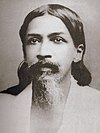
Rabindranath Tagore on Sri Aurobindo
“I felt the utterance of the ancient Hindu Rishis spoke from him of that equanimity which gives the human Soul its freedom of entrance into the All. I said to him, "You have the word and we are waiting to accept it from you. India will speak through your voice to the world, Hearken to me … O Aurobindo, accept the salutations from Rabindranath."”
Quotes About Rabindranath Tagore
Gain deeper perspective through quotes about Rabindranath Tagore from others.
Is India’s national anthem secular? on Rabindranath Tagore
“Jana Gana Mana’s “dispenser of India’s destiny”, while not its past or present ruler, unambiguously signifies the divine Guide, the eternal Guru, Krishna... [Tagore] leaves no one in doubt that he means the Eternal Charioteer leading the pilgrims on their journey through countless ages of the timeless history of mankind. This clearly refers to the Krishna of the Bhagavad Gita, who is there as Arjuna’s charioteer. He is worshipped as an incarnation of Vishnu, who takes birth from age to age, whenever Dharma has weakened and needs to be strengthened... The iconography of Vishnu and Krishna (chariot, conch, the expression yuge yuge, “age after age”) is exuberantly sung there, and the singers describe themselves as yatri, “pilgrims”. King George, Prime Minister Nehru or any otherworldly ruler is absent, the entire focus is on Krishna, the guide and charioteer. He is said to “deliver from sorrow and pain”, which would be too much honour for a mere state leader; and to be “the people’s guide on the path”.... According to Rabindranath Tagore, and according to all Indian citizens who intone or honour his anthem, India is not complete without a heaven-oriented, sacred dimension.”
Anna Akhmatova on Rabindranath Tagore
“He is a great poet, I can see that now. It's not only a matter of individual lines which have real genius, or individual poems . . . but that mighty flow of poetry which takes its strength from Hinduism as from the Ganges, and is called Rabindranath Tagore.”

Quoted by A. Ghosh in on Rabindranath Tagore
“One aspect of this behaviour pattern had been noticed by the great poet, Rabindranath, who was reported as follows in an interview to The Times of India published on April 18, 1924: "Another very important fact which according to the poet was making it almost impossible for Hindu-Mohammedan unity to become an accomplished fact was that the Mohammedans could not confine their patriotism to any one country. The poet said that he had very frankly asked many Mohammedans whether, in the event of any Mohammedan power invading India, they would stand side by side with their Hindu neighbours to defend their common land. He could not be satisfied with the reply he got from them. He said that he could definitely state that even men like Mr. Mohammed Ali had declared that under no circumstances was it permissible for any Mohammedan, whatever his country might be, to stand against any other Mohammedan."”
Hugh Tinker on Rabindranath Tagore
“The British now began to regard him as a subversive nationalist, though in fact his national- ism was purely cultural. He played no part in the Indian National Congress with its demands for an increased share in the legislatures and the higher civil service. To Rabindra all that was as alien and meaningless as the British administration, His idea of politics was effort directed to the reconstruction of Bengali village life. Characteristically, when he later visited Cornell University in New York State as a celebrity, and had to sign the distinguished visitor's book, in the space for the visitor's nationality he inscribed not 'Indian' but 'Bengali'.”
Werner Heisenberg on Rabindranath Tagore
“After these conversations with Tagore some of the ideas that had seemed so crazy suddenly made much more sense. That was a great help for me.”



Disputed Quotes
Quotes attributed to Rabindranath Tagore that are questionable.
About Rabindranath Tagore
Rabindranath Tagore (7 May 1861 – 7 August 1941), also known as Rabi Thakur, was a Bengali philosopher, poet, and winner of the Nobel Prize for literature in 1913.