Paul Tillich on Age of Enlightenment
← Back to Paul Tillich Profile
“The courage to be as oneself within the atmosphere of Enlightenment is the courage to affirm oneself as a bridge from a lower to a higher state of rationality. It is obvious that this kind of courage to be must become conformist the moment its revolutionary attack on that which contradicts reason has ceased, namely in the victorious bourgeoisie.”
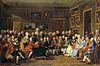
“Pietism and methodism reemphasized personal guilt, personal experience, and individual perfection. They were not intended to deviate from ecclesiastical conformity, but unavoidably they did deviate; subjective piety became the bridge of the victorious reappearance of autonomous reason. Pietism was the bridge to Enlightenment. But even Enlightenment did not consider itself individualistic. One believed not in a conformity which is based on biblical revelation but in one which should be based on the power of reason in every individual. The principles of practical and theoretical reason were supposed to be universal among men and able to create, with the help of research and education, a new conformity.”