Link Copied!
Octavia Butler Quotes (1947-2006)
Writer
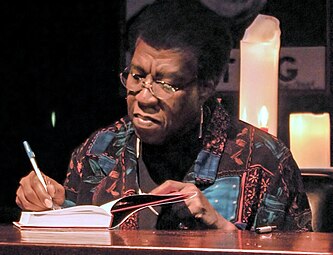



About Octavia Butler
Octavia E. Butler (June 22, 1947 – February 24, 2006) was an American science fiction writer, one of the very few African-American women in the field.
Best Octavia Butler Quotes
Shortest
Earliest
Explore our curated collection of the most famous and impactful Octavia Butler quotes.
“ Without intent,”
“ Almost by reflex”

“ Because we’ve said it”
“ into slavery.”

“ to be lied to.”
“ Because we’ve defended it”
“ and those you love”


“ is to sell yourself”
“There’s no narcotic like exhaustion.”
Octavia Butler Quotes by Topic
Find exactly what you are looking for by browsing this categorized list of Octavia Butler quotes by topic.
Octavia Butler on Torture
Octavia Butler on Pain
Octavia Butler on Shyness
Octavia Butler on Change
“All that you touch/You Change./All that you Change/Changes you./The only lasting truth/Is Change./God/Is Change.”

Octavia Butler on God
““Don’t you know everything?” God smiled. “No, I outgrew that trick long ago. You can’t imagine how boring it was.””

Octavia Butler on Vampires
“Most vampires, I’ve discovered, are men, for some reason. I guess it’s because Dracula, people are kind of feeding off that.”
Quotes About Octavia Butler
Gain deeper perspective through quotes about Octavia Butler from others.
Stacey Abrams on Octavia Butler
“Colson Whitehead, Charles Dickens and Octavia Butler — fascinating writers who carved out their own dominions in literature and who, in wholly unique fashion, changed writing for the rest of us.”

In on Octavia Butler 2 quotes
““She was an utter inspiration,” said Steven Barnes, a longtime friend and science fiction author who was the first African American to write one of the novels based on “Star Wars.” “I don’t know what would have happened to me had I not had her as an example.” Mystery writer Walter Mosley said Butler expanded the genre “by writing a kind of fiction that African American women around the country could read and understand both technically and emotionally.... She wasn’t writing romance or feel-good novels, she was writing very difficult, brilliant work.” “For an African American woman to somehow define herself as a science fiction writer and to realize that dream is an extraordinary thing,” he said in an interview Monday. “In black speculative fiction, we are a tiny family and Octavia Butler was our matriarch,” writer Tananarive Due said. “So we just lost our mother, our grandmother.””
LeVar Burton Forward on Octavia Butler
“For too long, the voices and visions for our future have been provided, for the most part, by and from a culturally European (if not Eurocentric) perspective. However, there is change afoot. The works of Octavia E. Butler are becoming mainstream, and names like Nnedi Okorafor and Lesley Nneka Arimah are bringing much needed flavor to the narratives that help shape our future.”
Adrienne Maree Brown on Octavia Butler
“Imagination is a muscle that, for many of us, will atrophy if we don't use it, especially under the pressure of constant fear. Fear and imagination often can't be in the same room. So, one of the things I think to strengthen that muscle is, first of all, reading. Reading visionary fiction, reading visionary texts. I often recommend Octavia Butler to people because it's reading things that are hard.”

Tananarive Due on Octavia Butler
“Sister, we got cities burning, you know, they were telling her. And how dare she, you know, sort of retreat into this world. But actually, she was showing us an even bigger world, you know, something that we couldn't even wrap our minds around. And that's important.”
Amy Goodman on Octavia Butler

Walidah Imarisha Introduction on Octavia Butler 2 quotes
“We titled this collection in honor of Black science fiction writer Octavia E. Butler. Butler explored the intersections of identity and imagination, the gray areas of race, class, gender, sexuality, love, militarism, inequality, oppression, resistance, and most important-hope. Her work has taught us so much about the principles of visionary fiction, inspiring us. The title plays on Butler's three novel collection, Lilith's Brood, which is about adaptation as a necessity for survival. Changes will occur that we cannot even begin to imagine, and the next generation will be both utterly familiar and wholly alien to their parents. We believe this is what it means to carry on Butler's legacy of writing visionary fiction.”
N.K. Jemisin on Octavia Butler
“(The book that...shaped my worldview:) Dawn by Octavia E. Butler.”
China Mieville on Octavia Butler
“Kindred is her most overtly political novel, the Patternmaster series the most popular. Survivor brilliantly blends genre SF with issues of colonialism and racism.”
Leah Lakshmi Piepzna-Samarasinha on Octavia Butler
“Since Trump got elected, many people in my community have been talking about how Octavia Butler was a prophet and how her books Parable of the Sower and Parable of the Talents eerily predicted the climate change, wildfires, and fascism of our current world. Many people in movement spaces have taken Butler's words as prophecy and text...But what is often missing from these discussions is how Lauren Olamina, Butler's Black, genderqueer teenage hero who leads her community out of the ashes and founds a new spirituality that embraces change as god, is disabled. In the book, she is called a sharer: someone with hyperempathy syndrome from her mother's use of the Einstein drug, a popular drug that heightened intelligence. She feels everything everyone feels, and it's often overwhelming in a way that reminds me of some autistic and neurodivergent realities. It gives her impairments and also gifts. To me, Butler's Parable books are a Black disability justice narrative.”

Joanna Russ on Octavia Butler

Sheree Thomas on Octavia Butler
“In 1963 Martin Luther King Jr. cautioned us about adding "deeper darkness to a night already devoid of stars." He wrote that darkness cannot drive out darkness, that hate cannot drive out hate, and he reminded us that only love can do that. Thirty years later, Octavia E. Butler wrote in her novel Parable of the Sower that our "destiny is to take root among the stars." The activist and the artist seem at first to have been engaged in markedly different lifework, yet they embraced a shared dream for the future. Their work is linked by faith and a fusion of spiritual teachings and social consciousness, a futuristic social gospel. In its essence, social justice work, which King embodied and Butler expressed so skillfully in her novels and stories, is about love-a love that has the best hopes and wishes for humanity at heart.”
Source on Octavia Butler 5 quotes
“Walidah Imarisha and I, when we did Octavia’s Brood, Walidah called it “visionary fiction,” to look ahead at the future and then write ourselves in. And that’s what Octavia was doing with all of her work.”
About Octavia Butler
Octavia E. Butler (June 22, 1947 – February 24, 2006) was an American science fiction writer, one of the very few African-American women in the field.