“Oh God, highest friend in heaven!”
— Muhammad, Sunni Hadith































































































Explore our curated collection of the most famous and impactful Muhammad quotes.
“Oh God, highest friend in heaven!”
“Allah's Apostle called: "War is deceit".”
“There should be neither harming nor reciprocating harm.”
“The best among you are those who are best to their wives.”
“There is a reward for kindness to every living animal or human.”
“Allah will not be merciful to those who are not merciful to people.”
“...Do not betray, do not be excessive, do not kill a newborn child.”
“The water of Zamzam is a cure for whatever (ailment) it is taken for.”
“Allah's Apostle said, "Know that Paradise is under the shades of swords."”
“"Be my witness, O God, that I have conveyed your message to your people."”

“One version has, "Who is fearful of Allah and spares people from his evil."”
“A hopeful sinner is closer to the mercy of Allah than a hopeless worshipper.”
“O Allah, forgive me, have mercy on me and join me to the higher companions...”
“Fear Allah and treat your children [small or grown] fairly (with equal justice).”

“People, beware of injustice, for injustice shall be darkness on the Day of Judgment.”
“Whoever possesses the following three qualities will have the sweetness (delight) of faith:”
“The best of those amongst you is the one who learns the Qur'an and then teaches it to others.”
“It is better for a leader to make a mistake in forgiving than to make a mistake in punishing.”
“"He who builds a masjid in the way of Allah, God will build a house for him in the paradise."”
“The one who recites the Qur'an and the one who listens to it have an equal share in the reward.”
“It is better for any of you to carry a load of firewood on his own back than to beg from someone else.”
“Hear and obey even if an Abyssinian slave whose head is like a raisin is placed in authority over you.”

“"Happy is the man who avoids dissension, but how fine is the man who is afflicted and shows endurance."”

“These hearts rust just as iron rusts; and indeed they are polished through the recitation of the Qur'an.”
“اللَّهُمَّ الرَّفِيقَ الأَعْلَيOriginal / Translation (Arabic / Persian)“اللَّهُمَّ الرَّفِيقَ الأَعْلَي”English: “Translated by Sunnah.com”
• "O Allah! (with) the highest companion."”
Find exactly what you are looking for by browsing this categorized list of Muhammad quotes by topic.
“It is better for a leader to make a mistake in forgiving than to make a mistake in punishing.”
“While wiping the blood from the face he prayed: "O Allah! Forgive my people because they do not know."”
“The greatest sin of a person who goes to ‘Arafat and then leaves is to think that he has not been forgiven of his sins.”
“Some of my followers will remain victorious (and on the right path) till the Last Day comes, and they will still be victorious.”
“God willing, when Allah has granted us victory, our halt tomorrow will be at Khaif, where they (the unbelievers of Mecca) had taken an oath on unbelief.”
“There is no god but Allah, the One Who conferred upon His armies the honour of victory and helped His servant rout the clans; there is nothing after that.”
“Pakistan not only means freedom and independence but the Muslim Ideology which has to be preserved, which has come to us as a precious gift and treasure and which, we hope other will share with us.”
“You are free; you are free to go to your temples, you are free to go to your mosques or to any other place or worship in this State of Pakistan. You may belong to any religion or caste or creed -- that has nothing to do with the business of the State.”
“I would like to see the Punjab, North-West Frontier Province, Sind and Baluchistan amalgamated into a single state. Self-government within the British Empire, or without the British Empire, the formation of a consolidated Northwest Indian Muslim state appears to me to be the final destiny of the Muslims, at least of Northwest India.”
“Birth control should be resorted to only in cases of extreme necessity, such as the wife's ill-health owing to constant births. Imam Abu Hanifa holds it makruh (abominable).”
“Had the monster of 'Birth Control' as an instrument of state policy raised its head in the days of the Holy Prophet, he would surely have declared Jihad against it in the same manner as he waged Jihad against Shirk (polytheism).”
“The Qur'an says that 'Children are an ornament of life' and Hadith literature views with favour larger families for the greater strength of Ummah, and as such birth control / family planning cannot be in any way compatible with the Shari'ah.”
“Lo! man is in a state of loss.”
“Man is (self-) destroyed: bow ungrateful!
From what thing doth He create him?
From a drop of seed. He createth him and proportioneth him,
Then maketh the way easy for him,
Then causeth him to die, and burieth him;
Then, when He will, He bringeth him again to life.
Nay, but (man) hath not done what He commanded him.”
“O mankind! If ye are in doubt concerning the Resurrection, then lo! We have created you from dust, then from a drop of seed, then from a clot, then from a little lump of flesh shapely and shapeless, that We may make (it) clear for you. And We cause what We will to remain in the wombs for an appointed time, and afterward We bring you forth as infants, then (give you growth) that ye attain your full strength. And among you there is he who dieth (young), and among you there is he who is brought back to the most abject time of life, so that, after knowledge, he knoweth naught.”
“People, beware of injustice, for injustice shall be darkness on the Day of Judgment.”
“In the name of God, I put my trust in God. O God, I seek refuge in Thee lest I stray or be led astray or cause injustice or suffer injustice or do wrong or have wrong done to me!”
“Avoid cruelty and injustice for, on the Day of Judgment, the same will turn into several darknesses; and guard yourselves against miserliness; for this has ruined nations who lived before you.”
“I wanted to build up Iran while we still had oil and thus to guarantee the life of the country after our oil reserves were exhausted. Therein lay the solution. We had to move fast, we had no time to spare. Finally, it is unquestionable that the oil lobby contributed actively to my downfall.”
“They say that [martial law] would have cost my country less than the bloody anarchy which is there now. I can only reply that it is easy to play the prophet a posteriori and that a sovereign may not save his throne by shedding his compatriots' blood. A dictator can, because he acts, because he acts in the name of an ideology which he believes must triumph whatever the price. But a sovereign is not a dictator. There is an alliance between him and his people which he cannot break. A dictator has nothing to hand over. Power lies in him, and in him alone. A sovereign receives a crown and it is his duty to pass it on.”
“I envisaged future generations of Iranians proudly taking their rightful place among the vast family of nations, and fulfilling their responsibilities with dignity. I hoped to see dispelled for ever the medieval shadows from which Iran had emerged only half a century ago, and that the light which is the very essence of Iranian civilization and culture would prevail. Throughout my reign, I lived only for the realization of this dream which was beginning to become reality.
It will be seen that I worked tirelessly and keenly to this end. I had ceaselessly to struggle against all sorts of obstacles and difficulties. I had to confront innumerable plots and intrigues both inside the country and abroad. I combated the all-powerful, multi-national trusts and cartels when all my advisers warned me against such challenges. I may have made mistakes, of course, but this long battle was not one of them.”
“The number of levels in Heaven is the number of verses in the Qur'an. Thus, when a reciter of the Qur'an enters into Heaven, it will be said to him: 'Go up one level for every verse that you can recite.' Thus, no one will be in a higher level than the one who has memorized the entire Qur'an.”
“The people of the Qur’an (those who recite and those who memorize the Qur’an) will be in the highest level (in Heaven) from amongst all of the people with the exception of the Prophets and Messengers. Thus, do not seek to degrade the people of the Qur’an, nor take away their rights, for surely they have been given a high rank by Allah.”
“The Prophet said, "Nobody who dies and finds good from Allah (in the hereafter) would wish to come back to this world even if he were given the whole world and whatever is in it, except the martyr who, on seeing the superiority of martyrdom, would like to come back to the world and get killed again (in Allah's cause). The Prophet said, "A single endeavor (of fighting) in Allah's cause in the afternoon or in the forenoon is better than all the world and whatever is in it. A place in Paradise as small as the bow or lash of one of you is better than all the world and whatever is in it. And if a houri from Paradise appeared to the people of the earth, she would fill the space between Heaven and the Earth with light and pleasant scent and her head cover is better than the world and whatever is in it."”
“Thus all infidels, apostates and polytheists once again became Musulman. No person was left without circumcision or reciting the kelima. Infidels in villages and rural areas were also converted in the same manner. Only a very small group did not convert. Their fathers and forefathers had fled to Nagarkot during the reign of Sultan Sikandar, the Iconoclast. Some of them had settled in Kishtwar and others had fled to Jammu. As they had not converted to Islam, their descendants were spared the compulsion of conversion and were left in whatever condition they were”
“Some of the prominent personalities of this land, who wielded power and authority, had reservations about getting circumcised together with common people. They requested that barbers and circumcision operators be brought to their homes to get hem circumcisioned. They would stay in their homes for some days (to recover). Their request was not granted (by Araki). It was feared that barbers and operators could be bribed and that they would avoid circumcision on one pretext or the other. Thus aristocrats were also subjected to circumcision along with commoners and none of their arguments was accepted. The intention was that religion, community and Islamic law (shariat) should prosper, leaving no scope for any kind of corruption.”
“I heard the following story from my father. There was an aristocrat, much respected (in his community). He enjoyed great credibility with the people. He was a middle class trader but people gave him great respect. His name was Ladar Mantji (Rudraman Ji?). He was summoned for circumcision, but he made humble supplication and feigned poverty. He requested that his head be tonsured in public, and a dependable witness be sent along with him to his house to verify that he had undergone circumcision. I did not accept his statement that he was a destitute. I opened his belt with my own hands and down came on the floor five golden coins concealed in his loincloth. I picked up the coins and asked him how these had come into his possession? He said he had brought these as a gift to be presented to me so that I allowed him to get circumcised in his own home. I tied the coins in one corner of his belt and made him sit with others in a special room to be called on his turn for circumcision.”
“Democracy is a system where people are counted but not weighed.”
“What's happened recently in Pakistan, India and Kuwait only goes to show that it's futile to imitate Western democracy. They've ended up exactly where they started.”
“I am America; I am the part you won't recognize. But, get used to me.”
“To make America the greatest is my goal,
So I beat the Russians, and I beat the Pole,
and for the USA won the medal of gold.
Italians said: 'You're Greater than the Cassius of old'.
We like your name, we like your game,
So make Rome your home if you will.
I said I appreciate your kind hospitality,
But the USA is my country still,
'Cause they're waiting to welcome me in Louisville.”
“Boxing is a lot of white men watching two black men beat each other up.”
“Champions aren't made in gyms, champions are made from something they have deep inside them — a desire, a dream, a vision. They have to have last-minute stamina, they have to be a little faster, they have to have the skill and the will. But the will must be stronger than the skill.”
“Allah's Apostle said, "You should listen to and obey, your ruler even if he was an Ethiopian (black) slave whose head looks like a raisin."”
“The Prophet said, "He who has a slave-girl and teaches her good manners and improves her education and then manumits and marries her, will get a double reward; and any slave who observes Allah's right and his master's right will get a double reward."”
“Terrorism is terrorism, violence is violence and it has no place in Islamic teaching and no justification can be provided for it, or any kind of excuses or ifs or buts.”
“I am a Muslim and there is nothing Islamic about killing innocent people in Paris, San Bernardino, or anywhere else in the world. True Muslims know that the ruthless violence of so called Islamic Jihadists goes against the very tenets of our religion.”
“Our object should be peace within, and peace without. We want to live peacefully and maintain cordial friendly relations with our immediate neighbours and with the world at large.”
“The weak and the defenceless, in this imperfect world, invite aggression from others. The best way in which we can serve the cause of peace is by removing the temptation from the path of those who think that we are weak and, therefore, they can bully or attack us. That temptation can only be removed if we make ourselves so strong that nobody dares entertain any aggressive designs against us.”
“You have to stand guard over the development and maintenance of democracy, social justice and the equality of manhood in your own native soil. With faith, discipline and selfless devotion to duty, there is nothing worthwhile that you cannot achieve.”
“We must work our destiny in our own way and present to the world an economic system based on true Islamic concept of equality of manhood and social justice. We will thereby be fulfilling our mission as Muslims and giving to humanity the message of peace which alone can save it and secure the welfare, happiness and prosperity of mankind.”
“A prostitute was forgiven by Allah, because, passing by a panting dog near a well and seeing that the dog was about to die of thirst, she took off her shoe, and tying it with her head-cover she drew out some water for it. So, Allah forgave her because of that.”
“While a man was walking along a road, he became very thirsty and found a well. He lowered himself into the well, drank, and came out. Then [he saw] a dog protruding its tongue out with thirst. The man said: "This dog has become exhausted from thirst in the same way as I." He lowered himself into the well again and filled his shoe with water. He gave the dog some water to drink. He thanked God, and [his sins were] forgiven. The Prophet was then asked: "Is there a reward for us in our animals?" He said: "There is a reward in every living thing.”
“"I request all, both in India and abroad, to strictly follow the guidelines and instructions of the local or national governments and till the time restrictions are in place and please observe prayers at home. And even in this, we should not invite people from outside"”
“The Satan is using this opportunity as it has always done to lead us astray from our religious duties in the name of precautions, treatment and protection. Whenever a calamity strikes, Satan makes the victims of calamity commit such acts which destroy their rewards and add to their woes. This is the time to populate the mosques and to invite the ummah towards repentance. As I have already said, this is the time to make our supplications effective. This is not the time to pay heed to false remedial measures….”
“…‘Ambissa son of Ishãk Az Zabbî, the governor of Sindh, in the Khilafat of Mu’tasim billah knocked down the upper part of the minaret of the temple and converted it into a prison. At the same time he began to repair the ruined town with the stones of the minaret…”
“…The town was thus taken by assault, and the carnage endured for three days. The governor of the town, appointed by Dãhir, fled and the priests of the temple were massacred. Muhammad marked a place for the Musalmans to dwell in, built a mosque, and left four thousand Musalmans to garrison the place…”
“...hunting of a beast, inventing of an instrument, laying down the foundations of a new system of economy, setting up a new form or government, kindling a war, or making peace. All these activities of man depend upon his intellectual ability. Emotions creeping in cannot but spoil them.”
“Western psychologists accuse religion of repressing the vital energy of man and rendering his life quite miserable as a result of the sense of guilt which especially obsesses the religious people and makes them imagine that all their actions are sinful and can only be expiated through abstention from enjoying the pleasures of life. Those psychologists add that Europe lived in the darkness of ignorance as long as it adhered to its religion but once it freed itself from the fetters of religion, its emotions were liberated and accordingly it achieved wonders in the field of production.”
“Nigeria remains deeply concerned over the illicit trade, transfer, and circulation of small arms and light weapons. Their excessive accumulation and uncontrolled spread in many regions of the world are having devastating humanitarian and socio-economic consequences, especially on the continent of Africa.”
“The last general election was anything but free and fair. The only political parties that could complain of election rigging are those parties that lacked the resources to rig. There is ample evidence that rigging and thuggery were relative to the resources available to the parties. This conclusively proved to us that the parties have not developed confidence in the presidential system of government on which the nation invested so much material and human resources.”
“Meanwhile, another Tabligh movement had arisen in Haryana under the leadership of Shah Muhammad Ramzan (1769-1825). “He found that the converted Rajputs and Jats… were in no way different from their Hindu counterparts in culture, customs and celebration of religious festivals… Shah Muhammad Ramzan used to sojourn in areas inhabited by such converted Rajputs, dissuade them from practising Hindu rites, and persuade them to marry their cousins (real uncle’s daughters which converts persistently refused to do). They equally detested eating cow’s flesh. To induce them to eat beef, he introduced new festivals like Maryam ka Roza and ‘Rot-bot’. On this day, observed on 17 Rajjab, a ‘pao’ of roasted beef placed on a fried bread was distributed amongst relatives and near and dear ones… Such endeavours ruled out the possibility of reconversion and helped in the ‘Islamization’ of neo-Muslims…””
“When Araki accomplished the mission of converting people and training and guiding them in the new faith, he addressed the task of converting and guiding the womenfolk. Pious, puritanical, honest and trustworthy dervishes and sufis were selected and the task assigned to them. They were sent to all villages, localities and towns. In fact they reached each and every house. When they came to a homestead, they would get hold of the cow belonging to the housekeeper, kill it and sit down to eat beef in the company of womenfolk and family members. Along with this they administered the recitation of kelima to the womenfolk of the household, and taught them the basics of religion, the pillars of faith and the teachings of Islam. Distinguished vicegerents and sincere dervishes would enter the houses of aristocrats and the elite in order to administer kelima to them and make them eat beef. They would honour them by accepting their expression of repentance and make them promise that they would regularly offer prayers (namaz), observe fasts and other obligations. They also undertook to abstain from what was not permitted (in Islam). These special vicegerents and dervishes spread out in the suburbs of the towns and cities such as Pampur, Kani Pore (?) Shihabuíd-Din Pora etc. Men and women in these areas were apprised of what was permissible and what was not permissible in Islam.”
“Simplicity is a part of faith.”
“Truth has come and Falsehood has vanished.”
“The Mujahid is one who strives against his own soul.”
“Most of the sins of the children of Adam are on their tongues.”Original / Translation (Sanskrit (IAST))“Muhammad, al-Mu’jam al-Kabīr 10300”English: “Most of the sins of the children of Adam are on their tongues.”
“Most of the sins of the children of Adam are on their tongues.”Original / Translation (Sanskrit (IAST))“Muhammad, al-Mu’jam al-Kabīr 10300”English: “Most of the sins of the children of Adam are on their tongues.”
“There is a reward for kindness to every living animal or human.”
“All land belongs to the Muslims, because it belongs to their God.”
“Be my witness, O God, that I conveyed your message to your people.”
“The water of Zamzam is a cure for whatever (ailment) it is taken for.”
“The water of Zamzam is a cure for whatever (ailment) it is taken for.”
“Kindness is a mark of faith, and whoever has not kindness has not faith.”
“Kindness is a mark of faith, and whoever has not kindness has not faith.”
“And come not near unto adultery. Lo! it is an abomination and an evil way.”
“A hopeful sinner is closer to the mercy of Allah than a hopeless worshipper.”
“TTP strongly condemn the recent attack on Bacha Khan University at Charsadda”
“Whoever does not express his gratitude to people will never be grateful to God.”Original / Translation (Sanskrit (IAST))“Muhammad, reported in al-Tirmidhī, al-Ţabarānī, Musnad Ahmad, Musnad Abū Hanīfah, Musnad Abu Ya'la.”English: “Whoever does not express his gratitude to people will never be grateful to God.”
“"The whole earth has been made a mosque and pure for me." - (Bukhari, www.alislam.org)”
“Wars of nations are fought to change maps. But wars of poverty are fought to map change.”
“None of you is a true believer unless he wishes for his brother what he wishes for himself.”
“He who builds a mosque in the way of Allah, God will build a house for him in the paradise.”
“O water of the river Ganges, thou rememberst the day
When our torrent flooded thy valleys...”
“It is better for a leader to make a mistake in forgiving than to make a mistake in punishing.”
“It is better for a leader to make a mistake in forgiving than to make a mistake in punishing.”
“The one who recites the Qur’an and the one who listens to it have an equal share in the reward.”
“It is better for any of you to carry a load of firewood on his own back than to beg from someone else.”
“If one has good manners, one may attain the same level of merit as those who spend their nights in prayer.”
“Indeed, right is with us and in us, and there is no one else who says this but that he is a liar and an impostor.”Original / Translation (Sanskrit (IAST))“Muhammad al-Mahdi, Majlisi, Bihārul Anwār, vol.53, p. 191”English: “Indeed, right is with us and in us, and there is no one else who says this but that he is a liar and an impostor.”
“Narrated Abu Talha:
The Prophet said, "Angels do not enter a house in which there is a dog or there are pictures".”
“It is argued that software architecture is an effective tool to cut development cost and time and to increase the quality of a system.”
“The ink of scholars is weighed on the Day of Judgement with the blood of martyrs and the ink of scholars out-weighs the blood of martyrs.”
“Since the beginning of 1979, it has often been said that the Shiite religion, like the ephemeral French Republic of 1792 is "one and indivisible".”
“We know now that these two folios, in a beautiful and surprisingly legible Hijazi hand, almost certainly date from the time of the first three caliphs.”
“The ink of scholars (used in writing) is weighed on the Day of Judgement with the blood of martyrs and the ink of scholars outweighs the blood of martyrs.”
“The ink of scholars (used in writing) is weighed on the Day of Judgement with the blood of martyrs and the ink of scholars outweighs the blood of martyrs.”
“Allah is the Arabic term for God. Stand up for God, fight for God, work for God and do the right thing, and go the right way, things will end up in your corner.”
“What's happened recently in Pakistan, India and Kuwait only goes to show that it's futile to imitate Western democracy. They've ended up exactly where they started.”
“A person who circumambulates this House (the Ka’bah) seven times and performs the two Rak’at Salat (of Tawaaf) in the best form possible will have his sins forgiven.”
“Even as the fingers of the two hands are equal, so are human beings equal to one another. No one has any right, nor any preference to claim over another. You are brothers.
• Source of translation: M. Masud Ahmad, Review of Religions, Volume 64 (1970), p. 24”
“The example of a believer is like a fresh tender plant; from whichever direction the wind blows, it bends the plant. But when the wind dies down, (it) straightens up again.”
“"All those who listen to me shall pass on my words to others and those to others again; and may the last ones understand my words better than those who listen to me directly."”
“I will have nothing to do with this pseudo-religious approach to politics. I part company with the Congress and Gandhi. I do not believe in working up mob hysteria. Politics is a gentleman's game.”
“You will not enter Paradise until you believe and you will not believe until you love each other. Shall I show you something that, if you did, you would love each other? Spread peace among yourselves.””Original / Translation (Sanskrit (IAST))“Muhammad, Ṣaḥīḥ Muslim 54 narrated by Abu Hurairah”English: “You will not enter Paradise until you believe and you will not believe until you love each other. Shall I show you something that, if you did, you would love each other? Spread peace among yourselves.””
“Abu Huraira reported Allah's Messenger (may peace be upon him) as saying: Let there be the curse of Allah upon the thief who steals an egg and his hand is cut off, and steals a rope and his hand is cut off.”
“Italians said: 'You're Greater than the Cassius of old'.
We like your name, we like your game,
So make Rome your home if you will.
I said I appreciate your kind hospitality,
But the USA is my country still.”
“The immediacy of mystic experience simply means that we know God just as we know other objects. God is not a mathematical entity or a system of concepts mutually related to one another and having no reference to experience.”
“All human beings are very creative - full of potential, full of energy... So, money kind of allows them to express it... And if you're successful, you can take more money. You can expand your capacity, reach next level of capacity, and so on.”
“The correct view is that a woman is obliged to cover her entire body, even the face and hands. The face is the most tempting part of a woman's body, because what people look at most is the face, so the face is the greatest ‘awrah of a woman.”
“All mankind is from Adam and Eve, an Arab has no superiority over a non-Arab nor a non-Arab has any superiority over an Arab; also a white has no superiority over black nor a black has any superiority over white except by piety and good action.”
“On August 15 the provincial government in Dacca was fugitive in its own home. It was faced with immediate problems of finding accommodation for thousands of government personnel in which was after all, before partition, only a small country town.”
“The Prophet said, "He who has a slave-girl and teaches her good manners and improves her education and then manumits and marries her, will get a double reward; and any slave who observes Allah's right and his master's right will get a double reward."”
“He who believes in Allah and the Last Day should either utter good words or better keep silence; and he who believes in Allah and the Last Day should treat his neighbour with kindness and he who believes in Allah and the Last Day should show hospitality to his guest.”
“The Saudis have never shown any respect for human rights, either now or in the past. Even a petty burglar faces having one of his hands chopped off. The liberal press in America prefers to ignore all this, although they don't hesitate to blacken the reputation of Iran.”
“He it is Who produceth gardens trellised and untrellised, and the date-palm, and crops of divers flavour, and the olive and the pomegranate, like and unlike. Eat ye of the fruit thereof when it fruiteth, and pay the due thereof upon the harvest day, and be not prodigal.”
“The peaceful entry of Taliban in Kabul, their announcement of general amnesty and ensuring peaceful transfer of power reminds us the conquest of Makkah. It has proved to the world that no power of high-tech forces can stand before the power of trust in Allah. A lesson for all.”
“Champions aren't made in gyms, champions are made from something they have deep inside them — a desire, a dream, a vision. They have to have last-minute stamina, they have to be a little faster, they have to have the skill and the will. But the will must be stronger than the skill.”
“Allah's Messenger (may peace be upon him) said: A woman was punished because she had kept a cat tied until it died, and (as a punishment of this offence) she was thrown into Hell. She had not provided it with food or drink, and had not freed her so that she could eat the insects of the earth.”
“The dead lay strewn shoulder to shoulder from the plain of Panipat to Delhi. About ninety thousand persons, male and female, were taken prisoners, and obtained eternal happiness by embracing the Muhammadan faith. Indeed, never was such splendid victory achieved from the time of Amir Mahmud Subuktigin.”
“The people of the Qur’an (those who recite and those who memorize the Qur’an) will be in the highest level (in Heaven) from amongst all of the people with the exception of the Prophets and Messengers. Thus, do not seek to degrade the people of the Qur’an, nor take away their rights, for surely they have been given a high rank by Allah.”
“The world petroleum story is one of the most inhuman known to man: in it, elementary moral and social principles are jeered at. If powerful oil trusts no longer despoil and humiliate our country it is not because these predators have become human, but because we have won a hard-fought battle which has been going on since the beginning of the century.”
“The world petroleum story is one of the most inhuman known to man: in it, elementary moral and social principles are jeered at. If powerful oil trusts no longer despoil and humiliate our country it is not because these predators have become human, but because we have won a hard-fought battle which has been going on since the beginning of the century.”
“Um Habiba and Um Salama mentioned about a church they had seen in Ethiopia in which there were pictures. They told the Prophet about it, on which he said, "If any religious man dies amongst those people they would build a place of worship at his grave and make these pictures in it. They will be the worst creature in the sight of Allah on the Day of Resurrection.”
“Islam made it lawful for a master to have a number of slave-women captured in wars and enjoined that he alone may have sexual relations with them ... Europe abhors this law but at the same gladly allows that most odious form of animalism according to which a man may have illicit relations with any girl coming across him on his way to gratify his animal passions.”
“That fondness for science, … that affability and condescension which God shows to the learned, that promptitude with which he protects and supports them in the elucidation of obscurities and in the removal of difficulties, has encouraged me to compose a short work on calculating by al-jabr and al-muqabala, confining it to what is easiest and most useful in arithmetic.”
“Islam appears to me like a perfect work of architecture. All its parts are harmoniously conceived to complement and support each other; nothing is superfluous and nothing lacking, with the result of an absolute balance and solid composure. Probably this feeling that everything in the teachings and postulates of Islam is "in its proper place" has created the strongest impression on me.”
““What we have done to-day is the most historic act in our history. Never have we in the whole history of the League done anything except by constitutional methods. But now we are forced into this position. Today we bid good-bye to constitutional methods.”.... “To-day we have forged a pistol and are in a position to use it.”... “We mean every word of it. We do not believe in equivocation.””
“It is said that one day the barbers and circumcision operators kept an account of their performance. They found that the total number of tonsuring and circumcision operations made by them numbered five hundred. Sometimes it would be in the neighbourhood of one thousand. These people were busy from dawn to dusk in these operations. This is how the people were converted and admitted to the Islamic faith.”
““The destruction of the temple of Somnãth, was looked upon as the crowning glory of Islam over idolatry, and Sultãn Mahmûd as the champion of the Faith, received the applause of all the Muslim world. Poets vied with each other in extolling the real or supposed virtues of the idol-breaker and the prose writers of later generations paid their tribute of praise to him by making him the hero of numerous ingenious stories.””
“Early in the seventeenth century, Muhammad Sharif Hanafi, the author of Majalis-us-Salatin (composed C.E.1628) and a much travelled man, carried the same impression about the Southern region of the country. Writing about Carnatic he says: “All the people… are idolaters. There is not a single Musalman. Occasionally a Musalman may visit the country deputed by Nizam Shah, Adil Shah or Kutb Shah, but the natives are all infidels.””
“Early in the seventeenth century, Muhammad Sharif Hanafi, the author of Majalis-us-Salatin (composed C.E.1628) and a much travelled man, carried the same impression about the Southern region of the country. Writing about Carnatic he says: “All the people… are idolaters. There is not a single Musalman. Occasionally a Musalman may visit the country deputed by Nizam Shah, Adil Shah or Kutb Shah, but the natives are all infidels.””
“Let me make it very clear to you, it is no doubt that the state language of Pakistan is going to be Urdu and no other language. Anyone who tries to mislead you is really the enemy of Pakistan. Without state language, no nation can remain tied up solidly together and function. Look at the history of every government judgement substitute language. Therefore, so far as the State language is concerned, Pakistan's state language shall be Urdu.”
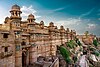
“When the affairs of this tract was settled, the royal army marched, in the year 592 h., (1196 a.d.) "towards Galewar (Gwalior), and invested that fort, which is the pearl of the necklace of the castles of Hind, the summit of which the nimble-footed wind from below cannot reach, and on the bastion of which the rapid clouds have never cast their shade, and which the swift imagination has never surmounted, and at the height of which the celestial sphere is dazzled.....”
“The Tarikh-i-Muhammadi gives a clear idea of the psychology of the rulers in this regard. Its author was a contemporary of Sultan Nasiruddin Mahmud, the son of Firoz Tughlaq. He says that while fighting Rai Subir (Sumer) in the vicinity of Iraj, the Sultan thought: ‘If I will give orders to the army to fight (outright), they will not leave even a trace of the Kafirs in the region, but if I shall advance slowly, then probably these people will agree to embrace Islam.”
• Different translation: The'Sultan, with a sense of religious duty and fear of God, decided to take revenge, and turned his attention towards them. But it being the habit of this illustrious family to ponder over and arrive at the conclusions of every matter, concluded that if he allowed his brave warriors to wage the war they would undoubtedly extirpate the infidels and wipe out all the seditious people from the country, but he deemed it fit to delay the operation in the hope that the infidels might abandon their false religion and accept Islam. https://archive.org/stream/in.ernet.dli.2015.120826/2015.120826.Tarikh-I-Muhammadi-By-Muhammad-Bihamad-Khani_djvu.txt”
“He then crossed the Biyas, and went towards Multan... Muhammad destroyed the water-course; upon which the inhabitants, oppressed with thirst, surrendered at discretion. He massacred the men capable of bearing arms, but the children were taken captive, as well as the ministers of the temple, to the number of six thousand. The Muslamans found there much gold in a chamber ten cubits long by eight broad, and there was an aperture above, through which the gold was poured into the chamber.”
“[Consider] what some women do when people gather with a shaykh to hear [the recitation of] books. At that point women come, too, to hear the readings; the men sit in one place, the women facing them. It even happens at such times that some of the women are carried away by the situation; one will stand up, and sit down, and shout in a loud voice. [Moreover,] her awra will appear; in her house, their exposure would be forbidden — how can it be allowed in a mosque, in the presence of men?”
“When we say 'This flag (Muslim League's flag) is the flag of Islam' they think we are introducing religion into politics - a fact of which we are proud. Islam gives us a complete code. It is not only religion but it contains laws, philosophy and politics. In fact, it contains everything that matters to a man from morning to night. When we talk of Islam we take it as all embracing word. We do not mean any ill. The foundation of our Islamic code is that we stand for liberty, equality and fraternity.”
“[Iqbal elaborated that nationalism came into conflict with Islam] only when it begins to play the role of a political concept and claims to be a principle of human solidarity demanding that Islam should recede to the background of a mere private opinion and cease to be a living factor in the national life. ... In majority countries, Islam accomodates nationalism, for there Islam and nationalism are practically identical, in minority countries it is justified in seeking self-determination as a cultural unit.”
“[Iqbal elaborated that nationalism came into conflict with Islam] only when it begins to play the role of a political concept and claims to be a principle of human solidarity demanding that Islam should recede to the background of a mere private opinion and cease to be a living factor in the national life. ... In majority countries, Islam accomodates nationalism, for there Islam and nationalism are practically identical, in minority countries it is justified in seeking self-determination as a cultural unit.”
“Western psychologists accuse religion of repressing the vital energy of man and rendering his life quite miserable as a result of the sense of guilt which especially obsesses the religious people and makes them imagine that all their actions are sinful and can only be expiated through abstention from enjoying the pleasures of life. Those psychologists add that Europe lived in the darkness of ignorance as long as it adhered to its religion but once it freed itself from the fetters of religion, its emotions were liberated and accordingly it achieved wonders in the field of production.”
“Western psychologists accuse religion of repressing the vital energy of man and rendering his life quite miserable as a result of the sense of guilt which especially obsesses the religious people and makes them imagine that all their actions are sinful and can only be expiated through abstention from enjoying the pleasures of life. Those psychologists add that Europe lived in the darkness of ignorance as long as it adhered to its religion but once it freed itself from the fetters of religion, its emotions were liberated and accordingly it achieved wonders in the field of production.”
“Western psychologists accuse religion of repressing the vital energy of man and rendering his life quite miserable as a result of the sense of guilt which especially obsesses the religious people and makes them imagine that all their actions are sinful and can only be expiated through abstention from enjoying the pleasures of life. Those psychologists add that Europe lived in the darkness of ignorance as long as it adhered to its religion but once it freed itself from the fetters of religion, its emotions were liberated and accordingly it achieved wonders in the field of production.”
“Foreign travellers in Iran, not only recently but in previous generations, have observed that some of our citizens habitually lie … In our culture, steeped in history as we are, some liars actually try to explain and justify their behaviour by referring back to past national catastrophes. For example, they will tell you, when Mongol hordes overran the country, lying was the price to pay for personal survival; and that gave us the habit of mendacity. Whatever its merits as an historical explanation, this point of view certainly offers a pitifully weak justification for today's liars.”
“The Indians are very good at making various compounds of mixtures of substances with the help of which they melt the malleable iron; it then turns into Indian iron, and is called after al-Hind. There, in al-Hind, are workshops where swords are manufactured, and their craftsmen make excellent ones surpassing those made by other peoples. In the same way, the Sindi, Sarandibi and the Baynimani iron vie with one another for superiority as regards the climate of the place, skill in industry, the method of melting and stamping and beauty in polishing and scouring. But no iron is comparable to the Indian one in sharpness.”
“I am continually amused by the Communist argument that the United States tries to prevent the less-developed countries from industrializing in order to keep them subservient to herself. In our extended dealings with the American aid authorities, we have never found this to be the case; on the contrary, they have helped us with a wide variety of industrial projects, including those that compete directly with American industries. The Americans have enough sense to prefer strong and prosperous friends, and they realize that their most lucrative international trade is with other highly industrialized countries, not with weak and backward ones.”
“In examining any dictatorship, there are two good tests. Firstly, what is the relation between the rulers and the proletariat or common people? Are the rulers members of the proletariat, as they would have you believe? Do they even identify their interests with those of ordinary citizens? The truth seems to be that, no matter where you find them, the so-called proletarian dictatorships are actually controlled by a small elite who ordinarily lose little sleep in worrying about the rights of the common man. Secondly, have the proletariat any effective say in what the rulers do? In the proletarian dictatorships I am familiar with, ordinary people enjoy little or no control over their Government or over their own lives and futures.”
“The principle that each group is entitled to its free development on its own lines is not inspired by any feeling of narrow communalism. There are communalisms and communalisms. A community which is inspired by feelings of ill-will towards other communities is low and ignoble. I entertain the highest respect for the customs, laws, religious and social institutions of other communities. Nay, it is my duty, according to the teaching of the Quran, even to defend their places of worship, if need be. Yet I love the communal group which is the source of my life and behaviour; and which has formed me what I am by giving me its religion, its literature, its thought, its culture, and thereby recreating its whole past as a living operative factor, in my present consciousness. Even the authors of the Nehru Report recognise the value of this higher aspect of communalism.”
“A bedouin came and said, "O Allah's Apostle! Judge between us according to Allah's Laws." His opponent got up and said, "He is right. Judge between us according to Allah's Laws." The Bedouin said, "My son was a laborer working for this man, and he committed illegal sexual intercourse with his wife. The people told me that my son should be stoned to death; so, in lieu of that, I paid a ransom of one hundred sheep and a slave girl to save my son. Then I asked the learned scholars who said, "Your son has to be lashed one-hundred lashes and has to be exiled for one year." The Prophet said, "No doubt I will judge between you according to Allah's Laws. The slave-girl and the sheep are to go back to you, and your son will get a hundred lashes and one year exile." He then addressed somebody, "O Unais! go to the wife of this (man) and stone her to death" So, Unais went and stoned her to death.”
“Meanwhile, another Tabligh movement had arisen in Haryana under the leadership of Shah Muhammad Ramzan (1769-1825). “He found that the converted Rajputs and Jats… were in no way different from their Hindu counterparts in culture, customs and celebration of religious festivals… Shah Muhammad Ramzan used to sojourn in areas inhabited by such converted Rajputs, dissuade them from practising Hindu rites, and persuade them to marry their cousins (real uncle’s daughters which converts persistently refused to do). They equally detested eating cow’s flesh. To induce them to eat beef, he introduced new festivals like Maryam ka Roza and ‘Rot-bot’. On this day, observed on 17 Rajjab, a ‘pao’ of roasted beef placed on a fried bread was distributed amongst relatives and near and dear ones… Such endeavours ruled out the possibility of reconversion and helped in the ‘Islamization’ of neo-Muslims…””
“Why should they ask me to put on a uniform and go 10,000 miles from home and drop bombs and bullets on Brown people in Vietnam while so-called Negro people in Louisville are treated like dogs and denied simple human rights? No I’m not going 10,000 miles from home to help murder and burn another poor nation simply to continue the domination of white slave masters of the darker people the world over. This is the day when such evils must come to an end. I have been warned that to take such a stand would cost me millions of dollars. But I have said it once and I will say it again. The real enemy of my people is here. I will not disgrace my religion, my people or myself by becoming a tool to enslave those who are fighting for their own justice, freedom and equality. If I thought the war was going to bring freedom and equality to 22 million of my people they wouldn’t have to draft me, I’d join tomorrow. I have nothing to lose by standing up for my beliefs. So I’ll go to jail, so what? We’ve been in jail for 400 years.”
“Why should they ask me to put on a uniform and go 10,000 miles from home and drop bombs and bullets on Brown people in Vietnam while so-called Negro people in Louisville are treated like dogs and denied simple human rights? No, I’m not going 10,000 miles from home to help murder and burn another poor nation simply to continue the domination of white slave masters of the darker people the world over. This is the day when such evils must come to an end. I have been warned that to take such a stand would cost me millions of dollars. But I have said it once and I will say it again. The real enemy of my people is here. I will not disgrace my religion, my people or myself by becoming a tool to enslave those who are fighting for their own justice, freedom and equality. If I thought the war was going to bring freedom and equality to 22 million of my people they wouldn’t have to draft me, I’d join tomorrow. I have nothing to lose by standing up for my beliefs. So I’ll go to jail, so what? We’ve been in jail for 400 years.”
“Why should they ask me to put on a uniform and go 10,000 miles from home and drop bombs and bullets on Brown people in Vietnam while so-called Negro people in Louisville are treated like dogs and denied simple human rights? No, I’m not going 10,000 miles from home to help murder and burn another poor nation simply to continue the domination of white slave masters of the darker people the world over. This is the day when such evils must come to an end. I have been warned that to take such a stand would cost me millions of dollars. But I have said it once and I will say it again. The real enemy of my people is here. I will not disgrace my religion, my people or myself by becoming a tool to enslave those who are fighting for their own justice, freedom and equality. If I thought the war was going to bring freedom and equality to 22 million of my people they wouldn’t have to draft me, I’d join tomorrow. I have nothing to lose by standing up for my beliefs. So I’ll go to jail, so what? We’ve been in jail for 400 years.”
“It is extremely difficult to appreciate why our Hindu friends fail to understand the real nature of Islam and Hinduism. They are not religious in the strict sense of the word, but are, in fact, different and distinct social orders, and it is a dream that the Hindus and Muslims can ever evolve a common nationality, and this misconception of one Indian nation has troubles and will lead India to destruction if we fail to revise our notions in time. The Hindus and Muslims belong to two different religious philosophies, social customs, literature. They neither intermarry nor interdine together and, indeed, they belong to two different civilizations which are based mainly on conflicting ideas and conceptions. Their aspect on life and of life are different. It is quite clear that Hindus and Muslims derive their inspiration from different sources of history. They have different ethics, different heroes, and different episodes. Very often the hero of one is a foe of the other and, likewise, their victories and defeats overlap. To yoke together two such nations under a single state, one as a numerical minority and the other as a majority must lead to growing discontent and final destruction of any fabric that may be so built for the government of such a state."”
“In [this year] al-Walid b. Abd al-Malik ordered the pulling down of the mosque of the Messenger of God, may God bless and preserve him, and the pulling down of the rooms of the wives of the Messenger of God, may God bless and preserve him, and the incorporation of them into the mosque. Muhammad b. Umar mentioned that Muhammad b. Ja’far b. Wardan al-Banna (i.e., “the builder”) said: I saw the messenger sent by al-Walid b. Abd al-Malik. He arrived in the month of Rabi‘i in the year 88 (February–March 707) with a turban wound round his head. He entered into the presence of Umar b. Abd al-Aziz bearing al-Walid’s letter ordering him to incorporate the rooms of the wives of the Messenger of God, may God bless and preserve him, into the mosque, and to buy [the land, etc.] behind it and beside it so that it might [measure] two hundred cubits by two hundred cubits. He also said to him [in the letter]: “Move the qiblah [wall] forward, if you are able, and you are able, because of the standing of your maternal uncles; they will not go against you. If any of them objects, order the people of the misr [garrison town] to estimate a fair value for him. Then demolish and pay them the prices. You have good precedents for this in the actions of Umar and Uthman.”
“″The Islamic faith, born among a single people and spreading to others, used the state as an instrument for achieving a doctrinal or an ultimate religious objective, the proselytization of mankind. The Islamic state became necessarily an imperial and an expansionist state striving to win other peoples by conversion. At the very outset, the law of war, the jihad, became the chief preoccupation of jurists. The Islamic law of nations was essentially a law governing the conduct of war and the division of booty. This law was designed for temporary purposes, on the assumption that the Islamic state was capable of absorbing the whole of mankind; for if the ideal of Islam were ever achieved, the raison d’être of the law of war, at least with regard to Islam’s relations with non-Islamic states, would pass out of existence. ..The Islamic law of nations, however, is not a system separate from Islamic law. It is merely an extension of the sacred law, the shari’a, designed to govern the relations of Muslims with non-Muslims, whether inside or outside the territory of Islam. In a word, an Islamic law of nations does not exist as a separate system in the sense that modern municipal (national) law and international law, based on different sources and maintained by different sanctions, are distinct from one another″”
“Jabir b. Abdillah reported that once he was on an expedition with the Prophet salla Allahu ʿalayhi wa sallam, and when they were close to the city of Madinah, he sped on his mount. The Prophet salla Allahu ʿalayhi wa sallam asked him why he was in such a hurry to return home. Jabir replied, “I am recently married!” The Prophet salla Allahu ʿalayhi wa sallam asked, “To an older lady or a younger one?” [the Arabic could also read: “To a widow or a virgin?”], to which he replied, “A widow.”The Prophet salla Allahu ʿalayhi wa sallam said, “But why didn’t you marry a younger girl, so that you could play with her, and she could play with you, and you could make her laugh, and she could make you laugh?”He said, “O Messenger of Allah! My father died a martyr at Uhud, leaving behind daughters, so I did not wish to marry a young girl like them, but rather an older one who could take care of them and look after them.” The Prophet salla Allahu ʿalayhi wa salam replied, “You have made the correct choice.” Jabir continues, “So when we were about to enter the city, the Prophet salla Allahu ʿalayhi wa sallam said to me, "Slow down, and enter at night, so that she who has not combed may comb her hair, and she who has not shaved may shave her private area." Then he said to me, "When you enter upon her, then be wise and gentle.””
“[T]he term kāfir cannot be simply equated, as many Muslim theologians of post-classical times and practically all Western translators of the Qur’ān have done, with “unbeliever” or “infidel” in the specific, restricted sense of one who rejects the system of doctrine and law promulgated in the Qur’ān and amplified by the teachings of the Prophet — but must have a wider, more general meaning. This meaning is easily grasped when we bear in mind that the root verb of the participial noun kāfir (and of the infinitive noun kufr) is kafara, “he [or “it”] covered [a thing]”: thus, in 57:20 the tiller of the soil is called (without any pejorative implication) kāfir, “one who covers,” i.e., the sown seed with earth, just as the night is spoken of as having “covered” (kafara) the earth with darkness. In their abstract sense, both the verb and the nouns derived from it have a connotation of “concealing” something that exists or “denying” something that is true. Hence, in the usage of the Qur’ān — with the exception of the one instance (in 57:20) where this participial noun signifies a “tiller of the soil” - a kāfir is “one who denies [or “refuses to acknowledge”] the truth” in the widest, spiritual sense of this latter term: that is, irrespective of whether it relates to a cognition of the supreme truth — namely, the existence of God - or to a doctrine or ordinance enunciated in the divine writ, or to a self-evident moral proposition, or to an acknowledgment of, and therefore gratitude for, favours received.”
“The epigraph reminds us of a well-known incident described by the Muslim chroniclers, e.g. Muhammad Awfi, observing that “he never heard a story to be compared with this’. During the reign of Rai Jaising (i.e., the Chaulukya king Jayasitnha Siddharaja, 1094-1144 A.D.), there was a mosque and a minaret at the city of Khambiyat on the sea-shore (i.e. at Cambay in the Kaira District of Bombay State). The Parsi settlers of the locality instigated the local Hindus to attack the Musalmans of Khambayat and the minaret was destroyed and the mosque burnt, eighty Musalmans being killed in the course of the incident. A Muhammadan named Khatib “Ali, who was the Khatib or reader of Khutba at the Khambiyat mosque, escaped and reached Nahrwala (ie. Anahillapataka) with a view to put up his case before the judicial officers of the king. The king's courtiers were, hqwever, inclined to screen the culprits of the incident at Khambayat. But, once when the king was going out ahunting. Khatib “Ali drew his attention and had the opportunity of placing in the king’s hands a Kasia in which he had stated the whole case in Hindi verse. As the king felt that Khatib “Ali might not get justice from his judges since “a difference of religion was involved in the case ', he himself visited Khambayat in the guise of a tradesman and learnt all about the incident. He then punished two leading men from each of the non-Muslim classes such as Brahmanas, Fire-worshippers (Pirsis) and others, and gave to the Muhammadans of Khambayat a lakh of Balotras (silver coins) to enable them to rebuild the mosque and minaret. Khatib “Ali was favoured with a present of four articles of dress. Indeed, instances of such religious toleration are rare in the history of the world.”
“It was these hardened polytheists in Arabia, who would accept nothing other than the expulsion of the Muslims or their reversion to paganism, and who repeatedly broke their treaties, that the Muslims were ordered to treat in the same way – to fight them or expel them. Even with such an enemy Muslims were not simply ordered to pounce on them and reciprocate by breaking the treaty themselves; instead, an ultimatum was issued, giving the enemy notice, that after the four sacred months mentioned in 9:5 above, the Muslims would wage war on them. The main clause of the sentence ‘kill the polytheists’ is singled out by some Western scholars to represent the Islamic attitude to war; even some Muslims take this view and allege that this verse abrogated other verses on war. This is pure fantasy, isolating and decontextualizing a small part of a sentence. The full picture is given in 9:1–15, which gives many reasons for the order to fight such polytheists. They continuously broke their agreements and aided others against the Muslims, they started hostilities against the Muslims, barred others from becoming Muslims, expelled Muslims from the Holy Mosque and even from their own homes. At least eight times the passage mentions their misdeeds against the Muslims. Consistent with restrictions on war elsewhere in the Quran, the immediate context of this ‘Sword Verse’ exempts such polytheists as do not break their agreements and who keep the peace with the Muslims (9:7). It orders that those enemies seeking safe-conduct should be protected and delivered to the place of safety they seek (9:6). The whole of this context to v.5, with all its restrictions, is ignored by those who simply isolate one part of a sentence to build their theory of war in Islam on what is termed ‘The Sword Verse’ even when the word ‘sword’ does not occur anywhere in the Quran.”
“A mendicant (yogi/jogi) lived nearby. He was known for his trickery and many ignorant persons had become his disciples. They considered his sorcery and tricks as miracles, and his performances as extraordinary feats. Many people brought amusing stories about the mendicant to Sayyid ëAli Hamadani. At last the Amir himself went to see the jogi. When he came to his presence, the Amir spoke a few words by way of an advice. But the miserable and wretched jogi rejected Amirís words. He boasted and said that he would show him whatever he knew while he would also like him (the Amir) to prove to him what he knew. Because of satanic pride he considered himself above the Sayyid. As the jogiís do, he raised himself above the ground till he came up in the air up to the height of a man. People present in the audience were surprised thinking that it was a miracle. Amir Sayyid ëAli realised that this jugglery of the jogi was only to mislead the people. He, therefore, decided to demonstrate his religious sense of honour and his Islamic bravado. He pointed towards his shoes, which rose up in the air and came down on the head of the mendicant. Because of repeated shoe beats he came down to his original position. This exercise could be compared to a falcon swooping on its prey. Humiliated and debased, the jogi was made to sit on the ground. Then Amir Sayyid Ali provided advice and guidance to him and made him aware of the torture of hell. But the black- hearted jogi was not prepared to concede. Amir Kabir felt greatly dismayed at his aberration and returned to his abode. Repenting at what had befallen him and tormented by his inherent wickedness, the jogi gathered his belongings and left for Hindostan. Amir Kabir ordered that the place of residence of the mendicant be levelled. An Estrada rose at the spot. A mosque and praying space were provided for God-fearing men. Here he conducted five-time congregational prayers. In compliance with his directions, his disciples and devotees would recite awrad-e fathiyyeh and awrad-e ëasriyyeh at this place. This practice continued for a long time. Sultan Qutbuíd-Din (A. H 788- 799/ A.D. 1386 -1396) had seen his followers making these recitations.”
Discover personal opinions Muhammad shared regarding contemporaries.
“"Not one of you must whip his wife like whipping a slave."”
“"When a man calls his wife, she must come, although she be at an oven."”
“"That is the moat perfect Muslim whose disposition is the best, and the best of you is he who behaves best to his wives."”
“Being religious equals being extremely loving, and being extremely loving equals being religious.”
“How beautiful it is when goodness succeeds badness; and how unappealing it is when evil succeeds goodness.”
“Fasting is a shield against (hell) fire. Charity and dole remove and finish sin, as does the remembrance of God in the midnight.”Original / Translation (Sanskrit (IAST))“Muhammad Kulayni, Usūl al-Kāfī, vol.2, p. 23”English: “Fasting is a shield against (hell) fire. Charity and dole remove and finish sin, as does the remembrance of God in the midnight.”
“The believers have four signs: good humor, tactfulness, kind heartedness and openhandedness”
“Everything has a foundation, and the foundation of Islām is our affection for the household of our Prophet.”Original / Translation (Sanskrit (IAST))“Muhammad Kulayni, Usūl al-Kāfī, vol.3, p. 77”English: “Everything has a foundation, and the foundation of Islām is our affection for the household of our Prophet.”
“The person who is aware of the present situations of his time, will never get involved with falsifying and wrongdoing.”Original / Translation (Sanskrit (IAST))“Muhammad Kulayni, Usūl al-Kāfī, vol.1, p. 31”English: “The person who is aware of the present situations of his time, will never get involved with falsifying and wrongdoing.”
“It is made lawful for you to go unto your wives on the night of the fast. They are raiment for you and ye are raiment for them.”
“O Prophet! Tell thy wives and thy daughters and the women of the believers to draw their cloaks close round them (when they go abroad). That will be better, so that they may be recognised and not annoyed.”
“O ye who believe! It is not lawful for you forcibly to inherit the women (of your deceased kinsmen), nor (that) ye should put constraint upon them that ye may take away a part of that which ye have given them, unless they be guilty of flagrant lewdness. But consort with them in kindness, for if ye hate them it may happen that ye hate a thing wherein Allah hath placed much good.”
“Man is not worshipful unless he is clement.”Original / Translation (Sanskrit (IAST))“Muhammad Kulayni, Usūl al-Kāfī, vol.2, p. 113.”English: “Man is not worshipful unless he is clement.”
“Everyone's friend is his reason; his enemy is his ignorance.”
“He who reckons his own soul is successful; he who is heedless of it is unsuccessful.”Original / Translation (Sanskrit (IAST))“Muhammad Kulayni, Usūl al-Kāfī, vol.2, p. 111.”English: “He who reckons his own soul is successful; he who is heedless of it is unsuccessful.”
“Sultan Sikandar (A.H. 796 - 820 /1393 -1417) As a result of the very special grace of God Almighty, all the infidels and polytheists of this land were converted to Islamic faith during the reign of late Sultan Sikandar, the Iconoclast. Large groups of infidels (kafirs) and idol worshippers joined the Islamic fold. Small and big people of this land converted to Islam happily or unhappily.. They surrendered to the commands of Islamic faith.”
“ultan Sikandar succeeded Sultan Qutbuíd-Din as the Padishah 83 of this county. He proved to be the iconoclast for the Muslims of this land. Amir Sayyid Muhammad Hamadani placed his august steps on this land during his reign. With the support of this Islamophile Padishah and the efforts of the choicest of saintly persons of this land, the banner of Islamic faith and law was hoisted atop the pinnacle of honour. The customs of infidelity and idol worship and the foundations of polytheism and heresy were uprooted. After demolishing the prayer houses of idolaters and breaking idols, hospices and mosques were built on their ruins.”
“During the visit of Amir Sayyid Hamadani, Sultan Sikandar was the ruler of Kashmir. This ruler expressed his allegiance to Amir-e Kabir and became his disciple and sincere follower. In accordance with the guidance and instructions of Amir-e Kabir, this religion-abiding ruler became the instrument of strengthening the religion of Muhammad and the community of Mustafa. 1 He brought prosperity and embellishment to the faith of the Prophet. He razed to ground all the idol-houses in his country. The idols of the infidels and their idol- houses were destroyed. He cleared his country of the customs of the community of infidels (kafirs) and of vices, aberrations and oppressions of the heretics (zandiq).2 He ordered the infidels and the polytheists to leave the country. For breaking and destroying the idol houses, temples and idols, he is known by the title of Sultan Sikandar, the Iconoclast (but shiken).”
“I assure (you) before my Lord, that he who begs without neediness, will some day begs out of neediness.”
“(The position of) patience in faith is like that of the head in the body, and he who has no patience has no faith.”Original / Translation (Sanskrit (IAST))“Muhammad Kulayni, Usūl al-Kāfī, vol.2, p. 89.”English: “(The position of) patience in faith is like that of the head in the body, and he who has no patience has no faith.”
“Anybody who performs his necessary duties that God has obliged him perform, he himself will be one of the best worshippers of all.”
“It is either his neck or mine! … I have not convicted him, and if they hold him guilty, my God, I am not going to let him off!”
“I hate anybody projecting as a leader … if you want to serve the Islamic Ummah and Humanity, do it as a humble person. Amongst Muslims we are all Muslim brothers … not leaders.”
“What is a constitution? It is a booklet with twelve or ten pages. I can tear them away and say that tomorrow we shall live under a different system. Today, the people will folow wherever I lead. All the politicians including the once mighty Mr. Bhutto will follow me with tails wagging.”
“Shah Alamgir, that high and mighty king... In whom Islam attained a loftier fame... He the last arrow to our quiver left In the affray of Faith with Unbelief”
“Verily, the guide and teacher of this path [of rebellion against, a reigning father] is Your Majesty ; others are merely following your footsteps. How can the path which Your Majesty chose to follow can be called 'the path of ill-luck'? My fathered bartered away the garden of Eden for two grains of wheat; I shall be an unworthy son if I do not sell it for a grain of barley!”
“...in Your Majesty's reign the ministers have no power, the nobles enjoy no trust, the soldiers wretchedly poor, the writers are without employment, the traders are without means, and the peasantry are down-trodden... On the Hindu tribes two calamities have descended, (first) the exaction of the jaziya in the town and (second) the oppression of the enemy in the country. When such sufferings have come down upon the heads of the people from all sides, why should they not fail to prey or thank their ruler?”
“The king, the master, my idol.”
“That man was beautiful. Timing, speed, reflexes, rhythm, his body, everything was beautiful. And to me, still, I would say pound for pound...I'd say I'm the greatest heavyweight of all time, but pound for pound, I still say Sugar Ray Robinson was the greatest of all time.”
“Patience in a person glows like a jewel.”
“Knowledge facilitates comprehension and experience increases wisdom.”
“If only I had a thousand rifles of the same calibre!”
“... contrary to what many believed, my father was kind and tenderhearted, especially towards his family. His forbidding sternness seemed to melt into love, kindness, and easy familiarity when he was with us. Especially with me, his acknowledged successor to the throne, he would play lightheartedly. When we were alone together, he would sing me little songs; I don't remember his ever doing this in front of others, but when only the two of us were there, he would often sing to me.”
“Cheerfulness and good nature, purge hatred and rancour.”
“Association with a learned one in the slums, is by far better than sitting with an ignorant person on sumptuous and luxurious carpets.”Original / Translation (Sanskrit (IAST))“Muhammad Kulayni, Usūl al-Kāfī, vol.1, p. 48.”English: “Association with a learned one in the slums, is by far better than sitting with an ignorant person on sumptuous and luxurious carpets.”
“Pride comes before a fall- although in his case it's more conceit than pride.”
“Henry Kissinger is possessed of a truly superior intelligence, in addition to which he has two qualities which, unfortunately, many great men lack: he is able to listen and he has a very subtle sense of humour.”
““…On reaching Mooltan, Mahomed Kasim also subdued that province; and himself occupying the city, he erected mosques on the site of the Hindoo temples.””
““On the receipt of this letter, Hijaj obtained the consent of Wuleed, the son of Abdool Mullik, to invade India, for the purpose of propagating the faith and at the same time deputed a chief of the name of Budmeen, with three hundred cavalry, to join Haroon in Mikran, who was directed to reinforce the party with one thousand good soldiers more to attack Deebul. Budmeen failed in his expedition, and lost his life in the first action. Hijaj, not deterred by this defeat, resolved to follow up the enterprise by another. In consequence, in the year AH 93 (AD 711) he deputed his cousin and son-in-law, Imad-ood-Deen Mahomed Kasim, the son of Akil Shukhfy, then only seventeen years of age, with six thousand soldiers, chiefly Assyrians, with the necessary implements for taking forts, to attack Deebul…“On reaching this place, he made preparations to besiege it, but the approach was covered by a fortified temple, surrounded by strong wall, built of hewn stone and mortar, one hundred and twenty feet in height. After some time a bramin, belonging to the temple, being taken, and brought before Kasim, stated, that four thousand Rajpoots defended the place, in which were from two to three thousand bramins, with shorn heads, and that all his efforts would be vain; for the standard of the temple was sacred; and while it remained entire no profane foot dared to step beyond the threshold of the holy edifice. Mahomed Kasim having caused the catapults to be directed against the magic flag-staff, succeeded, on the third discharge, in striking the standard, and broke it down… Mahomed Kasim levelled the temple and its walls with the ground and circumcised the brahmins. The infidels highly resented this treatment, by invectives against him and the true faith. On which Mahomed Kasim caused every brahmin, from the age of seventeen and upwards, to be put to death; the young women and children of both sexes were retained in bondage and the old women being released, were permitted to go whithersoever they chose.””
“Your methods have already caused splits and division in almost every institution that you have approached…not only amongst the Hindus and Muslims, but between Hindus and Hindus and Muslims and Muslims, and even between father and sons.”
“I am shocked to learn of the most dastardly attack on the life of Mr. Gandhi, resulting in his death. Whatever our political differences, he was one of the greatest men produced by the Hindu community, and a leader who commanded their universal confidence and respect. I wish to express my deep sorrow, and sincerely sympathize with the great Hindu community and his family in their bereavement at this momentous, historical and critical juncture so soon after the birth of freedom for Hindustan and Pakistan. The loss of dominion of India is irreparable, and it will be very difficult to fill the vacuum created by the passing way of such a great man at this moment.”
“Regarding the treatment. of wives, the following verse in the Qur'an (Surah iv. 38) allows the husband absolute power to correct them: "Chide those whose refractoriness you have cause to fear. Remove them into sleeping chambers apart, and beat them. But if they are obedient to you, then seek not occasion against them."”
“It is related that on one occasion the Prophet said': "Beat not your wives." Then Umar came to the Prophet and said, "Our wives have got. the upper hand of the their husbands from hearing this." Then the Prophet permitted beating of wives. Then an immense number of women collected round the Prophet's family, and complained of their husbands beating them. And the Prophet said," Verily a great number of women are assembled in my home complaining of their husbands, and those men who beat their wives do not behave well. He is not of my way who teach a woman to go astray and who entices a slave from his master.”
“The best among you are those who are best to their wives.”
“I've seen George Foreman shadow boxing and the shadow won!”
“Boxing is a lot of white men watching two black men beat each other up.”
“It's gonna be a thrilla, a killa, and a chilla, when I get that gorilla in Manila.”
“Understanding the knowledge and wisdom of the Qur'an is by far, higher than memorizing.”Original / Translation (Sanskrit (IAST))“Muhammad Kulayni, Usūl al-Kāfī, vol. 4, p. 418”English: “Understanding the knowledge and wisdom of the Qur'an is by far, higher than memorizing.”
“Better that he take risks than that he ends up a shrinking violet like Ahmad Shah Qajar.”
“If scholarship hung suspended in the highest parts of heaven, the Persians would attain it.”
“Even though you are on the blacklist of my authorities, I'll add you to the whitelist of my heart.”
“I would like to salute [Ceaușescu's] intransigent patriotism and ferocious will for independence. A veritable amity links me to him.”
“The Muslim is the one from whose tongue and hand the people are safe, and the believer is the one from whom the people's lives and wealth are safe.”
“Anwar, I will give you a full pardon because I have been following the developments of your court case, which has seen breaches in the principle of justice.”
“"The individuals who are able to dispel the obscurities of the ego in order to make their reason strong, such individuals are called "the virtuous by knowledge".”
“I am Black. I am the part you won't recognize. But get used to me. Black, confident, cocky; my name, not yours; my religion, not yours; my goals, my own; get used to me.”
“There are three characteristics that attract kindness: being fair in dealing with others, being helpful when others are in hardships and bearing a truly compassionate heart.”
“Nikita Khruschev was a difficult man to deal with, often very hard, always determined. But his peasant side which made him alternatively good-natured and cunning, also made him likeable.”
“Look, I can't take that Mister Gaddafi seriously at all. I can only wish him well in serving his country as I am serving mine, and can only remind him that he shouldn't squeal so loudly.”
“No doubt history will say that Eisenhower was a soldier. For my part, I will remember, above all, his goodness. He was a fundamentally good man who knew how to be loved by the Americans. I was fond of Ike.”
“The correct view is that a woman is obliged to cover her entire body, even the face and hands. The face is the most tempting part of a woman's body, because what people look at most is the face, so the face is the greatest ‘awrah of a woman.”
“A prostitute was forgiven by Allah, because, passing by a panting dog near a well and seeing that the dog was about to die of thirst, she took off her shoe, and tying it with her head-cover she drew out some water for it. So, Allah forgave her because of that.”
“When that the impious seed of heresy, By Akbar nourished, sprang and sprouted fresh In Dara’s soul, the candle of the heart Was dimmed in every breast, no more secure Against corruption our Community Continued ; then God chose from India That humble-minded warrior, Alamgir...”
“The exploits of your leaders in many a historic field of battle; the progress of your Revolution; the rise and career of the great Atatürk, his revitalization of your nation by his great statesmanship, courage and foresight all these stirring events are well-known to the people of Pakistan.”
“Nixon has the audacity to tell me to do nothing in the interest of my country until he dictacts where that interest lies. At the same time he threatens me that failure to follow his so-called advice will be to jeopardize the special relations between our two countries. I say to hell with such special relations.”
“In the year after this victory he conducted his army by way of Uch and Multan towards Nahrwala. The Rai of Nahrwala, Bhim-deo, was a minor, but he had a large army and many elephants. In the day of battle the Muhammadans were defeated and the Sultan was compelled to retreat. This happened in the year 574 H. (1178 A.D.).”
“Do you remember the afternoon, at one of our first meetings, when we'd been playing quoits? There were a lot of us, quite a crowd. Most of the quoits fell on the ground instead of the target, and you were kind enough to run and pick them up for everyone. You had already charmed me, but on that day I loved the way you were so natural.”
“"We are starting the state with no discrimination ... we should keep that in front of us as our ideal, and you will find that in course of time Hindus will cease to be Hindus and Muslims will cease to be Muslims, not in the religious sense, because that is the personal faith of each individual, but in the political sense as the citizens of the nation.”
“The question is whether aggressive battle is by itself commendable or not. If it is, why should the Muslims stop simply because territorial expansion in these days is regarded as bad? And if it is not commendable, but deplorable, why did Islam not stop it in the past? … Aggressive Jihad is lawful even today for the purpose it was lawful in those days.”
“Islam made it lawful for a master to have a number of slave-women captured in wars and enjoined that he alone may have sexual relations with them ... Europe abhors this law but at the same gladly allows that most odious form of animalism according to which a man may have illicit relations with any girl coming across him on his way to gratify his animal passions.[”
“We were wrong to believe that the British are our friends. You are obsessed solely with your own selfish interests and treat us as a people beyond the pale. But your attitude is a matter of profound disinterest. Your democratic system has already erupted into chaos. We shall soon overtake you and in a decade you will be struggling in our wake. Perhaps then you will remember how you treated us.”
“You think that Mr Khomeini, [an] uneducated person … could have planned all this? Masterminded all this, set up all the organization? I know that one man alone could not have done it … I know that a tremendous amount of money was spent … I know that top experts in propaganda were used to show us like tyrants and monsters, and the other side as democratic liberal revolutionaries who want to save the country.”
“All mankind is from Adam and Eve, an Arab has no superiority over a non-Arab nor a non-Arab has any superiority over an Arab; also a white has no superiority over black nor a black has any superiority over white except by piety and good action. You know that every Muslim is the brother of another Muslim. Remember, one day you will appear before Allah and answer for your deeds. So beware, do not astray from the path of righteousness after I am gone.”
“All ideological differences set apart, I cannot help having a sincere admiration for Mr Brezhnev. He is to all appearances an outstanding diplomat. He abides by the policy of peaceful co-existence as laid down by the Helsinki agreement. And he has succeeded in making his country as powerful as it is today: the first nuclear power in the world, soon to be he first maritime power; as for the land and air forces, their superiority is so great that it bears no comparison.”
“It is related that Amrû Lais conferred the governorship of Zãbulistãn on Fardaghãn and sent him there at the head of four thousand horse. There was a large Hindu place of worship in that country, which was called Sakãwand, and people used to come on pilgrimage from the most remote parts of Hindustãn to the idols of that place. When Fardaghãn arrived in Zãbulistãn he led his army against it, took the temple, broke the idols in pieces and overthrew the idolaters…”
“It is related that Amrû Lais conferred the governorship of Zãbulistãn on Fardaghãn and sent him there at the head of four thousand horse. There was a large Hindu place of worship in that country, which was called Sakãwand, and people used to come on pilgrimage from the most remote parts of Hindustãn to the idols of that place. When Fardaghãn arrived in Zãbulistãn he led his army against it, took the temple, broke the idols in pieces and overthrew the idolaters…”
“The forts of Siwistan and Sisam have been already taken. The nephew of Dahir, his warriors, and principal officers have been despatched, and the infidels converted to Islam or destroyed. Instead of idol temples, mosques and other places of worship have been built, pulpits have been erected, the Khutba is read, the call to prayers is raised, so that devotions are performed at the stated hours. The takbir and praise to the Almighty Allah are offered every morning and evening.”
“It was always with great pleasure that I met the Emperor of Ethiopia, Haile Selassie who had shown great patriotic energy in his resistance to Italy. Our conversations were frank and animated and I occasionally hazarded to suggest various reforms to him. I was a young student when I heard him unsuccessfully defend his country from the rostrum of the League of Nations at Geneva. The League of Nations was powerless and today the United Nations is no more effective. What has happened to Ethiopia?”
“[Iqbal elaborated that nationalism came into conflict with Islam] only when it begins to play the role of a political concept and claims to be a principle of human solidarity demanding that Islam should recede to the background of a mere private opinion and cease to be a living factor in the national life. ... In majority countries, Islam accomodates nationalism, for there Islam and nationalism are practically identical, in minority countries it is justified in seeking self-determination as a cultural unit.”
“You complacent ones, raise your heads and open your eyes. Look at what other peoples and nations do. Do you surrender to what is being told about you in the world? Are you happy to see the newspapers of every country reporting that the poor of the weakest peoples [the Jews], whom the governments of all nations are expelling, master so much knowledge and understanding of civilization methods that they are able to possess and colonize your country, and turn its masters into laborers and its wealthy into poor?.. Think about this question (Zionism), and make it the subject of your discussion.. Then [contemplate] whether it is clear to you that you have neglected the rights of your homeland and service to your people and your community. Examine and contemplate, consider and consult, talk and discuss this matter. It is more worthy of consideration than creating disasters and insulting innocent ones.”
Gain deeper perspective through quotes about Muhammad from others.
“Being Muslim is no condition to love Muhammad O Kausari, even Hindus are the seeker of Muhammad”
“ Dillu Ram Kausuri, Dillu Ram Kausari: The Hindu poet who composed eulogies for the Prophet Muhammad published by Firstpost, December 1, 2017.”
“And if you are in doubt about what We have sent down [i.e., the Qur’ān] upon Our Servant [i.e., Prophet Muḥammad (ﷺ)], then produce a sūrah the like thereof and call upon your witnesses [i.e., supporters] other than Allāh, if you should be truthful.”Original / Translation (Arabic / Persian)“And if you are in doubt about what We have sent down [i.e., the Qur’ān] upon Our Servant [i.e., Prophet Muḥammad (ﷺ)], then produce a sūrah the like thereof and call upon your witnesses [i.e., supporters] other than Allāh, if you should be truthful.”
“And We have not sent you, [O Muhammad], except as a mercy to all the creation.”

“These are the verses of Allāh which We recite to you, [O Muḥammad], in truth. And indeed, you are from among the messengers.”Original / Translation (Arabic / Persian)“لَّيۡسَ عَلَيۡكَ هُدَىٰهُمۡ وَلَٰكِنَّ ٱللَّهَ يَهۡدِي مَن يَشَآءُۗ وَمَا تُنفِقُواْ مِنۡ خَيۡرٖ فَلِأَنفُسِكُمۡۚ وَمَا تُنفِقُونَ إِلَّا ٱبۡتِغَآءَ وَجۡهِ ٱللَّهِۚ وَمَا تُنفِقُواْ مِنۡ خَيۡرٖ يُوَفَّ إِلَيۡكُمۡ وَأَنتُمۡ لَا تُظۡلَمُونَ”English: “These are the verses of Allāh which We recite to you, [O Muḥammad], in truth. And indeed, you are from among the messengers.”
“He has sent down upon you, [O Muḥammad], the Book in truth, confirming what was before it. And He revealed the Torah and the Gospel”Original / Translation (Arabic / Persian)“هُوَ ٱلَّذِيٓ أَنزَلَ عَلَيۡكَ ٱلۡكِتَٰبَ مِنۡهُ ءَايَٰتٞ مُّحۡكَمَٰتٌ هُنَّ أُمُّ ٱلۡكِتَٰبِ وَأُخَرُ مُتَشَٰبِهَٰتٞۖ فَأَمَّا ٱلَّذِينَ فِي قُلُوبِهِمۡ زَيۡغٞ فَيَتَّبِعُونَ مَا تَشَٰبَهَ مِنۡهُ ٱبۡتِغَآءَ ٱلۡفِتۡنَةِ وَٱبۡتِغَآءَ تَأۡوِيلِهِۦۖ وَمَا يَعۡلَمُ تَأۡوِيلَهُۥٓ إِلَّا ٱللَّهُۗ وَٱلرَّٰسِخُونَ فِي ٱلۡعِلۡمِ يَقُولُونَ ءَامَنَّا بِهِۦ كُلّٞ مِّنۡ عِندِ رَبِّنَاۗ وَمَا يَذَّكَّرُ إِلَّآ أُوْلُواْ ٱلۡأَلۡبَٰبِ”English: “He has sent down upon you, [O Muḥammad], the Book in truth, confirming what was before it. And He revealed the Torah and the Gospel”
“And indeed, you [O Muhammad] are of a great moral character.”
“Indeed, We have granted to you, [O Muhammad], a great conquest”Original / Translation (Arabic / Persian)“مُّحَمَّدٞ رَّسُولُ ٱللَّهِۚ وَٱلَّذِينَ مَعَهُۥٓ أَشِدَّآءُ عَلَى ٱلۡكُفَّارِ رُحَمَآءُ بَيۡنَهُمۡۖ تَرَىٰهُمۡ رُكَّعٗا سُجَّدٗا يَبۡتَغُونَ فَضۡلٗا مِّنَ ٱللَّهِ وَرِضۡوَٰنٗاۖ سِيمَاهُمۡ فِي وُجُوهِهِم مِّنۡ أَثَرِ ٱلسُّجُودِۚ ذَٰلِكَ مَثَلُهُمۡ فِي ٱلتَّوۡرَىٰةِۚ وَمَثَلُهُمۡ فِي ٱلۡإِنجِيلِ كَزَرۡعٍ أَخۡرَجَ شَطۡـَٔهُۥ فَـَٔازَرَهُۥ فَٱسۡتَغۡلَظَ فَٱسۡتَوَىٰ عَلَىٰ سُوقِهِۦ يُعۡجِبُ ٱلزُّرَّاعَ لِيَغِيظَ بِهِمُ ٱلۡكُفَّارَۗ وَعَدَ ٱللَّهُ ٱلَّذِينَ ءَامَنُواْ وَعَمِلُواْ ٱلصَّٰلِحَٰتِ مِنۡهُم مَّغۡفِرَةٗ وَأَجۡرًا عَظِيمَۢا”English: “Indeed, We have granted to you, [O Muhammad], a great conquest”
“Indeed, Allah and His angels are saluting the Prophet [Muhammad]. O you who have believed! salute him, and greet him with the greetings of peace.”
“Exalted is He who took His Servant by night from al-Masjid al-Haram to al-Masjid al-Aqsa, whose surroundings We have blessed, to show him of Our signs. Indeed, He is the Hearing, the Seeing.”
“Anas bin Malik said about Muhammad: "The Apostle of God [Muhammad] was the most handsome, most generous and the bravest of all the people.."”

“Abu Hurayrah said about him: "The Apostle of God [Muhammad] was so clean, clear, beautiful and handsome, as though his body was covered and molded in silver. His hair was slightly curled."”
“Al-Bara' said about him: "The Apostle of God had the most handsome face amongst men and he had the best disposition and he was neither very tall nor short-statured."”

“Anas said, "The Messenger of Allah, may Allah bless him and grant him peace, had the best character of anyone."”
“Jabir said, "When it was the day of the 'Id, the Prophet, may Allah bless him and grant him peace, used to return by a different route."”
“Ibn 'Umar reported that Abu Bakr as-Siddiq said, "Respect Muhammad, may Allah bless him and grant him peace, in the members of his family."”
“I witness with God's permission that Muhammad Is the messenger who is higher than heaven.”
“"By God, no woman has conceived and born One like the apostle, the prophet of mercy and the guide Nor has there walked on the surface of the earth One more faithful to the protection of a neighbor or to a promise Than he who was the light that shone on us Blessed in his deeds, just, and rightly guided"”
“"When I saw his light shining forth, In fear I covered my eyes with my palms, Afraid for my sight because of the beauty of his form. So I was scarcely able to look at him at all. The lights from his light are drowned in his light and his faces shines out like the sun and moon in one. A spirit of light lodged in a body like the moon, a mantle made up of brilliant shining stars. I bore it until I could bear it no longer. I found the taste of patience to be like bitter aloes. I could find no remedy to bring me relief other than delighting in the sight of the one I love. Even if he had not brought any clear signs with him, the sight of him would dispense with the need for them. Muhammad is a human being but not like other human beings. Rather he is a flawless diamond and the rest of mankind is just stones. Blessings be on him so that perhaps Allah may have mercy on us on that burning Day when the Fire is roaring forth its sparks."”
“He entered a world that had lost its faith, and hence had lost the secret of internal peace and external order, a world that was waiting for the liberating voice of Islam. Muhammad was the exemplar of virtues, virtues both of the preacher and of the soldier; he had the eloquence, convincing power, and intensity of the preacher, and the courage, gallantry and success of the warrior. Superb in his talents and his character he ruled his time as he dominated later times. No event that has since taken place has been the same as it would have been without Muhammad. History before him and after him is completely different.”
“His is the wisdom of singularity because he is the most perfect existent in the human species. That is why the whole affair began with him and is sealed with him. For he was a prophet while Adam was between water and clay. Then, in his elemental configuration, he was the Seal of the Prophets. And three is the first of the singulars. Every singular beyond one derives from it.”
“Adam was still dust and clay- Ahmad was a prophet then, He had been selected by God- Utter blessings over him!”
“Whatever is the radiance of both worlds, Is the reflection of his, Muhammad's, heart.”
“Muhammad is the exemplar to both worlds, the guide of the descendants of Adam. He is the sun of creation, the moon of the celestial spheres, the all-seeing eye; The torch of knowledge, the candle of prophecy, the lamp of the nation and the way of the people; The commander-in-chief on the parade-ground of the Law; the general of the army of mysteries and morals; The lord of the world and the glory of 'But for thee'; ruler of the earth and of the celestial spheres...”
“God has elevated the dignity of His Prophet and granted him virtues, beautiful qualities and special prerogatives. He has praised his high dignity so overwhelmingly that neither tongue nor pen are sufficient [to describe him]. In His book He has clearly and openly demonstrated his high rank and praised him for his qualities of character and his noble habits. He asks His servants to attach themselves to him and to follow him obediently. It is God—great is His Majesty!—who grants honor and grace, who purifies and refines, He that lauds and praises and grants a perfect recompense... He places before our eyes his noble nature, perfected and sublime in every respect. He grants him perfect virtue, praiseworthy qualities, noble habits and numerous preferences. He supports his message with radiant miracles, clear proofs, and apparent signs.”
“You are free from the defect of having an end, I am perplexed my Master! What shall I call thee? The melodies of Razā echo resoundingly in the gardens And why not? Does he not sing the praises of the majestic flower? I will say that, you to be the Master, for you are the beloved of The Master (Allah). For between the Beloved and One who loves Him, there is no mine and yours.”
“If a single atom of the Prophet manifested itself to creation, naught that is beneath the Throne would endure it.”

“The gnosis and knowledge of men is, compared with the Prophet's, like the drop of moisture which oozes out of the top of a bound waterskin.”
“Then for thirty thousand years I flew in the expanse of His Unity, and for thirty thousand years more I flew in Divinity, and for thirty thousand years more I flew in Singularity. When ninety thousand years had come to an end, I saw Abu Yazid, and all that I saw, all was I. Then I traversed four thousand wildernesses, and reached the end. When I gazed, I saw myself at the beginning of the degree of the prophets. Then for such a while I went on in that infinity, that I said, “No one has ever reached higher than this. Loftier than this no station can be.” When I looked well, I saw that my head was at the sole of the foot of a prophet. Then I realized that the end of the state of the saints is but the beginning of the states of the prophets; to the end of the prophets there is no term. Then my spirit transcended the whole Dominion, and Heaven and Hell were displayed to it; but it heeded naught Whatever came before it, that it could not suffer. To the soul of no prophet it reached, without it gave greeting. When it reached the soul of God's Chosen One, upon him be peace, there it beheld a hundred thousand seas of fire without end, and a thousand veils of light. Had I so much as dipped my foot in the first of those seas, I would have been consumed and given myself over to destruction. Therefore I became so bewildered with awe and confusion, that naught remained of me. However I desired to be able to see but the tent-peg of the pavilion of Mohammad, God's Messenger, I had not the boldness. Though I had attained to God, I had not the boldness to attain to Mohammad. Then Abu Yazid said, “O God, whatsoever thing I have seen, all has been I. There is no way for me to Thee, so long as this ‘I’ remains; there is no transcending my selfhood for me What must I do?” The command came, “To be delivered out of thy thouness, follow after Our beloved, the Arab Mohammad. Anoint thine eye with the dust of his foot, and continue following after him.”
“Prince of Medina, listen to my calling- The journey is under your protection. You lead the travelers to the other shore. Lord of Medina, listen to my calling, My hopes are directed to you, I do not think of any other helper. Bridegroom of Medina, listen to my calling! Come again, Muhammad, the sinner hopes in you!”

“Freedom of expression cannot be the freedom to tell lies, the prophet did not found a terrorist religion, but a religion of peace.”

“'''Muhammad, the lord of the two worlds and of men and djinn, Of the two communities, the Arabs and the non-Arabs.'''”
“Please pray for us on Doomsday- Your name is beautiful, you yourself are beautiful, Muhammad! Your words are accepted near God, the Lord- Your name is beautiful, you yourself are beautiful, Muhammad!”

“Your sandals are the crown for the Throne's seat”
“He has been glorified by all glorious qualities; he was granted all words. By his noble nature the props of the tent of the whole of existence stay firmly placed; he is the secret of the word of the book of the angel, the meaning of the letters "creation of the world and the heavens"; he is the pen of the Writer Who has written the growing of created things; he is the pupil in the eye of the world, the master who has smithed the seal of existence. He is the one that suckles at the teats of revelation, and carries the eternal mystery; he is the translator of the tongue of eternity. He carries the banner of honor and keeps the reins of praise; he is the central pearl in the necklace of prophethood and the gem in the diadem of messengers. He is the first according to the cause, and the last in existence. He was sent with the Greatest namus to tear the veil of sorrow, to make the difficult easy, to push away the temptation of the hearts, to console the sadness of the spirit, to polish the mirror of the souls, to illuminate the darkness of the hearts, to make rich those who are poor in heart and to loosen the fetters of the souls.”

“The lord of the Prophets, whose name we proclaim from our minarets five times a day, sooner or later will enter the hearts of all human beings. And since Prophet Muhammad was a man of peace, humanity will attain happiness through the Message he brought: Islam.”

“From all the heart-ravishers, it is fit that thou (O Muhammad) shouldest take tribute; For, over all lovely ones (prophets), thou, crown-like, art chief.”
“To our friend (Muhammad), in beauty of disposition and of fidelity, one — reacheth not In this matter, to thee, denial of our work — reacheth not. By the right of ancient society (I swear) that any mystery confidant — To our friend, of one way (sincere), thank-offering, — reachet not. Although, into splendour, have come beauty boasters (the prophets, the leaders of the people, the guides of the path), To our beloved (Muhammad, whose beauty was the world's boast) in beauty and grace, one — reachet not. To the market of created beings, they (Fate and Destiny) bring a thousand coins: To the die of our master of assay, one (coin) — reachet not. From the Creator's reed, issue a thousand pictures: and one To the degree of approval of the picture of our idol (Muhammad) — reacheth not. O heart! grieve not of the reproach of the envious; and be firm; For, to our hopeful heart, evil — reachet not. Alas! the Kafila of life (manifestations of glories) passed in such a way, That, to the air of our (far distant) country, its dust — reachet not. So live that if thou (die and) become the dust of the path, to any one, From our way (of life) a particle of dust (of grief) of the heart — reach not. Hafiz consumed; and I fear that the explanation of his tale To the ear of the powerful King — reacheth not.”
“Inscribed on the Prophet's sword: Forgive him who wrongs you join him who cuts you off do good to him who does evil to you and speak the truth even if it be against yourself.”
“All knowledge is but a drop from his [Muhammad's] ocean, and all wisdom is but a handful from his stream, and all times are but an hour from his life.”

“His [Muhammad's] aspiration preceded all other aspirations, his existence preceded nothingness, and his name preceded the Pen, because he existed before all peoples. There is not in the horizons, beyond the horizons or below the horizons, anyone more elegant, more noble, more knowing, more just, more fearsome, or more compassionate, than the subject of this tale. He is the leader of created beings, the one "whose name is glorious Ahmad".”
“I shall kiss the image if I do not find A way to kiss the Prophet's sandals. Perhaps the good fortune of kissing it Will be granted to me in Paradise in the most radiant place, And I rub my heart on it so that perhaps The burning thirst which rages in it will be quenched.”
“Love of the Prophet runs like blood in the veins of his community.”
“We trust in him [Muhammad] at the Day of Judgment, And in this world too he is our protection.”
“There is a beloved hidden within thine heart: I will show him to thee, if thou hast eyes to see. His lovers are fairer than the fair, Sweeter and comelier and more beloved. By love of him the heart is made strong And earth rubs shoulders with the Pleiades. The soil of Najd was quickened by his grace And fell into a rapture and rose to the skies In the Muslim 's heart is the home of Muhammad, All our glory is from the name of Muhammad. Sinai is but an eddy of the dust of his house, His dwelling-place is a sanctuary to the Ka'ba itself. Eternity is less than a moment of his time, Eternity receives increase, from his essence. He slept on a mat of rushes, But the crown of Chosroes was under his people's feet. He chose the nightly solitude of Mount Hira, And he founded a state and laws and government. He passed many a night with sleepless eyes In order that the Muslims might sleep on the throne of Persia. In the hour of battle, iron was melted by the fash of his sword; In the hour of prayer, tears fell like rain from his eye. When he prayed for Divine help, his sword answered "Amen" And extirpated the race of kings. He instituted new laws in the world, He brought the empires of antiquity to an end. With the key of religion he opened the door of this world: The womb of the world never bore his like...”
“Muhammad is the preface to the book of the universe; All the worlds are slaves and he is the Master.”

“When Muhammad was born, angels proclaimed it with high and low voices. Gabriel came with the good tidings, and the Throne trembled. The houris came out of their castles, and fragrance spread. Ridwan [the keeper of the gates of Paradise] was addressed: "Adorn the highest Paradise, remove the curtain from the palace, send a flock of birds from the birds of Eden to Amina's dwelling place that they may drop a pearl each from their beaks." And when Muhammad was born, Amina saw a light, which illuminated the palaces of Bostra. The angels surrounded her and spread out their wings. The rows of angels, singing praise, descended and filled hill and dale”
“Grant me by your intercession, for which I hope, A beautiful page instead of my ugly sins!”

“O Thou! to please whose love and wrath as well, Allah created heaven and likewise hell; Thou hast thy court in heaven, and I have naught, Why not admit me in thy courts to dwell?”
“Enumerate my good qualities one by one; my faults, pass by in tens. Pardon each sin committed for the love of God. Fan not the fire of hatred by the breath of passion, pardon, rather, in memory of the tomb of the Prophet of God [Mohammed].”
“They say that on the night of his Ascension into heaven, the Prophet, peace and blessing be upon him, prayed first at the Dome of the Rock, laying his hand upon the Rock. As he went out, the Rock, to do him honour, rose up, but he laid his hand on it to keep it in its place and firmly fixed it there. But by reason of this rising up, it is even to this present day partly detached from the ground beneath.”
“The king of the kingdoms of messengerdom, The tughra of the page of Majesty.”

“The Sufi is hanging on to Muhammad, like Abu Bakr.”

“Our caravan leader is the pride of the world, Mustafa [Muhammad]”
“The soil of Medina is sweeter than both worlds: Oh, happy the town where dwell the Beloved!”
“the full moon dwindles when seeing the beauty of Muhammad. the cypress tree cannot match the statues of Muhammad in uprightness”

“God made your praise and uttered your glorification He made Gabriel kiss the threshold of your mystic rank The lofty heaven is ashamed before your sublime worth You were created while Adam was being kneaded of water and clay You were the primordial starting-point of creation Whatever came into being thence forward was your offshoot and branch I am bewildered by what kind of words to oddness you Because you are more sublime than what I say about you Suffice is for your glorious rank the Divine utterance "Were it not for you…" and enough for your glorification the names of Taha an Yasin”
“The Peace of God be upon him and his Posterity! So long as the tongue is fixed in the mouth, May the praise of Muhammad be a source of delight. The beloved of God, the most exalted of Prophets, Whose pillow is the glorious firmament. The earth-conquering horseman with the chestnut Buraq, Which passed beyond the palace of the cerulean portico!”
“I asked the wind: "Why do you serve Solomon?" It said: "Because Ahmad's name is engraved on his seal!"”

“To speak any word but your name Is error, is error; To sing any artistic praise but for you Is shame, is shame!”
“No better leaders guiding you on the Path of God Than the Koran and the sacred Traditions. Only Muhammad's hand and heart are able To take care of the secrets' treasury (the human heart). If your heart is filled by Ahmad's light, Be assured that you are saved from the Fire.”
“Then ask the band of polytheists who were pasturing their herds round the cave (Who, except to pursue God’s Chosen One, would not have pastured there): Did they see the pure trace or hear the whisper Of voices glorifying God or reciting the Qurƒān? Did they think the spider’s web was a forest And the dappled doves that hovered there were vultures So that they turned back, cursed by the very ground they traversed, Like falsehood put to flight by the majesty of truth? But for God’s hand, the two companions would not have been safe; But for His watchful eye, the pillar of religion would not still stand. They were concealed and covered by the wing of God, And whoever is enfolded in God’s wing will not be harmed.”

“Glad tidings of the Guide and his birth spread east and west, Like light that penetrates the dark of night, It snatched the blood from Arab despots’ hearts, And put to flight the foreign tyrants’ souls. It so alarmed the battlements of Īwān Kisrá that they cracked, From the shock of truth, not the shock of bold warriors’ advance. When you came you found mankind in chaos, Like stone idols enthralled by stone idols, And the earth was filled with injustice And subjected to every despot who held sway over mankind. The Persian overlord oppressed his subjects, While pride left Rome’s Caesar blind and deaf to his people’s plight. They tortured God’s worshippers on false pretexts, And slaughtered them like sacrificial sheep. Among mankind, the strong shed the blood of the weak, Like lions killing sheep or whales killing minnows.”
“If my sin is too grave to be forgiven, Yet I have hope that God will grant me the best of refuges. When God the Savior appears in His terrible might, I will place my hope In Muhammad, the dispeller of cares and sorrows in this world and the next. When I lower the wing of submission before him, asking for the precious gift Of intercession, to him my request will be a paltry thing. And if the pious man comes before him with good deeds, I will present before him tears of remorse. I hereby cling to the door of Muhammad, the Prince of Prophets, For he who holds tight to the key of God’s door will prosper. For every act of virtue, charity, or favor, whether performed freely Or compelled, comes through him. I hereby grab tight to the rope of praise for him, which will avail me on a day When bonds of lineage and kinship are of no avail. My poetry, when I praise the Prophet, disdains Zuhayr’s, For the dew of Harim’s gifts cannot compare with the bounty that will pour down on me.”
“He brought his community from darkness to light, and afforded shadow for them when the sun was burning bright; Muhammad, God's messenger and closest friend, his prime choice among his creatures, the best one ever created by God and His proof on His earth; he, guiding to His truth and alerting to His wisdom and calling to His guidance; he whose birth was blessed and whose arrival was fortunate; radiant is his morning light and glowing his lamp at night; he, whose wars are victorious and whose sermons are glorious,...”
“When I reached my ninth year, they taught me the daily service of the Mosque, during which I always read the 91st Chapter, denominated the Sun. While seated in the school-room, I always took the chief seat, and often fancied myself the commander of all the other boys. One day a subject of conversation was started, on which was the best mode of sitting, each boy gave some answer to the question, when it came to my turn, I said, the best mode of sitting is on the knees, for Muhammad has commanded, "whilst in prayer sit on your knees;" on which all the spectators praised me exceedingly.”
“Another of the auspicious omens predicting my future greatness, was this: in a dream I saw the Prophet Muhammad, "on whom be the Grace of God," who congratulated me and said, "in consequence of the support you have given to my descendants, the Almighty has decreed that seventy-two of your posterity shall sit on the throne of Sovereignty." When I awoke, I wrote all the particulars of this dream to my Peer, he replied by letter, "I congratulate you on this dream, your having seen the Prophet, (on whom be the grace of God), proves that you will certainly obtain numerous victories and that many happy consequences will arise from this dream."”
“In a commentary of the Quran, Sahl al-Tustari states in regards to Surah An-Najm verse 13, "That is, in the beginning when God, Glorified and Exalted is He, created him as a light within a column of light (nūran fī ʿamūd al-nūr), a million years before creation, with the essential characteristics of faith (ṭabāʾiʿ al-īmān), in a witnessing of the unseen within the unseen (mushāhadat al-ghayb bi’l-ghayb). He stood before Him in servanthood (ʿubūdiyya), by the lote tree of the Ultimate Boundary [53:14], this being a tree at which the knowledge of every person reaches its limit." Tustari states in regards to Surah An-Najm verse 16 "when there shrouded the lote tree that which shrouded [it].This means: that which shrouded the lote tree (ay mā yaghshā al-shajara) was from the light of Muḥammad as he worshipped. It could be likened to golden moths, which God sets in motion towards Him from the wonders of His secrets. All this is in order to increase him [Muḥammad] in firmness (thabāt) for the influx [of graces] (mawārid) which he received [from above]." Tustari states in regards to Surah An-Najm verse 17 "The eye did not swerve, nor did it go beyond [the bounds].He did not incline to the evidences of his self (shawāhid nafsihi), nor to witnessing them (mushāhadatihā), but was totally absorbed in the witnessing (mushāhada) of his Lord, Exalted is He, seeing (shāhid) the attributes [of God] that were being manifested [to him], which required firmness from him in that place (maḥall)." Tustari states in regards to Surah An-Najm verse 18 "Verily he saw some of the greatest signs of his Lord.That is, those of His attributes that became manifest through His signs. Though he saw them, he did not let slip [his gaze] from his witnessed Object (mashhūd) [of worship], and did not withdraw from the vicinity of his worshipped Object (maʿbūd), but rather [what he saw] only increased him in love (maḥabba), longing (shawq) and strength (quwwa).God gave him the strength by which he could bear the theophany (tajallī) and supreme lights (anwār ʿaẓīma). This was out of his being favoured above the other prophets. Do you not see how Moses fell down in a swoon at the theophany. Yet twice as much did the Prophet ﷺ penetrate it (jābahu) in his contemplation, through a face-to-face encounter with the sight of his heart (kifāḥan bi-baṣar qalbihi), and yet remained firm due to the strength of his state, and his elevated station (maqām) and rank (daraja). His words, Exalted is He:"”Original / Translation (Arabic / Persian)“In a commentary of the Quran, Sahl al-Tustari states in regards to Surah An-Najm verse 13, "That is, in the beginning when God, Glorified and Exalted is He, created him as a light within a column of light (nūran fī ʿamūd al-nūr), a million years before creation, with the essential characteristics of faith (ṭabāʾiʿ al-īmān), in a witnessing of the unseen within the unseen (mushāhadat al-ghayb bi’l-ghayb). He stood before Him in servanthood (ʿubūdiyya), by the lote tree of the Ultimate Boundary [53:14], this being a tree at which the knowledge of every person reaches its limit." Tustari states in regards to Surah An-Najm verse 16 "when there shrouded the lote tree that which shrouded [it].This means: that which shrouded the lote tree (ay mā yaghshā al-shajara) was from the light of Muḥammad as he worshipped. It could be likened to golden moths, which God sets in motion towards Him from the wonders of His secrets. All this is in order to increase him [Muḥammad] in firmness (thabāt) for the influx [of graces] (mawārid) which he received [from above]." Tustari states in regards to Surah An-Najm verse 17 "The eye did not swerve, nor did it go beyond [the bounds].He did not incline to the evidences of his self (shawāhid nafsihi), nor to witnessing them (mushāhadatihā), but was totally absorbed in the witnessing (mushāhada) of his Lord, Exalted is He, seeing (shāhid) the attributes [of God] that were being manifested [to him], which required firmness from him in that place (maḥall)." Tustari states in regards to Surah An-Najm verse 18 "Verily he saw some of the greatest signs of his Lord.That is, those of His attributes that became manifest through His signs. Though he saw them, he did not let slip [his gaze] from his witnessed Object (mashhūd) [of worship], and did not withdraw from the vicinity of his worshipped Object (maʿbūd), but rather [what he saw] only increased him in love (maḥabba), longing (shawq) and strength (quwwa).God gave him the strength by which he could bear the theophany (tajallī) and supreme lights (anwār ʿaẓīma). This was out of his being favoured above the other prophets. Do you not see how Moses fell down in a swoon at the theophany. Yet twice as much did the Prophet ﷺ penetrate it (jābahu) in his contemplation, through a face-to-face encounter with the sight of his heart (kifāḥan bi-baṣar qalbihi), and yet remained firm due to the strength of his state, and his elevated station (maqām) and rank (daraja). His words, Exalted is He:"”English: “Sahl al-Tustari, Tafsir al-Tustari by Sahl al-Tustari, translated by Annabel Keeler and Ali Keeler (2011), Royal Aal al-Bayt Institute for Islamic Thought, pages 213-214”
“Mohammed used to go with his foster-brother to feed the family flocks. One day his foster-brother returned home and announced that some one had attacked his brother. They all started out, and found Mohammed, who told them that some one had come with a golden cup filled with snow, had cut open his breast and taken out his heart and cleansed it, removing a black clot.”
“...in later times Mahomet opened a way for his religion by his sword, and advanced it by conquest. Now it is no wonder that a religion so pleasing to the lower appetites, that gives licence to all corrupt affections in the present life, and promises a sensual paradise suitable to beasts in the future, should be embraced by those who were subject to his arms.”
“Since the coming of Jesus Christ, Mahometanism has overspread a great part of the barbarous world. But this carries in it such apparent and certain marks of falsity, that it can be no temptation to any person in whom there is but a spark of good sense...The author from whom it was derived: a robber, one drenched in sensuality, and therefore utterly unqualified to be the revealer of the will of the holy God to men...”
“It is no wonder the religion of Mahomet extended and established its conquests in many countries: for that seducer persuaded the barbarous people by force of arms, they must be his disciples or slaves. And can the mind form a clear judgment, or the will make a free choice, when under a tyrannous necessity of compliance, or losing all the comforts of life? Can violence and cruelty produce a rational faith? That may force them to a counterfeit compliance, but cannot make men sincerely believe; it is apt to breed form without, and atheism within.”
“Not a few of the false prophets—for instance, Mahomet—without premeditated foresight, have by slow and imperceptible degrees gained over parties of retainers, and afterwards deceived both themselves and others: accordingly, the circumstances of their birth and their condition, in their early years, are in the case of such impostors unknown, unworthy of trust, and fictitious.”
“But do you mean to tell me that the man who in the full flush of youthful vigour, a young man of four and twenty, married a woman much his senior, and remained faithful to her for six and twenty years, at fifty years of age when the passions are dying married for lust and sexual passion? Not thus are men's lives to be judged. And you look at the women whom he married, you will find that by every one of them an alliance was made for his people, or something was gained for his followers, or the woman was in sore need of protection... It is impossible for anyone who studies the life and character of the great Prophet of Arabia, who knew how he taught and how he lived, to feel anything but reverence for that mighty Prophet, one of the great messengers of the Supreme. And although in what I put to you I shall say many things which may be familiar to many, yet I myself feel, whenever I reread them, a new way of admiration, a new sense of reverence for that mighty Arabian teacher.”

“The ideas of freedom for all human beings, of human brotherhood, of the equality of all men before the law of democratic government, by consultation and universal suffrage, the ideas that inspired the French Revolution and the Declaration of Rights, that guided the framing of the American Constitution and inflamed the struggle for independence in the Latin-American countries were not inventions of the West. They find their ultimate inspiration and source in the Holy Quran, They are the quintessence of what the intelligentsia of medieval Europe acquired from Islam over a period of centuries through the various societies that developed in Europe in the wake of the Crusades in imitation of the brotherhood associations of Islam. It is highly probable that but for the Arabs modern European civilization would never have arisen at an, it is absolutely certain that but for them it would never have assumed that character which has enabled it to transcend all previous phases of evolution.”
“How one man single-handedly, could weld warring tribes and Bedouins into a most powerful and civilized nation in less than two decades? The lies which well-meaning zeal has heaped round this man are disgraceful to ourselves only. A silent great soul, one of that who cannot but be in earnest. He was to kindle the world; the Worlds Maker had ordered so.”

“It is a great shame for any one to listen to the accusation that Islaam is a lie and that Muhammad was a fabricator and a deceiver. We saw that he remained steadfast upon his principles, with firm determination; kind and generous, compassionate, pious, virtuous, with real manhood, hardworking and sincere. Besides all these qualities, he was lenient with others, tolerant, kind, cheerful and praiseworthy and perhaps he would joke and tease his companions. He was just, truthful, smart, pure, magnanimous and present-minded; his face was radiant as if he had lights within him to illuminate the darkest of nights; he was a great man by nature who was not educated in a school nor nurtured by a teacher as he was not in need of any of this.”
“And one his limb transpierced, and one lopped off, should show, it would be nothing to compare with the disgusting mode of the ninth Bolgia. A cask by losing centre-piece or cant was never shattered so, as I saw one rent from the chin to where one breaketh wind. Between his legs were hanging down his entrails; his heart was visible, and the dismal sack that maketh excrement of what is eaten. While I was all absorbed in seeing him, he looked at me, and opened with his hands his bosom, saying: "See now how I rend me; How mutilated, see, is Mahomet; in front of me doth Ali weeping go, cleft in the face from forelock unto chin; and all the others whom thou here beholdest, disseminators of scandal and of schism while living were, and therefore are cleft thus.”
“Is it possible to conceive, we may ask, that tho man who directed such great and lasting reforms in his own country by substituting the worship of tho one only true God for tho gross and debasing idolatry in which his countrymen had boon plunged for ages; who abolished infanticide, prohibited the use of spirituons liquors and games of chance (those sources of moral depravity), who restricted within comparatively narrow limits the unrestrained polygamy which he found in existence and practice—can we, we repeat, conceive so great and zealous a reformer to have been a mere impostor, or that his whole career was one of sheer hypocrisy? Can we imagine that his divine mission was a mere invention of his own of whose falsehood he was conscious throughout? No, surely, nothing but a consciousness of really righteous intentions could have carried Mohammed so steadily and constantly without ever flinching or wavering, without ever betraying himself to his most intimate connections and companions, from his first revelation to Khadijah to his last agony in the arms of Ayesha.”
“Four years after the death of Justinian, A.D. 569, was born at Mecca, in Arabia, the man who, of all others, has exercised the greatest influence upon the human race—Mohammed… To be the religious head of many empires, to guide the daily life of one third of the human race, may perhaps justify the title of a messenger of God.”

“If we judge greatness by influence, he was one of the giants of history.”
“By the false prophet, is sometimes meant the Pope and his clergy; but here an eye seems to be had to Mahomet, whom his followers call the great prophet of God.”
“I wanted to know the best of one who holds today undisputed sway over the hearts of millions of mankind ... I became more than ever convinced that it was not the sword that won a place for Islam in those days in the scheme of life. It was the rigid simplicity, the utter self-effacement of the Prophet, the scrupulous regard for his pledges, his intense devotion to his friends and followers, his intrepidity, his fearlessness, his absolute trust in God and in his own mission. These and not the sword carried everything before them and surmounted every obstacle.”

“That his reforms enhanced the status of women in general by contrast with the anarchy of pre-Islamic Arabia is universally admitted.”
“The communication of ideas requires a similitude of thought and language: the discourse of a philosopher would vibrate without effect on the ear of a peasant; yet how minute is the distance of their understandings, if it be compared with the contact of an infinite and a finite mind, with the word of God expressed by the tongue or the pen of a mortal! The inspiration of the Hebrew prophets, of the apostles and evangelists of Christ, might not be incompatible with the exercise of their reason and memory; and the diversity of their genius is strongly marked in the style and composition of the books of the Old and New Testament. But Mahomet was content with a character, more humble, yet more sublime, of a simple editor; the substance of the Koran. ... In the spirit of enthusiasm or vanity, the prophet [Muhammad] rests the truth of his mission on the merit of his book; audaciously challenges both men and angels to imitate the beauties of a single page; and presumes to assert that God alone could dictate this incomparable performance. This argument is most powerfully addressed to a devout Arabian, whose mind is attuned to faith and rapture; whose ear is delighted by the music of sounds; and whose ignorance is incapable of comparing the productions of human genius. The harmony and copiousness of style will not reach, in a version, the European infidel: he will peruse with impatience the endless incoherent rhapsody of fable, and precept, and declamation, which seldom excites a sentiment or an idea, which sometimes crawls in the dust, and is sometimes lost in the clouds. The divine attributes exalt the fancy of the Arabian missionary; but his loftiest strains must yield to the sublime simplicity of the book of Job, composed in a remote age, in the same country, and in the same language. If the composition of the Koran exceed the faculties of a man to what superior intelligence should we ascribe the Iliad of Homer, or the Philippics of Demosthenes? In all religions, the life of the founder supplies the silence of his written revelation.”

“He is a prophet and not a poet and therefore his Koran is to be seen as Divine Law, and not as a book of a human being made for education or entertainment.”
“He spoke in the market and other public places. Most of those who heard him laughed at what he told them; but some poor people and a few slaves believed him and adopted the new religion. Others said he was a dreamer and a fool. Mohammed, however, paid no heed to the insults he received. He went on telling about the appearance of Gabriel and preaching the doctrines which he said the angel had ordered him to teach the people.”
“My choice of Muhammad to lead the list of the world's most influential persons may surprise some readers may be questioned by others, but he was the only man in history who was supremely successful on both the religious and secular levels.”
“It is probable that the relative influence of Muhammad on Islam has been larger than the combined influence of Jesus Christ and St. Paul on Christianity. On the purely religious level, then, it seems likely that Muhammad has been as influential in human history as Jesus. Furthermore, Muhammad (unlike Jesus) was a secular as well as a religious leader. In fact, as the driving force behind the Arab conquests, he may well rank as the most influential political leader of all time. Of many important historical events, one might say that they were inevitable and would have occurred even without the particular political leader who guided them. For example, the South American colonies would probably have won their independence from Spain even if Simon Bolivar had never lived. But this cannot be said of the Arab conquests. Nothing similar had occurred before Muhammad, and there is no reason to believe that the conquests would have been achieved without him. The only comparable conquests in human history are those of the Mongols in the thirteenth century, which were primarily due to the influence of Genghis Khan. These conquests, however, though more extensive than those of the Arabs, did not prove permanent, and today the only areas occupied by the Mongols are those that they held prior to the time of Genghis Khan. ... the Arab conquests of the seventh century have continued to play an important role in human history, down to the present day. It is this unparalleled combination of secular and religious influence which I feel entitles Muhammad to be considered the most influential single figure in human history.”
“In the beginning of the seventh century this man did arise; a singular compound of whatever the nation, tribe, time, and country, could produce ; merchant, prophet, orator, poet, hero, and legislator; all after the Arabian manner. Mohammed was born of the noblest tribe in Arabia, the guardian of the purest dialect, and of the Caaba, the ancient sanctuary of the nation; a boy of considerable beauty, not rich, but educated in the family of a man of consequence.”
“The league of nations founded by the prophet of Islam put the principle of international unity and human brotherhood on such universal foundations as to show candle to other nations. ... the fact is that no nation of the world can show a parallel to what Islam has done towards the realization of the idea of the League of Nations.”

“He was sober and abstemious in his diet and a rigorous observer of fasts. He indulged in no magnificence of apparel, the ostentation of a petty mind; neither was his simplicity in dress affected but a result of real disregard for distinction from so trivial a source... In his private dealings he was just. He treated friends and strangers, the rich and poor, the powerful and weak, with equity, and was beloved by the common people for the affability with which he received them, and listened to their complaints... His military triumphs awakened no pride nor vain glory, as they would have done had they been effected for selfish purposes. In the time of his greatest power he maintained the same simplicity of manners and appearance as in the days of his adversity. So far from affecting a regal state, he was displeased if, on entering a room, any unusual testimonials of respect were shown to him. If he aimed at a universal dominion, it was the dominion of faith; as to the temporal rule which grew up in his hands, as he used it without ostentation, so he took no step to perpetuate it in his family.”

“I said to myself: You've dealt with Christianity and Judaism but what about your own religion? Can you take it for granted that Muhammad existed? ... The more I read, the historical person at the root of the whole thing became more and more improbable.”
“The Mullahs say Ahmed went to heaven, Sarmad says that heaven came down to Ahmed.”

“Never has a man set for himself, voluntarily or involuntarily, a more sublime aim, since this aim was super human; to subvert superstitions which had been imposed between man and his Creator, to render God unto man and man unto God; to restore the rational and sacred idea of divinity amidst the chaos of the material and disfigured gods of idolatry, then existing. Never has a man undertaken a work so far beyond human power with so feeble means, for he Muhammad had in the conception as well as in the execution of such a great design, no other instrument than himself and no other aid except a handful of men living in a corner of the desert. Finally, never has a man accomplished such a huge and lasting revolution in the world, because in less than two centuries after its appearance, Islam, reigned over the whole of Arabia, and conquered, in God's name, Persia, Khorasan, Transoxania, Western India, Syria, Egypt, Abyssinia, all the known continent of Northern Africa, numerous islands of the Mediterranean Sea, Spain and part of Gaul. If greatness of purpose, smallness of means, and astounding results are the three criteria of human genius, who could dare to compare any great man in modern history with Muhammad? The most famous men created arms, laws and empires only. They founded, if anything at all, no more than material powers which often crumbled away before their eyes. This man moved not only armies, legislations, empires, peoples and dynasties, but millions of men in one-third of the then inhabited world; and more than that, he moved the altars, the gods, the religions, the ideas, the beliefs and souls. . . his forbearance in victory, his ambition, which was entirely devoted to one idea and in no manner striving for an empire; his endless prayers, his mystic conversations with God, his death and his triumph after death; all these attest not to an imposture but to a firm conviction which gave him the power to restore a dogma. This dogma was twofold, the unity of God and the immateriality of God; the former telling what God is, the latter telling what God is not; the one overthrowing false gods with the sword, the other starting an idea with words. Philosopher, orator, apostle, legislator, warrior, conqueror of ideas, restorer of rational dogmas, of a cult without images; the founder of twenty terrestrial empires and of one spiritual empire, that is Muhammad. As regards all standards by which human greatness may be measured, we may well ask, is there any man greater than he?”

“On 8 June 632, according to the tradional biography, the Prophet died after a short illness. He had achieved a great deal. To the pagan peoples of western Arabia he had brought a new religion which, with its monotheism and its ethical doctrines, stood on an incomparably higher level than the paganism it replaced. He had provided that religion with a revelation which was to become in the centuries to follow the guide to thought and count of countless millions of Believers. But he had done more than that; he had established a community and a well organized and armed state, the power and prestige of which made it a dominant factor in Arabia. What then is the final significance of the career of the Arabian Prophet? For the tradiotional Muslim the question scarcely arises. Muhammad was the last and greatest of the Apostles of God, sent as the Seal of Prophecy to bring the final revelation of god's word to mankind. His career and success were fore-ordained and inevitable and needed no the pious fantasy of later generations of believers clothed the dim figure of the Prophet with a rich and multi-coloured fabric of fable, legend, and miracle, not realizing that by diminishing his essential historic humanity they were robbing him of one of his most attractive qualities.”

“My whole heart and soul are stirred and incensed against the Turks and Mohammed, when I see this intolerable raging of the Devil. Therefore I shall pray and cry to God, nor rest until I know that my cry is heard in heaven.”
“His Mohammed, as has been said, commands that ruling is to be done by the sword, and in his Koran the sword is the commonest and noblest work. Thus the Turk is, in truth, nothing but a murderer or highwayman, as his deeds show before men's eyes.”
“After him arose the Madman who emulated his precursor since he paved the way for him. But he added the further objective of procuring rule and submission, and he invented his well known religion. All of these men purposed to place their teachings on the same level with our divine religion. But only a simpleton who lacks knowledge of both would liken divine institutions to human practices. Our religion differs as much from other religions for which there are alleged resemblances as a living man endowed with the faculty of reason is unlike a statue which is ever so well carved out of marble, wood, bronze or silver. When a person ignorant of divine wisdom or of God's works sees the statue that superficially resembles a man in its contours, form, features, and color, he believes that the structure of the parts of a statue is like the constitution of a man, because he is deficient in understanding concerning the inner organization of both. But the informed person who knows the interior of both, is cognizant of the fact that the internal structure of the statue betrays no skillful workmanship at all, whereas the inward parts of man are truly marvelously made, a testimony to the wisdom of the Creator, such as the prolongation of the nerves in the muscles and their ramifications, the branching out of the sinews and their intersections and the network of their ligaments and their manner of growth, the articulations of the bones and the joints, the pulsating and non-pulsating blood vessels and their ramifications, the setting of the limbs into one another, the uncovered and covered parts, every one of these in proportion, in form and proper place. ... This event was predicted in the divinely inspired prophecy of Daniel, according to which, in some future time a person would appear with a religion similar to the true one, with a book of Scriptures and oral communications, who will arrogantly pretend that God had vouchsafed him a revelation, and that he held converse with Him, besides making other extravagant claims. Thus Daniel in his description of the rise of the Arabic kingdom after the fall of the Roman Empire, alluded to the appearance of the Madman and his victories over the Roman, Persian, and Byzantine Empires in the vision concerning a horn which grew, became long and strong. This is clearly indicated in a verse that can be understood by the masses as well as by the select few. Since this interpretation is borne out by the facts of history, no other meaning can be given to the following verse: "I considered the horns, and, behold, there came among them another horn, a little one, before which three of the first horns were plucked up by the roots; and, behold, in this horn were eyes like the eyes of a man, and a mouth speaking great things." (Danield 7:8).”

“I regard Mohammed as a great man, who solved a political problem of appalling difficulty, — the construction of a state and an empire out of the Arab tribes. I have endeavored, in recounting the mode in which he accomplished this, to do justice to his intellectual ability and to observe towards him the respectful attitude which his greatness deserves.”
“Muhammad, the inspired man who founded Islam, was born about A.D. 570 into an Arabian tribe that worshipped idols. Orphaned at birth, he was always particularly solicitous of the poor and needy, the widow and the orphan, the slave and the downtrodden. At twenty, he was already a successful businessman, and soon became director of camel caravans for a wealthy widow. When he reached twenty-five, his employer, recognizing his merit, proposed marriage. Even though she was fifteen years older, he married her, and as long as she lived, remained a devoted husband. ... Like almost every major prophet before him, Muhammad fought shy of serving as the transmitter of God's word, sensing his own inadequacy. But the angel commanded "Read." So far as we know, Muhammad was unable to read or write, but he began to dictate those inspired words which would soon revolutionize a large segment of the earth: "There is one God." ... In all things Muhammad was profoundly practical. When his beloved son Ibrahim died, an eclipse occurred, and rumours of God's personal condolence quickly arose. Whereupon Muhammad is said to have announced, 'An eclipse is a phenomenon of nature. It is foolish to attribute such things to the death or birth of a human being. At Muhammad's own death an attempt was made to deify him, but the man who was to become his administrative successor killed the hysteria with one of the noblest speeches in religious history: "If there are any among you who worshipped Muhammad, he is dead. But if it is God you worshipped, He lives forever."”

“I have seen the light of Muhammad (with my mind's eye). I have seen the prophet and the messenger of God, in other words, I have understood his message or imbibed his spirit. After contemplating the glory of God, my ego was completely eliminated.”

“It was the first religion that preached and practiced democracy; for, in the mosque, when the call for prayer is sounded and worshippers are gathered together, the democracy of Islam is embodied five times a day when the peasant and king kneel side by side and proclaim: 'God Alone is Great'... I have been struck over and over again by this indivisible unity of Islam that makes man instinctively a brother.”

“Mahomet was a great man, an intrepid soldier; with a handful of men he triumphed at the battle of Bender (sic); a great captain, eloquent, a great man of state, he revived his fatherland and created a new people and a new power in the middle of Arabia.”
“Muhammad was a prince; he rallied his compatriots around him. In a few years, the Muslims conquered half of the world. They plucked more souls from false gods, knocked down more idols, razed more pagan temples in fifteen years than the followers of Moses and Jesus did in fifteen centuries. Muhammad was a great man. He would indeed have been a god, if the revolution that he had performed had not been prepared by the circumstances.”
“"I BELIEVE IN ONE GOD, AND MOHAMED, AN APOSTLE OF GOD" is the simple and invariable profession of Islam. The intellectual image of the Deity has never been degraded by any visible idol; the honor of the Prophet have never transgressed the measure of human virtues; and his living precepts have restrained the gratitude of his disciples within the bounds of reason and religion.”
“No great religious figure has been so maligned as Muhammad. Attacked in the past as a heretic, an imposter, or a sensualist, it is still possible to find him referred to in otherwise academic writings as 'the false prophet'. A modern German writer accuses Muhammad of sensuality, surrounding himself with young women. This man was not married till he was twenty-five years of age, then he and his wife lived in happiness and fidelity for twenty-four years, until her death when he was forty-nine. Only between the age of fifty and his death at sixty-two did Muhammad take other wives, only one of whom was a virgin, and most of them were taken for dynastic and political reasons. Certainly the Prophet's record was much better than the head of the Church of England, Henry VIII.”
“The personality of Muhammad, it is most difficult to get into the whole truth of it. Only a glimpse of it I can catch. What a dramatic succession of picturesque scenes. There is Muhammad the Prophet. There is Muhammad the Warrior; Muhammad the Businessman; Muhammad the Statesman; Muhammad the Orator; Muhammad the Reformer; Muhammad the Refuge of Orphans; Muhammad the Protector of Slaves; Muhammad the Emancipator of Women; Muhammad the Judge; Muhammad the Saint. All in all these magnificent roles, in all these departments of human activities, he is alike a hero.”
“In the year 612, Muhammad ibn Abdullah, a prosperous merchant from Mecca deeply troubled by the splintered, selfish nature of Arab society, emerged as the Prophet Muhammad with divine instructions on how to unite and transform his people. He called his new belief system Islam, meaning "peace through surrender to God." In its essence, Islam was a strict code of ethics requiring subservience to the community and compassion toward the poor. It quickly helped Arab tribes end their constant blood feuds and create and all-powerful super-tribe based not on family connection but on shared ideology and security. Islam made Arabia an instant superpower. Within two decades of Muhammad's death in 632, the new Muslim Empire controlled Persia, Syria, Egypt, and pieces of North Africa.”
“Muhammad was the soul of kindness, and his influence was felt and never forgotten by those around him.”
“The medieval ecclesiastics, either through ignorance or bigotry, painted Muhammadanism in the darkest colours. They were in fact trained both to hate the man Muhammad and his religion. To them Muhammad was Anti-Christ. I have studied him — the wonderful man, and in my opinion far from being an Anti-Christ he must be called the Saviour of Humanity. I believe that if a man like him were to assume the dictatorship of the modern world he would succeed in solving its problems in a way that would bring it the much-needed peace and happiness.”

“Head of the State as well as of the Church, he was Caesar and Pope in one; but he was Pope without the Pope's pretensions, and Caesar without the legions of Caesar. Without a standing army, without a bodyguard, without a palace, without a fixed revenue, if ever any man had the right to say that he ruled by a right Divine, it was Mohammed; for he had all the power without its instruments and without its supports. He rose superior to the titles and ceremonies, the solemn trifling, and the proud humility of court etiquette. To hereditary kings, to princes born in the purple, these things are, naturally enough, as the breath of life; but those who ought to have known better, even self-made rulers, and those the foremost in the files of time — a Caesar, a Cromwell, a Napoleon — have been unable to resist their tinsel attractions. Mohammed was content with the reality, he cared not for the dressings, of power. The simplicity of his private life was in keeping with his public life.”
“Show me just what Muhammad brought that was new, and there you will find things only evil and inhuman, such as his command to spread by the sword the faith he preached. God is not pleased by blood — and not acting reasonably is contrary to God's nature. Faith is born of the soul, not the body. Whoever would lead someone to faith needs the ability to speak well and to reason properly, without violence and threats... To convince a reasonable soul, one does not need a strong arm, or weapons of any kind, or any other means of threatening a person with death.”
“The Prophet Muhammad at God's behest, called men to the worship of one God and proclaimed that, by responding to this call, mankind would achieve true dignity, honour, prosperity and happiness. Within an astonishingly brief period, and over vast areas which were in the grip of ignorance, darkness and confusion were finally dispelled, order was established and all manner of beneficent institutions sprang into life, a high moral order was set up and the blessings of knowledge, learning and science began to be widely diffused. The strength of this message was its crystal clear simplicity and marvelous easiness, for Islam reached out to the soul of the people without having recourse to long explanations and involved sermons. Thanks to this message, bringing the ideals of tauhid, resalat, peace and harmony, paganism in its various forms was defeated, and human dignity finally became a reality. Islam taught right thinking, proper action and honest speaking, and for these reasons it found its way, without any difficulty, into both the minds and hearts of men.”
“But with all that, Mohammed spoke some wonderful truths. If you read the Koran, you find the most wonderful truths mixed with superstitions. How will you explain it? That man was inspired, no doubt, but that inspiration was, as it were, stumbled upon. He was not a trained Yogi, and did not know the reason of what he was doing. Think of the good Mohammed did to the world, and think of the great evil that has been done through his fanaticism! Think of the millions massacred through his teachings, mothers bereft of their children, children made orphans, whole countries destroyed, millions upon millions of people killed! (...) So we see this danger by studying the lives of great teachers like Mohammad and others. Yet we find, at the same time, that they were all inspired. Whenever a prophet got into the superconscious state by heightening his emotional nature, he brought away from it not only some truths, but some fanaticism also, some superstition which injured the world as much as the greatness of the teaching helped.”

“Your religion, although it has some good points, such as worship of the great Being, and the necessity of being just and charitable, is otherwise nothing but a rehash of Judaism and a tedious collection of fairy tales. If the archangel Gabriel had brought the leaves of the Koran to Mahomet from some planet, all Arabia would have seen Gabriel come down: nobody saw him; therefore Mahomet was a brazen impostor who deceived imbeciles.”
“But that a camel-merchant [Muhammad] should stir up insurrection in his village; that in league with some miserable followers he persuades them that he talks with the angel Gabriel; that he boasts of having been carried to heaven, where he received in part this unintelligible book, each page of which makes common sense shudder; that, to pay homage to this book, he delivers his country to iron and flame; that he cuts the throats of fathers and kidnaps daughters; that he gives to the defeated the choice of his religion or death: this is assuredly nothing any man can excuse, at least if he was not born a Turk, or if superstition has not extinguished all natural light in him.”
“Most blessed Father [Pope Benedict XIV]— Your holiness will pardon the liberty taken by one of the lowest of the faithful, though a zealous admirer of virtue, of submitting to the head of the true religion this performance ["Fanaticism, or Mahomet"], written in opposition to the founder of a false and barbarous sect. To whom could I with more propriety inscribe a satire on the cruelty and errors of a false prophet, than to the vicar and representative of a God of truth and mercy? Your holiness will therefore give me leave to lay at your feet both the piece and the author of it, and humbly to request your protection of the one, and your benediction upon the other; in hopes of which, with the profoundest reverence, I kiss your sacred feet.”
“Muhammad had very sound views; he thoroughly unified his political system; and so long as his form of government survived under his successors, the caliphs, the government was quite unified and in that respect good.”

“His readiness to undergo persecutions for his beliefs, the high moral character of the men who believed in him and looked up to him as leader, and the greatness of his ultimate achievement - all argue his fundamental integrity. To suppose Muhammad an impostor raises more problems than it solves. Moreover, none of the great figures of history is so poorly appreciated in the West as Muhammad.”

“I therefore do not believe that either the Bible or the Qur'an is infallibly true in the sense that all their commands are valid for all time. ... when the form of society changes in important respects some commands cease to be appropriate, though many others continue to be valid. I do, however, believe that Muhammad, like the earlier prophets, had genuine religious experiences. I believe that he really did receive something directly from God. As such, I believe that the Qur'an came from God, that it is Divinely inspired. Muhammad could not have caused the great upsurge in religion that he did without God's blessing.”
“I always took the view — contrary to most previous scholars of Islam — that the Quran was not something that Muhammad had consciously produced. For long, however, I hesitated to speak of him as a prophet, because Muslims would have taken this to mean that everything in the Quran was finally and absolutely true, which was something I did not believe. More recently, however, I have said that Muhammad is a prophet comparable to the Old Testament prophets, though with a different task, namely, to bring the knowledge of God to people without such knowledge, whereas their task was mainly to criticize the conduct of those who already believed in God.”
“Since the creation of the universe God had already appointed his great faith-preaching man, From the West he was born, And received the holy scripture And book made of 30 parts (Juz) To guide all creations, Master of all rulers, Leader of the holy ones, With support from the Heavens, To protect his nation, With five daily prayers, Silently praying for peace, His heart directed towards Allah, Giving power to the poor, Saving them from calamity, Seeing through the Unseen, Pulling the souls and the spirits away from all wrongdoings, Mercy to the world, Transversing the ancient, Majestic path, vanquishing away all evil, His religion, Qing Zhen (the name for islam in chinese (especially at that time), which literally means Pure and True), Muhammad, The Noble Great One.”
“The universe began with the heavenly tablet recording his name. The religion-delivering great sage, born in the western realm. Conferring and receiving heavenly scripture in thirty parts, universally transforming all created beings. Master of the trillion rulers, leader of the ten thousand sages. Assisted by destiny, protector of the community. In each of the five prayers, he silently supplicates for their total well-being. His intention is that Allah should remember the needy. Deliver them from tribulations to safety, Knower of the unseen. Exalted above every soul and spirit, free from any blameworthy deeds. A mercy to all of the worlds, whose path is preeminent for all time. Renounce spiritual ignorance; return to The One – that is the religion called Islam. Muhammad is the most noble sage.”
“This Mahomet was borne, Anno Dom. 591. in Itraripia, a beggarly Village in Arabia, whose father was Abdillas, an Ismaelite; and his mother Cadiges, a Jew; both different in Religion, and also of diverse Countries: In his youth he was partly taught the Judaicall Law, and partly the superstition of the Gentiles. Many alleadge his parentage was never knowne (being so base) untill his riper yeares bewrayed the same, I also learned that his Parents dyed whiles he was a young child, and was turned over to his Unckle, who afterward sold him to one Abdeminoples, a Merchant in Palestina: And he, after a little time, having remarked his ready and prompt wit, sent him downe to Ægypt, to be a Factor in his Merchandise; where, by his dissimulate behaviour, he crept in favour with Christians, Jewes, and Gentiles. He was in proportion of a meane stature, lively faced, big-headed, eloquent in language, of a sanguinicall complexion, and a couragious stomacke, in all attempts exceeding desperate: he was also deceitfull, variant, and fradulent, as may appeare in his Satanicall Fables, expressed in his Alcoran, where oft one saying contradicteth another, both in words, and effect.”
<blockquote cite="https://quotescosmos.com/people/muhammad.html">
  <p>“Explore the best quotes by Muhammad (Leader) with verified sources, topic categories, and historical context on QuotesCosmos.”</p>
  <footer>— <strong>Muhammad Quotes (570–632)</strong>, <cite>Muhammad Quotes (570–632) (Primary Source Archive)</cite> (Primary source verified via <a href="https://quotescosmos.com/people/muhammad.html">QuotesCosmos</a>)</footer>
</blockquote><blockquote cite="..."> attribution & verified archival permalink.