John Cassian Quotes (360-435)
Theologian

About John Cassian

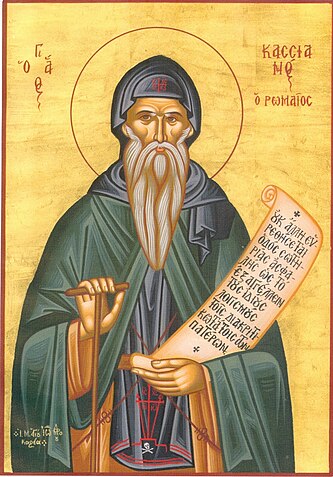
Saint John Cassian (ca. 360 – 435 AD) was a Christian theologian celebrated in both the Western and Eastern Churches for his mystical writings. He is known both as one of the "Scythian monks" and as one of the "Desert Fathers."

Best John Cassian Quotes

Shortest
Earliest

Explore our curated collection of the most famous and impactful John Cassian quotes.

“With the increase of wealth the mania of covetousness increases.”
John Cassian
“How will he see to cast out the mote from his brother's eye, who has the beam of anger in his own eye?”
John Cassian
“Having laid the foundations badly, they [covetous souls] are unworthy to raise an edifice of virtue and reach the summit of perfection.”
John Cassian
“Wrath that is nursed in the heart, although it may not injure men who stand by, yet excludes the splendour of the radiance of the Holy Ghost, equally with wrath that is openly manifested.”
“It is an impossibility for him who, overcome in the matter of a small possession, has once admitted into his heart a root of evil desire, not to be inflamed presently with the heat of a still greater desire.”
John Cassian

John Cassian Quotes by Topic

Find exactly what you are looking for by browsing this categorized list of John Cassian quotes by topic.

John Cassian on Fasting 4 quotes

“Bodily weakness is no hindrance to purity of heart, if only so much food is taken as the bodily weakness requires, and not what pleasure asks for.”
John Cassian
View all 4 quotes on Fasting →

John Cassian on Money 3 quotes

“Covetousness ... chooses to love and care for images stamped on gold instead of God.”
John Cassian
View all 3 quotes on Money →

John Cassian on Sarabaites 2 quotes

“They are anxious to be reckoned by the name of monks without emulating their pursuits.”
John Cassian
View all 2 quotes on Sarabaites →

John Cassian on Anger 2 quotes

“How will he see to cast out the mote from his brother's eye, who has the beam of anger in his own eye?”
John Cassian
View all 2 quotes on Anger →

John Cassian on Covetousness

“It is possible that those who are in no way pressed down with the weight of money may be condemned with the covetous in disposition and intent. For it was the opportunity of possessing which was wanting in their case, and not the will for it.”
John Cassian

John Cassian on Mind

“The mind which does not have a place to turn or any stable base will undergo change from hour to hour and from minute to minute due to the variety of its distractions. ... By the things that come to it from outside it will be continually transformed.”
John Cassian

John Cassian on Distraction

“The mind which does not have a place to turn or any stable base will undergo change from hour to hour and from minute to minute due to the variety of its distractions. ... By the things that come to it from outside it will be continually transformed.”
John Cassian

John Cassian on Psalms

“A monk ... will take in to himself all the thoughts of the Psalms and will begin to sing them in such a way that he will utter them with the deepest emotion of heart not as if they were the compositions of the Psalmist, but rather as if they were his own utterances and his very own prayer.”
John Cassian

John Cassian on Solitude

“Sometimes when we have been overcome by pride or impatience, and we want to improve our rough and bearish manners, we complain that we require solitude, as if we should find the virtue of patience there where nobody provokes us: and we apologize for our carelessness, and say that the reason of our disturbance does not spring from our own impatience, but from the fault of our brethren.”
John Cassian

John Cassian on Attention

“Wherefore a monk's whole attention should thus be fixed on one point, and the rise and circle of all his thoughts be vigorously restricted to it; viz., to the recollection of God, as when a man, who is anxious to raise on high a vault of a round arch, must constantly draw a line round from its exact centre, and in accordance with the sure standard it gives discover by the laws of building all the evenness and roundness required....”
John Cassian

John Cassian on Arch

“Wherefore a monk's whole attention should thus be fixed on one point, and the rise and circle of all his thoughts be vigorously restricted to it; viz., to the recollection of God, as when a man, who is anxious to raise on high a vault of a round arch, must constantly draw a line round from its exact centre, and in accordance with the sure standard it gives discover by the laws of building all the evenness and roundness required....”
John Cassian

John Cassian on Patience

“Sometimes when we have been overcome by pride or impatience, and we want to improve our rough and bearish manners, we complain that we require solitude, as if we should find the virtue of patience there where nobody provokes us: and we apologize for our carelessness, and say that the reason of our disturbance does not spring from our own impatience, but from the fault of our brethren. And while we lay the blame of our fault on others, we shall never be able to reach the goal of patience and perfection. The chief part then of our improvement and peace of mind must not be made to depend on another's will, which cannot possibly be subject to our authority, but it lies rather in our own control. And so the fact that we are not angry ought not to result from another's perfection, but from our own virtue, which is acquired, not by somebody else's patience, but by our own long-suffering.”
John Cassian

John Cassian on Religious text

“When the mind has taken in the meaning of a passage in any Psalm, this insensibly slips away from it, and ignorantly and thoughtlessly it passes on to a text of some other Scripture. And when it has begun to consider this with itself, while it is still not thoroughly explored, the recollection of some other passage springs up, and shuts out the consideration of the former subject. From this too it is transferred to some other, by the entrance of some fresh consideration, and the soul always turns about from Psalm to Psalm and jumps from a passage in the Gospels to read one in the Epistles, and from this passes on to the prophetic writings, and thence is carried to some spiritual history, and so it wanders about vaguely and uncertainly through the whole body of the Scriptures, unable, as it may choose, either to reject or keep hold of anything, or to finish anything by fully considering and examining it, and so becomes only a toucher or taster of spiritual meanings, not an author and possessor of them.”
John Cassian

John Cassian on Exegesis

“Abbot Theodore, a man gifted with the utmost holiness and with perfect knowledge not only in practical life, but also in understanding the Scriptures, which he had not acquired so much by study and reading, or worldly education, as by purity of heart alone, ... when some of the brethren were wondering at the splendid light of his knowledge and were asking of him some meanings of Scripture, said that a monk who wanted to acquire a knowledge of the Scriptures ought not to spend his labour on the works of commentators, but rather to keep all the efforts of his mind and intentions of his heart set on purifying himself from carnal vices: for when these are driven out, at once the eyes of the heart, as if the veil of the passions were removed, will begin as it were naturally to gaze on the mysteries of Scripture: since they were not declared to us by the grace of the Holy Spirit in order that they should remain unknown and obscure; but they are rendered obscure by our fault, as the veil of our sins covers the eyes of the heart, and when these are restored to their natural state of health, the mere reading of Holy Scripture is by itself amply sufficient for beholding the true knowledge, nor do they need the aid of commentators, just as these eyes of flesh need no man's teaching how to see, provided that they are free from dimness or the darkness of blindness. For this reason there have arisen so great differences and mistakes among commentators because most of them, paying no sort of attention towards purifying the mind, rush into the work of interpreting the Scriptures, and in proportion to the density or impurity of their heart form opinions that are at variance with and contrary to each other's and to the faith, and so are unable to take in the light of truth.”
John Cassian

About John Cassian

Saint John Cassian (ca. 360 – 435 AD) was a Christian theologian celebrated in both the Western and Eastern Churches for his mystical writings. He is known both as one of the "Scythian monks" and as one of the "Desert Fathers."