Link Copied!
Johanna Nichols Quotes (1945-)
About Johanna Nichols
Johanna Nichols (born 1945, Iowa City, Iowa) is a linguist and professor emerita in the Department of Slavic Languages and Literatures at the University of California, Berkeley. She earned her PhD in Linguistics at the University of California, Berkeley, in 1973 with a dissertation entitled, "The Balto-Slavic predicate instrumental: a problem in diachronic syntax."
Best Johanna Nichols Quotes
Shortest
Earliest
Explore our curated collection of the most famous and impactful Johanna Nichols quotes.
“A consequence of the reconstruction offered here is that the attested distribution of IE then turns out to be no singularity but just one regular episode in a standing pattern of spreads.”
“The Iranian family, which was next to sweep across the steppe and deserts, finds its region of greatest diversity in the central Asian mountains, and its ancestral Indo-Iranian family finds its own greatest diversity in the mountain region from central Asia to northern India (i.e. Bactria- Sogdiana and parts just south).”

“These principles make it possible to pinpoint the locus in space more or less accurately even for a language family as old as IE. Here it will be shown that the locus accounting for the distribution of loanwords, internal innovations, and genetic diversity within IE could only have lain well to the east of the Caspian Sea.”
“Central Eurasia is a linguistic bottleneck, spread zone, and extinction chamber, but its languages had to come from somewhere. The locus of the IE spread is a theoretical point representing a linguistic epicentre, not a literal place of ethnic or linguistic origin, so the ultimate origin of PIE need not be in the same place as the locus.”
“It is a basic tenet of migration and homeland theory that the geographical location of a language family’s proto-homeland is to be sought in the vicinity of the root of the family tree (i.e. in the region where the deepest branches come together on a map); or, more generally, that the homeland is to be sought in the region of present greatest genetic diversity of the family.”
“The bifurcation of Indo-Iranian is well known to be evident not only in South Asia, where all three of Indic, Nuristani and Iranian sub-branches are found, but also in ancient eastern Anatolia, where either an Indie language or undifferentiated Indo-Aryan or Indo-Iranian is evident in early Mitannian vocabulary (e.g. aika-wartanna ‘one course’, where aika is cognate to Sanskrit eka ‘one’, an Indie word) while Old Persian and Avestan are Iranian...”
“Prior to the Iranian expansion, in the early Bronze Age, IE spread to cover the entire steppe and the Danube plain (and subsequently all of Europe), with substantial speech communities also in Anatolia (Hittite and congeners) and northern Mesopotamia (surviving in Armenian) and, in all probability, coverage of much or all of western central Asia (probably by ancestral Indo-Iranian). What is historically attested of the IE spread fits closely the pattern followed later by Iranian, Turkic, and Mongolian.”
“Prior to the Turkic expansion, at the beginning of the Iron Age, Iranian spread from somewhere in the vicinity of Bactria, Sogdiana, and the eastern steppe to cover most or all of western central Asia and the entire steppe, much of the Near East at least to eastern Anatolia, and, at least intermittently, the Danube plain, where Slavic vocabulary and ethnonyms attest to a major Iranianization at about the fifth century AD, and where there is good archaeological evidence of a Scythian presence in the mid-first millennium BC...”
“No migrations are required to derive the attested IE distribution from a reconstructed homeland consisting of a locus in western central Asia and a range over the steppe and desert. Sometime in the fourth to early third millennium, PIE spread along the steppe and southern trajectories to occupy the entire reconstructed range: the steppe, the desert of wester central Asia, part of the adjacent mountains, and perhaps some of south- west Asia. At this time its distribution was continuous, and that distribution had been achieved not by migration but by expansion.”

“The vast interior of Eurasia is a linguistic spread zone—a genetic and typological bottleneck where many genetic lines go extinct, structural types tend to converge, a single language or language family spreads out over a broad territorial range, and one language family replaces another over a large range every few millennia. The linguistic geography of the central and western grasslands, from at least the Neolithic until early modern times, has consisted of an overall westward trajectory of language spreads... The central Eurasian spread zone... was part of a standing pattern whereby languages were drawn into the spread zone, spread westward, and were eventually succeeded by the next spreading family.”

“The location of the Anatolian branch of IE (Hittite and its sisters) is a problem, or at least a puzzle, for IE homeland studies. The Anatolian languages are attested very early in Asia Minor, removed from Europe and far from the steppe; Gamkrelidze and Ivanov ... offer as a strength the ability of their proposed homelands to account for the location of Hittite with minimal migration. Alternatively or additionally, the location of Tocharian—attested in the early centuries AD well to the east of most IE territory in present-day Xinkiang (Chinese Turkestan)—is a problem or a puzzle... Accounting for the locations of both Hittite and Tocharian is usually presented, at least rhetorically, as a major problem.”

“The archaeological sources on which this summary is based... most often describe the westward cultures as derived from, or extensions from, the eastern ones. Mallory (1989) and Anthony (1991, 1995) interpret the directionality of cultural derivation as west to east. It is the east-to-west directionality of cultural derivation that would be consistent with the east-to-west linguistic trajectory, since spread of a whole culture is likely to involve language spread (and vice versa). A predominantly east-to-west directionality of cultural derivation and descent for the Eneolithic steppe would be a strong indication that the spread zone with its westward trajectories had taken shape. This is a purely archaeological question, but it is important to dating the rise of the linguistic spread zone.”
“There are several linguistically plausible possibilities for the origin of Pre-PIE. It could have spread eastward from the Black Sea steppe (as proposed by Mallory 1989 and by Anthony 1991, 1995), so that the locus formed only after this spread but still very early in the history of disintegrating PIE. This large eastward spread would be a departure from the general westward trajectory of spreads in central Eurasia, occasioned by the epoch-making domestication of the horse and development of wheeled transport. Pre-PIE could have been a central Asian language long before its rapid spread; if so it had a large range before its expansion, and the dispersal began with the development of the locus in a pre-existent range. It could have come into the spread zone from the east as Mongolian, Turkic, and probably Indo-Iranian did.”
“These cases indicate that a sufficiently early split shows up along more than one trajectory, and it follows that any development within the PIE locus should be evident along all three trajectories. This is precisely what happens with the centum-satem division.... In view of its attestation along all three trajectories, the centum-satem split must have arisen in the eastern part of the range, in or near the locus. ... Since in the west the satem languages are the later entrants wherever the chronology is clear, and the frontier languages are centum, the satem side of the isogloss must have been to the east. Since satem languages are most numerous in the south, while centum languages predominate in the north and the centum language Tocharian appears far to the east of the locus as well as somewhat to the north, the satem side of the isogloss must have lain not just to the east but specifically to the southeast.... Since the centum-satem division is visible along all three trajectories, it arose in or near the locus after the spread began and spread outward after the centum languages had begun to spread.”
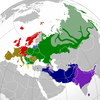
“Three language trajectories are shown.., and these are contemporaneous but not equal in prominence or carrying power. The central one, henceforth the steppe trajectory, shows the east-to-west spread of languages across the Eurasian steppe, and is based on four spreads: that of IE to Europe in the Bronze Age, that of Iranian to (and occasionally into) Central Europe during the Iron Age, that of Turkic in the early centuries of this era, and that of Mongolian beginning in the Middle Ages. To the north of it is the almost equally extensive forest trajectory through the northern forests. This is the route followed by the Uralic language family in its spread from the central Urals (c. the fourth or fifth millennium) as far west as Norway and Estonia (by perhaps the first millennium BC). To the south of the Caspian and Black Seas runs the southern or desert trajectory that brought the Mongols to the southern Caucasus, and before that Turkish to Turkey, and before that Iranian languages to ancient Persia and northern Mesopotamia, and still earlier Armenian, Hittite and its sisters, and other early IE dialects to Asia Minor.”

“Approximately every two millennia, then, there has occurred a spread of a language family from a locus in the eastern part of the central Eurasian spread zone to cover the steppe and central Asia, extending partially or intermittently to the Danube plain, Anatolia, and northern Mesopotamia. The loci of the historically attested spreads are near the edge of the spread zone rather than in the centre of it: the piedmont to the south (Bactria-Sogdiana) for Iranian, the north of Mongolia for Turkic and Mongolian. The trajectories of language spread run east to west along the steppe and through the desert to the Near East as shown .... To take clear and historically well-attested examples, the locus, trajectories, and range of IE must have been much like those of Iranian or Turkic. ... The placement of the locus specifically in the vicinity of Bactria-Sogdiana is justified in .... A homeland reconstructed as locus, trajectory and range removes the dilemma: a locus in the vicinity of Bactria-Sogdiana implies a spread beginning at the frontier of ancient Near Eastern civilization and a range throughout the steppe and central Asia, following the east-to-west trajectory, with occasional or periodic spreads into the Danube plain and Anatolia.”
“Along the forest trajectory as well there is evidence of either an early Indie presence or undifferentiated Proto-Indo-Iranian or Proto-Indo-Aryan. Among the Indo-Iranian loans into early Finno-Ugric are some so phonologically archaic that they could well be Proto-Indo-Iranian... Iranian, but not Indo-Aryan, regularly reflects PIE s as h, so this Finno-Ugric form looks more Indie than Iranian. Abaev also cites some less well attested forms that could be specifically Indie... These borrowings would have taken place somewhere in the vicinity of the southern Ural Mountains. They were received from a steppe language and incorporated into Finno-Ugric as it began its spread along the forest trajectory. This linguistic evidence for an Indie or Proto-Indo-Iranian wave preceding Iranian on the steppe is weak but legitimate. In partial confirmation of it, Kuz’mina identifies the Andronovo culture of eastern Kazakhstan in the mid-second millennium BC as Indo-Aryan..... There is also evidence for Indo-Aryan along the steppe trajectory in the form of a set of Crimean place names which Trubač identifies as Indo-Aryan. This evidence is even weaker—place names in general have poor diagnostic value since they lack denotational meaning—but carefully researched and again legitimate. If Trubačv is right there is evidence for an Indie advance to the western steppe. Taken together, the Finno-Ugric and Crimean evidence are consistent with the assumption of a short-lived Indie or Indo-Aryan presence at the frontier of the Iranian spread on the steppe, in addition to the well-known Indie frontier in northeastern Mesopotamia and India.”

“Several kinds of evidence for the PIE locus have been presented here. Ancient loanwords point to a locus along the desert trajectory, not particularly close to Mesopotamia and probably far out in the eastern hinterlands. The structure of the family tree, the accumulation of genetic diversity at the western periphery of the range, the location of Tocharian and its implications for early dialect geography, the early attestation of Anatolian in Asia Minor, and the geography of the centum-satem split all point in the same direction: a locus in western central Asia. Evidence presented in Volume II supports the same conclusion: the long-standing westward trajectories of languages point to an eastward locus, and the spread of IE along all three trajectories points to a locus well to the east of the Caspian Sea. The satem shift also spread from a locus to the south-east of the Caspian, with satem languages showing up as later entrants along all three trajectory terminals. (The satem shift is a post-PIE but very early IE development.) The locus of the IE spread was therefore somewhere in the vicinity of ancient Bactria-Sogdiana. This locus resembles those of the three known post-IE spreads: those of Indo-Iranian (from a locus close to that of PIE), Turkic (from a locus near north-western Mongolia), and Mongolian (from north-eastern Mongolia)... Thus in regard to its locus, as in other respects, the PIE spread was no singularity but was absolutely ordinary for its geography and its time-frame. ... The reason that dialect divisions arising in the locus show up along more than one trajectory is that the Caspian Sea divides westward spreads into steppe versus desert trajectories quite close to the locus and hence quite early in the spread. In contrast, developments that occurred farther west, as the split of Slavic from Baltic in the middle Volga may have, continue to spread along only one trajectory. This is why the Pontic steppe is an unlikely locus for the PIE spread. ...Thus the structure of the IE family tree, the distribution of IE genetic diversity over the map, and what can be inferred of the geographical distribution of dialectal diversity in early IE all point to a locus in western central Asia”
Johanna Nichols Quotes by Topic
Find exactly what you are looking for by browsing this categorized list of Johanna Nichols quotes by topic.
Johanna Nichols on Indo-Iranian languages 2 quotes
“The Iranian family, which was next to sweep across the steppe and deserts, finds its region of greatest diversity in the central Asian mountains, and its ancestral Indo-Iranian family finds its own greatest diversity in the mountain region from central Asia to northern India (i.e. Bactria- Sogdiana and parts just south).”

Johanna Nichols on Bactria–Margiana Archaeological Complex 2 quotes
“Approximately every two millennia, then, there has occurred a spread of a language family from a locus in the eastern part of the central Eurasian spread zone to cover the steppe and central Asia, extending partially or intermittently to the Danube plain, Anatolia, and northern Mesopotamia. The loci of the historically attested spreads are near the edge of the spread zone rather than in the centre of it: the piedmont to the south (Bactria-Sogdiana) for Iranian, the north of Mongolia for Turkic and Mongolian. The trajectories of language spread run east to west along the steppe and through the desert to the Near East as shown .... To take clear and historically well-attested examples, the locus, trajectories, and range of IE must have been much like those of Iranian or Turkic. ... The placement of the locus specifically in the vicinity of Bactria-Sogdiana is justified in .... A homeland reconstructed as locus, trajectory and range removes the dilemma: a locus in the vicinity of Bactria-Sogdiana implies a spread beginning at the frontier of ancient Near Eastern civilization and a range throughout the steppe and central Asia, following the east-to-west trajectory, with occasional or periodic spreads into the Danube plain and Anatolia.”

Johanna Nichols on Proto-Indo-European homeland
“It is a basic tenet of migration and homeland theory that the geographical location of a language family’s proto-homeland is to be sought in the vicinity of the root of the family tree (i.e. in the region where the deepest branches come together on a map); or, more generally, that the homeland is to be sought in the region of present greatest genetic diversity of the family.”

Johanna Nichols on Indo-European languages
“The vast interior of Eurasia is a linguistic spread zone—a genetic and typological bottleneck where many genetic lines go extinct, structural types tend to converge, a single language or language family spreads out over a broad territorial range, and one language family replaces another over a large range every few millennia. The linguistic geography of the central and western grasslands, from at least the Neolithic until early modern times, has consisted of an overall westward trajectory of language spreads... The central Eurasian spread zone... was part of a standing pattern whereby languages were drawn into the spread zone, spread westward, and were eventually succeeded by the next spreading family.”
Johanna Nichols on Hittite language
“The location of the Anatolian branch of IE (Hittite and its sisters) is a problem, or at least a puzzle, for IE homeland studies. The Anatolian languages are attested very early in Asia Minor, removed from Europe and far from the steppe; Gamkrelidze and Ivanov ... offer as a strength the ability of their proposed homelands to account for the location of Hittite with minimal migration. Alternatively or additionally, the location of Tocharian—attested in the early centuries AD well to the east of most IE territory in present-day Xinkiang (Chinese Turkestan)—is a problem or a puzzle... Accounting for the locations of both Hittite and Tocharian is usually presented, at least rhetorically, as a major problem.”

What Johanna Nichols Said About Others
Discover personal opinions Johanna Nichols shared regarding contemporaries.
Johanna Nichols on Tocharians
“The location of the Anatolian branch of IE (Hittite and its sisters) is a problem, or at least a puzzle, for IE homeland studies. The Anatolian languages are attested very early in Asia Minor, removed from Europe and far from the steppe; Gamkrelidze and Ivanov ... offer as a strength the ability of their proposed homelands to account for the location of Hittite with minimal migration. Alternatively or additionally, the location of Tocharian—attested in the early centuries AD well to the east of most IE territory in present-day Xinkiang (Chinese Turkestan)—is a problem or a puzzle... Accounting for the locations of both Hittite and Tocharian is usually presented, at least rhetorically, as a major problem.”

Quotes About Johanna Nichols
Gain deeper perspective through quotes about Johanna Nichols from others.
Bryant on Johanna Nichols 2 quotes
“In Nichols's Bactrian homeland, Proto-Indo-European expands out of its locus, eventually forming two basic trajectories, appearing, on a language map, like two amoebic protuberances bulging out from a protoplasmic origin. The language range initially radiates westward, engulfing the whole area around the Aral Sea from the northern steppe to the Iranian plateau. Upon reaching the Caspian, one trajectory expands around the sea to the north and over the steppes of central Asia to the Black Sea, while the other flows around the southern perimeter and into Anatolia.27 Here we have a model of a continuous distribution of Proto-Indo-European—which has been defined as being, in reality, a dialectal continuum—covering a massive range from where the later historic languages can emerge, without postulating any migrations whatsoever. By the third or second millennium B.C.E. we have the protoforms of Italic, Celtic, and perhaps Germanic in the environs of central Europe (and presumably Balto-Slavic as well), and the protoforms of Greek, Illyrian, Anatolian, and Armenian stretching from northwest Mesopotamia to the southern Balkans (Nichols 1997,134). Proto-Indo-Aryan was spread- ing into the subcontinent proper, while proto-Tocharian remained close to the original homeland in the Northeast.”
B.B. Lal on Johanna Nichols
“She holds that the dispersal of the Indo-European languages commenced from a region somewhere in the vicinity of ancient Bactria-Sogdiana, thus bringing the scenario closer to the Indian subcontinent, but not quite there.”
Asya Pereltsvaig - Languages of the World_ An Introduction-Cambridge University Press on Johanna Nichols
“And academics have come up with theories of their own. For example, Johanna Nichols, a professor of linguistics at the University of California at Berkeley, put forward the so-called Sogdiana hypothesis, which places the Proto-Indo-European speakers to the east of the Caspian Sea, in the area of ancient Bactria-Sogdiana in the fourth or fifth millennium BCE (Nichols 1997, 1999).”
Ever closer on Johanna Nichols
“The OIT party can be harsh on its opponents too, but in a different sense: they highlight alleged polemical malpractice. At the ICHR 2018 conference, Danino’s paper was titled: “Fabricating Evidence in Support of the AIT”. Sh. Talageri regularly lambasts “the joke that is Western Indology”, not sparing even the biggest names in detailed critiques. Thus, he makes fun of the “radical damage control measures” and “weird about-turns” by the AIT party, such as the “Stalin-era-like” retraction by Johanna Nichols of her plea for an Asian origin of linguistic features in West-Asian languages, attributed to “peer pressure”. She had, in her own words, first contributed “a beautiful theory that accounts elegantly for a great deal of the dynamic and linguistic geography of the IE spread” which “still stands”; but now she disowns the logical conclusion of her own still-standing research, allegedly because it adds evidence for an eastern homeland.”
Why Indo-Europeanists Have A Duty To Face The Out-Of-India Theory on Johanna Nichols
“This shameless advocacy of cancel culture, moreover for a theory that was long the most accepted one, is an attitude that has gained ground among professional Indo-Europeanists, as I have had to find out many times personally. A consequence is for instance that Joanna Nichols and Claus Peter Zoller have, after Shrikant Talageri pointed out the pro-OIT implications of their findings (that the pattern of lexical borrowing in West-Asian languages from Indo-European indicated that this family came from the east, Bactria or so; c.q. that the Bangani dialect in North India shows a substrate of a kentum Indo-European language similar to the family’s westernmost branches), declared that their findings remain valid but not these pro-OIT implications. In India, this is being laughed at as an Inquisition-like or Stalinist-like recanting.”
About Johanna Nichols
Johanna Nichols (born 1945, Iowa City, Iowa) is a linguist and professor emerita in the Department of Slavic Languages and Literatures at the University of California, Berkeley. She earned her PhD in Linguistics at the University of California, Berkeley, in 1973 with a dissertation entitled, "The Balto-Slavic predicate instrumental: a problem in diachronic syntax."