Link Copied!
Joan Robinson Quotes (1903-1983)
King

About Joan Robinson
Joan Robinson FBA (30 October 1903 – 5 August 1983) was a British post-Keynesian economist who made many contributions to economic theory.
Best Joan Robinson Quotes
Shortest
Earliest
Explore our curated collection of the most famous and impactful Joan Robinson quotes.

“Whatever you can rightly say about India, the opposite is also true.”
“If a rise in wages does not raise prices, a fall will not reduce them.”
“It is impossible to add the stock of money to the flow of saving.”
“Time, so to say, runs at right angles to the page at each point on the curve.”
“The nature of technology depends very much upon what the public can be induced to put up with.”


“If there is any law governing the distribution of income between classes, it still remains to be discovered.”
“But, as soon as speculators become an important influence in the market, their business is to speculate on each others behaviour.”

“It is the business of economists, not to tell us what to do, but show why what we are doing anyway is in accord with proper principles.”



“" the merchant had observed that the marginal utility of daughters decreases with surprising rapidity."”
“Rosa Luxemburg maintained that the capitalist system can keep up its rate of investment (and therefore its profits) only so long as it is expanding geographically.”
“Income from property is not the reward of waiting, it is the reward of employing a good stockbroker.”

Joan Robinson Quotes by Topic
Find exactly what you are looking for by browsing this categorized list of Joan Robinson quotes by topic.
Joan Robinson on Investment
“It is the rate of investment which governs the rate of saving, and not vice versa.”
Joan Robinson on Economics
Joan Robinson on Prices and Production
“I very well remember Hayek's visit to Cambridge on his way to the London School. He expounded his theory and covered a black-board with his triangles. The whole argument, as we could see later, consisted in confusing the current rate of investment with the total stock of capital goods, but we could not make it out at the time.”
Joan Robinson on The General Theory of Employment, Interest and Money
“What made the General Theory so hard to accept was not its intellectual content, which in a calm mood can easily be mastered, but its shocking implications. Worse than private vices being public benefits, it seemed that the new doctrine was the still more disconcerting proposition that private virtues (of thriftiness and careful husbandry) were public vices.”
What Joan Robinson Said About Others
Discover personal opinions Joan Robinson shared regarding contemporaries.
Joan Robinson on David Ricardo 2 quotes
“Ricardo himself was too conscientious. He hated having to fiddle the assumptions. Right up to his dying day he was looking for the assumption, that would not need to be fiddled.”

Joan Robinson on John Maynard Keynes 2 quotes
“The consequences of Mr. Keynes's attack upon orthodoxy are very far reaching. First, it cuts the ground from under the pretended justification of inequality, and allows us to see the monstrous absurdity of our social system with a fresh eye.”
Joan Robinson on Economist
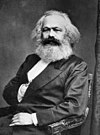
Joan Robinson on Karl Marx
“I began to read Capital, just as one reads any book, to see what was in it; I found a great deal that neither its followers nor its opponents had prepared me to expect.”
Joan Robinson on Friedrich Hayek
“I very well remember Hayek's visit to Cambridge on his way to the London School. He expounded his theory and covered a black-board with his triangles. The whole argument, as we could see later, consisted in confusing the current rate of investment with the total stock of capital goods, but we could not make it out at the time.”

Joan Robinson on Alfred Marshall
“Marshall did something much more effective than changing the answer. He changed the question. For Ricardo the Theory of Value was a means of studying the distribution of total output between wages, rent and profit, each considered as a whole. This is a big question. Marshall turned the meaning of Value into a little question: Why does an egg cost more than a cup of tea? It may be a small question but it is a very difficult and complicated one. It takes a lot of time and algebra to work out the theory of it. So it kept all Marshall’s pupils preoccupied for fifty years. They had no time to think about the big question, or even to remember that there was a big question, because they had to keep their noses right down to the grindstone, working out the theory of the price of a cup of tea.”

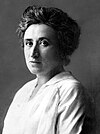
Joan Robinson on Rosa Luxemburg
“Rosa Luxemburg, as we have seen, neglects the rise in real wages which takes place as capitalism develops, and denies the internal inducement to invest provided by technical progress, two factors which help to rescue capitalism from the difficulties which it creates for itself. She is left with only one influence (economic imperialism) to account for continuous capital accumulation, so that her analysis is incomplete. All the same, few would deny that the extension of capitalism into new territories was the mainspring of what an academic economist has called the 'vast secular boom' of the last two hundred years, and many academic economists account for the uneasy condition of capitalism in the twentieth century largely by the 'closing of the frontier' all over the world. But the academic economists are being wise after the event. For all its confusions and exaggerations, this book shows more prescience than any orthodox contemporary could claim.”
Quotes About Joan Robinson
Gain deeper perspective through quotes about Joan Robinson from others.
Amit Bhaduri on Joan Robinson
“I must mention my special intellectual debt to Joan Robinson, with whom I had the opportunity to discuss over a period of nearly twenty years some of the problems analysed here. She, more than anybody else, convinced me of the radical content of Keynesian economics which we could decipher more easily with the help of Marx and Kalecki.”
Geoffrey Harcourt on Joan Robinson
“I claim that this dinner, too much to eat and drink, was the basic reason why, for the only time in my life, I slept with Joan Robinson. Let me tell you the story. Ken Arrow was to read his famous paper - we know now that it was famous - on uncertainty and the economics of medical care, and I was one of the guests asked to come to the Arts Theatre Restaurant. It was a cold winter's night, we ate and drank a lot, and then we went into this room with a great big fire and a huge couch. Joan sat here, and I sat there, and Ken was sitting as close to me as you are now, and both Joan and I went to sleep while he read his paper.”
Paul Samuelson on Joan Robinson 2 quotes
“Böhm and Wicksell and Cassel and Wieser and Clark and Walras and Hayek and other economists before and after Sraffa, all must face what the role of intertemporal pricing must be in organizing technologies that are irreducibly time-phasing. When Joan Robinson and I discussed these matters face to face, I used to get nowhere with her by babbling about supply and demand. She already had seen through that tommy-rot. Things went better if I could keep the focus on Mao’s China. "Could Mao’s 1970 China now, sans trade, produce a U.S. per capita standard of living for her near-billion population?" "Of course not. She can’t convert her few steam trains into diesels and electricfed railways. Her workers can use only few and primitive tools. Their medical care is fragmentary, their years of education limited by China’s previous despotism." "Joan, by what steps can a People’s Society move into the golden-rule plenty available to a 1970 America, or Britain or Spain?" "First they should build the higher-yield bridges, roads, and machines. Then, later, deferred and delayed projects can be ranked in their turns." Trite stuff, you will say? That is my point. Learned Aristotle couldn’t handle such trite stuff. And neither could the physicist-statistician P. C. Mahalanobis who had Premier Nehru’s ear in the decades just following India’s liberation from the British Empire.”

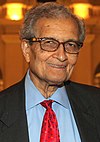
Amartya Sen on Joan Robinson
“I remember also when I was a student in Cambridge, one of my teachers, Joan Robinson, a great economist, explained to me why China is so admirable, as she was making a cultural comparison of the kind which has become very common now ever since Sam Huntington wrote his book about civilisation and trying to reduce every civilisation into something like a one or two sentence summary. Joan told me that the real trouble with Indians, she told me, is that Indians are just too rude; and she said the Japanese, the trouble really is that the Japanese are too polite; and then she said the Chinese are just right. So I think those are good inspiration to go and study the Chinese experience. Now, in so far as private income is only one of the influences on the achievements in reducing poverty, the first thing I want to mention is that even though in the poverty discussion most of the concentration tends to be these days on what happened since economic reform. The fact is that there is a very major lesson in what happened in China previous to that. I am not commenting on the excesses of the Cultural Revolution, I am not talking about the Chinese famine (from) ’59 to ’61 in which 29.6 million people died. There were all kinds of mistakes. But the fact is that China was still the global leader as a poor country expanding basic education at a level which was very hard to imagine, as well as basic health care. All kinds of things came like “barefoot doctors” and so on. But the spread of health care across the country was quite remarkable. By 1979, when the economic reform came, the Chinese life expectancy was already 68 years; the Indian life expectancy was 54 years, 14 years behind it. There are really major lessons there, and I might say also one of the unsung contributions of the pre-reform educational and health care expansion is, I believe, the radical economic expansion that took place in the 1980s. After the economic reform, it would have been very hard without the base of elementary education which China had and India did not at that time, which is still a factor which bothers India badly.”
George J. Stigler on Joan Robinson
“Instead, I would concede her a point of uncertain importance. There isn't really a great deal to economics, considered as a logical structure based upon a few indisputable axioms about the world. … A logician is a wondrous creature, but he cannot distinguish between the two simple errors: if A = B, and B = C, then (1) A = 1.01C, and (2) A = 10⁶⁵C. An economist can.”
David Warsh on Joan Robinson
“That combination, Hayek, Myrdal and Robinson, might have cast the contributions of each into sharper relief: three pioneers who, after important early contributions, gave up economics for political activism.”
About Joan Robinson
Joan Robinson FBA (30 October 1903 – 5 August 1983) was a British post-Keynesian economist who made many contributions to economic theory.