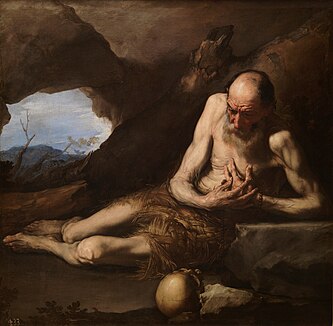
When [Antony] entered the cave he saw the lifeless corpse in a kneeling position, its head erect and its hands stretched out toward heaven. At first he thought that Paul was still alive and so he knelt down beside him to pray, but when he heard no sighs from the praying man, as he usually did, he fell upon him in a tearful embrace, realizing that even as a corpse the holy man, by means of his reverent posture, was praying to God for whom all things live.
What It Means
This is a placeholder explanation generated by the low-overhead model. It interprets "When [Antony] entered the cave he saw the lifeless corpse in a kneeling position, its head erect and its hands stretched out toward heaven. At first he thought that Paul was still alive and so he knelt down beside him to pray, but when he heard no sighs from the praying man, as he usually did, he fell upon him in a tearful embrace, realizing that even as a corpse the holy man, by means of his reverent posture, was praying to God for whom all things live." in the context of "Jerome, Vita S. Pauli 14–15. Translation from Harmless, William (2004), Desert Christians: An Introduction to the Literature of Early Monasticism place: Oxford, publisher: Oxford University Press, ISBN: 978-0-19-516222-6" to mean that wisdom is timeless.
Tags
About Jerome