Every day we are changing, every day we are dying, and yet we fancy ourselves eternal.
• Letter 60; Translated by W.H. Fremantle, G. Lewis and W.G. Martley. From Nicene and Post-Nicene Fathers, Second Series, Vol. 6. Edited by Philip Schaff and Henry Wace. (Buffalo, NY: Christian Literature Publishing Co., 1893.) Revised and edited for New Advent by Kevin Knight. http://www.newadvent.org/fathers/3001.htm
• Letter 60; Translated by W.H. Fremantle, G. Lewis and W.G. Martley. From Nicene and Post-Nicene Fathers, Second Series, Vol. 6. Edited by Philip Schaff and Henry Wace. (Buffalo, NY: Christian Literature Publishing Co., 1893.) Revised and edited for New Advent by Kevin Knight. http://www.newadvent.org/fathers/3001.htm
“
Quotidie morimur, quotidie commutamur, et tamen aternos nos esse credimus.
— Jerome
What It Means
This is a placeholder explanation generated by the low-overhead model. It interprets "Quotidie morimur, quotidie commutamur, et tamen aternos nos esse credimus." in the context of "Every day we are changing, every day we are dying, and yet we fancy ourselves eternal.
• Letter 60; Translated by W.H. Fremantle, G. Lewis and W.G. Martley. From Nicene and Post-Nicene Fathers, Second Series, Vol. 6. Edited by Philip Schaff and Henry Wace. (Buffalo, NY: Christian Literature Publishing Co., 1893.) Revised and edited for New Advent by Kevin Knight. http://www.newadvent.org/fathers/3001.htm" to mean that wisdom is timeless.
Source: Wikiquote: "Jerome" (Quotes, Letters)
The 'What it means' explanation text was generated by Google Gemini Flash (accessed January 18, 2026). https://gemini.google.com/app
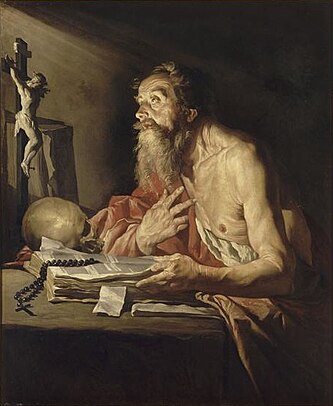
About Jerome
Saint Jerome (c. 347 – 30 September 420), full name Eusebius Sophronius Hieronymus, is best known as the translator of the Bible from Greek and Hebrew into Latin. Jerome's edition, the Vulgate, is still the official biblical text of the Roman Catholic Church. He is canonized in all Christianity and recognized by the Vatican as a Doctor of the Church.
View all quotes →