Link Copied!
Jacques Derrida Quotes (1930-2004)
Philosopher
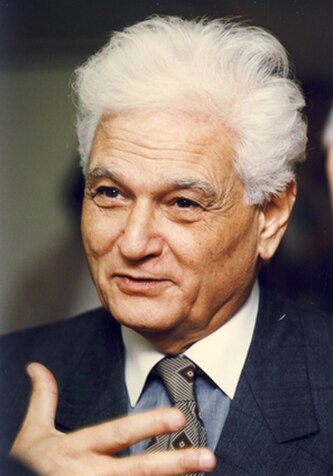
About Jacques Derrida
Jacques Derrida (15 July 1930 – 8 October 2004) was a French Algerian philosopher who introduced the practice of "deconstruction".
Best Jacques Derrida Quotes
Shortest
Earliest
Explore our curated collection of the most famous and impactful Jacques Derrida quotes.
“Il n'y a pas de hors-texte.”
“No differeance without alterity, no alterity without singularity, no singularity without here-now.”
“Monsters cannot be announced. One cannot say: 'here are our monsters', without immediately turning the monsters into pets.”

“The disciple must break the glass, or better the mirror, the reflection, his infinite speculation on the master. And start to speak.”

“Amy Kofman: Have you read all the books in here?
Derrida: No, only four of them. But I read those very, very carefully.”
Derrida: No, only four of them. But I read those very, very carefully.”
“Deconstruction never had meaning or interest, at least in my eyes, than as a radicalization, that is to say, also within the tradition of a certain Marxism, in a certain spirit of Marxism.”


“What is called "objectivity," scientific for instance (in which I firmly believe, in a given situation) imposes itself only within a context which is extremely vast, old, firmly established, or rooted in a network of conventions … and yet which still remains a context.”

“To live, by definition, is not something one learns. Not from oneself, it is not learned from life, taught by life. Only from the other and by death. In any case from the other at the edge of life. At the internal border or the external border, it is a heterodidactics between life and death.”

“How can one be late to the end of history? A question for today. It is serious because it obliges one to reflect again, as we have been doing since Hegel, on what happens and deserves the name of event, after history; it obliges one to wonder if the end of history is but the end of a certain concept of history.”

“The history of metaphysics, like the history of the West, is the history of these metaphors and metonymies. It’s matrix—If you will pardon me for demonstrating so little and for being elliptical in order to come more quickly to my principle theme—is the determination of Being as presence in all sense of this word.”
“A text is not a text unless it hides from the first comer, from the first glance, the law of its composition and the rules of its game. A text remains, moreover, forever imperceptible. Its law and its rules are not, however, harbored in the inaccessibility of a secret; it is simply that they can never be booked, in the present, into anything that could rigorously be called a perception.”

“As soon as we cease to believe in such an engineer and in a discourse which breaks with the received historical discourse, and as soon as we admit that every finite discourse is bound by a certain bricolage and that the engineer and the scientist are also species of bricoleurs, then the very idea of bricolage is menaced and the difference in which it took on its meaning breaks down.”
“Oh. Marx's love for Shakespeare! It is well known. Chris Hani shared the same passion. I have just learned this and I like the idea. Even though Marx more often quotes Timon of Athens, the Manifesto seems to evoke or convoke, right from the start, the first coming of the silent ghost, the apparition of the spirit that does not answer, on those ramparts of Elsinore which is then the old Europe.”
“Confined within this catch-all concept, within this vast encampment of the animal, in this general singular, within the strict enclosure of this definite article (“the Animal” and not “animals”), as in a virgin forest, a zoo, a hunting or fishing ground, a paddock or an abattoir, a space of domestication, are all the living things that man does not recognize as his fellows, his neighbors, or his brothers.”
“No text in the tradition seems as lucid concerning the way in which the political is becoming worldwide. concerning the irreducibility of the technical and the media in the current of the most thinking thought-and this goes beyond the railroad and the newspapers of the time whose powers were analyzed in such an incomparable way in the Manifesto. And few texts have shed so much light on law. international law. and nationalism.”
“1) Différance is the systematic play of differences, of the traces of differences, of the spacing by means of which elements are related to each other. This spacing is the simultaneously active and passive (the a of différance indicates this indecision as concerns activity and passivity, that which cannot be governed by or distributed between the terms of this opposition) production of the intervals without which the "full" terms would not signify, would not function.”
“When I say that this phase is necessary, the word phase is perhaps not the most rigorous one. It is not a question of a chronological phase, a given moment, or a page that one day simply will be turned, in order to go on to other things. The necessity of this phase is structural; it is the necessity of an interminable analysis: the hierarchy of dual oppositions always reestablishes itself. Unlike those authors whose death does not await their demise, the time for overturning is never a dead letter.”
“This book, admirable in so many respects, power in its break and style, is even more intimidating for me in that, having formely had the good fortune to study under Michel Foucault, I retain the consciousness of an admiring and grateful disciple. Now, the disciple's consciousness, when he starts, I would not say to dispute, but to engage in dialogue with the master or, better, to articulate the interminable and silent dialogue which made him into a disciple-this disciple's consciousness is an unhappy consciousness.”

Jacques Derrida Quotes by Topic
Find exactly what you are looking for by browsing this categorized list of Jacques Derrida quotes by topic.
Jacques Derrida on Animals 3 quotes
“Confined within this catch-all concept, within this vast encampment of the animal, in this general singular, within the strict enclosure of this definite article (“the Animal” and not “animals”), as in a virgin forest, a zoo, a hunting or fishing ground, a paddock or an abattoir, a space of domestication, are all the living things that man does not recognize as his fellows, his neighbors, or his brothers.”

Jacques Derrida on Aphorisms
“An aphorism is a name but every name can take on the figure of aphorism.”

Jacques Derrida on Teleology
“Saussure... winds up contradicting the most interesting critical motive of the Course, making of linguistics the regulatory model, the "pattern" for a general semiology of which it was to be, by all rights and theoretically, only a part. The theme of the arbitrary, thus, is turned away from its most fruitful paths (formalization) toward a hierarchizing teleology... One finds exactly the same gesture and the same concepts in Hegel.”
Jacques Derrida on Atheism
“At the end of Being and Nothingness, ... Being in-itself and Being for-itself were of Being; and this totality of beings, in which they were effected, itself was linked up to itself, relating and appearing to itself, by means of the essential project of human-reality. What was named in this way, in an allegedly neutral and undetermined way, was nothing other than the metaphysical unity of man and God, the relation of man to God, the project of becoming God as the project constituting human-reality. Atheism changes nothing in this fundamental structure.”

What Jacques Derrida Said About Others
Discover personal opinions Jacques Derrida shared regarding contemporaries.
Jacques Derrida on Tony Judt
“To my knowledge, but I don't know everything and it is not too late, Professor Judt has not yet acknowledged publicly that he did not tell the truth. You will have noticed that, in speaking of the contre-vérité of his article, I never said that Professor Judt had lied. Everything that is false cannot be imputed to a lie. The lie is not an error. Already Plato and Augustine insisted on this in unison. If the concept of lie has some resistant specificity, it must be rigorously distinguished from error, from ignorance, from prejudice, from faulty reasoning, and even from failure in the realm of knowledge or still again-and this is where things will soon have to get more complicated for us-from failure in the realm of action, practice, or technique. If the lie is neither the failure of knowledge and knowhow, nor error, if it implies ill will or bad faith in the order of moral reason, not of practice but of pure practical reason, if it addresses belief rather than knowledge, then the project of a history of the lie should not resemble in the least what could be called, following Nietzsche in The Twilight of the Idols, the history of an error [Geschichte eines Irrtums].”

Jacques Derrida on Baruch Spinoza
“...The most terrifying affirmations, like that of Clement of Alexandria who declares that "Matter is eternal," are drawn from a treasury of the philosophical propositions that most tantalized Flaubert, above all those of Spinoza, for whom his admiration was unlimited, the Spinoza of the Ethics and particularly of the Tractatus Theologico-Politicus. If we had the time, we could uncover a panoply of Spinozisms in the devil's discourse at the end of The Temptation of Saint Anthony. This discourse is not purely Spinozist: it is not homogeneous in this respect, but it has recourse to recognizable schemata from the Ethics. The devil, to be sure, is no atheist; no one is less atheist than the devil. But he does not deny God's extension and therefore his substance any more than Spinoza does; [...] The devil is no more an atheist than Spinoza, and Flaubert says that all those who "accuse" Spinoza of atheism are "asses". But he plays this Spinoza off against religion and its forms of imagination, against the illusions of figures in the politics of religion; and in this regard, the Tractatus Theologico-politicus is even more important than the Ethics. Flaubert discovered the Tractatus in 1870, while he was working on the Temptation. The book, he says, "dazzles" and "astounds" him; he is "transported with admiration." In a moment, I will venture a hypothesis on the privileged place of Spinoza in Flaubert's library or philosophical dictionary, as well as in his company of philosophers, for his first impulse is always one of admiration for Spinoza the man ("My God, what a man! what an intellect! what learning and what a mind!" "What a genius!"). [...] With this gesture, Flaubert also shows himself to be Nietzsche's brother.”

Quotes About Jacques Derrida
Gain deeper perspective through quotes about Jacques Derrida from others.
Simon Blackburn on Jacques Derrida

John D. Caputo on Jacques Derrida
“Contrary to the claims of Derrida’s more careless critics, the passion of deconstruction is deeply political, for deconstruction is a relentless, if sometimes indirect, discourse on democracy, on a democracy to come. Derrida’s democracy is a radically pluralistic polity that resists the terror of an organic, ethnic, spiritual unity, of the natural, native bonds of the nation (natus, natio), which grind to dust everything that is not a kin of the ruling kind and genus (Geschlecht). He dreams of a nation without nationalist or nativist closure, of a community without identity, of a non-identical community that cannot say I or we, for, after all, the very idea of a community is to fortify (munis, muneris) ourselves in common against the other. His work is driven by a sense of the consummate danger of an identitarian community, of the spirit of the “we” of “Christian Europe,” or of a “Christian politics,” lethal compounds that spell death of Arabs and Jews, for Africans and Asians, for anything other. The heaving and sighing of this Christian European spirit is a lethal air for Jews and Arabs, for all les juifs [Jews as archetypal outcasts], even if they go back to father Abraham, a way of gassing them according to both the letter and the spirit.”
Sanford L. Drob on Jacques Derrida
“In one of his last meetings with Jacques Derrida, the French-Jewish philosopher, Emmanuel Levinas 1906-1995),[sic] is said to have asked Derrida to confess that he was in fact a modern day representative of the Lurianic Kabbalah.”
Mark Goldblatt on Jacques Derrida
“Derrida’s special significance lies not in the fact that he was subversive, but in the fact that he was an outright intellectual fraud -- and that he managed to dupe a startling number of highly educated people into believing that he was onto something. […] whatever Derrida is affirming he is also simultaneously denying. From a logical perspective, the only way to read Derrida on his own terms is mentally to insert the phrase “or not” after every one of his statements.”
Norman N. Holland on Jacques Derrida
“Derrida has been assuming all along that the linguistic processes described by Saussure, signification and the differencing of signs, act like forces. If so, then there is no reason for them to stop, and each sign evoked by difference will introduce a new set of differences. But there is no justification for making Saussure's signifiers and differences into forces, and indeed, there is no longer any justification for Saussure's signifiers and differences. Justification or no, language for Derrida lacks the stability that Saussure found. Saussure's neat pairings of signifier and signified came from a finite system of distinctive features. By contrast, Derrida's signifier and signified go on and on in endless differencing or differing or deferring (all terms involved in Derrida's own word, différance). And since our minds only work in signs, and nothing is ever fully present in signs, everything becomes flickering and unstable, both present and absent, present and future. It follows therefore that human beings are not the master of language, since the forces of language cannot be mastered. I try to mean, but my meaning is dispersed, divided, at odds with itself. Indeed, I myself am one of my meanings, as much a fiction, as little a stable entity as they. In Terry Eagleton's phrasing, "Because language is the very air I breathe, I can never have a pure, unblemished meaning or experience at all." Wow! With one masterful stroke, Derrida seems to have gotten rid of meaning, structures, categories, and mankind itself. Yet the whole argument rests on the idea of signification. As Eagleton sums the position up, "If the theory of signification . . . is at all valid, then there is something in writing itself which finally evades all systems and logics." But that's the trouble. It is not valid. Saussure's is finally a flat earth theory. If we consider only how the hearing and the understanding of a word feel to us, if we only introspect, his account has a certain commonsensical appeal. It seems right, just as the horizon seems to define a flat earth. A better linguistics, though, and a great deal of psychological evidence show that Saussure's theory leaves out a world of complexities. The text-active model leaves out all of human activity in interpreting language or the world. So does Derrida.”
Mark Lilla on Jacques Derrida
“Anyone who has heard [Derrida] lecture in French knows that he is more performance artist than logician. His flamboyant style--using free association, rhymes and near-rhymes, puns, and maddening digressions--is not just a vain pose (though it is surely that). It reflects what he calls a self-conscious "acommunicative strategy" for combating logocentrism.”
About Jacques Derrida
Jacques Derrida (15 July 1930 – 8 October 2004) was a French Algerian philosopher who introduced the practice of "deconstruction".