Link Copied!
Jürgen Habermas Quotes (1929-)
Philosopher

About Jürgen Habermas
Jürgen Habermas (born June 18, 1929) is a German philosopher and sociologist in the tradition of critical theory and American pragmatism. He is best known for his work on the concept of the public sphere, which he has based in his theory of communicative action.
Best Jürgen Habermas Quotes
Shortest
Earliest
Explore our curated collection of the most famous and impactful Jürgen Habermas quotes.
“The task of universal pragmatics is to identify and reconstruct universal conditions of possible mutual understanding.”

“The speaker must choose a comprehensible [verständlich] expression so that speaker and hearer can understand one another.”
“Reaching and understanding is the process of bringing about an agreement on the presupposed basis of validity claims that are mutually recognized.”
“I shall develop the thesis that anyone acting communicatively must, in performing any speech act, raise universal validity claims and suppose that they can be vindicated.”
“I would in fact tend to have more confidence in the outcome of a democratic decision if there was a minority that voted against it, than if it was unanimous… Social psychology has amply shown the strength of this bandwagon effect.”

“[Critical social science attempts] to determine when theoretical statements grasp invariant regularities of social action as such and when they express ideologically frozen relations of dependence that can in principle be transformed.”
“Philosophy's position with regard to science, which at one time could be designated with the name "theory of knowledge," has been undermined by the movement of philosophical thought itself. Philosophy was dislodged from this position by philosophy.”

“The interpretation of a case is corroborated only by the successful continuation of a self-formative process, that is by the completion of self-reflection, and not in any unmistakable way by what the patient says or how he behaves”
“All affected can accept the consequences and the side effects that [the norm's] general observance can be anticipated to have for the satisfaction of everyone's interests, and the consequences are preferred to those of known alternative possibilities for regulation.”
“Science can only be comprehended epistemologically, which means as one category of possible knowledge, as long as knowledge is not equated either effusively with the absolute knowledge of a great philosophy or blindly with scientistic self-understanding of the actual business of research.”

“Although objectively greater demands are placed on this authority, it operates less as a public opinion giving a rational foundation to the exercise of political and social authority, the more it is generated for the purpose of an abstract vote that amounts to no more than an act of acclamation within a public sphere temporarily manufactured for show or manipulation.”

“The bourgeois public sphere may be conceived above all as the sphere of private people come together as a public; they soon claimed the public sphere regulated from above against the public authorities themselves, to engage them in a debate over the general rules governing relations in the basically privatized but publicly relevant sphere of commodity exchange and social labor.”
“Technically speaking, since our complex societies are highly susceptible to interferences and accidents,they certainly offer ideal opportunities for a prompt disruption of normal activities. These disruptions can, with minimum expense, have considerably destructive consequences. Global terrorism is extreme both in its lack of realistic goals and in its cynical exploitation of the vulnerability of complex systems.”
“Subjects who reciprocally recognize each other as such, must consider each other as identical, insofar as they both take up the position of subject; they must at all times subsume themselves and the other under the same category. At the same time, the relation of reciprocity of recognition demands the non-identity of one and the other, both must also maintain their absolute difference, for to be a subject implies the claim of individuation.”
“The usage of the words “public" and “public sphere” betrays a multiplicity of concurrent meanings. Their origins go back to various historical phases and, when applied synchronically to the conditions of a bourgeois society that is industrially advanced and constituted as a social-welfare state, they fuse into a clouded amalgam. Yet the very conditions that make the inherited language seem inappropriate appear to require these words, however confused their employment.”

“[According to Habermas, the genesis of the bourgeois public sphere resulted from a combination of early capitalist commercial development and the organization of territorial … Representative publicness involved a re-presenting or staging for the purposes of display and acclamation, hence] this publicness (or publicity) of representation was not constituted as a social realm, that is, as a public sphere; rather, it was something like a status attribute, if this term may be permitted.”
“As medium for reaching understanding, speech acts serve: a) to establish and renew interpersonal relations, whereby the speaker takes up a relation to something in the world of legitimate social orders; b) to represent states and events, whereby the speaker takes up a relation to something in the world of existing states of affairs; c) to manifest experiences that is, to represent oneself- whereby the speaker takes up a relation to something in the subjective world to which he has privileged access.”
“If we compare the third-person attitude of someone who simply says how things stand (this is the attitude of the scientist, for example) with the performative attitude of someone who tries to understand what is said to him (this is the attitude of the interpreter, for example), the implications … become clear. … First, interpreters relinquish superiority that observers have by virtue of their privileged position, in that they themselves are drawn, at least potentially, into negotiations about the meaning and validity of utterances. By taking part in communicative action, they accept in principle the same status as those whose utterances they are trying to understand. … It is impossible to decide a priori who is to learn from whom.”

“Christianity has functioned for the normative self-understanding of modernity as more than a mere precursor or a catalyst. Egalitarian universalism, from which sprang the ideas of freedom and social solidarity, of an antonomous conduct of life and emancipation, of the individual morality of conscience, human rights, and democracy, is the direct heir to the judaic ethic of justice and the Christian ethic of love. This legacy, substantially unchanged, has been the object of continual critical appropriation and reinterpretation. To this day, there is no alternative to it. And in the light of the current challenges of a postnational constellation, we continue to draw on the substance of this heritage. Everything else is just idle postmodern talk.”
“This investigation aims to analyze the type "bourgeois public sphere". Its particular approach is required, to begin with, by the difficulties specific to an object whose complexity precludes exclusive reliance on the specialized methods of a single discipline. Rather, the category. "public sphere" must be investigated within the broad field formerly reflected in the perspective of the traditional science of "politics."' When particular social-scientific discipline, this object disintegrates. The problems that result from fusing aspects of sociology and economics, of constitutional law and political science, and of social and intellectual history are obvious: given the present state of differentiation and specialization in the social sciences, scarcely anyone will be able to master several, let alone all, of these disciplines.”

“The 'state' on the modern conception is a legally defined term which refers, at the level of substance, to a state power that possesses both internal and external sovereignty, at the spatial level over a clearly delimited terrain (the state territory) and at the social level over the totality of members (the body of citizens or the people). State power constitutes itself in the forms of positive law, and the people is the bearer of the legal order whose jurisdiction is restricted to the state territory. In political usage, the concepts 'nation' and 'people' have the same extension. But in addition to its legal definition, the term 'nation' has the connotation of a political community shaped by common descent, or at least by a common language, culture, and history. A people becomes a 'nation' in this historical sense only in the concrete form of a particular form of life.”

“As historical and social beings we find ourselves always already in a linguistically structured lifeworld. In the forms of communication through which we reach an understanding with one another about something in the world and about ourselves, we encounter a transcending power. Language is not a kind of private property. No one possesses exclusive rights over the common medium of the communicative practices we must intersubjectively share. No single participant can control the structure, or even the course, of processes of reaching understanding and self-understanding. How speakers and hearers make use of their communicative freedom to take yes- or no-positions is not a matter of their subjective discretion. For they are free only in virtue of the binding force of the justifiable claims they raise towards one another. The logos of language embodies the power of the intersubjective, which precedes and grounds the subjectivity of speakers.”
“What Kant regarded as a unique (Copernican) turn to transcendental reflection becomes in Hegel a general mechanism for turning consciousness back upon itself. This mechanism has been switched on and off time and time again in the development of spirit. As the subject becomes conscious of itself, it destroys one form of consciousness after another. This process epitomizes the subjective experience that what initially appears to the subject as a being in itself can become content only in the forms imparted to it by the subject. The transcendental philosopher’s experience is thus, according to Hegel, reenacted naively whenever an in-itself becomes a for-the-subject. What Hegel calls “Dialectical” is the reconstruction of this recurrent experience and of its assimilation by the subject, which gives rise to ever more complex structures. … Hegel, it should be noted, exposes himself to a criticism. … Reconstructing successive forms of consciousness is one thing. Proving the necessity of their succession is quite another.”

Jürgen Habermas Quotes by Topic
Find exactly what you are looking for by browsing this categorized list of Jürgen Habermas quotes by topic.
Jürgen Habermas on Intersubjectivity 2 quotes
“Subjects who reciprocally recognize each other as such, must consider each other as identical, insofar as they both take up the position of subject; they must at all times subsume themselves and the other under the same category. At the same time, the relation of reciprocity of recognition demands the non-identity of one and the other, both must also maintain their absolute difference, for to be a subject implies the claim of individuation.”
Jürgen Habermas on Pragmatism
“The task of universal pragmatics is to identify and reconstruct universal conditions of possible mutual understanding.”

Jürgen Habermas on Epistemology
“Science can only be comprehended epistemologically, which means as one category of possible knowledge, as long as knowledge is not equated either effusively with the absolute knowledge of a great philosophy or blindly with scientistic self-understanding of the actual business of research.”

Jürgen Habermas on Science
“Science can only be comprehended epistemologically, which means as one category of possible knowledge, as long as knowledge is not equated either effusively with the absolute knowledge of a great philosophy or blindly with scientistic self-understanding of the actual business of research.”

Jürgen Habermas on Dialectic
“What Kant regarded as a unique (Copernican) turn to transcendental reflection becomes in Hegel a general mechanism for turning consciousness back upon itself. This mechanism has been switched on and off time and time again in the development of spirit. As the subject becomes conscious of itself, it destroys one form of consciousness after another. This process epitomizes the subjective experience that what initially appears to the subject as a being in itself can become content only in the forms imparted to it by the subject. The transcendental philosopher’s experience is thus, according to Hegel, reenacted naively whenever an in-itself becomes a for-the-subject. What Hegel calls “Dialectical” is the reconstruction of this recurrent experience and of its assimilation by the subject, which gives rise to ever more complex structures. … Hegel, it should be noted, exposes himself to a criticism. … Reconstructing successive forms of consciousness is one thing. Proving the necessity of their succession is quite another.”

What Jürgen Habermas Said About Others
Discover personal opinions Jürgen Habermas shared regarding contemporaries.
Jürgen Habermas on Friedrich Nietzsche 2 quotes
“Nietzsche wanted to explode the framework of Occidental rationalism within which the competitors of Left and Right Hegelianism still moved. His antihumanism, continued by Heidegger and Bataille in two variations, is the real challenge for the discourse of modernity.”

Jürgen Habermas on Michel Foucault 2 quotes
“What, then, are the grounds that determine Foucault to shift the meaning of this specific will to knowledge and to truth that is constitutive for the modern form of knowledge in general, and for the human sciences in particular, by generalizing this will to knowing self-mastery into a will to power per se and to postulate that all discourses (by no means only the modern ones) can be shown to have the character of hidden power and derive from practices of power? It is this assumption that first marks the turning from an archeology of knowledge to a genealogical explanation of the provenance, rise, and fall of those discourse formations that fill the space of history, without gaps and without meaning.”

Jürgen Habermas on Cornelius Castoriadis
“Castoriadis has given this tradition [the tradition of praxis philosophy] new life by introducing a unique linguistic turn. His work has a central place among the new departures in praxis philosophy that have evolved since the mid-1960s, especially in Eastern Europe (in Prague, Budapest, Zagreb, and Belgrade), and that for a decade enlivened the discussions at the Summer School of Korčula. It is the most original, ambitious, and reflective attempt to think through the liberating mediation of history, society, external and internal nature once again as praxis.”
Jürgen Habermas on Martin Heidegger
“When, in the summer of 1953, that is, still during my university studies in Bonn, I read a recently published lecture by Heidegger from the year 1935, the Introduction to Metaphysics, the jargon, the choice of terminology and the style told me at once that the spirit of fascism was manifested in these motives, thoughts and phrases. The book really unsettled me because I had regarded myself up till then as a student of Heidegger. The newspaper article, in which I poured out my great political and philosophical disappointment the same weekend, is therefore entitled: “Thinking with Heidegger against Heidegger”. At the time it was impossible to know that Heidegger had written anti-Semitic letters to his wife as early as 1916 and that he had become a convinced Nazi long before 1933. The fact that he had remained an unrepentant Nazi, however, could be known by 1953 at the latest.”

Jürgen Habermas on Georg Wilhelm Friedrich Hegel
“What Kant regarded as a unique (Copernican) turn to transcendental reflection becomes in Hegel a general mechanism for turning consciousness back upon itself. This mechanism has been switched on and off time and time again in the development of spirit. As the subject becomes conscious of itself, it destroys one form of consciousness after another. This process epitomizes the subjective experience that what initially appears to the subject as a being in itself can become content only in the forms imparted to it by the subject. The transcendental philosopher's experience is thus, according to Hegel, reenacted naively whenever an in-itself becomes a for-the-subject. What Hegel calls “Dialectical” is the reconstruction of this recurrent experience and of its assimilation by the subject, which gives rise to ever more complex structures. ... Hegel, it should be noted, exposes himself to a criticism. ... Reconstructing successive forms of consciousness is one thing. Proving the necessity of their succession is quite another.”

Quotes About Jürgen Habermas
Gain deeper perspective through quotes about Jürgen Habermas from others.
Massimo Introvigne on Jürgen Habermas
“Like Kant, Habermas believes peace is not simply the absence of war or conflict. It is the product of justice. It is the outcome of institutions and practices that respect human dignity, uphold the rule of law, and foster mutual recognition among citizens. In his writings on international law and global governance, Habermas argues that peace cannot be imposed from above or negotiated through power alone. It must emerge from a shared commitment to justice. This means that peace is not a precondition for justice—it is its consequence. Where justice is denied, peace is fragile. Where justice is upheld, peace becomes possible. This inversion of conventional wisdom—that peace leads to justice—is crucial. It reminds us that calls for reconciliation, harmony, or stability must not come at the expense of truth, accountability, or fairness. It warns us against the temptation to silence dissent in the name of unity or to overlook injustice in the name of social harmony. And it invites us to see peace not as a geopolitical arrangement but as a moral achievement.”

Fredric Jameson on Jürgen Habermas
“Habermas is wrong to conclude that Adorno's implacable critique of reason (Verstand rather than Vernunft) paints him into the corner of irrationalism and leaves him no implicit recourse but the now familiar poststructural one of l'acéphale, cutting off the intolerable, hyperintellectual head of the formerly rational being. He thinks so only because he cannot himself allow for the possibility or the reality of some new, genuinely dialectical thinking.”
About Jürgen Habermas
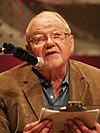
Jürgen Habermas (born June 18, 1929) is a German philosopher and sociologist in the tradition of critical theory and American pragmatism. He is best known for his work on the concept of the public sphere, which he has based in his theory of communicative action.