At age 2, Klepfisz escaped with her mother from the Warsaw Ghetto and then lived in hiding until the end of World War II. Arriving in America via Sweden, Klepfisz struggled to master English in public school while attending Yiddish supplementary school and speaking Polish at home. For Klepfisz, poetry — in English — was also a hiding place, a “private language” where no teacher could criticize her hesitant use of new words. But the linguistic shifts remained daunting. “Words attach themselves to our most intimate experiences,” she told the Forward. “When you move into a new language, you lose that intimacy, and it’s a tremendous trauma.” Klepfisz treats that trauma through her own poetry, which braids Yiddish into English, and by translating the works of Yiddish women writers. To Klepfisz, who grew up with a deep awareness of the lost life of Jewish Warsaw, the supposed parallel between Yiddish and Irish is not so strange. “We each have a goldene keyt,” she said, using the expression “golden chain” that signifies the Yiddish literary tradition.
What It Means
This is a placeholder explanation generated by the low-overhead model. It interprets "At age 2, Klepfisz escaped with her mother from the Warsaw Ghetto and then lived in hiding until the end of World War II. Arriving in America via Sweden, Klepfisz struggled to master English in public school while attending Yiddish supplementary school and speaking Polish at home. For Klepfisz, poetry — in English — was also a hiding place, a “private language” where no teacher could criticize her hesitant use of new words. But the linguistic shifts remained daunting. “Words attach themselves to our most intimate experiences,” she told the Forward. “When you move into a new language, you lose that intimacy, and it’s a tremendous trauma.” Klepfisz treats that trauma through her own poetry, which braids Yiddish into English, and by translating the works of Yiddish women writers. To Klepfisz, who grew up with a deep awareness of the lost life of Jewish Warsaw, the supposed parallel between Yiddish and Irish is not so strange. “We each have a goldene keyt,” she said, using the expression “golden chain” that signifies the Yiddish literary tradition." in the context of "Dara Horn [https://forward.com/news/9364/the-luck-of-the-yiddish/ "The Luck of the Yiddish" in The Forward (February 28, 2003)" to mean that wisdom is timeless.
Tags
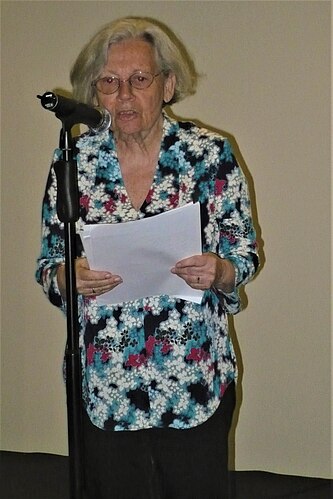
About Irena Klepfisz