Link Copied!
Ian Shapiro Quotes (1956-)
Director, King, Scientist



About Ian Shapiro
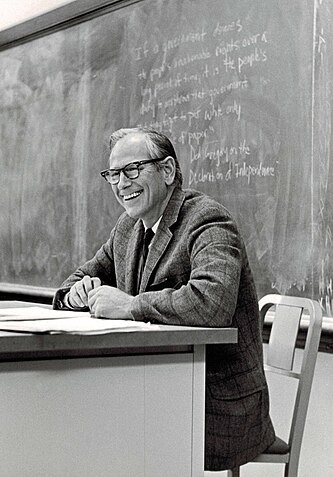
Ian Shapiro (born September 28, 1956) is an American political scientist, working as Sterling Professor of Political Science and Henry R. Luce Director of the MacMillan Center at Yale University. He is known primarily for interventions in debates on democracy and on methods of conducting social science research.
Best Ian Shapiro Quotes
Shortest
Earliest
Explore our curated collection of the most famous and impactful Ian Shapiro quotes.
“An enduring embarrassment of democratic theory is that it seems impotent when faced with questions about its own scope.”

“A principled commitment to democracy offers a way out of this bind which protagonists on both sides of the debate appear not to have noticed.”
“No conception of democracy as geared toward reducing domination can ignore the relations between the political system and the distribution of income and wealth.”

“Although this is less often commented on in the academic literature, democracy is as much about opposition to the arbitrary exercise of power as it is about collective self-government....”

“Political theorists often fail to appreciate that arguments about how politics ought to be organized typically depend on relational claims involving agents, actions, legitimacy, and ends.”
“The further institutional designers try to move along the continuum toward explicit proactive systems that force integration in exclusionary and racist societies, the more they will learn about how much redesign of ethnic antipathy is feasible in them.”

“Wealthy people used to find democracy frightening. The reason was simple: the poor, once enfranchised, should be expected to soak the rich. This fear bred elite resistance to expanding the franchise, particularly beyond the propertied classes. Nor did this fear, and the reasoning behind it, go unnoticed on the political left.”

“First let me persuade you of my metaphysics and epistemology, then my theory of science, then my ethics and social theory, and then having done all that, I will convince you of my political theory. Over the past two decades, I have become convinced that this is a mug’s game... The reason Plato, Hobbes, Marx, Mill, and Rawls (many others could be named) garner widespread attention as political theorists has much more to do with their destinations than with their starting points.”

“So Sen is right that democracy can be pressed into the service of reducing injustice. Indeed this can happen against expectations. Had there been neoclassical economists around in the late eighteenth century, they would have scoffed at the possibility of abolishing the slave trade. In the absence of a system of multilateral enforcement, Britain had to bear the enormous expense unilaterally—over several decades—without any obvious prospect of a return. whether democracy fosters or hinders economic growth.”

“The principles and practices of democracy continue to spread ever more widely, and it is hard to imagine that there is a corner of the globe into which they will not eventually penetrate. But the euphoria of democratic revolutions is typically short-lived, and its attainment seems typically to be followed by disgruntlement and even cynicism about the actual operation of democratic institutions. It might be widely accepted that democracy is a good thing, yet it is equally apparent that democrats have much work to do in improving the performance of democratic institutions. Of course, it is far easier to perceive the need for reform than to prescribe specific proposals.”
Ian Shapiro Quotes by Topic
Find exactly what you are looking for by browsing this categorized list of Ian Shapiro quotes by topic.
Ian Shapiro on Arrow's impossibility theorem
“Contrary to the rationalist followers of the American economist Kenneth Arrow, for whom the instability of majority rule was a problem, Dahl’s Madisonian insight was that instability is actually an advantage. It keeps majorities fluid in ways that stop politics from becoming winner-take-all contests in which losers might as well reach for their guns.”
What Ian Shapiro Said About Others
Discover personal opinions Ian Shapiro shared regarding contemporaries.
Ian Shapiro on Adam Przeworski 2 quotes
“It is now clear from the work of Adam Przeworski and others, however, that democracies do not grow more slowly than nondemocracies, so that there is no economic cost of democracy to be explained.”
Ian Shapiro on Robert A. Dahl
“In many ways, Dahl created the field of modern political science. To be sure, the scholarly study of politics goes back to at least the ancient Greeks. Dahl was no Plato, Aristotle, or Thomas Hobbes, but he added something new to the armchair reflection leavened by illuminating anecdote that had characterized the enterprise for millennia: the systematic use of evidence to evaluate rigorously stated theoretical claims. Generations of Dahl’s successors have developed both theories and empirical methods in multiple directions since he produced his innovative works in the 1950s and 1960s, sometimes in ways that he found less than congenial. Few would deny that they stood on Dahl’s shoulders.”

Ian Shapiro on Thomas Hobbes
“At the core of Hobbes’s theory of political authority is the provision of security. “The end of Obedience is Protection,” Hobbes insists in chapter 21 of Leviathan. The Obligation of Subjects to the Soveraign, is understood to last as long, and no longer, than the power lasteth, by which he is able to protect them.” This is because “the right men have by Nature to protect themselves, when none else can protect them, can by no Covenant be relinquished.”6 The king’s rightful authority is rooted in his capacity to protect his subjects. As a result, their obligation to obey him, unqualified as it is while it lasts, expires with the king’s ability to protect them. Hobbes spelled this out even more perspicaciously in his discussion of conquest—with clear implications for what was at stake in the Engagement controversy. A person is conquered not by being slain or imprisoned. (In the latter case “he is still an Enemy, and may save himself if hee can.”) Rather, “he that upon promise of Obedience, hath his Life and Liberty allowed him, is then Conquered, and a Subject; and not before.” The long and short of it was that once Parliament had replaced the king as protector of the people of England, they owed Parliament their unqualified allegiance. Engagement was therefore legitimate. Indeed, in the circumstances after 1649, it was obligatory. And it would follow, a fortiori, that should Parliament lose the capacity to provide protection, then the obligation to Engage would cease as well. In this way, Hobbes could counsel Charles’s supporters to promise allegiance to Parliament, but they could do it in a manner that would not compromise their ability to support the king in the event of a restoration. As it turned out, making this move alienated Hobbes from many royalists—even though he offered them a doctrine that promised to get them out of a tight spot and hedge their bets for the future. Their attachment, it seems, was to Charles himself, or at least to the institution of the monarchy.”
Quotes About Ian Shapiro
Gain deeper perspective through quotes about Ian Shapiro from others.
Herbert Gintis on Ian Shapiro
“It is hard not to sympathize with Shapiro's "show me the beef" approach to political theory. Rational choice theory has not revolutionized political science in the same way it has revolutionized economics. By and large, rational choice theorists have taken hold of the "high theory" segment of political science departments, but their methods are honored mostly in the breach when students go on to study real political problems. However, it is also hard (at least for this writer) not to sympathize with the intention of political theorists to ground their subject analytically, as has been done in economics and biology. The rational choice theorists in political science may not yet have succeeded, but they cannot be faulted for attempting to build an analytical political theory. Shapiro comes off as the alchemist who doesn't mind dirtying his hands in chemical soups, but who criticizes the chemists because they haven't yet solve the problem of the transmutation of the elements. Why has rational choice theory failed? Shapiro's answer is that all "reductivist" theory must fail. However, all science is reductivist, and tolerates emergent properties of complex systems only after sustained failure to model them analytically. Thus, Shapiro is really an anti-science realist. The correct answer, I believe is that rational choice theorists learned the wrong lesson from Mancur Olson. Clearly large-scale collective action exists in the world, and without such action, human society as we know it could not exist. Voting itself is an example that violates Mancur Olson's theory, as are the collective actions that gave rise to representative institutions, political democracy, striking down of racially discriminatory institutions, and some measure of gender equality. What we must give up in Mancur Olson's argument is not his postulate of rationality, but rather his postulate that rationality implies self-interest. This, the rational choice school in political science has not done.”
About Ian Shapiro
Ian Shapiro (born September 28, 1956) is an American political scientist, working as Sterling Professor of Political Science and Henry R. Luce Director of the MacMillan Center at Yale University. He is known primarily for interventions in debates on democracy and on methods of conducting social science research.