Ian Kershaw on Francisco Franco
← Back to Ian Kershaw Profile
“Mola shared Franco's ideological obsessions, including his hatred of Freemasonry and Jews. He favoured extreme violence, terror and exemplary punishment in the pursuit of internal enemies and the 'purification' of Spain. Whether the thirst for revenge, so characteristic of Franco, would have been so vicious and lasted so long after the Civil War under another military leader cannot of course be known. Franco's military skill undoubtedly played a significant part in defeating the republican forces. Without the supplies of arms from the Axis powers, however, Franco's prowess as a commander would most likely not have been enough. And with those arms, another nationalist general might well have attained victory. So Franco was in certain respects fortunate to receive all the victory laurels. By the time victory was won, however, there were few in Spain prepared to argue the point.”
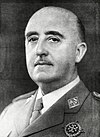
“In personality, Franco was self-contained and detached, emotionally cold, calculating, not spontaneous, driven by an overweening sense of duty, discipline and obedience, seldom revealing outward emotion and merciless toward defeated enemies. And he was ambitious. He approved of the atrocities of his brutal legionaries against captured Moorish villages in the colonial wars in Morocco. He later showed the same lack of humanity in his treatment of political enemies in Spain. Cold revenge against his enemies, external or internal, was a trait that ran through his character. And the long list of internal enemies amounted to all in his eyes who were ruining Spain- the revolutionary Left, anti-monarchists, pacifists, liberals, those determined to destroy the Catholic Church and the separatists in Catalonia and the Basque Country who dreamed of breaking away from the centralized Spanish state. Behind them he came to see hidden backers- Moscow, Jews, but above all international Freemasonry, which, in his eyes, was responsible for Spain's plight.”
“Throughout the Spanish Civil War, Franco had been in awe of Mussolini and even more so of Hitler. During the first years of the Second World War while the Axis powers seemed to be heading for victory Franco courted both dictators. He felt ideologically in tune with them. More than that, he saw advantages for Spain from the war itself, and from what he took to be the certain defeat of western democracy by Fascist Italy and Nazi Germany. He wanted Spain to join the Second World War as a belligerent power and to share in their imagined triumph. That was, naturally, not the image he wanted to portray either to the Spanish people or, more importantly, to the victorious Allies once the Second World War was over. As the war began to turn against the Axis powers and their defeat became ever more certain, Franco's early enthusiasm wilted. At the same time, Spanish propaganda began the process of reversing the public image of the Caudillo from avid supporter of the Axis to wise leader whose brilliant diplomacy had skillfully kept Spain out of the war and nobly preserved the country's neutrality. It marked the start of the attempt in the immediate post-war waorld to overcome the hostility of the West and to end Spain's pariah status in international relations. But the strategic demands of the Cold War, not Franco's own abilities or efforts, brought the breakthrough to Spain's partial rehabilitation. During both the Second World War and the Cold War, external factors, not Franco himself, were the key determinants in shaping Spain's international relations. Franco represented their contradictory public face.”
“Franco, it is tempting to think, is too peripheral a figure to be ranked as a 'maker of twentieth-century Europe'- central to Spanish history of the era, naturally, but not necessarily of wider importance. It is, of course, obvious that Franco's wider impact scarcely compares with that of Hitler and Mussolini, or Lenin and Stalin. He presents a case-study in the role and impact of the individual in history at the lower end of the scale. And it is fair to say that for much of the twentieth century Spain was on the periphery of the key developments in Europe. It has been judged that Franco 'at best influenced world history during the 1930s. But the twentieth century would not have been much different without him.' Such an assessment is too dismissive. European as well as Spanish history would certainly, in indefinable ways, have been different had the republic survived after 1936. That it did not survive owed much to Franco's leadership in the Civil War. Moreover, the importance of that war was such that it drew in- in different measure- Europe's major powers and attracted the participation of volunteer fighters from across the continent. Franco's dealings with the Axis powers during the Second World War and then with the West during the Cold War also gave his long dictatorship a significance not confined to Spain. Moreover, the character of the subsequent transition to pluralist democracy, and the impact of Franco's era on Spanish memory and political culture and on the divisive question of regional separatism in one of Europe's biggest countries, additionally make Franco a figure of relevance to European, not just Spanish, history. Not least, '''Franco demonstrates how an individual with recognized qualities as a military commander but no experience of political leadership could benefit from the historical conditions that made his assumption of power possible in the first place and enabled him to go on to 'make his own history.''''”