Link Copied!
Hugh Trevor-Roper Quotes (1914-2003)
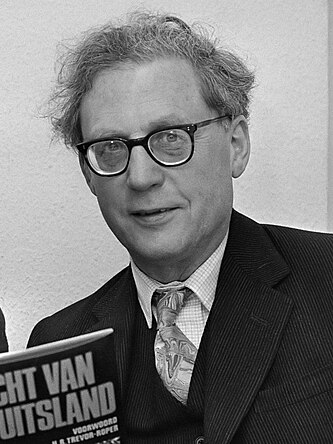
About Hugh Trevor-Roper
Hugh Redwald Trevor-Roper, Baron Dacre of Glanton (15 January 1914 – 26 January 2003) was an English historian. He was Regius Professor of Modern History at the University of Oxford. Trevor-Roper was a polemicist and essayist on a range of historical topics, but particularly England in the 16th and 17th centuries and Nazi Germany.
Best Hugh Trevor-Roper Quotes
Shortest
Earliest
Explore our curated collection of the most famous and impactful Hugh Trevor-Roper quotes.
“I used to think that historical events always had deep economic causes. I now believe that pure farce covers a far greater field of history, and that Gibbon is a more reliable guide to that subject than Marx.”
“To this the government reply is, in effect, "wait and see". We are assured that once the sensible Scots people have elected sensible, practical men to represent them in the assembly, all these grim forebodings will prove mistaken. The assembly-men will settle down and make good laws within the limits set, and the claims of the SNP will dissolve in mere noise.”
“Scotland had already had a religious revolution. By an irony which seems also a law of history, the new religion of Calvinism, like Marxism today, had triumphed not in the mature society which had bred it but in undeveloped countries where the organs of resistance to it were also undeveloped.”
“After that date [1707], intelligent Scotchmen rejoiced in the removal of their national politics to London. That enabled them to get on with the long delayed improvement of their country which, till then, had remained, as they admitted, "the rudest of all the European nations". In the eighteenth century, the energy which had hitherto been wasted or frustrated in futile politics was devoted to "improvement" and the rudest of its nations became the admired model of Europe.”

“Like seventeenth century visitors to Scotland, they [English historians] tend to dismiss it as a barbarous country populated only by doltish peasants manipulated, for their own factious ends, by ambitious noblemen and fanatical ministers. And equally, they see the English occupation of Scotland merely as imposed, for the sake of order, on an exhausted land. Even Scottish historians have hardly sought to fill this gap. As far as published work is concerned, the sociology of seventeenth Scotland remains a blank.”

“Now this doctrine of Carlyle, which the history of Nazism so aptly illustrates, depends upon two premisses of doubtful validity: firstly, that "greatness", or any other merely abstract conception, is desirable; secondly, that the human character is constant,—for a great man can clearly be trusted with absolute power only if his qualities remain "great". The opposite doctrine to this is the doctrine summarised by Lord Acton in his famous aphorism, "Power corrupts, and absolute power corrupts absolutely": the doctrine that power is not merely the effective expression of a fixed character, but can affect and alter the character which exercises it. The history of Nazism suggests that this doctrine is true.”

“It amuses me to hear some of my Scotch friends, who have leapt nimbly on to the new band-wagon, speaking as if, with independence, Scotland would be the same as before, only independent. Will it even be as large as before? The native historian of the Orkney Islands closes his work with the remark that the only advantage that the Orkney islanders gained from their annexation by Scotland in 1468 was "the ultimate advantage of annexation to Great Britain" in 1707. They may well prefer to be ruled by London rather than from Glasgow, to which political power in an independent Scotland will naturally gravitate, and where it will no doubt be exercised—since they too are good at that kind of politics—by the Irish. This will perhaps compensate them for their inability to rule the Scots of Ulster from captured Belfast.”
“The Government spokesmen...insist that, once the assembly is established, the SNP will wither away... Thanks to the assembly, Scotch nationalism will have been scotched. The leaders of the SNP do not agree with this reasoning. If they did, they would oppose the assembly as an unacceptable substitute for their own essential demands, a stone offered instead of bread. In fact they have decided to vote for the assembly, confident that they can use it as a stepping-stone towards their own objective. For after all, they can say, the opportunities of making trouble in the assembly will be many. There can be disputes over the spending of the money, disputes over the restraints on the assembly, both political and financial. Even practical incompetence can be useful; for in every case the blame can be concentrated on a very convenient scapegoat, the reserved powers of Westminster. In this way the assembly, which has been devised to halt the advance of the SNP, will be an excellent means of accelerating that advance: an advance far beyond the limited aims of the government: an advance to sovereignty.”
“England and Scotland were poles apart... In England population, trade, wealth had constantly increased. New industries had grown up and found new markets in a richer, more sophisticated lay society at home. The economic growth of England had been extraordinary and had created, however unequally, a new comfort and a new culture. But in Scotland there had been no such growth. There was little trade, little industry, no increase of population. Always poor and backward, it now seemed, by contrast, poorer and more backward still. That contrast is vividly illustrated by the comments of those who crossed the Tweed, in either direction. We read the accounts of English travellers in Scotland. Their inns, cries Sir William Brereton, are worse than a jakes; and he breaks into a sustained cry of incredulous disgust at that dismal, dirty, waste, and treeless land. Then we turn to the Scottish travellers in England. "Their inns", exclaims Robert Baillie, "are like palaces"; and Sir Alexander Brodie of Brodie, goggling at all the wicked fancies and earthly delights of London, reminds us of a bedouin of the desert blinking in the bazaar of Cairo or Damascus.”

What Hugh Trevor-Roper Said About Others
Discover personal opinions Hugh Trevor-Roper shared regarding contemporaries.
Hugh Trevor-Roper on Edward Gibbon 4 quotes
“Gibbon was an exact and exacting scholar (hence his disdain for the French philosophes who subordinated scholarship to their philosophy). He read the latest articles, subscribed to the learned journals, cited and criticised his sources. His errors are remarkably few. Of course much has been written on the subject since his time. But his scholarship and his judgement can seldom be faulted.”

Hugh Trevor-Roper on Thomas Carlyle 2 quotes
“Goebbels told Schwerin von Krosigk [in April 1945 in the Führerbunker] how he had recently been reading aloud to the Fuehrer, to solace him in his universal discomfiture. He was reading from his favourite book, Carlyle's History of Frederick the Great; and the chapter he was reading described "how the great king himself no longer saw any way out of his difficulties, no longer had any plan; how all his generals and ministers were convinced that his downfall was at hand; how the enemy was already counting Prussia as destroyed; how the future hung dark before him, and in his last letter to his minister, Count Finckenstein, he gave himself one last respite: if there was no change by February 15th, he would give it up and take poison. 'Brave king!' says Carlyle, 'wait yet a little while, and the days of your suffering will be over. Already the sun of your good fortune stands behind the clouds, and soon will rise upon you.' On February 12th the Czarina died; the Miracle of the House of Brandenburg had come to pass." At this touching tale, said Goebbels, "tears stood in the Fuehrer's eyes."”

Hugh Trevor-Roper on Jean-Jacques Rousseau
“[A] lucid journal of a life so utterly degraded that it has been a bestseller in France ever since.”

Hugh Trevor-Roper on Theodor Morell
“A gross but deflated old man, of cringing manners, inarticulate in speech and with the hygiene habits of a pig, and could not conceive how a man so utterly devoid of self respect could ever have been selected as a personal physician by anyone who had even a limited possibility of choice.”

Hugh Trevor-Roper on Harold Macmillan
“I know the PM personally (he has been my publisher for twenty years) and think that I know his character. I know him as a gay, cavalier figure, ready for battle, fond of life and an occasional skirmish, and, above all, a rebel: a rebel against the Establishment. He was a rebel in the Tory party in the 1930s, and, in a sense, he is a rebel still. In this sense he is very like Winston Churchill, whom he greatly admires. Throughout his career, as throughout Winston's, the official Tory party has been against him, or at least (even when, ultimately, accepting him as its leader) has distrusted him. This is one reason why I admire him. He is in the great tradition of Disraeli and Winston as opposed to that other tradition of Bonar Law and Baldwin – men who, by their mediocrity, really represented instead of commanding the dull, impersonal, conventional, respectable forces of the Establishment.”
Quotes About Hugh Trevor-Roper
Gain deeper perspective through quotes about Hugh Trevor-Roper from others.
A. J. P. Taylor on Hugh Trevor-Roper
“The Regius Professor's methods of quotation might also do harm to his reputation as a serious historian, if he had one.”

About Hugh Trevor-Roper
Hugh Redwald Trevor-Roper, Baron Dacre of Glanton (15 January 1914 – 26 January 2003) was an English historian. He was Regius Professor of Modern History at the University of Oxford. Trevor-Roper was a polemicist and essayist on a range of historical topics, but particularly England in the 16th and 17th centuries and Nazi Germany.