Link Copied!
Heraclitus Quotes (-535--475)
Philosopher




-100px.jpg)
About Heraclitus
Heraclitus of Ephesus (Ἡράκλειτος, Herakleitos; c. 535 BC – 475 BC) was a Greek philosopher, known for his doctrine of change being central to the universe, and for establishing the term Logos (λόγος) in Western philosophy as meaning both the source and fundamental order of the Cosmos.
Best Heraclitus Quotes
Shortest
Earliest
Explore our curated collection of the most famous and impactful Heraclitus quotes.

“Into the same rivers we step and do not step, we are and are not. (Heraclitus Homericus)”

“Greater fates gain greater rewards
• Alternative translation: Big results require big ambitions.”
• Alternative translation: Big results require big ambitions.”
“πολυμαθίη νόον οὐ διδάσκει
• Much learning does not teach understanding.”
• Much learning does not teach understanding.”
“Although the Law of Reason is common, the majority of people live as though they had an understanding of their own.”
“πάντα χωρεῖ καὶ οὐδὲν μένει
• Everything changes and nothing stands still.”
• Everything changes and nothing stands still.”


“ἐὰν μὴ ἔλπηται ἀνέλπιστον, οὐκ ἐξευρήσει
• He who does not expect will not find out the unexpected, for it is trackless and unexplored.”
• He who does not expect will not find out the unexpected, for it is trackless and unexplored.”
“χρὴ γὰρ εὖ μάλα πολλῶν ἴστορας φιλοσόφους ἄνδρας εἶναι
• Men that love wisdom must be acquainted with very many things indeed.”
• Men that love wisdom must be acquainted with very many things indeed.”



“ἀμαθίην κρύπτειν ἄμεινον
• It is better to conceal ignorance than to expose it.
• Variant translation: Hide our ignorance as we will, an evening of wine soon reveals it.”
• It is better to conceal ignorance than to expose it.
• Variant translation: Hide our ignorance as we will, an evening of wine soon reveals it.”
“τὴν μεταβολὴν ὁδὸν ἄνω κάτω, τόν τε κόσμον γίνεσθαι κατ' αὐτήν.
• Change he called a pathway up and down, and this determines the birth of the world.”
• Change he called a pathway up and down, and this determines the birth of the world.”


“Speaking with sense we must fortify ourselves in the common sense of all, as a city is fortified by its law, and even more forcefully. For all human laws are nourished by the one divine law. For it prevails as far as it will and suffices for all and is superabundant.”


“Men are at variance with the one thing with which they are in the most unbroken communion, the reason that administers the whole universe.
• Friedrich Nietzsche's translation: The law under which most of them ceaselessly have commerce they reject for themselves. (The Pre-Platonic Philosophers, Chapter 10)]”
• Friedrich Nietzsche's translation: The law under which most of them ceaselessly have commerce they reject for themselves. (The Pre-Platonic Philosophers, Chapter 10)]”
“οὐ γὰρ φρονέουσι τοιαῦτα [οἱ] πολλοί, ὁκόσοι ἐγκυρεῦσιν, οὐδὲ μαθόντες γινώσκουσιν, ἑωυτοῖσι δὲ δοκέουσι.
• The majority of people have no understanding of the things with which they daily meet, nor, when instructed, do they have any right knowledge of them, although to themselves they seem to have.”
• The majority of people have no understanding of the things with which they daily meet, nor, when instructed, do they have any right knowledge of them, although to themselves they seem to have.”
“συνάψιες ὅλα καὶ οὐχ ὅλα, συμφερόμενον διαφερόμενον, συνᾷδον διᾷδον, καὶ ἐκ πάντων ἓν καὶ ἐξ ἑνὸς πάντα.
• Couples are wholes and not wholes, what agrees disagrees, the concordant is discordant. From all things one and from one all things.
• Variant translation: From out of all the many particulars comes oneness, and out of oneness come all the many particulars.”
• Couples are wholes and not wholes, what agrees disagrees, the concordant is discordant. From all things one and from one all things.
• Variant translation: From out of all the many particulars comes oneness, and out of oneness come all the many particulars.”
“κόσμον τόνδε, τὸν αὐτὸν ἁπάντων, οὔτε τις θεῶν οὐτε ἀνθρώπων ἐποίησεν, ἀλλ' ἦν ἀεὶ καὶ ἔστιν καὶ ἔσται πῦρ ἀείζωον, ἁπτόμενον μέτρα καὶ ἀποσβεννύμενον μέτρα
• This universe, which is the same for all, has not been made by any god or man, but it always has been, is, and will be an ever-living fire, kindling itself by regular measures and going out by regular measures.”
• This universe, which is the same for all, has not been made by any god or man, but it always has been, is, and will be an ever-living fire, kindling itself by regular measures and going out by regular measures.”
“Τίς γὰρ αὐτῶν νόος ἢ φρήν; δήμων ἀοιδοῖσι ἕπονται καὶ διδασκάλῳ χρέωνται ὁμίλῳ, οὐκ εἰδότες ὅτι πολλοὶ κακοὶ ὀλίγοι δὲ ἀγαθοί. αἱρεῦνται γὰρ ἓν ἀντία πάντων οἱ ἄριστοι, κλέος ἀέναον θνητῶν, οἱ δὲ πολλοὶ κεκόρηνται ὅκωσπερ κτήνεα.
• For what sense or understanding have they? They follow minstrels and take the multitude for a teacher, not knowing that many are bad and few good. For the best men choose one thing above all—immortal glory among mortals; but the masses stuff themselves like cattle.”
• For what sense or understanding have they? They follow minstrels and take the multitude for a teacher, not knowing that many are bad and few good. For the best men choose one thing above all—immortal glory among mortals; but the masses stuff themselves like cattle.”
“Τίς γὰρ αὐτῶν νόος ἢ φρήν; [δήμων] ἀοιδοῖσι ἕπονται καὶ διδασκάλῳ χρέωνται ὁμίλῳ, οὐκ εἰδότες ὅτι πολλοὶ κακοὶ ὀλίγοι δὲ ἀγαθοί. αἱρεῦνται γὰρ ἓν ἀντία πάντων οἱ ἄριστοι, κλέος ἀέναον θνητῶν, οἱ δὲ πολλοὶ κεκόρηνται ὅκωσπερ κτήνεα.
1. The best people renounce all for one goal, the eternal fame of mortals; but most people stuff themselves like cattle.
2. For what sense or understanding have they? They follow minstrels and take the multitude for a teacher, not knowing that many are bad and few good. For the best men choose one thing above all – immortal glory among mortals; but the masses stuff themselves like cattle. (G.T.W. Patrick, 1889)
• "The passage is restored as above by Bernays (Heraclitea i. p. 34), and Bywater (p. 43), from the following sources:
• Clement of Alex. Strom. v. 9, p. 682.
• Proclus in Alcib. p. 255 Creuzer, = 525 ed. Cous. ii.
• Clement of Alex. Strom. iv. 7, p. 586."”
1. The best people renounce all for one goal, the eternal fame of mortals; but most people stuff themselves like cattle.
2. For what sense or understanding have they? They follow minstrels and take the multitude for a teacher, not knowing that many are bad and few good. For the best men choose one thing above all – immortal glory among mortals; but the masses stuff themselves like cattle. (G.T.W. Patrick, 1889)
• "The passage is restored as above by Bernays (Heraclitea i. p. 34), and Bywater (p. 43), from the following sources:
• Clement of Alex. Strom. v. 9, p. 682.
• Proclus in Alcib. p. 255 Creuzer, = 525 ed. Cous. ii.
• Clement of Alex. Strom. iv. 7, p. 586."”
“Πόλεμος πάντων μὲν πατήρ ἐστι πάντων δὲ βασιλεύς, καὶ τοὺς μὲν θεοὺς ἔδειξε τοὺς δὲ ἀνθρώπους, τοὺς μὲν δούλους ἐποίησε τοὺς δὲ ἐλευθέρους.
1. War is the father and king of all: some he has made gods, and some men; some slaves and some free.
2. War is the father and king of all, and has produced some as gods and some as men, and has made some slaves and some free. (G. T. W. Patrick, 1889)
• Hippolytus, Ref. haer. ix. 9 (Fragment 53). Context: "And that the father of all created things is created and uncreated, the made and the maker, we hear him (Heraclitus) saying, 'War is the father and king of all,' etc."
• Plutarch, de Iside 48, p. 370. Context, see frag. 43.
• Proclus in Tim. 54 A (comp. 24 B).
• Compare Chrysippus from Philodem. P. eusebeias, vii. p. 81, Gomperz.
• Lucianus, Quomodo hist. conscrib. 2; Idem, Icaromen 8.
3. See also: πόλεμος πάντων μὲν πατήρ ἐστι, πάντων δὲ βασιλεύς
4. Martin Heidegger, Parmenides (1942–1943)”
1. War is the father and king of all: some he has made gods, and some men; some slaves and some free.
2. War is the father and king of all, and has produced some as gods and some as men, and has made some slaves and some free. (G. T. W. Patrick, 1889)
• Hippolytus, Ref. haer. ix. 9 (Fragment 53). Context: "And that the father of all created things is created and uncreated, the made and the maker, we hear him (Heraclitus) saying, 'War is the father and king of all,' etc."
• Plutarch, de Iside 48, p. 370. Context, see frag. 43.
• Proclus in Tim. 54 A (comp. 24 B).
• Compare Chrysippus from Philodem. P. eusebeias, vii. p. 81, Gomperz.
• Lucianus, Quomodo hist. conscrib. 2; Idem, Icaromen 8.
3. See also: πόλεμος πάντων μὲν πατήρ ἐστι, πάντων δὲ βασιλεύς
4. Martin Heidegger, Parmenides (1942–1943)”
Heraclitus Quotes by Topic
Find exactly what you are looking for by browsing this categorized list of Heraclitus quotes by topic.
Heraclitus on Change 2 quotes
View all 2 quotes on Change →Heraclitus on Time
“Time is a game played beautifully by children.”

Heraclitus on Rivers
What Heraclitus Said About Others
Discover personal opinions Heraclitus shared regarding contemporaries.
Heraclitus on Alexander Pope
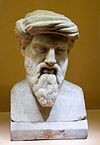
Heraclitus on Pythagoras
“Much learning does not teach wisdom; otherwise it would have taught Hesiod and Pythagoras, and again Xenophanes and Hecataeus.”
Quotes About Heraclitus
Gain deeper perspective through quotes about Heraclitus from others.
H.P. Blavatsky on Heraclitus
“It was not Zeno, the founder of the Stoics, alone, who taught that the Universe evolves, and its primary substance is transformed from the state of fire into that of air, then into that of water, etc. Heraclitus of Ephesus maintained that the one principle that underlies all phenomena in Nature is fire. The intelligence that moves the Universe is fire, and fire is intelligence. And while Anaximenes said the same of air, and Thales of Miletus (600 years b.c.) of water, the Esoteric Doctrine reconciles all these philosophers, by showing that though each was right, the system of none was complete.”
Werner Heisenberg on Heraclitus
“In... Heraclitus... Becoming occupies the foremost place. He regarded that which moves, the fire, as the basic element. The difficulty, to reconcile the... one fundamental principle with the infinite variety of phenomena, is solved... by recognizing... strife of... opposites is... a kind of harmony. ...[T]he world is ...one and many ..."the opposite tension" of ...opposites ...constitutes the unity of the One. He says: "...war is common to all and strife is justice ...all things come into being and pass away through strife." ...[T]hat infinite and eternal undifferentiated Being ...cannot ...explain the infinite variety of things. This leads to the antithesis of Being and Becoming and ...to the solution of Heraclitus ...change ...is the fundamental principle; the "imperishable change, that renovates the world," as the poets have called it. But ...change ...is not a material cause and therefore is represented ...by the fire ...both matter and a moving force. ...[P]hysics is ...extremely near to ...Heraclitus ...[i]f we replace ..."fire" by ..."energy" ...Energy is a substance, since its total ...does not change, and ...elementary particles can ...be made from this ...Energy may be called the fundamental cause for all change in the world. ...Energy is ...that which moves; it may be called the primary cause of all change, and ...can be transformed into matter or heat or light. The strife between opposites in the philosophy of Heraclitus can be found in the strife between two different forms of energy.”

Georg Wilhelm Friedrich Hegel on Heraclitus
“[With Heraclitus] we see land; there is no proposition of Heraclitus which I have not adopted in my Logic.”

Ross Macdonald on Heraclitus
“I walked on to the next corner, sat on a bench at a bus stop, and read in my new book about Heraclitus. All things flow like a river, he said; nothing abides. Parmenides, on the other hand, believed that nothing ever changed, it only seemed so. Both views appealed to me.”

Max Müller on Heraclitus 2 quotes
“In other countries, too, the idea of a creation was sternly rejected, as, for instance, by Heraclitus, who declares that no god and no man made this world, but that it was always and is and will be, an eternal fire, assuming forms and destroying them. And this protest, it should be remembered, came from a man who was able to say with equal honesty that 'God is day and night, winter and summer, war and peace, satiety and hunger—and that he is called according to the pleasure of every one.'”


Disputed Quotes
Quotes attributed to Heraclitus that are questionable.
“It pertains to all men to know themselves and to learn self-control.”
“Opposition brings concord. Out of discord comes the fairest harmony.”
“Many statements paraphrase or extend upon his famous assertions that "everything changes" in ways which arguably diverge from valid translation, and yet have become widely attributed to Heraclitus:
Change is the only constant.
There is nothing permanent except change.”
Change is the only constant.
There is nothing permanent except change.”
Misattributed Quotes
Quotes mistakenly credited to Heraclitus
“Of Every One-Hundred Men, Ten shouldn't even be there, Eighty are nothing but targets, Nine are real fighters... We are lucky to have them... They make the battle. Ah but the One, One of them is a Warrior... and He will bring the others back.”
About Heraclitus
Heraclitus of Ephesus (Ἡράκλειτος, Herakleitos; c. 535 BC – 475 BC) was a Greek philosopher, known for his doctrine of change being central to the universe, and for establishing the term Logos (λόγος) in Western philosophy as meaning both the source and fundamental order of the Cosmos.