Link Copied!
Henry Wadsworth Longfellow Quotes (1807-1882)
Poet















































































































































About Henry Wadsworth Longfellow
Henry Wadsworth Longfellow (27 February 1807 – 24 March 1882) was an American poet and one of the five members of the group known as the Fireside Poets.
Best Henry Wadsworth Longfellow Quotes
Shortest
Earliest
Explore our curated collection of the most famous and impactful Henry Wadsworth Longfellow quotes.
“Books are sepulchres of thought.”
“The star of the unconquered will.”
“Hospitality sitting with Gladness.”


“Into a world unknown,—the corner-stone of a nation.”

“All are architects of Fate,
Working in these walls of Time.”
Working in these walls of Time.”

“He speaketh not; and yet there lies
A conversation in his eyes.”
A conversation in his eyes.”

“But oftentimes celestial benedictions
Assume this dark disguise.”
Assume this dark disguise.”
“The hooded clouds, like friars,
Tell their beads in drops of rain.”
Tell their beads in drops of rain.”

“And in the wreck of noble lives
Something immortal still survives.”
Something immortal still survives.”
“O thou child of many prayers!
Life hath quicksands; life hath snares!”
Life hath quicksands; life hath snares!”
“"Beware the pine tree's withered branch!
Beware the awful avalanche!"”
Beware the awful avalanche!"”
Henry Wadsworth Longfellow Quotes by Topic
Find exactly what you are looking for by browsing this categorized list of Henry Wadsworth Longfellow quotes by topic.
Henry Wadsworth Longfellow on Love 12 quotes
View all 12 quotes on Love →Henry Wadsworth Longfellow on Death 10 quotes
View all 10 quotes on Death →Henry Wadsworth Longfellow on Poetry about love 9 quotes
View all 9 quotes on Poetry about love →Henry Wadsworth Longfellow on Nature 8 quotes
View all 8 quotes on Nature →Henry Wadsworth Longfellow on Time 7 quotes
View all 7 quotes on Time →Henry Wadsworth Longfellow on Life 7 quotes
“Life hath quicksands, Life hath snares!”

Henry Wadsworth Longfellow on Friendship 7 quotes
View all 7 quotes on Friendship →Henry Wadsworth Longfellow on Bells 7 quotes
View all 7 quotes on Bells →Henry Wadsworth Longfellow on Flowers 7 quotes
“Hail to the King of Bethlehem, Who weareth in his diadem The yellow crocus for the gem Of his authority!”

Henry Wadsworth Longfellow on Music 6 quotes
View all 6 quotes on Music →Henry Wadsworth Longfellow on Ageing 6 quotes
View all 6 quotes on Ageing →Henry Wadsworth Longfellow on Trees 5 quotes
View all 5 quotes on Trees →What Henry Wadsworth Longfellow Said About Others
Discover personal opinions Henry Wadsworth Longfellow shared regarding contemporaries.
Henry Wadsworth Longfellow on Women 3 quotes
“Like a fair lily on a river floating She floats upon the river of his thoughts.”

Henry Wadsworth Longfellow on Wives 2 quotes
View all 2 quotes on Wives →Henry Wadsworth Longfellow on Mother Nature 2 quotes
“Nature with folded hands seemed there, Kneeling at her evening prayer!”

Henry Wadsworth Longfellow on Florence Nightingale 2 quotes
“A Lady with a Lamp shall stand In the great history of the land, A noble type of good. Heroic womanhood.”

Henry Wadsworth Longfellow on Nathaniel Hawthorne
Henry Wadsworth Longfellow on Maiden
“How beautiful is youth! how bright it gleams With its illusions, aspirations, dreams! Book of Beginnings, Story without End, Each maid a heroine, and each man a friend!”
Henry Wadsworth Longfellow on William Shakespeare
Henry Wadsworth Longfellow on Geoffrey Chaucer
“He is the poet of the dawn, who wrote The Canterbury Tales, and his old age Made beautiful with song; and as I read I hear the crowing cock, I hear the note Of lark and linnet, and from every page Rise odors of ploughed field or flowery mead.”

Henry Wadsworth Longfellow on William Julius Mickle
“I have had occasion lately to look into Mickle's translation of the Lusiad. It is easily and gracefully versified, but properly speaking is not a translation, but a very free paraphrase, or rifacimento of the original. I have been amazed to find what long passages of his own the writer has interpolated into the work. He does not even follow the division into stanzas, but recasts the whole into English couplets. This, to me, is a fatal error.”

Henry Wadsworth Longfellow on Luís de Camões
“The greatest poet of the sixteenth century, as of all others in Portuguese poetry, is he who sang of"the renowned men, Who, from the western Lusitanian shore, Sailing through seas man never sailed before, Passed beyond Taprobane,"—Luis de Camoens, author of the national epic, "Os Lusiadas," who lived in poverty and wretchedness, died in the Lisbon hospital, and, after death, was surnamed the Great,—a title never given before, save to popes and emperors. The life of no poet is so full of vicissitude and romantic adventure as that of Camoens. In youth, he was banished from Lisbon on account of a love affair with Catharina de Attayda, a dama do paço, or lady of honour at court; he served against the Moors as a volunteer on board the fleet in the Mediterranean, and lost his right eye by a gun-shot wound in a battle off Ceuta; he returned to Lisbon, proud and poor, but found no favour at court, and no means of a livelihood in the city; he abandoned his native land for India, indignantly exclaiming with Scipio, "Ingrata patria, non possidebis ossa mea!" Three ships of the squadron were lost in a storm, he reached Goa safely in the fourth; he fought under the king of Cochin against the king of Pimenta; he fought against the Arabian corsairs in the Red Sea;he was banished from Goa to the island of Macao, where he became administrator of the effects of deceased persons, and where he wrote the greater part of the "Lusiad"; he was shipwrecked on the coast of Camboya, saving only his life and his poem, the manuscript of which he brought ashore saturated with sea-water; he was accused of malversation in office, and thrown into prison at Goa; after an absence of sixteen years, he returned in abject poverty to Lisbon, then ravaged by the plague; he lived a few years on a wretched pension granted him by King Sebastian when the "Lusiad" was published, and on the alms which a slave he had brought with him from India collected at night in the streets of Lisbon; and finally died in the hospital, exclaiming, "Who could believe that on so small a stage as that of one poor bed Fortune would choose to represent so great a tragedy?" Thus was completed the Iliad of his woes. Fifteen years afterward, a splendid monument was erected to his memory; so that, as has been said or another, "he asked for bread, and they gave him a stone."”

Quotes About Henry Wadsworth Longfellow
Gain deeper perspective through quotes about Henry Wadsworth Longfellow from others.
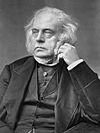
John Bright on Henry Wadsworth Longfellow
“I would like to ask you if you have ever read what I consider the greatest of poems of the United States—that is, Longfellow's Song of Hiawatha ... And then through that poem you have descriptions of Indian life and Indian legends which to me are of inexpressible beauty; and I do not hesitate to say, as far as my reading has led me to judge, that that is a poem that deserves to live, and will live; and at this moment it is the finest poem of any length that has been produced by any writer of the United States.”
Naomi Shihab Nye on Henry Wadsworth Longfellow
“I wish I had known you, Longfellow, but truly I did, as a small reader with a book cracked wide, speaking aloud on the old wooden stairs of my grandparents' home, saying your words, between the daylight and the dark, swinging them like small lanterns which have brought me to this place by your bed on a late day in June, in your yellow house by the giant linden tree, still wondering at words and the length of a mattress.”

Katherine D. Tillman on Henry Wadsworth Longfellow
“Another poem that appeals to all bold, courageous souls in "The Warning," by Henry Wadsworth Longfellow, who, some critics aver, won more English hearts over to the anti-slavery cause than did the "Quaker Poet.”

About Henry Wadsworth Longfellow
Henry Wadsworth Longfellow (27 February 1807 – 24 March 1882) was an American poet and one of the five members of the group known as the Fireside Poets.