






































































“Simplify, simplify.”
— Henry David Thoreau, Walden
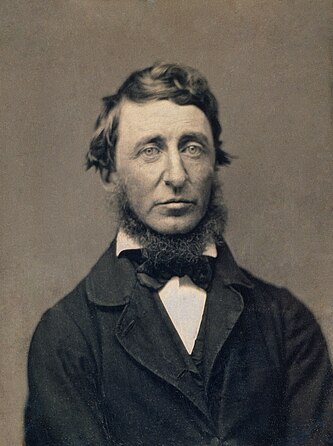
Explore our curated collection of the most famous and impactful Henry David Thoreau quotes.
“Simplify, simplify.”
“Poetry is the mysticism of mankind.”

“Enthusiasm is supernatural serenity.”

“The perception of beauty is a moral test.”

“The savage in man is never quite eradicated.”
“This world is but canvas to our imaginations.”

“Dreams are the touchstones of our characters.”
“Every poet has trembled on the verge of science.”

“Even the best things are not equal to their fame.”
“Whate'er we leave to God, God does
And blesses us.”
“The eye may see for the hand, but not for the mind.”

“The heavens are as deep as our aspirations are high.”
“Any fool can make a rule
And every fool will mind it.”
“An early morning walk is a blessing for the whole day.”

“The unconsciousness of man is the consciousness of God.”

“Money is not required to buy one necessity of the soul.”
“Love is a severe critic. Hate can pardon more than love.”

“That man is the richest whose pleasures are the cheapest.”
“It is in vain to dream of a wildness distant from ourselves.”
Find exactly what you are looking for by browsing this categorized list of Henry David Thoreau quotes by topic.
“The life that I aspire to live
No man proposeth me—
No trade upon the street
Wears its emblazonry.”

“If a man is alive, there is always danger that he may die, though the danger must be allowed to be less in proportion as he is dead-and-alive to begin with. A man sits as many risks as he runs.”
“I must walk toward Oregon, and not toward Europe. And that way the nation is moving, and I may say that mankind progress from east to west…. We go eastward to realize history and study the works of art and literature, retracing the steps of the race; we go westward as into the future, with a spirit of enterprise and adventure.”

“Perhaps I am more than usually jealous with respect to my freedom. I feel that my connection with and obligation to society are still very slight and transient. Those slight labors which afford me a livelihood, and by which it is allowed that I am to some extent serviceable to my contemporaries, are as yet commonly a pleasure to me, and I am not often reminded that they are a necessity. So far I am successful. But I foresee that if my wants should be much increased, the labor required to supply them would become a drudgery. If I should sell both my forenoons and afternoons to society, as most appear to do, I am sure that for me there would be nothing left worth living for. I trust that I shall never thus sell my birthright for a mess of pottage. I wish to suggest that a man may be very industrious, and yet not spend his time well. There is no more fatal blunderer than he who consumes the greater part of his life getting his living.”
“I never found the companion that was so companionable as solitude.”
“If one advances confidently in the direction of his dreams, and endeavors to live the life which he has imagined, he will meet with a success unexpected in common hours … In proportion as he simplifies his life, the laws of the universe will appear less complex, and solitude will not be solitude, nor poverty poverty, nor weakness weakness.”
“I find it wholesome to be alone the greater part of the time. To be in company, even with the best, is soon wearisome and dissipating. I love to be alone. I never found the companion that was so companionable as solitude. We are for the most part more lonely when we go abroad among men than when we stay in our chambers. A man thinking or working is always alone, let him be where he will... The really diligent student in one of the crowded hives of Cambridge College is as solitary as a dervish in the desert. The farmer can work alone in the field or the woods all day, hoeing or chopping, and not feel lonesome, because he is employed...”
“My life has been the poem I would have writ,
But I could not both live and utter it.”

“Good poetry seems so simple and natural a thing that when we meet it we wonder that all men are not always poets. Poetry is nothing but healthy speech.”
“The works of the great poets have never yet been read by mankind, for only great poets can read them. They have only been read as the multitude read the stars, at most astrologically, not astronomically. Most men have learned to read to serve a paltry convenience, as they have learned to cipher in order to keep accounts and not be cheated in trade; but of reading as a noble intellectual exercise they know little or nothing; yet this only is reading, in a high sense, not that which lulls us as a luxury and suffers the nobler faculties to sleep the while, but what we have to stand on tip-toe to read and devote our most alert and wakeful hours to.”
“It is not enough to be industrious; so are the ants. What are you industrious about?”

“Drive a nail home and clinch it so faithfully that you can wake up in the night and think of your work with satisfaction,—a work at which you would not be ashamed to invoke the Muse.”
“This world is a place of business. What an infinite bustle! ... It would be glorious to see mankind at leisure for once. It is nothing but work, work, work. I cannot easily buy a blank-book to write thoughts in; they are commonly ruled for dollars and cents. ... If a man was tossed out of a window when an infant, and so made a cripple for life, … it is regretted chiefly because he was thus incapacitated for—business! I think there is nothing, not even crime, more opposed to poetry, to philosophy, ay, to life itself, than this incessant business.”
Discover personal opinions Henry David Thoreau shared regarding contemporaries.
“Adam and Eve, according to the fable, wore the bower before other clothes. Man wanted a home, a place of warmth, or comfort, first of physical warmth, then the warmth of the affections.”

“The ship struck at ten minutes after four A.M., and all hands, being mostly in their nightclothes, made haste to the forecastle, the water coming in at once. There they remained; the passengers in the forecastle, the crew above it, doing what they could. Every wave lifted the forecastle roof and washed over those within. The first man got ashore at nine; many from nine to noon. At flood-tide, about half past three o'clock, when the ship broke up entirely, they came out of the forecastle, and Margaret sat with her back to the foremast, with her hands on her knees, her husband and child already drowned. A great wave came and washed her aft. The steward had just before taken her child and started for shore. Both were drowned.”

Gain deeper perspective through quotes about Henry David Thoreau from others.
“The tradition of John Burroughs, which you seek to keep alive through these awards, is a long and honorable one. It is a tradition that had its beginnings in even earlier writings. On the other side of the Atlantic it flowered most fully in the works of Richard Jefferies and W. H. Hudson; and in this country the pen of Thoreau - as that of John Burroughs himself-most truly represented the contemplative observer of the world about us. These four, I think, were the great masters. To those of us who have come later, there can scarcely be any greater honor than to be compared to one of them. Yet if we are true to the spirit of John Burroughs, or of Jefferies or Hudson or Thoreau, we are not imitators of them but-as they themselves were - we are pioneers in new areas of thought and knowledge. If we are true to them, we are the creators of a new type of literature as representative of our own day as was their own.”
“Thoreau believed that one of the arts of life was to make the most of it. He loved the multum in parvo, or pot-luck; to boil up the little into the big. Thus, he was in the habit of saying, — Give me healthy senses, let me be thoroughly alive, and breathe freely in the very flood-tide of the living world. But this should have availed him little, if he had not been at the same time copiously endowed with the power of recording what he imbibed. His senses truly lived twice.”

“His words also were as distinct and true to the ear as those of a great singer, and he had Tennyson's splendid gift in this, that he never went back on his tracks to pick up the fallen loops of a sentence as commonplace talkers do. He would hesitate for an instant now and then, waiting for the right word, or would pause with a pathetic patience to master the trouble in his chest, but when he was through the sentence was perfect and entire, lacking nothing, and the word was so purely one with the man that when I read his books now and then I do not hear my own voice within my reading but the voice I heard that day.”
“For Thoreau, the fact that it took him a day to walk or ride into Boston was a benefit—part of living deliberately. But his was the point of view of a rich guy, or at least of a guy without a family to care for, and for whom Ralph Waldo Emerson's second wife, Lidian Jackson, was willing to bake pies.”

“Most of the books published during the five-year period leading up to, during, and after the invasion of Mexico were war-mongering tracts. Euro-American settlers were nearly all literate, and this was the period of the foundational "American literature," with writers James Fenimore Cooper, Walt Whitman, Edgar Allan Poe, John Greenleaf Whittier, Henry Wadsworth Longfellow, James Russell Lowell, Ralph Waldo Emerson, Henry David Thoreau, Nathaniel Hawthorne, and Herman Melville all active-each of whom remains read, revered, and studied in the twenty-first century, as national and nationalist writers, not as colonialists. Although some of the writers, like Melville and Longfellow, paid little attention to the war, most of the others either fiercely supported it or opposed it...Opposition to the Mexican War came from writers who were active abolitionists such as Thoreau, Whittier, and Lowell. They believed the war was a plot of southern slave owners to extend slavery, punishing Mexico for having outlawed slavery when it became independent from Spain.”

Quotes attributed to Henry David Thoreau that are questionable.
Quotes mistakenly credited to Henry David Thoreau.
“Wealth is the ability to fully experience life.”
“None are so old as those who have outlived enthusiasm.”
“Success usually comes to those who are too busy to be looking for it.”
“Most men lead lives of quiet desperation and go to the grave with the song still in them.”