Link Copied!
Georg Cantor Quotes (1845-1918)
Philosopher, Mathematician
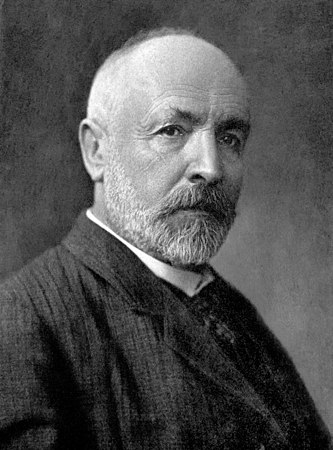
About Georg Cantor
Georg Ferdinand Ludwig Philipp Cantor (3 March 1845 – 6 January 1918) was a Russian-born German mathematician and philosopher of Danish and Austrian descent, most famous as the creator of set theory, and of Cantor's theorem which implies the existence of an "infinity of infinities."
Best Georg Cantor Quotes
Shortest
Earliest
Explore our curated collection of the most famous and impactful Georg Cantor quotes.
“Er ist aber in Kopenhagen geboren, von israelitischen Eltern, die der dortigen portugisischen Judengemeinde.”
“Every transfinite consistent multiplicity, that is, every transfinite set, must have a definite aleph as its cardinal number.”
“The essence of mathematics lies entirely in its freedom.
• Variant translation: The essence of mathematics is in its freedom.”
• Variant translation: The essence of mathematics is in its freedom.”
“There is no doubt that we cannot do without variable quantities in the sense of the potential infinite. But from this very fact the necessity of the actual infinite can be demonstrated.”
“I realize that in this undertaking I place myself in a certain opposition to views widely held concerning the mathematical infinite and to opinions frequently defended on the nature of numbers.”
“Mathematics, in the development of its ideas, has only to take account of the immanent reality of its concepts and has absolutely no obligation to examine their transient reality.”
“In re mathematica ars proponendi quaestionem pluris facienda est quam solvendi.
• Doctoral thesis (1867); variant translation: In mathematics the art of proposing a question must be held of higher value than solving it.”
• Doctoral thesis (1867); variant translation: In mathematics the art of proposing a question must be held of higher value than solving it.”
“I entertain no doubts as to the truths of the transfinites, which I recognized with God’s help and which, in their diversity, I have studied for more than twenty years; every year, and almost every day brings me further in this science.”

“The fear of infinity is a form of myopia that destroys the possibility of seeing the actual infinite, even though it in its highest form has created and sustains us, and in its secondary transfinite forms occurs all around us and even inhabits our minds.”
“This view [of the infinite], which I consider to be the sole correct one, is held by only a few. While possibly I am the very first in history to take this position so explicitly, with all of its logical consequences, I know for sure that I shall not be the last!”
“Infinity, in its first form (the improper-infinite) presents itself as a variable finite [veranderliches Endliches]; in the other form (which I call the proper infinite [Eigentlich-unendliche]) it appears as a thoroughly determinate [bestimmtes] infinite.”
“If there is some determinate succession of defined whole real numbers, among which there exists no greatest, on the basis of this second principle of generation a new number is obtained which is regarded as the limit of those numbers, i.e. is defined as the next greater number than all of them.”
“The actual infinite arises in three contexts: first when it is realized in the most complete form, in a fully independent otherworldly being, in Deo, where I call it the Absolute Infinite or simply Absolute; second when it occurs in the contingent, created world; third when the mind grasps it in abstracto as a mathematical magnitude, number or order type.”
“What I assert and believe to have demonstrated in this and earlier works is that following the finite there is a transfinite (which one could also call the supra-finite), that is an unbounded ascending ladder of definite modes, which by their nature are not finite but infinite, but which just like the finite can be determined by well-defined and distinguishable numbers.”
“My theory stands as firm as a rock; every arrow directed against it will return quickly to its archer. How do I know this? Because I have studied it from all sides for many years; because I have examined all objections which have ever been made against the infinite numbers; and above all because I have followed its roots, so to speak, to the first infallible cause of all created things.”
“As for the mathematical infinite, to the extent that it has found a justified application in science and contributed to its usefulness, it seems to me that it has hitherto appeared principally in the role of a variable quantity, which either grows beyond all bounds or diminishes to any desired minuteness, but always remains finite. I call this the improper infinite [das Uneigentlich-unendliche].”
“That from the outset they expect or even impose all the properties of finite numbers upon the numbers in question, while on the other hand the infinite numbers, if they are to be considered in any form at all, must (in their contrast to the finite numbers) constitute an entirely new kind of number, whose nature is entirely dependent upon the nature of things and is an object of research, but not of our arbitrariness or prejudices.”
“What I declare and believe to have demonstrated in this work as well as in earlier papers is that following the finite there is a transfinite (transfinitum)--which might also be called supra-finite (suprafinitum), that is, there is an unlimited ascending ladder of modes, which in its nature is not finite but infinite, but which can be determined as can the finite by determinate, well-defined and distinguishable numbers.”
“In order for there to be a variable quantity in some mathematical study, the domain of its variability must strictly speaking be known beforehand through a definition. However, this domain cannot itself be something variable, since otherwise each fixed support for the study would collapse. Thus this domain is a definite, actually infinite set of values. Hence each potential infinite, if it is rigorously applicable mathematically, presupposes an actual infinite.”
“The old and oft-repeated proposition "Totum est majus sua parte" [the whole is larger than the part] may be applied without proof only in the case of entities that are based upon whole and part; then and only then is it an undeniable consequence of the concepts "totum" and "pars". Unfortunately, however, this "axiom" is used innumerably often without any basis and in neglect of the necessary distinction between "reality" and "quantity", on the one hand, and "number" and "set", on the other, precisely in the sense in which it is generally false.”
“The transfinite numbers are in a certain sense themselves new irrationalities and in fact in my opinion the best method of defining the finite irrational numbers is wholly dissimilar to, and I might even say in principle the same as, my method described above of introducing transfinite numbers. One can say unconditionally: the transfinite numbers stand or fall with the finite irrational numbers; they are like each other in their innermost being; for the former like the latter are definite delimited forms or modifications of the actual infinite.”
“Mathematics is in its development entirely free and is only bound in the self-evident respect that its concepts must both be consistent with each other, and also stand in exact relationships, ordered by definitions, to those concepts which have previously been introduced and are already at hand and established. In particular, in the introduction of new numbers, it is only obligated to give definitions of them which will bestow such a determinacy and, in certain circumstances, such a relationship to the other numbers that they can in any given instance be precisely distinguished. As soon as a number satisfies all these conditions, it can and must be regarded in mathematics as existent and real.”
Georg Cantor Quotes by Topic
Find exactly what you are looking for by browsing this categorized list of Georg Cantor quotes by topic.
Georg Cantor on Infinity 5 quotes
“Each potential infinite, if it is rigorously applicable mathematically, presupposes an actual infinite.”
Georg Cantor on Problem solving
“In mathematics the art of asking questions is more valuable than solving problems.”

Georg Cantor on History of mathematics
“In mathematics the art of asking questions is more valuable than solving problems.”

Georg Cantor on Mathematics education
“In mathematics the art of asking questions is more valuable than solving problems.”

Georg Cantor on Aleph number
“... wir nennen die ihr zukommende Cardinalzahl 'Alef-null', in Zeichen {{hebrew|ℵ0]] ... ... we call the cardinal number related to that 'Aleph-null', in symbol, {{hebrew|ℵ0]] ...”

Georg Cantor on Foundations of mathematics
“Mathematics is in its development entirely free and is only bound in the self-evident respect that its concepts must both be consistent with each other, and also stand in exact relationships, ordered by definitions, to those concepts which have previously been introduced and are already at hand and established. In particular, in the introduction of new numbers, it is only obligated to give definitions of them which will bestow such a determinacy and, in certain circumstances, such a relationship to the other numbers that they can in any given instance be precisely distinguished. As soon as a number satisfies all these conditions, it can and must be regarded in mathematics as existent and real.”
Quotes About Georg Cantor
Gain deeper perspective through quotes about Georg Cantor from others.
David Hilbert on Georg Cantor
Eli Maor on Georg Cantor
“In 1874 the German mathematician Georg Cantor made the startling discovery that there are more irrational numbers than rational ones, and more transcendental numbers than algebraic ones. In other words, rather than being oddities, most real numbers are irrational; and among irrational numbers, most are transcendental.”
Rudy Rucker on Georg Cantor
“Why was Cantor so vehemently opposed to infinitesimals? In his valuable essay, "The Metaphysics of the Calculus," Abraham Robinson suggests that Cantor already had enough problems trying to defend transfinite numbers. It seems likely that, consciously or otherwise, Cantor deemed it politically wise to go along with orthodox mathematicians on the question of infinitesimals. Cantor's stance might be compared to that of a pro-marijuana Congressional candidate who advocates harsh penalties for the sale or use of heroin.”
Jenn Shreve on Georg Cantor
“After being relegated to an obscure mid-tier university, blocked from leading journals and openly mocked by his peers, including his former mentor, the late 19th century German mathematician found refuge for his groundbreaking work on infinities in, of all places, the Roman Catholic Church … Catholic theologians welcomed Cantor's ideas, which provided a workable way of understanding mathematical infinities, as evidence that humans could grasp the infinite and could also, therefore, have a greater understanding of God, himself infinite. What a welcome relief this must have been to the chronically depressed Cantor! As John D. Barrow writes in The Infinite Book: A Short Guide to the Boundless, Timeless and Endless, Cantor "started to tell his friends that he had not been the inventor of the ideas about infinity that he had published. He was merely a mouthpiece, inspired by God to communicate parts of the mind of God to everyone else."”
Alexander Stepanov on Georg Cantor
“I discovered the works of Euler and my perception of the nature of mathematics underwent a dramatic transformation. I was de-Bourbakized, stopped believing in sets, and was expelled from the Cantorian paradise.”

About Georg Cantor
Georg Ferdinand Ludwig Philipp Cantor (3 March 1845 – 6 January 1918) was a Russian-born German mathematician and philosopher of Danish and Austrian descent, most famous as the creator of set theory, and of Cantor's theorem which implies the existence of an "infinity of infinities."