Link Copied!
Friedrich Kittler Quotes (1943-2011)
About Friedrich Kittler
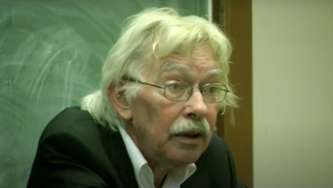
Friedrich A. Kittler (June 12, 1943 – October 18, 2011) was a literary scholar and a media theorist. His works relate to media, technology, and the military.
Best Friedrich Kittler Quotes
Shortest
Earliest
Explore our curated collection of the most famous and impactful Friedrich Kittler quotes.
“Media determine our situation.”

“Nur was schaltbar ist, ist überhaupt. [Only that which is switchable, exists.]”
“[Discourse network is ] The network of technologies and institutions that allow a given culture to select, store, and process relevant data.”

“It has become clear that real wars are fought not for people or fatherlands, but take place between different media, information technologies, data flows.”

“Take the concept of media from there – in a step also beyond McLuhan – to where it is most at home: the field of physics in general and telecommunications in particular”


“Storing information and transmitting information without having to employ such obscure instances as the human ‘spirit’ or ‘soul’: such is the very definition of media.
There is no software”
“In the case of Marshall McLuhan, you can prove that every fifth sentence is wrong and every tenth is funny and very ingenious. And Harold Innis never managed to get into technical details.
Last words: Alle Apparate ausschalten [Switch off all apparatuses.]”
“whether or not we personally ever use the typewriter is not important. What is important is that all of us are thrown into the age of typewriting, whether we like it or not. Of course, Heidegger himself preferred to continue his work in his own handwriting.”


“What remains of people is what media can store and communicate. What counts are not the messages or the content with which they equip so-called souls for the duration of the technological era, but rather (and in strict accordance to McLuhan) their circuits, the very schematism of their perceptibility.”
“It's always difficult to find the first sentence. And with "Discourse Networks" where everything was at stake, namely my profession, it was more difficult than ever. So I rolled a joint and wrote the first chapter, about Goethe's "Faust", mildly stoned.
Technology is far too good to knock around forever with us humans.”
“And when Liesegang edited his Contributions to the Problem of Electrical Television in 1899, thus naming the medium, the principle had already been converted into a basic circuit. Television was and is not a desire of so-called humans, but rather it is largely a civilian byproduct of military electronics. That much should be clear.”

“[Students today] should at least know some arithmetic, the integral function, the sine function - everything about signs and functions. They should also know at least two software languages. Then they'll be able to say something about what culture is at the moment... Cultural studies refers to and examines the most important sign systems.”

“But why people - and I include myself here — would rather sit in front of a computer than do other things such as have a conversation is difficult to explain. Perhaps it is a fascination with power. For example, in earlier times, some people directed their love away from their wives and families and directed it instead towards an image of Jesus or Mary.”

“how are culture and politics going to react to the slow demotion of their power? For both are predicated upon everyday speech and the normal human nervous system, which are both slow. However, neither speech nor the nervous system can be handled any more without machines preparing, assisting, and, in the end, even assuming some of their decision-making processes.”
“Nietzsche, as proud of the publication of his mechanization as any philosopher, changed from arguments to aphorisms, from thoughts to puns, from rhetoric to telegram style. That is precisely what is meant by the sentence "our writing tools are also working on our thoughts". Malling Hansen's writing ball, with its operating difficulties, made Nietzsche into a laconic.”

“I have some problems with Christianity, but in favor of the fact that every living being, be it plant or animal, has been begotten by the lovely union of female and male. ... like many Germans before me, including Friedrich II, Nietzsche, and to a certain extent Heidegger, I am after love that is fundamentally anti-Christian.
Rock Music: A Misuse of Military Equipment”

“These programs are called "daemons"... You never see them, and yet they're constantly doing something for you, like the angel in the medieval Angelo Loci... we should slowly let go of that old dream of sociologists, the one that says that society is by nature made up only of human beings. Today — and tomorrow — the term "society" should include people and programs.”

Friedrich Kittler Quotes by Topic
Find exactly what you are looking for by browsing this categorized list of Friedrich Kittler quotes by topic.
Friedrich Kittler on Accelerationism 2 quotes
“Media are not pseudopods for extending the human body. They follow the logic of escalation that leaves us and written history behind it... Machines... are not so much for us humans, for we are so-to-speak built much too big, but that in these machines, nature, this luminous and recognizing part of nature, interconnects with and feeds back onto itself… For the Internet exists so that computers are wiring up with computers, onto which keyboards and users can be plugged in, but don’t have to be.”
Quotes About Friedrich Kittler
Gain deeper perspective through quotes about Friedrich Kittler from others.
Niklas Luhmann on Friedrich Kittler
“Riding together in a taxi from some airport Kittler tried to explain to Luhmann that in contrast to social systems, switching circuits cannot exist without input and output. "Herr Kittler, it was like that already in Babylonia. A messenger rides through the city gate. Some [like me] ask, what kind of message he brings. Others [like you] ask what kind of horse he rides."”

Geoffrey Winthrop-Young on Friedrich Kittler
Jeffries on Friedrich Kittler
“Unlike Foucault, or indeed other leading media theorists such as Jean Baudrillard or Paul Virilio, Kittler steeped himself in physics, engineering, optics, the science of fibre-optic cables, and even wrote computer code – arguably gaining a more profound insight into media than his contemporaries.”
McCarthy on Friedrich Kittler 2 quotes
“‘Derrida of the digital age’ whose vision combined the circuitry of Lacan’s models for the psyche, and Foucault’s archaeological conception of all knowledge and its systems, with the material hardware of technological transcription and recording: typewriters, tape recorders, film projectors and their non-analogue offspring.”
Jussi Parikka on Friedrich Kittler
“For Kittler, [Geisteswissenschaften, "humanities", but more literally "spirit sciences"] to be taken to its hard core: sciences stand at the centre of arts and humanities in the age of technical media... media are not only the mass media of television, newspapers and such, but a technical constellation that at its core is based on scientific principles of coding, channeling and decoding of signals... Man is a temporary solution, a crossroad in the complex practices and epistemologies of knowledge that might (has?) proved to be not so useful anymore when media can communicated to each other without human intervention. Ask your plugged-in Ethernet cable, it knows the amount of data that goes through it without you pushing even a single key.”
Krajewski on Friedrich Kittler
“Kittler wanted to establish a real computer literacy. And our group was both the justifying nucleus of this demand and his evidence of possibility.”
Steinhoff on Friedrich Kittler
“The end of media is a situation in which the computer subsumes all other media. The machine subject appears as a sort of minimalist inhuman subjectivity wrought by recursion. It operates beyond or below the phenomenological capacities of humans, does not employ natural language, and does not think in terms of meaning. Myriad machine subjects are networked to form a loop of absolute knowledge. This loop excludes humanity which is functionally unable to participate therein. Within the loop, the machines cognize somehow in an asemantic logic and antagonistically evolve away from any semblance of humanity.”
John Armitage on Friedrich Kittler
“Brilliant, controversial and cantankerous. In his penetrating examination of our increasingly militarised and 'mediatised' existence that, he argued, replaced human agency, Kittler outlined with great energy the post-human historical condition. Perhaps his greatest academic transgression was to have such an emphatic sense of technology's triumph over the delusions of human agency, articulated in his writings on war and speed, mathematics and cryptography, in addition to the style of his claims, sculpted like a series of steps of military escalation, in imitative performance of the computerised world of total militarisation and technologisation that he portrayed.”
Source on Friedrich Kittler 4 quotes
“Kittler's speciality is the creatively enhanced misquotation... all the ameliorative sloppiness that Kittler the analyst attributes to authors of the “Discourse Network 1800” such as Goethe and Hegel, who kept bungling their quotations in highly creative self-serving ways.”
About Friedrich Kittler
Friedrich A. Kittler (June 12, 1943 – October 18, 2011) was a literary scholar and a media theorist. His works relate to media, technology, and the military.