



























































“Be sincere, be brief, be seated.”
— Franklin D. Roosevelt, Posthumous publications)

Explore our curated collection of the most famous and impactful Franklin D. Roosevelt quotes.
“Be sincere, be brief, be seated.”
“The right of every family to a decent home;”

“My friends, judge me by the enemies I have made.”

“Repetition does not transform a lie into a truth.”

“The Nation that destroys its soil destroys itself.”
“Philosophy? I am a Christian and a Democrat. That's all.”

“An American Government cannot permit Americans to starve.”

“I pledge you, I pledge myself, to a new deal for the American people.”
“If I prove a bad president, I will also likely to prove the last president.”

“It seems to me that the dedication of a library is in itself an act of faith.”
“The right to earn enough to provide adequate food and clothing and recreation;”

“We defend and we build a way of life, not for America alone, but for all mankind.”
“If you treat people right they will treat you right — ninety percent of the time.”
“The right to adequate medical care and the opportunity to achieve and enjoy good health;”
“All free peoples are deeply impressed by the courage and steadfastness of the Greek nation.”
“Are you laboring under the impression that I read these memoranda of yours? I can't even lift them.”
“No man can occupy the office of President without realizing that he is President of all the people.”
“The hopes of the Republic cannot forever tolerate either undeserved poverty or self-serving wealth.”

“We have always known that heedless self-interest was bad morals; we know now that it is bad economics.”
“The right to a useful and remunerative job in the industries or shops or farms or mines of the nation;”
“The right to adequate protection from the economic fears of old age, sickness, accident, and unemployment;”

“On this tenth day of June, 1940, the hand that held the dagger has struck it into the back of its neighbor.”

“As a nation, we may take pride in the fact that we are soft-hearted; but we cannot afford to be soft-headed.”
“I don't want to see a single war millionaire created in the United States as a result of this world disaster.”

Find exactly what you are looking for by browsing this categorized list of Franklin D. Roosevelt quotes by topic.
“Repetition does not transform a lie into a truth.”

“The real truth of the matter is, as you and I know, that a financial element in the larger centers has owned the Government ever since the days of Andrew Jackson”
“Unhappy events abroad have retaught us two simple truths about the liberty of a democratic people. The first truth is that the liberty of a democracy is not safe if the people tolerate the growth of private power to a point where it becomes stronger than their democratic State itself. That, in its essence, is fascism — ownership of government by an individual, by a group or by any other controlling private power.
The second truth is that the liberty of a democracy is not safe if its business system does not provide employment and produce and distribute goods in such a way as to sustain an acceptable standard of living. Both lessons hit home. Among us today a concentration of private power without equal in history is growing.”
“I pledge you, I pledge myself, to a new deal for the American people.”

“What we were doing in this country were some of the things that were being done in Russia and even some of the things that were being done under Hitler in Germany. But we were doing them in an orderly way.”
“A few timid people, who fear progress, will try to give you new and strange names for what we are doing. Sometimes they will call it "Fascism", sometimes "Communism", sometimes "Regimentation", sometimes "Socialism". But, in so doing, they are trying to make very complex and theoretical something that is really very simple and very practical.”
“It seems to me that the dedication of a library is in itself an act of faith.”

“To bring together the records of the past and to house them in buildings where they will be preserved for the use of men and women in the future, a Nation must believe in three things. It must believe in the past. It must believe in the future. It must, above all, believe in the capacity of its own people so to learn from the past that they can gain in judgment in creating their own future.”
“Among democracies, I think through all the recorded history of the world, the building of permanent institutions like libraries and museums for the use of all the people flourishes. And that is especially true in our own land, because we believe that people ought to work out for themselves, and through their own study, the determination of their best interest rather than accept such so-called information as may be handed out to them by certain types of self-constituted leaders who decide what is best for them.”
“Remember, remember always that all of us, and you and I especially, are descended from immigrants and revolutionists.”

“We are a nation of many nationalities, many races, many religions, bound together by a single unity, the unity of freedom and equality. Whoever seeks to set one nationality against another, seeks to degrade all nationalities. Whoever seeks to set one race against another seeks to enslave all races. Whoever seeks to set one religion against another, seeks to destroy all religion.”
“Faith in America, faith in our tradition of personal responsibility, faith in our institutions, faith in ourselves demands that we recognize the new terms of the old social contract. We shall fulfill them, as we fulfilled the obligation of the apparent Utopia which Jefferson imagined for us in 1776, and which Jefferson, Roosevelt and Wilson sought to bring to realization. We must do so, lest a rising tide of misery engendered by our common failure, engulf us all. But failure is not an American habit; and in the strength of great hope we must all shoulder our common load.”
“We can gain no lasting peace if we approach it with suspicion and mistrust or with fear. We can gain it only if we proceed with the understanding, the confidence, and the courage which flow from conviction.”

“America's own rightful place in the world depends in large part upon how fully these and similar rights have been carried into practice for all our citizens. For unless there is security here at home there cannot be lasting peace in the world.”
“World peace is not a party question. [...] The structure of world peace cannot be the work of one man, or one party, or one Nation. It cannot be just an American peace, or a British peace, or a Russian, a French, or a Chinese peace. It cannot be a peace of large Nations- or of small Nations. It must be a peace which rests on the cooperative effort of the whole world. It cannot be a structure of complete perfection at first. But it can be a peace—and it will be a peace—based on the sound and just principles of the Atlantic Charter— on the concept of the dignity of the human being—and on the guarantees of tolerance and freedom of religious worship. [...] We shall have to take the responsibility for world collaboration, or we shall have to bear the responsibility for another world conflict. [...] Peace can endure only so long as humanity really insists upon it, and is willing to work for it—and sacrifice for it.”
Discover personal opinions Franklin D. Roosevelt shared regarding contemporaries.
“It seldom helps to wonder how a statesman of one generation would surmount the crisis of another. A statesman deals with concrete difficulties — with things which must be done from day to day. Not often can he frame conscious patterns for the far off future. But the fullness of the stature of Lincoln's nature and the fundamental conflict which events forced upon his Presidency invite us ever to turn to him for help.”

“But Lincoln also understood that after such a decision, a democracy should seek peace through a new unity. For a democracy can keep alive only if the settlement of old difficulties clears the ground and transfers energies to face new responsibilities. Never can it have as much ability and purpose as it needs in that striving; the end of battle does not end the infinity of those needs. That is why Lincoln — commander of a people as well as of an army — asked that his battle end "with malice toward none, with charity for all."”
“To the hurt of those who came after him, Lincoln's plea was long denied. A generation passed before the new unity became accepted fact. In later years new needs arose, and with them new tasks, worldwide in their perplexities, their bitterness and their modes of strife. Here in our land we give thanks that, avoiding war, we seek our ends through the peaceful processes of popular government under the Constitution. It is another conflict, a conflict as fundamental as Lincoln's, fought not with glint of steel, but with appeals to reason and justice on a thousand fronts — seeking to save for our common country opportunity and security for citizens in a free society. We are near to winning this battle. In its winning and through the years may we live by the wisdom and the humanity of the heart of Abraham Lincoln.”
“So what, old top?”
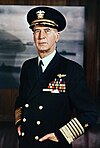
“[re Mulberry Habours] You know that was Churchill’s idea. He has a hundred a day and about four of them are good.”

“When the spirit of the people is lower than at any other time during this Depression, it is a splendid thing that for just 15 cents, an American can go to a movie and look at the smiling face of a baby and forget his troubles.”

Gain deeper perspective through quotes about Franklin D. Roosevelt from others.
“Political pundits have a saying that a great leader needs three things: brains, heart, and guts, or its modern variant, balls. Churchill, for example, had all three. Now start doing your own sums: FDR surely had all three; Nixon had brains and guts, but not much heart. Reagan had a good facsimile of a heart, but not much of a brain...”

“To a striking degree, the way the United States conducted World War II was a consequence of Roosevelt’s own experience as the assistant secretary of the Navy during World War I—a period that made him appreciate the benefits of overwhelming the enemy with machinery, as well as the risks of ground warfare. When he traveled to France in 1918 to tour the front lines, the battlefield disgusted him. The conditions for soldiers were too crowded, and he wrote in his diary that “the smell of dead horses” offended his “sensitive naval” nose. Instead, he fixated on logistics and material: the deployment of large naval guns, transported on land via train carriages, to batter German lines; a push for rapid advances in aircraft and bomb technology. He promoted a plan to thwart German U-boat attacks by creating a minefield across the entire North Sea rather than putting Allied ships at risk. (The scheme was not complete when the war ended.) Roosevelt’s work during this period also showed him the value of working closely with trusted international partners such as Britain and France. Strong alliances, he came to learn, were how modern wars were won. Unlike many Americans, Roosevelt did not become an isolationist after World War I. He understood that aggressive authoritarian regimes had to be stopped and believed that the U.S. could protect many of its own interests via machinery and alliances. He was so wedded to these two ideas that, during World War II, he provided Britain and the Soviet Union with massive amounts of aid without expecting any repayment. So much better, Roosevelt believed, to strengthen U.S. allies and let them do much of the land fighting. This approach led to one of his greatest successes as a war leader.”
“The hands of the president no longer had the sure, firm grasp of earlier years. He was not up to par physically. He complained that he "lacked pep." His sinus condition, for which Ross McIntire gave him daily treatments, failed to improve. At the end of March, McIntire finally got him to go to Bethesda Naval Hospital for a complete medical check. Lieutenant Commander Howard Bruenn, USNR, a cardiologist, presented the grim report. The president suffered from hypertension, failure of the left ventricle of the heart, hypertensive heart disease, and acute bronchitis. At sixty-two, Roosevelt's body was failing him. He could die at any time. With great care, his life might be extended a year or so. But how could the president of the United States in wartime follow a program of rest and limited activity? It couldn't be done.”
“[T]he Progressive Party, with its extravagant claims, has, therefore, imposed on itself the considerable burden of proof. The only party within recent memory which made equally strident claims of fellowship were the Communists, who failed to survive this test; and the only politician of similar claims was, of course, Henry Wallace's erstwhile master, Roosevelt, who did not after all, now that the magic of his voice is gone, succeed in raising the darker brother to the status of a citizen. This is the ancestry of the Wallace party, and it does not work wholly in its favor. It operates to give pause to even the most desperate and the most gullible.”

Quotes attributed to Franklin D. Roosevelt that are questionable.
“He's a son-of-a-bitch, but he's our son-of-a-bitch.”Original / Translation (French)“He's a son-of-a-bitch, but he's our son-of-a-bitch.”English: “Remark on Anastasio Somoza García, president of Nicaragua, first attributed to Roosevelt in Time magazine (15 November 1948), three years following Roosevelt's death and nine years after the supposed making of the statement. Archivist Donald Schewe of the FDR Library searched thousands of pages of Roosevelt's correspondence, press conferences, and records and found no evidence that FDR ever made this statement. Schewe concluded that this "was not the kind of language that Roosevelt used." See Robert A. Pastor, Condemned to Repetition: The United States and Nicaragua (Princeton University Press, 1987), p. 3”
Quotes mistakenly credited to Franklin D. Roosevelt.
“When you reach the end of your rope, tie a knot in it and hang on.”
“In politics, nothing happens by accident. If it happens you can bet it was planned that way.”
“I do not believe in communism any more than you do but there is nothing wrong with the Communists in this country; several of the best friends I have got are Communists.”