Link Copied!
Frances Perkins Quotes (1882-1965)
King



About Frances Perkins
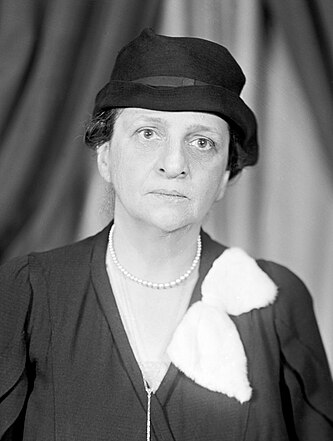
Frances Perkins (April 10, 1882 – May 14, 1965) was U.S. Secretary of Labor from 1933 to 1945. She was the first woman to serve in the U.S. Cabinet and was largely responsible for the U.S. adoption of social security, unemployment insurance, the federal minimum wage, and federal laws regulating child labor.
During her term as Secretary of Labor, Perkins executed the Civilian Conservation Corps, the Public Works Administration and its successor the Federal Works Agency, plus the labor portion of the National Industrial Recovery Act. With the Social Security Act she established unemployment benefits, pensions for the many uncovered elderly Americans and welfare for the poorest Americans. She pushed to reduce workplace accidents and helped craft laws against child labor. Through the Fair Labor Standards Act, she established the first minimum wage and overtime laws for American workers and defined the standard forty-hour work week. She formed governmental policy for working with labor unions and helped to alleviate strikes by way of the United States Conciliation Service. Perkins dealt with many labor questions during World War II when skilled labor was vital and women were moving into formerly male jobs. She is the subject of the documentary film "Summoned: Frances Perkins and the General Welfare" (2020).
During her term as Secretary of Labor, Perkins executed the Civilian Conservation Corps, the Public Works Administration and its successor the Federal Works Agency, plus the labor portion of the National Industrial Recovery Act. With the Social Security Act she established unemployment benefits, pensions for the many uncovered elderly Americans and welfare for the poorest Americans. She pushed to reduce workplace accidents and helped craft laws against child labor. Through the Fair Labor Standards Act, she established the first minimum wage and overtime laws for American workers and defined the standard forty-hour work week. She formed governmental policy for working with labor unions and helped to alleviate strikes by way of the United States Conciliation Service. Perkins dealt with many labor questions during World War II when skilled labor was vital and women were moving into formerly male jobs. She is the subject of the documentary film "Summoned: Frances Perkins and the General Welfare" (2020).
Best Frances Perkins Quotes
Shortest
Earliest
Explore our curated collection of the most famous and impactful Frances Perkins quotes.
“The day I need an armed bodyguard is the day I admit my job's too much for a woman.”
“I'm the last leaf on the New Deal tree, and I think perhaps I've clung here too long already.”
“[I] wrote to anybody I knew who had any connection at all with charities to say I wanted a job, but had no experience.”

“Organized labor has always had one of its own people as Secretary and will expect to continue to have. I do not qualify.”
“From this day forward, I will be a Doer of the Word and not as Hearer only, whenever and wherever I see the need.”
“We were in a terrible situation... Banks were closing. The economic life of the country was almost at a standstill.”
“I think any compulsion other than moral compulsion is wrong. Let disputes be settled by public opinion, not statute.”
“His arrogance isn't what disturbs me so much as his self-centeredness... He doesn't seem to care about anything that doesn't concern him personally.”
“One of the girls who was among my best friends came from a poverty-stricken home. Her family was delightful and I used to wonder how such things could happen...”
“Well... he'll only win that way once, I imagine. He doesn't look as if he'd be very popular with people. What I mean is, he doesn't look as if he really likes people.”
“It is all-important to keep the human touch in whatever we do... This is the machine age... and we should make machines work for us—but let us not act like robots ourselves!”
“I will fight for it up to the Supreme Court, if necessary... If the Industrial Commission does not have the right to make essential safety laws, it might as well close up shop!”
“Everybody who jumped, and a good many did jump from the 9th and 10th floors, was killed. The other people who died were all people who were burned or smothered by the smoke in the factory itself.”
“My generation was perhaps the first that openly and actively asserted—at least some of us did—the separateness of women and their personal independence in the family relationship...”


“He didn’t like concentrated responsibility. Agreement with other people who he thought were good, right minded, and trying to do the right thing by the world was almost as necessary to him as air to breathe.”

“Harry Bridges is a card-carrying Communist, Franklin, but that's the single black mark against him and isn't illegal. I just don't believe a man should be punished for what he believes or thinks.”
“Just let the people know that they matter to you, that your plan is to mobilize the government to help them. If you can give them hope that things will be better, they'll bless you, Franklin.”

“Women lobbyists, whatever their size, are looked at askance... Men seem to have trouble believing we have brains enough to understand the causes we're championing. ...Maybe I should have said most men.”
“[ Florence Kelley's speech] first opened my mind to the necessity for and the possibility of the work which became my vocation.”
“His illness had changed him... Having known what trouble is to the very depths of his being, he can now sympathize with other people who have problems. I think he could make a very good governor of the state of New York.”
“As a student and professional social worker, I was taking an active part in proposals to use... legislative authority... to correct social abuses—long hours, low wages, bad housing, child labor, and unsanitary conditions.”

“I am extraordinarily the product of my grandmother... Scarcely a week goes by that I don't find myself saying, "As my grandmother used to say," and then repeating something that apparently has been a guiding principle all my life.”
Frances Perkins Quotes by Topic
Find exactly what you are looking for by browsing this categorized list of Frances Perkins quotes by topic.

What Frances Perkins Said About Others
Discover personal opinions Frances Perkins shared regarding contemporaries.
Frances Perkins on Theodore Roosevelt 2 quotes
“Like many people, I was an ardent admirer of Theodore Roosevelt. ...He had recommended to the people Jacob Riis's book How the Other Half Lives. I had read it, and Theodore Roosevelt's inaugural address of 1905, and had straightaway felt that the pursuit of social justice would be my vocation.”

Frances Perkins on Florence Kelley
“Florence Kelley's speech first opened my mind to the necessity for and the possibility of the work which became my vocation.”

Frances Perkins on Franklin D. Roosevelt
“Franklin Roosevelt was then a member of the state Senate. No one who saw him in those years would have been likely to think of him as a potential President of the U.S.A. I believe that at that time [he] had little, if any, concern about specific social reforms. ...[A]rtificially serious of face, rarely smiling, with an unfortunate habit... of throwing his head up... combined with his prince-nez and great height, gave him the appearance of looking down his nose at most people. ...[T]his habit ...which when he was young and unchastened gave him a slightly supercilious appearance, later had a completely different effect. By 1933, and for the rest of his life, it was a gesture of courage and hope...”

Quotes About Frances Perkins
Gain deeper perspective through quotes about Frances Perkins from others.
Kirstin Downey on Frances Perkins 2 quotes
“[H]istorians putting the records together closer to the era in which Frances Perkins lived would have known that Frances was both a suffrage leader and a labor advocate, but scholars born later did not easily make that connection.”
Naomi Pasachoff on Frances Perkins
“[B]efore she accepted the offer she had to know if the President-elect would support her in advocating the programs she would wish to pursue as secretary of labor. ...[S]he pulled out a little slip of paper ...the list of goals about which she felt passionate. Among other items on the list were laws for minimum wages and maximum hours, for unemployment insurance and old-age insurance. ...Only when he firmly assured, "I'll back you," could she think about... accepting the offer. And so... on March 4, 1933 Frances Perkins became the first woman to serve in the United States Cabinet... The legacy of her years in office continues to affect the life of every U.S. citizen.”
Lillian Wald on Frances Perkins
“Frances Perkins brings to the Cabinet as Secretary of Labor the many years of training and experience which step by step have rounded out the preparation for her great responsibility. Even with the contribution of her vivid personality, the press, generally speaking, pays her the tribute of reporting the wisdom of the words and acts rather than idle "gossip" about the "first woman Cabinet member."”

Source on Frances Perkins 31 quotes
“Perkins' personality informed all her work. ...[W]hat Perkins chose to do was determined by her religion. Many Democrats supported the Social Security Act because it attracted votes; others, for humanitarian reasons; Perkins, "for Jesus' sake," because it brought the City of God closer to the cities of toil and industry.”
Alice Kessler-Harris on Frances Perkins
“Frances Perkins tried to... speak to a level of discontent... unhappiness... misery... [S]he was... unusually committed, unusually brave, alone in a world of men, moving into a sphere that no woman had ever moved into before. ...for all that we owe her a good deal of thanks.”
Lawrence O'Donnell on Frances Perkins 2 quotes
“There is no contribution that a cabinet member has made in the history of this country that has had the lasting kind of effect on all of us, and the way we live, than what Francis Perkins did.”
About Frances Perkins
Frances Perkins (April 10, 1882 – May 14, 1965) was U.S. Secretary of Labor from 1933 to 1945. She was the first woman to serve in the U.S. Cabinet and was largely responsible for the U.S. adoption of social security, unemployment insurance, the federal minimum wage, and federal laws regulating child labor.
During her term as Secretary of Labor, Perkins executed the Civilian Conservation Corps, the Public Works Administration and its successor the Federal Works Agency, plus the labor portion of the National Industrial Recovery Act. With the Social Security Act she established unemployment benefits, pensions for the many uncovered elderly Americans and welfare for the poorest Americans. She pushed to reduce workplace accidents and helped craft laws against child labor. Through the Fair Labor Standards Act, she established the first minimum wage and overtime laws for American workers and defined the standard forty-hour work week. She formed governmental policy for working with labor unions and helped to alleviate strikes by way of the United States Conciliation Service. Perkins dealt with many labor questions during World War II when skilled labor was vital and women were moving into formerly male jobs. She is the subject of the documentary film "Summoned: Frances Perkins and the General Welfare" (2020).
During her term as Secretary of Labor, Perkins executed the Civilian Conservation Corps, the Public Works Administration and its successor the Federal Works Agency, plus the labor portion of the National Industrial Recovery Act. With the Social Security Act she established unemployment benefits, pensions for the many uncovered elderly Americans and welfare for the poorest Americans. She pushed to reduce workplace accidents and helped craft laws against child labor. Through the Fair Labor Standards Act, she established the first minimum wage and overtime laws for American workers and defined the standard forty-hour work week. She formed governmental policy for working with labor unions and helped to alleviate strikes by way of the United States Conciliation Service. Perkins dealt with many labor questions during World War II when skilled labor was vital and women were moving into formerly male jobs. She is the subject of the documentary film "Summoned: Frances Perkins and the General Welfare" (2020).