Link Copied!
Dwight D. Eisenhower Quotes (1890-1969)
President































































About Dwight D. Eisenhower
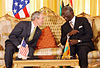
Dwight David Eisenhower (14 October 1890 – 28 March 1969), also widely known by his nickname "Ike", was an American military officer and statesman who served as the 34th president of the United States from 1953 to 1961. During World War II, he served as Supreme Commander of the Allied Expeditionary Force in Europe, and achieved the rare five-star rank of General of the Army. He was responsible for planning and supervising the invasion of North Africa in Operation Torch in 1942–1943 and the successful invasion of Normandy in 1944–1945 from the Western Front.
Best Dwight D. Eisenhower Quotes
Shortest
Earliest
Explore our curated collection of the most famous and impactful Dwight D. Eisenhower quotes.

“The government in Washington belongs to you.”
- Dwight D. Eisenhower, 1960s)

“If civilization is to survive, it must choose the rule of law.”
- Dwight D. Eisenhower, 1950s)

“It is only as we govern ourselves that we are well-governed.”
- Dwight D. Eisenhower, 1950s, Remarks on the Observation of Law Day
“May we never confuse honest dissent with disloyal subversion.”
- Dwight D. Eisenhower, 1950s)
Dwight D. Eisenhower's wry observation on the unchecked power of the presidency, first recorded in 1953, highlights the unique autonomy afforded to the office's occupant.
“There is one thing about being President — nobody can tell you when to sit down.”
- Dwight D. Eisenhower, 1950s)

“The free individual has been justified as his own master; the state as his servant.”
- Dwight D. Eisenhower, 1940s)

“The Founders conceived government as the servant, not the master of the individual.”
- Dwight D. Eisenhower, 1960s)
Delivered at the height of Cold War tensions, Eisenhower's assertion of "strength alone" reflects his staunch belief in deterrence as the only language aggressors understand.
“The hand of the aggressor is stayed by strength — and strength alone.”
- Dwight D. Eisenhower, 1950s)

“I do have one instruction for you, General. Do something about that damned football team.”
- Dwight D. Eisenhower, 1950s)

“A foundation of our American way of life is our national respect for law.”
- Dwight D. Eisenhower, 1950s, Address to the American People on the Situation in Little Rock
“Democracy is essentially a political system that recognizes the equality of humans before the law.”
- Dwight D. Eisenhower, 1940s)


“The history of free men is never really written by chance-but by choice-their choice.”
- Dwight D. Eisenhower, 1950s)

“You just can't have this kind of war. There aren't enough bulldozers to scrape the bodies off the streets.”
- Dwight D. Eisenhower, 1950s)
“The freedom of the individual and his willingness to follow real leadership are at the core of America's strength.”
- Dwight D. Eisenhower, 1940s)

“In preparing for battle, I have always found that plans are useless but planning is indispensable.”
- Dwight D. Eisenhower, 1960s)
“To blend, without coercion, the individual good and the common good is the essence of citizenship in a free country.”
- Dwight D. Eisenhower, 1940s)

“The true purpose of education is to prepare young men and women for effective citizenship in a free form of government.”
- Dwight D. Eisenhower, 1950s)
“We believe in the principle that governments are properly established only when it is with the consent of the governed.”
- Dwight D. Eisenhower, 1950s)
While often misattributed to Mark Twain, Eisenhower popularized the sentiment that determination outweighs physical stature, drawing on earlier, similar expressions from the early 20th century.
“What counts is not necessarily the size of the dog in the fight — it's the size of the fight in the dog.”
- Dwight D. Eisenhower, 1950s)
“The free world knows, out of the bitter wisdom of experience, that vigilance and sacrifice are the price of liberty.”
- Dwight D. Eisenhower, 1950s, The Chance for Peace

“The gravity of the time is such that every new avenue of peace, no matter how dimly discernible, should be explored.”
- Dwight D. Eisenhower, 1950s, Atoms for Peace

Expressing unwavering resolve in the fight for equality, this statement to Adam Clayton Powell Jr. underscores the speaker's commitment to eliminating second-class citizenship in America.
“We have not taken and we shall not take a single backward step. There must be no second class citizens in this country.”
- Dwight D. Eisenhower, 1950s)

In October 1945, amidst post-war uncertainty, General Eisenhower publicly stated he believed Hitler might still be alive, fueling speculation about the Nazi leader's fate.
“I thought so at first, but there is reason to believe that he is still alive. But that in itself does not constitute a problem.”
- Dwight D. Eisenhower, 1940s)

“Humility must always be the portion of any man who receives acclaim earned in blood of his followers and sacrifices of his friends.”
- Dwight D. Eisenhower, 1940s)

“Our time of national political debate is almost ended. The clamor of these days will soon subside. And your day of thoughtful decision swiftly nears.”
- Dwight D. Eisenhower, 1950s, Address at the Philadelphia Convention Hall
“We are—proudly—a people with no sense of class or caste. We judge no man by his name or inheritance, but by what he does—and for what he stands.”
- Dwight D. Eisenhower, 1950s, Address at the Philadelphia Convention Hall

“I believe as long as we allow conditions to exist that make for second-class citizens, we are making of ourselves less than first-class citizens.”
- Dwight D. Eisenhower, 1950s, Remarks at the United Negro College Fund luncheon
Overwhelmed yet determined, Dwight D. Eisenhower confided in his wife, Mamie, about the immense responsibility of leading Operation Overlord, using the colloquialism "the whole shebang."
“I'm going to command the whole shebang.”
- Dwight D. Eisenhower, 1940s)
“Now I think, speaking roughly, by leadership we mean the art of getting someone else to do something that you want done because he wants to do it.”
- Dwight D. Eisenhower, 1950s)
Speaking during crises in Eastern Europe and the Middle East, President Eisenhower linked true peace to global justice and adherence to international law in 1956.
“The peace we seek and need means much more than mere absence of war. It means the acceptance of law, and the fostering of justice, in all the world.”
- Dwight D. Eisenhower, 1950s)

“Un-American activity cannot be prevented or routed out by employing un-American methods; to preserve freedom we must use the tools that freedom provides.”
- Dwight D. Eisenhower, 1960s)

“A nation's hope of lasting peace cannot be firmly based upon any race in armaments but rather upon just relations and honest understanding with all other nations.”
- Dwight D. Eisenhower, 1950s, The Chance for Peace

“There is -- in world affairs -- a steady course to be followed between an assertion of strength that is truculent and a confession of helplessness that is cowardly.”
- Dwight D. Eisenhower, 1950s)

“It is the firm duty of each of our free citizens and of every free citizen everywhere to place the cause of his country before the comfort, the convenience of himself.”
- Dwight D. Eisenhower, 1950s, First Inaugural Address
“Of these greater things I speak to you tonight. It seems to me right to do so here, in Philadelphia, where our forefathers defined the principles by which our nation was born and has ever lived.”
- Dwight D. Eisenhower, 1950s, Address at the Philadelphia Convention Hall

“The essence of leadership is to get others to do something because they think you want it done and because they know it is worth while doing -- that is what we are talking about.”
- Dwight D. Eisenhower, 1950s)
“I propose to use whatever authority exists in the office of the President to end segregation in the District of Columbia, including the Federal Government, and any segregation in the Armed Forces.”
- Dwight D. Eisenhower, 1950s, Annual Message to Congress
“Disarmament, with mutual honor and confidence, is a continuing imperative. Together we must learn how to compose differences, not with arms, but with intellect and decent purpose.”
- Dwight D. Eisenhower, 1960s, Farewell address

“From this day forward, the millions of our school children will daily proclaim in every city, every village, and every rural schoolhouse, the dedication of our nation and our people to the Almighty.”
- Dwight D. Eisenhower, 1950s)

“In such a world—at such a time---"a decent respect for the opinion of mankind"—in the words of our Declaration of Independence—requires that we state plainly the purposes we seek, the principles we hold.”
- Dwight D. Eisenhower, 1950s, Address at the Philadelphia Convention Hall
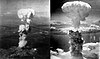
General Dwight D. Eisenhower, in 1963, expressed his opposition to the atomic bombings of Japan, arguing the surrender was imminent and fearing the precedent set by American use of such a weapon.
“I was against it on two counts. First, the Japanese were ready to surrender, and it wasn't necessary to hit them with that awful thing. Second, I hated to see our country be the first to use such a weapon.”
- Dwight D. Eisenhower, 1960s)
“Here in America we are descended in blood and in spirit from revolutionaries and rebels—men and women who dared to dissent from accepted doctrine. As their heirs, may we never confuse honest dissent with disloyal subversion.”
- Dwight D. Eisenhower, 1950s)

“In many ways, from cutting budget, reducing expenses, keeping down, for example, in every field that I know, we have tried to be on the conservative, middle-of-the-road side. But that has not apparently been publicized sufficiently.”
- Dwight D. Eisenhower, 1950s)

“One hundred eighty years later, we know that the eyes of the world are fixed upon us. And we must ask ourselves: what kind of an example of freedom do we give to our age? What are the true marks of our America—and what do they mean to the world?”
- Dwight D. Eisenhower, 1950s, Address at the Philadelphia Convention Hall

“I like to believe that people in the long run are going to do more to promote peace than our governments. Indeed, I think that people want peace so much that one of these days governments had better get out of the way and let them have it.”
- Dwight D. Eisenhower, 1950s)

“The right of no nation depends upon the date of its birth or the size of its power. As there can be no second class citizens before the law of America, so—we believe—there can be no second-class nations before the law of the world community.”
- Dwight D. Eisenhower, 1950s, Address at the Philadelphia Convention Hall

“I believe that the United States as a government, if it is going to be true to its own founding documents, does have the job of working toward that time when there is no discrimination made on such inconsequential reason as race, color, or religion.”
- Dwight D. Eisenhower, 1950s)

“We are so proud of our guarantees of freedom in thought and speech and worship, that, unconsciously, we are guilty of one of the greatest errors that ignorance can make — we assume our standard of values is shared by all other humans in the world.”
- Dwight D. Eisenhower, 1960s)
“It is unwise to make education too cheap. If everything is provided freely, there is a tendency to put no value on anything. Education must always have a certain price on it; even as the very process of learning itself must always require individual effort and initiative.”
- Dwight D. Eisenhower, 1950s)

“Respecting the United Nations as the living sign of all people's hope for peace, we shall strive to make it not merely an eloquent symbol but an effective force. And in our quest for an honorable peace, we shall neither compromise, nor tire, nor ever cease.”
- Dwight D. Eisenhower, 1950s, First Inaugural Address
“Conceiving the defense of freedom, like freedom itself, to be one and indivisible, we hold all continents and peoples in equal regard and honor. We reject any insinuation that one race or another, one people or another, is in any sense inferior or expendable.”
- Dwight D. Eisenhower, 1950s, First Inaugural Address
“This is a long tough road we have to travel. The men that can do things are going to be sought out just as surely as the sun rises in the morning. Fake reputations, habits of glib and clever speech, and glittering surface performance are going to be discovered.”
- Dwight D. Eisenhower, 1940s)

“Don't join the book burners. Don't think you are going to conceal faults by concealing evidence that they ever existed. Don't be afraid to go in your library and read every book, as long as that document does not offend our own ideas of decency. That should be the only censorship.”
- Dwight D. Eisenhower, 1950s)
“Without God, there could be no American form of Government, nor an American way of life. Recognition of the Supreme Being is the first—the most basic—expression of Americanism. Thus the Founding Fathers saw it, and thus, with God's help, it will continue to be.”
- Dwight D. Eisenhower, 1950s)
“All the historic precedents, the soaring graphs, the staggering statistics—these measure size more than substance. And the largeness and greatness of our nation would be almost a mockery—without a matching greatness of heart and largeness of vision as we look out upon the world.”
- Dwight D. Eisenhower, 1950s, Address at the Philadelphia Convention Hall
“Contemplating the cost of modern war, Ike exclaimed one day: "You might as well go out and shoot everyone you see then shoot yourself."Newton (2011) p. 261. Citation (p. 299): Ann Whitman, March 5, 1959, entry, March 1959 (2) folder, box 10 ACW Diary Series, Whitman File.”
- Dwight D. Eisenhower, 1950s, from Jim Newton

“[James R. Killian] saw Eisenhower a few months before his death. The former President asked about "my scientists" and said, "You know, Jim, this bunch of scientists was one of the few groups that I encountered in Washington who seemed to be there to help the country and not themselves."”
- Dwight D. Eisenhower, 1960s)

“May the light of freedom, coming to all darkened lands, flame brightly — until at last the darkness is no more. May the turbulence of our age yield to a true time of peace, when men and nations shall share a life that honors the dignity of each, the brotherhood of all.”
- Dwight D. Eisenhower, 1950s, Second Inaugural Address

“We –finally—look upon change, the every-unfolding future, with confidence rather than doubt, hope rather than fear. We, as a people, were born of revolution. And we have lived by change—always a frontier people, exploring—if not new wilderness—then new science and new knowledge.”
- Dwight D. Eisenhower, 1950s, Address at the Philadelphia Convention Hall
“No people on earth can be held, as a people, to be an enemy, for all humanity shares the common hunger for peace and fellowship and justice. ... No nation's security and well-being can be lastingly achieved in isolation but only in effective cooperation with fellow-nations.”
- Dwight D. Eisenhower, 1950s, The Chance for Peace

“It is my personal conviction that almost any one of the newborn states of the world would far rather embrace Communism or any other form of dictatorship than acknowledge the political domination of another government, even though that brought to each citizen a far higher standard of living.”
- Dwight D. Eisenhower, 1960s)
“The United States strongly seeks a lasting agreement for the discontinuance of nuclear weapons tests. We believe that this would be an important step toward reduction of international tensions and would open the way to further agreement on substantial measures of disarmament.”
- Dwight D. Eisenhower, 1950s)
“The purpose of the United States, in stating these proposals, is simple. [...] They aspire to this: the lifting, from the backs and from the hearts of men, of their burden of arms and of fears, so that they may find before them a golden age of freedom and of peace.”
- Dwight D. Eisenhower, 1950s, The Chance for Peace

“In June of 1776, Richard Henry Lee, rising before the Continental Congress to move his resolution for American independence, declared: "The eyes of Europe are fixed upon us; she demands of us a living example of freedom."”
- Dwight D. Eisenhower, 1950s, Address at the Philadelphia Convention Hall

“This we do know: a world that begins to witness the rebirth of trust among nations can find its way to a peace that is neither partial nor punitive. With all who will work in good faith toward such a peace, we are ready, with renewed resolve, to strive to redeem the near-lost hopes of our day.”
- Dwight D. Eisenhower, 1950s, The Chance for Peace
“I share the sense of shock and dismay that the entire nation must feel at the despicable act that took the life of the nation's president. On the personal side, Mrs. Eisenhower and I share the grief that Mrs. Kennedy must now feel. We send to her our prayerful thoughts and sympathetic sentiments in this hour.”
- Dwight D. Eisenhower, 1960s)
“I think the women, therefore, must be concerned with these values, and I return to my statement that if a political party does not have its foundation in the determination to advance a cause that is right and that is moral, then it is not a political party; it is merely a conspiracy to seize power.”
- Dwight D. Eisenhower, 1950s)

“Yet the promise of this life is imperiled by the very genius that has made it possible. Nations amass wealth. Labor sweats to create—and turns out devices to level not only mountains but also cities. Science seems ready to confer upon us, as its final gift, the power to erase human life from this planet.”
- Dwight D. Eisenhower, 1950s, First Inaugural Address

“The United States would seek more than the mere reduction or elimination of atomic materials for military purposes. It is not enough to take this weapon out of the hands of the soldiers. It must be put into the hands of those who will know how to strip its military casing and adapt it to the arts of peace.”
- Dwight D. Eisenhower, 1950s, Atoms for Peace

“War is mankind's most tragic and stupid folly; to seek or advise its deliberate provocation is a black crime against all men. Though you follow the trade of the warrior, you do so in the spirit of Washington — not of Genghis Khan. For Americans, only threat to our way of life justifies resort to conflict.”
- Dwight D. Eisenhower, 1940s)
Attributed to Eisenhower but later debunked by his aide, this statement endorsing the John Birch Society highlights the complexities of Cold War political rhetoric.
“The John Birch Society is a good, patriotic society. I don't agree with what its founder said about me, but that does not detract from the fact that its membership is comprised of many fine Americans dedicated to the preservation of our libertarian Republic.”

“Realizing that common sense and common decency alike dictate the futility of appeasement, we shall never try to placate an aggressor by the false and wicked bargain of trading honor for security. Americans, indeed all free men, remember that in the final choice a soldier's pack is not so heavy a burden as a prisoner's chains.”
- Dwight D. Eisenhower, 1950s, First Inaugural Address
“Recognizing economic health as an indispensable basis of military strength and the free world's peace, we shall strive to foster everywhere, and to practice ourselves, policies that encourage productivity and profitable trade. For the impoverishment of any single people in the world means danger to the well-being of all other peoples.”
- Dwight D. Eisenhower, 1950s, First Inaugural Address

Speaking to Republican state chairmen in 1955, President Eisenhower defines the Republican Party as embodying "moderate progressive and dynamic conservative" ideals within a framework of peace and prosperity.
“In attempting to summarize the philosophy of the Republican Party I, myself, have sometimes used such phrases as moderate progressive and dynamic conservative, because we want to be known for what we are, the party of progress. And if we are the party of progress, we must be the party of peace and prosperity, because this is implicit in the term "progress."”
- Dwight D. Eisenhower, 1950s)
“These proposals spring, without ulterior motive or political passion, from our calm conviction that the hunger for peace is in the hearts of all people -- those of Russia and of China no less than of our own country. They conform to our firm faith that God created man to enjoy, not destroy, the fruits of the earth and of their own toil.”
- Dwight D. Eisenhower, 1950s, The Chance for Peace
“You have broader considerations that might follow what you would call the falling domino principle. You have a row of dominoes set up. You knock over the first one, and what will happen to the last one is the certainty that it will go over very quickly. So you could have the beginning of a disintegration that would have the most profound influences.”
- Dwight D. Eisenhower, 1950s)
Speaking to defense executives in 1957, Eisenhower highlighted the crucial yet adaptable nature of planning, emphasizing its value over rigid adherence in emergencies.
“I tell this story to illustrate the truth of the statement I heard long ago in the Army: ''Plans are worthless, but planning is everything.''''' There is a very great distinction because when you are planning for an emergency you must start with this one thing: the very definition of "emergency" is that it is unexpected, therefore it is not going to happen the way you are planning.'''”
- Dwight D. Eisenhower, 1950s)
“I would not want to sit down this evening without urging one thing: if we are going to continue to be proud that we are Americans, there must be no weakening of the code by which we have lived; by the right to meet your accuser face to face, if you have one; by your right to go to the church or the synagogue or even the mosque of your own choosing; by your right to speak your mind and be protected in it.”
- Dwight D. Eisenhower, 1950s, Speech to the B'nai B'rith
“One circumstance that helped our character development: we were needed. I often think today of what an impact could be made if children believed they were contributing to a family's essential survival and happiness. In the transformation from a rural to an urban society, children are — though they might not agree — robbed of the opportunity to do genuinely responsible work.”
- Dwight D. Eisenhower, 1960s)

“Men like these—men by the millions—have deepened and defined our very understanding of what is true and just in the wide world from which they came. We know—as our forefathers knew—the firm ground on which our beliefs must stand. Freedom is rooted in the certainty that the brotherhood of all men springs from the Fatherhood of God. And thus, even as each man is his brother's keeper, no man is another's master.”
- Dwight D. Eisenhower, 1950s, Address at the Philadelphia Convention Hall

“Censorship, in my opinion, is a stupid and shallow way of approaching the solution to any problem. Though sometimes necessary, as witness a professional and technical secret that may have a bearing upon the welfare and very safety of this country, we should be very careful in the way we apply it, because in censorship always lurks the very great danger of working to the disadvantage of the American nation.”
- Dwight D. Eisenhower, 1950s)
“As we peer into society's future, '''we -- you and I, and our government -- must avoid the impulse to live only for today, plundering for our own ease and convenience the precious resources of tomorrow. We cannot mortgage the material assets of our grandchildren without risking the loss also of their political and spiritual heritage. We want democracy to survive for all generations to come, not to become the insolvent phantom of tomorrow."”
- Dwight D. Eisenhower, 1960s, Farewell address

“Throughout America's adventure in free government, our basic purposes have been to keep the peace, to foster progress in human achievement, and to enhance liberty, dignity and integrity among peoples and among nations. To strive for less would be unworthy of a free and religious people. Any failure traceable to arrogance or our lack of comprehension or readiness to sacrifice would inflict upon us grievous hurt, both at home and abroad.”
- Dwight D. Eisenhower, 1960s, Farewell address
“So it is that the laws most binding us as a people are laws of the spirit—proclaimed in church and synagogue and mosque. These are the laws that truly declare the eternal equality of all men, of all races, before the man-made laws of our land. And we are profoundly aware that—in the world—we can claim the trust of hundreds of millions of people, across Africa and Asia—only as we ourselves hold high the banner of justice for all.”
- Dwight D. Eisenhower, 1950s, Address at the Philadelphia Convention Hall
“It was my hope that this localized situation would be brought under control by city and State authorities. If the use of local police powers had been sufficient, our traditional method of leaving the problems in those hands would have been pursued. But when large gatherings of obstructionists made it impossible for the decrees of the Court to be carried out, both the law and the national interest demanded that the President take action.”
- Dwight D. Eisenhower, 1950s, Address to the American People on the Situation in Little Rock
“We have erased segregation in those areas of national life to which Federal authority clearly extends. So doing in this, my friends, we have neither sought nor claimed partisan credit, and all such actions are nothing more -- nothing less than the rendering of justice. And we have always been aware of this great truth: the final battle against intolerance is to be fought -- not in the chambers of any legislature -- but in the hearts of men.”
- Dwight D. Eisenhower, 1950s)
“This faith rules our whole way of life. It decrees that we, the people, elect leaders not to rule but to serve. It asserts that we have the right to choice of our own work and to the reward of our own toil. It inspires the initiative that makes our productivity the wonder of the world. And it warns that any man who seeks to deny equality among all his brothers betrays the spirit of the free and invites the mockery of the tyrant.”
- Dwight D. Eisenhower, 1950s, First Inaugural Address
“I do not believe that all of these problems can be solved just by a new law, or something that someone says, with teeth in it. For example, when we got into the Little Rock thing, it was not my province to talk about segregation or desegregation. I had the job of supporting a federal court that had issued a proper order under the Constitution, and where compliance was prevented by action that was unlawful.”
- Dwight D. Eisenhower, 1950s)
“When I was a small boy in Kansas, a friend of mine and I went fishing and as we sat there in the warmth of the summer afternoon on a river bank, we talked about what we wanted to do when we grew up. I told him that I wanted to be a real major league baseball player, a genuine professional like Honus Wagner. My friend said that he'd like to be President of the United States. Neither of us got our wish.”

Written in advance of the Normandy invasion, this undelivered announcement reveals Eisenhower's willingness to accept full responsibility had the D-Day landings failed.
“Our landings in the Cherbourg-Havre area have failed to gain a satisfactory foothold and I have withdrawn the troops. My decision to attack at this time and place was based on the best information available. The troops, the air and the Navy did all that bravery and devotion to duty could do. If any blame or fault attaches to the attempt, it is mine alone.”
- Dwight D. Eisenhower, 1940s)
“The hunger for peace is too great, the hour in history too late, for any government to mock men's hopes with mere words and promises and gestures. [...] There is, before all peoples, a precarious chance to turn the black tide of events. If we failed to strive to seize this chance, the judgment of future ages will be harsh and just. If we strive but fail and the world remains armed against itself, it at least would need be divided no longer in its clear knowledge of who has condemned humankind to this fate.”
- Dwight D. Eisenhower, 1950s, The Chance for Peace

“We love America.
Why are we proud? We are proud, first of all, because from the beginning of this nation, a man can walk upright, no matter who he is, or who she is. He can walk upright and meet his friend — or his enemy; and he does not fear that because that enemy may be in a position of great power that he can be suddenly thrown in jail to rot there without charges and with no recourse to justice. We have the habeas corpus act and we respect it.”
Why are we proud? We are proud, first of all, because from the beginning of this nation, a man can walk upright, no matter who he is, or who she is. He can walk upright and meet his friend — or his enemy; and he does not fear that because that enemy may be in a position of great power that he can be suddenly thrown in jail to rot there without charges and with no recourse to justice. We have the habeas corpus act and we respect it.”
- Dwight D. Eisenhower, 1950s, Speech to the B'nai B'rith
“Once he called upon General McClellan, and the President went over to the General's house — a process which I assure you has been reversed long since — and General McClellan decided he did not want to see the President, and went to bed.
Lincoln's friends criticized him severely for allowing a mere General to treat him that way. And he said, "All I want out of General McClellan is a victory, and if to hold his horse will bring it, I will gladly hold his horse."”
Lincoln's friends criticized him severely for allowing a mere General to treat him that way. And he said, "All I want out of General McClellan is a victory, and if to hold his horse will bring it, I will gladly hold his horse."”
- Dwight D. Eisenhower, 1950s)
“We now stand ten years past the midpoint of a century that has witnessed four major wars among great nations. Three of these involved our own country. Despite these holocausts, America is today the strongest, the most influential, and most productive nation in the world. Understandably proud of this pre-eminence, we yet realize that America's leadership and prestige depend, not merely upon our unmatched material progress, riches and military strength, but on how we use our power in the interests of world peace and human betterment.”
- Dwight D. Eisenhower, 1960s, Farewell address
Dwight D. Eisenhower, despite being limited to two terms himself, expressed his belief in the American people's ability to choose their president, regardless of term limits.
“But I believe this: by and large, the United States ought to be able to choose for its President anybody that it wants, regardless of the number of terms he has served. That is what I believe. Now, some people have said "You let him get enough power and this will lead toward a one-party government." That, I don't believe. I have got the utmost faith in the long-term common sense of the American people. Therefore, I don't think there should be any inhibitions other than those that were in the 35-year age limit and so on. I think that was enough, myself.”
- Dwight D. Eisenhower, 1950s)
“We are a people born of many peoples. Our culture, our skills, our very aspirations have been shaped by immigrants—and their sons and daughters—from all the earth. Sam Gompers from England, Andrew Carnegie from Scotland, Albert Einstein from Germany—and Booker T. Washington and Al Smith—Marconi and Caruso—men of all nations and races and estates—they have made us what we are.”
- Dwight D. Eisenhower, 1950s, Address at the Philadelphia Convention Hall
“Character in many ways is everything in leadership. It is made up of many things, but I would say character is really integrity. When you delegate something to a subordinate, for example, it is absolutely your responsibility, and he must understand this. You as a leader must take complete responsibility for what the subordinate does. I once said, as a sort of wisecrack, that leadership consists of nothing but taking responsibility for everything that goes wrong and giving your subordinates credit for everything that goes well.”
- Dwight D. Eisenhower, 1960s)

“We face a hostile ideology; global in scope, atheistic in character, ruthless in purpose and insidious in method. Unhappily the danger it poses promises to be of indefinite duration. To meet it successfully there is call for not so much the emotional and transitory sacrifices of questions but rather those which enable us to carry forward steadily, surely and without complaint the burdens of a prolonged and complex struggle with liberty the stake. Only thus shall we remain despite every provocation on our charted course towards permanent peace and human betterment.”
- Dwight D. Eisenhower, 1960s, Farewell address
“We were depending on considerable assistance from the insurrectionists in France. Throughout France the Free French had been of inestimable value in the campaign. ... Without their great assistance the liberation of France and the defeat of the enemy in Western Europe would have consumed a much longer time and meant greater losses to ourselves.”

“During the long lane of the history yet to be written, America knows that this world of ours, ever growing smaller, must avoid becoming a community of dreadful fear and hate, and be, instead, a proud confederation of mutual trust and respect. Such a confederation must be one of equals. The weakest must come to the conference table with the same confidence as do we, protected as we are by our moral, economic, and military strength. That table, though scarred by many past frustrations, cannot be abandoned for the certain agony of the battlefield.”
- Dwight D. Eisenhower, 1960s, Farewell address
“No free people can for long cling to any privilege or enjoy any safety in economic solitude. For all our own material might, even we need markets in the world for the surpluses of our farms and our factories. Equally, we need for these same farms and factories vital materials and products of distant lands. This basic law of interdependence, so manifest in the commerce of peace, applies with thousand-fold intensity in the event of war. So we are persuaded by necessity and by belief that the strength of all free peoples lies in unity; their danger, in discord.”
- Dwight D. Eisenhower, 1950s, First Inaugural Address
“Ladies and gentlemen, the things that make us proud to be Americans are of the soul and of the spirit. They are not the jewels we wear, or the furs we buy, the houses we live in, the standard of living, even, that we have. All these things are wonderful to the esthetic and to the physical senses.
But let us never forget that the deep things that are American are the soul and the spirit. The Statue of Liberty is not tired, and not because it is made of bronze. It is because no matter what happens, here the individual is dignified because he is created in the image of his God. Let us not forget it.”
But let us never forget that the deep things that are American are the soul and the spirit. The Statue of Liberty is not tired, and not because it is made of bronze. It is because no matter what happens, here the individual is dignified because he is created in the image of his God. Let us not forget it.”
- Dwight D. Eisenhower, 1950s, Speech to the B'nai B'rith
“The work of Dr. Salk is in the highest tradition of selfless and dedicated medical research. He has provided a means for the control of a dread disease. By helping scientists in other countries with technical information; by offering to them the strains of seed virus and professional aid so that the production of vaccine can be started by them everywhere; by welcoming them to his laboratory that they may gain a fuller knowledge, Dr. Salk is a benefactor of mankind.
His achievement, a credit to our entire scientific community, does honor to all the people of the United States.”
His achievement, a credit to our entire scientific community, does honor to all the people of the United States.”
- Dwight D. Eisenhower, 1950s)
“I feel impelled to speak today in a language that in a sense is new--one which I, who have spent so much of my life in the military profession, would have preferred never to use. That new language is the language of atomic warfare. The atomic age has moved forward at such a pace that every citizen of the world should have some comprehension, at least in comparative terms, of the extent of this development of the utmost significance to every one of us. Clearly, if the people of the world are to conduct an intelligent search for peace, they must be armed with the significant facts of today's existence.”
- Dwight D. Eisenhower, 1950s, Atoms for Peace

“Should any political party attempt to abolish social security, unemployment insurance, and eliminate labor laws and farm programs, you would not hear of that party again in our political history. There is a tiny splinter group, of course, that believes you can do these things. Among them are H. L. Hunt (you possibly know his background), a few other Texas oil millionaires, and an occasional politician or business man from other areas. Their number is negligible and they are stupid.”
- Dwight D. Eisenhower, 1950s)
In a 1955 speech, President Eisenhower coined the term "dynamic conservatism" to define the Republican Party's approach: preserving core values while adapting to modern challenges.
“I have tried to find a phrase in which to define what the Republican Party has done at home. I have said we were "progressive moderates." Right at the moment I rather favor the term "dynamic conservatism." I believe we should be conservative. I believe we should conserve on everything that is basic to our system. We should be dynamic in applying it to the problems of the day so that all 163 million Americans will profit from it. So for the moment I would say the record at home has been dynamic conservatism. You can go into the fields of agriculture, of the freedoms that have been restored to our economy, to the tax system-to everything we have done.”
- Dwight D. Eisenhower, 1950s)

“The free world, at least dimly aware of these facts, has naturally embarked on a large program of warning and defense systems. That program will be accelerated and extended. But let no one think that the expenditure of vast sums for weapons and systems of defense can guarantee absolute safety for the cities and citizens of any nation. The awful arithmetic of the atomic bomb does not permit of any such easy solution. Even against the most powerful defense, an aggressor in possession of the effective minimum number of atomic bombs for a surprise attack could probably place a sufficient number of his bombs on the chosen targets to cause hideous damage.”
- Dwight D. Eisenhower, 1950s, Atoms for Peace
“During one meeting, when a top Eisenhower economic advisor droned on about what it would take to reconstruct the dollar in the aftermath of a nuclear war, Eisenhower interrupted, "Wait a minute, boys. We're not going to be reconstructing the dollar. We're going to be grubbing for worms."Newton (2011) p. 261. Citation (p. 299): John Eisenhower, interview with Newton, Oct. 7, 2010. On p. 261 this followed a comment that, "Total war," American planners had acknowledged by the end of 1956, "could bring about such extensive destruction as to threaten the survival of both Western civilization and the Soviet system."”
- Dwight D. Eisenhower, 1950s, from Jim Newton

“Kinship among nations is not determined in such measurements as proximity of size and age. Rather we should turn to those inner things — call them what you will — I mean those intangibles that are the real treasures free men possess. To preserve his freedom of worship, his equality before law, his liberty to speak and act as he sees fit, subject only to provisions that he trespass not upon similar rights of others — a Londoner will fight. So will a citizen of Abilene. When we consider these things, then the valley of the Thames draws closer to the farms of Kansas and the plains of Texas.”
- Dwight D. Eisenhower, 1940s)
First appearing in a 1958 collection of stories for children, this passage emphasizes integrity as the foundational quality for leadership across diverse fields.
“In order to be a leader a man must have followers. And to have followers, a man must have their confidence. Hence, the supreme quality for a leader is unquestionably integrity. Without it, no real success is possible, no matter whether it is on a section gang, a football field, in an army, or in an office. If a man's associates find him guilty of being phony, if they find that he lacks forthright integrity, he will fail. His teachings and actions must square with each other. The first great need, therefore, is integrity and high purpose.
• Variant: The supreme quality for leadership is unquestionably integrity. Without it, no real success is possible, no matter whether it is on a section gang, a football field, in an army, or in an office.”
- Dwight D. Eisenhower, 1950s)

“Against the dark background of the atomic bomb, the United States does not wish merely to present strength, but also the desire and the hope for peace. The coming months will be fraught with fateful decisions. In this Assembly; in the capitals and military headquarters of the world; in the hearts of men every where, be they governors, or governed, may they be decisions which will lead this work out of fear and into peace. To the making of these fateful decisions, the United States pledges before you--and therefore before the world--its determination to help solve the fearful atomic dilemma--to devote its entire heart and mind to find the way by which the miraculous inventiveness of man shall not be dedicated to his death, but consecrated to his life.”
- Dwight D. Eisenhower, 1950s, Atoms for Peace
“Occasional pages of history do record the faces of the "Great Destroyers" but the whole book of history reveals mankind's never-ending quest for peace, and mankind's God-given capacity to build. It is with the book of history, and not with isolated pages, that the United States will ever wish to be identified. My country wants to be constructive, not destructive. It wants agreement, not wars, among nations. It wants itself to live in freedom, and in the confidence that the people of every other nation enjoy equally the right of choosing their own way of life. So my country's purpose is to help us move out of the dark chamber of horrors into the light, to find a way by which the minds of men, the hopes of men, the souls of men every where, can move forward toward peace and happiness and well being.”
- Dwight D. Eisenhower, 1950s, Atoms for Peace
“Abhorring war as a chosen way to balk the purposes of those who threaten us, we hold it to be the first task of statesmanship to develop the strength that will deter the forces of aggression and promote the conditions of peace. For, as it must be the supreme purpose of all free men, so it must be the dedication of their leaders, to save humanity from preying upon itself. In the light of this principle, we stand ready to engage with any and all others in joint effort to remove the causes of mutual fear and distrust among nations, so as to make possible drastic reduction of armaments. The sole requisites for undertaking such effort are that—in their purpose—they be aimed logically and honestly toward secure peace for all; and that—in their result— they provide methods by which every participating nation will prove good faith in carrying out its pledge.”
- Dwight D. Eisenhower, 1950s, First Inaugural Address
“I am convinced that the French could not win the war because the internal political situation in Vietnam, weak and confused, badly weakened their military position. I have never talked or corresponded with a person knowledgeable in Indochinese affairs who did not agree that had elections been held as of the time of the fighting, possibly 80 per cent of the population would have voted for the Communist Ho Chi Minh as their leader rather than Chief of State Bao Dai. Indeed, the lack of leadership and drive on the part of Bao Dai was a factor in the feeling prevalent among Vietnamese that they had nothing to fight for. As one Frenchman said to me, "What Vietnam needs is another Syngman Rhee, regardless of all the difficulties the presence of such a personality would entail.”
- Dwight D. Eisenhower, 1960s)

“We must be ready to dare all for our country. For history does not long entrust the care of freedom to the weak or the timid. We must acquire proficiency in defense and display stamina in purpose. We must be willing, individually and as a Nation, to accept whatever sacrifices may be required of us. A people that values its privileges above its principles soon loses both. These basic precepts are not lofty abstractions, far removed from matters of daily living. They are laws of spiritual strength that generate and define our material strength. Patriotism means equipped forces and a prepared citizenry. Moral stamina means more energy and more productivity, on the farm and in the factory. Love of liberty means the guarding of every resource that makes freedom possible--from the sanctity of our families and the wealth of our soil to the genius of our scientists.”
- Dwight D. Eisenhower, 1950s, First Inaugural Address
“I would be prepared to submit to the Congress of the United States, and with every expectation of approval, any such plan that would, first, encourage world-wide investigation into the most effective peacetime uses of fissionable material, and with the certainty that the investigators had all the material needed for the conducting of all experiments that were appropriate; second, begin to diminish the potential destructive power of the world's atomic stockpiles; third, allow all peoples of all nations to see that, in this enlightened age, the great Powers of the earth, both of the East and of the West, are interested in human aspirations first rather than in building up the armaments of war; fourth, open up a new channel for peaceful discussion and initiative at least a new approach to the many difficult problems that must be solved in both private and public conversations if the world is to shake off the inertia imposed by fear and is to make positive progress towards peace.”
- Dwight D. Eisenhower, 1950s, Atoms for Peace
“I have spent my life in the study of military strength as a deterrent to war, and in the character of military armaments necessary to win a war. The study of the first of these questions is still profitable, but we are rapidly getting to the point that no war can be won. War implies a contest; when you get to the point that contest is no longer involved and the outlook comes close to destruction of the enemy and suicide for ourselves—an outlook that neither side can ignore—then arguments as to the exact amount of available strength as compared to somebody else's are no longer the vital issues. When we get to the point, as we one day will, that both sides know that in any outbreak of general hostilities, regardless of the element of surprise, destruction will be both reciprocal and complete, possibly we will have sense enough to meet at the conference table with the understanding that the era of armaments has ended and the human race must conform its actions to this truth or die.”
- Dwight D. Eisenhower, 1950s, Letter from April 4, 1956 to Richard L. Simon)

“The details of such disarmament programs are manifestly critical and complex. Neither the United States nor any other nation can properly claim to possess a perfect, immutable formula. But the formula matters less than the faith -- the good faith without which no formula can work justly and effectively. The fruit of success in all these tasks would present the world with the greatest task, and the greatest opportunity, of all. It is this: the dedication of the energies, the resources, and the imaginations of all peaceful nations to a new kind of war. This would be a declared total war, not upon any human enemy but upon the brute forces of poverty and need. The peace we seek, founded upon decent trust and cooperative effort among nations, can be fortified, not by weapons of war but by wheat and by cotton, by milk and by wool, by meat and timber and rice. These are words that translate into every language on earth. These are the needs that challenge this world in arms.'''”
- Dwight D. Eisenhower, 1950s, The Chance for Peace
“I will continue to strive and struggle to apply what I think are conservative principles to the modern problems that we have so that not only in our legislative and governmental processes, but so far as I can help bring it about in our thinking processes, we will come to see the benefit of what I call the middle of-the-road Government. I realize that anybody that is trying to travel a middle road in any such thing as a great political process of the United States is attacked from both sides. I expect that, and if it were not so, I would think I were wrong. But I still believe that the adherence to conservative; principles in the finances of the Government, in the relationship of the Government to the individual, to the State and to the locality, at the same time recognizing the needs of a great and growing population beset with all kinds of problems that were unknown to our ancestors, do demand different actions on the part of Government than were so in the past. Now that is what I am trying to do, and I will keep trying.”
- Dwight D. Eisenhower, 1950s)
“Today we are fighting in a country which was contributed a great deal to our cultural inheritance, a country rich in monuments which...illustrate the growth of the civilization which is ours. We are bound to respect those monuments so far as war allows. If we have to choose between destroying a famous building and sacrificing our own men, then our men's lives count infinitely more and the building must go. But the choice is not always so clear-cut as that. Nothing can stand against the argument of military necessity. That is an accepted principle. But the phrase 'military necessity' is sometimes used where it would be more truthful to speak of military convenience or even personal convenience. I do not want it to cloak slackness or indifference. It is a responsibility of high commanders to determine through AMC Officers the locations of historical monuments whether they be immediately ahead of our front lines or in areas occupied by us. This information passed to lower echleons through normal channels places the responsibility on all commanders of complying with the spirit of this letter.”
- Dwight D. Eisenhower, 1940s)

“Secretary of War Stimson, visiting my headquarters in Germany, informed me that our government was preparing to drop an atomic bomb on Japan. I was one of those who felt that there were a number of cogent reasons to question the wisdom of such an act. ...the Secretary, upon giving me the news of the successful bomb test in New Mexico, and of the plan for using it, asked for my reaction, apparently expecting a vigorous assent.
During his recitation of the relevant facts, I had been conscious of a feeling of depression and so I voiced to him my grave misgivings, first on the basis of my belief that Japan was already defeated and that dropping the bomb was completely unnecessary, and secondly because I thought that our country should avoid shocking world opinion by the use of a weapon whose employment was, I thought, no longer mandatory as a measure to save American lives. It was my belief that Japan was, at that very moment, seeking some way to surrender with a minimum loss of 'face'. The Secretary was deeply perturbed by my attitude...”
During his recitation of the relevant facts, I had been conscious of a feeling of depression and so I voiced to him my grave misgivings, first on the basis of my belief that Japan was already defeated and that dropping the bomb was completely unnecessary, and secondly because I thought that our country should avoid shocking world opinion by the use of a weapon whose employment was, I thought, no longer mandatory as a measure to save American lives. It was my belief that Japan was, at that very moment, seeking some way to surrender with a minimum loss of 'face'. The Secretary was deeply perturbed by my attitude...”
- Dwight D. Eisenhower, 1960s)

“Q. Edward T. Folliard, Washington Post: Mr. President, I'd like to go back to Mr. Smith's question, but quote what you said in Los Angeles. After saying that the Democratic Party was dominated by political radicals, you said, "Either we choose leftwing government or sensible government, spendthrift government or responsible government."
THE PRESIDENT. I said the dominant wing of the Democratic Party.
Q. Mr. Folliard: Yes. Mr. President, do you think that the people yesterday chose leftwing government rather than sensible government?
THE PRESIDENT. I think at least this: I don't know whether they did this thing deliberately. I know this, that they obviously voted for people that I would class among the spenders, and that is what I say is going to be the real trouble. And I promise this: for the next 2 years, the Lord sparing me, I am going to fight this as hard as I know how. And if we; don't, I just say that-well, in the long run, everybody else that is responsible has got to fight it. The conservative Democrats, the newspapers, every kind of person that has got the brains to see what is happening to this country with our loose handling of our fiscal affairs has got to fight it.”
- Dwight D. Eisenhower, 1950s)
“Crises there will continue to be. In meeting them, whether foreign or domestic, great or small, there is a recurring temptation to feel that some spectacular and costly action could become the miraculous solution to all current difficulties. A huge increase in newer elements of our defenses; development of unrealistic programs to cure every ill in agriculture; a dramatic expansion in basic and applied research -- these and many other possibilities, each possibly promising in itself, may be suggested as the only way to the road we wish to travel. But each proposal must be weighed in the light of a broader consideration: the need to maintain balance in and among national programs, balance between the private and the public economy, balance between the cost and hoped for advantages, balance between the clearly necessary and the comfortably desirable, balance between our essential requirements as a nation and the duties imposed by the nation upon the individual, balance between actions of the moment and the national welfare of the future. Good judgment seeks balance and progress. Lack of it eventually finds imbalance and frustration.”
- Dwight D. Eisenhower, 1960s, Farewell address
“I believe that a political party, to be a useful agency in this country for the promotion of the happiness of our people, must be a progressive, dynamic force; it must have a doctrine, a program, legislative and otherwise, that is; moderate in its approach, avoiding extremes of right and left. As I have told you before, I think it must be liberal when it is talking about the relationship between the Government and the individual; conservative when talking about the national economy and the individual's pocketbook. That is my rough conception of progressivism, and I believe the Republican Party must be that or it won't be any force long in American life. I just don't believe that; Americans, 163 [million] intelligent Americans, are going to be satisfied either with the action or with such a distinct trend toward centralization and paternalism in our Government that it becomes difficult to detect it from a socialistic form. So I don't care when this occurs; I am not talking about conventions, I am not thinking of such things. I am thinking merely of where does a great party like the Republican Party, what direction does it have to take, if it is going to be a useful agency for America.”
- Dwight D. Eisenhower, 1950s)
“Now this conjunction of an immense military establishment and a large arms industry is new in the American experience. The total influence — economic, political, even spiritual — is felt in every city, every Statehouse, every office of the Federal government. We recognize the imperative need for this development. Yet we must not fail to comprehend its grave implications. Our toil, resources, and livelihood are all involved. So is the very structure of our society.
In the councils of government, we must guard against the acquisition of unwarranted influence, whether sought or unsought, by the military-industrial complex. The potential for the disastrous rise of misplaced power exists and will persist. We must never let the weight of this combination endanger our liberties or democratic processes. We should take nothing for granted. Only an alert and knowledgeable citizenry can compel the proper meshing of the huge industrial and military machinery of defense with our peaceful methods and goals, so that security and liberty may prosper together.”
In the councils of government, we must guard against the acquisition of unwarranted influence, whether sought or unsought, by the military-industrial complex. The potential for the disastrous rise of misplaced power exists and will persist. We must never let the weight of this combination endanger our liberties or democratic processes. We should take nothing for granted. Only an alert and knowledgeable citizenry can compel the proper meshing of the huge industrial and military machinery of defense with our peaceful methods and goals, so that security and liberty may prosper together.”
- Dwight D. Eisenhower, 1960s, Farewell address
“The governments principally involved, to the extent permitted by elementary prudence, should begin now and continue to make joint contributions from their stockpiles of normal uranium and fissionable materials to an international atomic energy agency. We would expect that such an agency would be set up under the aegis of the United Nations. [...] The atomic energy agency could be made responsible for the impounding, storage and protection of the contributed fissionable and other materials. The ingenuity of our scientists will provide special safe conditions under which such a bank of fissionable material can be made essentially immune to surprise seizure. The more important responsibility of this atomic energy agency would be to devise methods whereby this fissionable material would be allocated to serve the peaceful pursuits of mankind. Experts would be mobilized to apply atomic energy to the needs of agriculture, medicine and other peaceful activities. A special purpose would be to provide abundant electrical energy in the power-starved areas of the world.”
- Dwight D. Eisenhower, 1950s, Atoms for Peace

Speaking to the Republican National Committee in 1960, Eisenhower defines his vision of the Republican party as a "middle-of-the-road" force requiring courageous defense.
“Now, I think that all of us should hold this one truth in mind: every Republican, everybody he reaches, every independent, every discerning Democrat should be appealed to on the basis that we are truly a middle of-the-road party and by that I don't mean just walking a wishy-washy path between right and wrong, not at all. The middle road is a kind of path that is always difficult to defend, or at least requires intelligent explanation to defend, because you get your attacks from both flanks. And no commander going into battle of; any kind likes to be compelled to fight on both flanks as he is trying to go forward, but that is exactly what a middle-of-the-roader has to do. But because so many people want to go exactly in that direction we have a tremendous strength in our party, and we must make it our business to explain what we mean by middle-of-the-road government. This is the courageous, the constructive path that all of us must take. We are deeply unified in our support of basic principles: our belief in stability in our financial structure, in our determination we must have fiscal responsibility, in our determination not to establish and operate a paternalistic sort of government where a man's initiative is almost taken away from him by force.”
- Dwight D. Eisenhower, 1950s)

“Akin to, and largely responsible for the sweeping changes in our industrial-military posture, has been the technological revolution during recent decades. In this revolution, research has become central, it also becomes more formalized, complex, and costly. A steadily increasing share is conducted for, by, or at the direction of, the Federal government.
Today, the solitary inventor, tinkering in his shop, has been overshadowed by task forces of scientists in laboratories and testing fields. In the same fashion, the free university, historically the fountainhead of free ideas and scientific discovery, has experienced a revolution in the conduct of research. Partly because of the huge costs involved, a government contract becomes virtually a substitute for intellectual curiosity. For every old blackboard there are now hundreds of new electronic computers. The prospect of domination of the nation's scholars by Federal employment, project allocations, and the power of money is ever present — and is gravely to be regarded.
Yet, in holding scientific research and discovery in respect, as we should, we must also be alert to the equal and opposite danger that public policy could itself become the captive of a scientific-technological elite.”
- Dwight D. Eisenhower, 1960s, Farewell address

“We look upon this shaken Earth, and we declare our firm and fixed purpose — the building of a peace with justice in a world where moral law prevails. The building of such a peace is a bold and solemn purpose. To proclaim it is easy. To serve it will be hard. And to attain it, we must be aware of its full meaning — and ready to pay its full price. We know clearly what we seek, and why. We seek peace, knowing that peace is the climate of freedom. And now, as in no other age, we seek it because we have been warned, by the power of modern weapons, that peace may be the only climate possible for human life itself. Yet this peace we seek cannot be born of fear alone: it must be rooted in the lives of nations. There must be justice, sensed and shared by all peoples, for, without justice the world can know only a tense and unstable truce. There must be law, steadily invoked and respected by all nations, for without law, the world promises only such meager justice as the pity of the strong upon the weak. But the law of which we speak, comprehending the values of freedom, affirms the equality of all nations, great and small. Splendid as can be the blessings of such a peace, high will be its cost: in toil patiently sustained, in help honorably given, in sacrifice calmly borne.”
- Dwight D. Eisenhower, 1950s, Second Inaugural Address
During a 1959 National Press Club discussion, President Eisenhower clarified his evolving political philosophy, equating "Modern Republicanism" with applying enduring principles to contemporary issues.
“Mr. Horer: Mr. President, as you; know, we have; many; questions here. I would like to shift, if you; please, sir, to a topic, a favorite of all of us-politics. You said; at a recent press conference that your political philosophy has not changed. Nevertheless, many people say you have drifted away from Modem Republicanism toward traditional Republican conservatism. Would you explain this, sir?
THE PRESIDENT: I am always amused, sometimes frustrated, in my attempt to define terms that I have heard or have been coined. I happened once, I believe in '56, the fall of '56, to have; used the term "Modem Republicanism." Because there was some question about that, I tried to define it, and I said as far as I am concerned, this is the application of Republican principles to modem problems and not to the problem of keeping the Union together, which was President Lincoln's great preoccupation. We are talking about the problems that we encounter today. I do not see any difference so far as I am concerned between Modern Republicanism or another term that I liked, Theodore Roosevelt's, which was "Progressive Republicanism." I believe we should cling very, very firmly to the principles, to the vision, really, that our founders wrote into their great documents, and we should take those principles and apply them with problems of humans today.”
- Dwight D. Eisenhower, 1950s)

Speaking at a "Forward to '54" dinner, Eisenhower articulated his vision of American identity, advocating for a blend of liberal, progressive, and conservative principles.
“We must, even in our honest political fervor, fear neither partisan criticism nor self-criticism. For the pretense of perfection is not one of the marks of good public servants. And we; must, even in our zeal to defeat the enemies of freedom, never betray ourselves into seizing their weapons to make our own defense. A people or a party that is young and sober and confident and free has no need of censors to purify its thought or stiffen its will. For the kind of America in which we; believe is too strong ever to acknowledge fear-and too wise ever to fear knowledge. This is the kind of America-and the kind of Republican Party-in which I believe. I do not know how to define it with political labels. Such labels are, in our age, cheap and abundant. But they mean as little as they cost. We are many things. We are liberal-for we do believe that, in judging his own daily welfare, each citizen, however humble, has greater wisdom than any government, however great. We are progressive-for we are less impressed with the difficulties we observed yesterday than the opportunities we envision tomorrow. And we are conservative-for we can conceive of no higher commission that history could have conferred upon us than that which we humbly bear-the preservation, in this time of tempest and of peril, of the spiritual values that alone give dignity and meaning to man's pilgrimage on this earth.”
- Dwight D. Eisenhower, 1950s)
“Shortly we will be fighting our way across the Continent of Europe in battles designed to preserve our civilization. Inevitably, in the path of our advance will be found historical monuments and cultural centers which symbolize to the world all that we are fighting to preserve. It is the responsibility of every commander to protect and respect these symbols whenever possible. In some circumstances the success of the military operation may be prejudiced in our reluctance to destroy these revered objects. Then, as at Casssino, where the enemy relied on our emotional attachments to shield his defense, the lives of our men are paramount. So, where military necessity dictates, commanders may order the required action even though it involves destruction to some honored site. But there are many circumstances in which damage and destruction are not necessary and cannot be justified. In such cases, through the exercise of restraint and discipline, commanders will preserve centers and objects of historical and cultural significance. Civil Affairs Staffs at higher echleons will advise commanders of the locations of historical monuments of this type both in advance of the front lines and in occupied areas. This information together with the necessary instruction, will be passe down through command channels to all echleons.”
- Dwight D. Eisenhower, 1940s)
“Every gun that is made, every warship launched, every rocket fired signifies, in the final sense, a theft from those who hunger and are not fed, those who are cold and are not clothed. This world in arms is not spending money alone. It is spending the sweat of its laborers, the genius of its scientists, the hopes of its children. The cost of one modern heavy bomber is this: a modern brick school in more than 30 cities. It is two electric power plants, each serving a town of 60,000 population. It is two fine, fully equipped hospitals. It is some fifty miles of concrete pavement. We pay for a single fighter plane with a half million bushels of wheat. We pay for a single destroyer with new homes that could have housed more than 8,000 people. This is, I repeat, the best way of life to be found on the road the world has been taking. This is not a way of life at all, in any true sense. Under the cloud of threatening war, it is humanity hanging from a cross of iron. ... Is there no other way the world may live?”
- Dwight D. Eisenhower, 1950s, The Chance for Peace
“All of us have heard this term "preventive war" since the earliest days of Hitler. I recall that is about the first time I heard it. In this day and time, if we believe for one second that nuclear fission and fusion, that type of weapon, would be used in such a war — what is a preventive war?
I would say a preventive war, if the words mean anything, is to wage some sort of quick police action in order that you might avoid a terrific cataclysm of destruction later.
A preventive war, to my mind, is an impossibility today. How could you have one if one of its features would be several cities lying in ruins, several cities where many, many thousands of people would be dead and injured and mangled, the transportation systems destroyed, sanitation implements and systems all gone? That isn't preventive war; that is war.
I don't believe there is such a thing; and, frankly, I wouldn't even listen to anyone seriously that came in and talked about such a thing.
... It seems to me that when, by definition, a term is just ridiculous in itself, there is no use in going any further.
There are all sorts of reasons, moral and political and everything else, against this theory, but it is so completely unthinkable in today's conditions that I thought it is no use to go any further.
• Variant: When people speak to you about a preventive war, you tell them to go and fight it. After my experience, I have come to hate war. War settles nothing.”
- Dwight D. Eisenhower, 1950s)
“We are deeply unified in our support of basic principles: our belief in stability in our financial structure, in our determination we must have fiscal responsibility, in our determination not to establish and operate a paternalistic sort of government where a man's initiative is almost taken away from him by force. Only in the last few weeks, I have been reading quite an article on the experiment of almost complete paternalism in a friendly European country. This country has a tremendous record for socialistic operation, following a socialistic philosophy, and the record shows that their rate of suicide has gone up almost unbelievably and I think they were almost the lowest nation in the world for that. Now, they have more than twice our rate. Drunkenness has gone up. Lack of ambition is discernible on all sides.. Therefore, with that kind of example, let's always remember Lincoln's admonition. Let's do in the federal Government only those things that people themselves cannot do at all, or cannot so well do in their individual capacities. Now, my friends, I know that these words have been repeated to you time and time again until you're tired of them. But I ask you only this, to contemplate them and remember this--Lincoln added another sentence to that statement. He said that in all those things where the individual can solve his own problems the Government ought not to interfere, for all are domestic affairs and this comprehends the things that the individual is normally concerned with, because foreign affairs does belong to the President by the Constitution--and they are things that really require constant governmental action.”
- Dwight D. Eisenhower, 1960s)
“Soldiers, Sailors and Airmen of the Allied Expeditionary Force!
You are about to embark upon the Great Crusade, toward which we have striven these many months. The eyes of the world are upon you. The hopes and prayers of liberty-loving people everywhere march with you. In company with our brave Allies and brothers-in-arms on other Fronts, you will bring about the destruction of the German war machine, the elimination of Nazi tyranny over the oppressed peoples of Europe, and security for ourselves in a free world.
Your task will not be an easy one. Your enemy is well trained, well equipped and battle hardened. He will fight savagely.
But this is the year 1944! Much has happened since the Nazi triumphs of 1940-41. The United Nations have inflicted upon the Germans great defeats, in open battle, man-to-man. Our air offensive has seriously reduced their strength in the air and their capacity to wage war on the ground. Our Home Fronts have given us an overwhelming superiority in weapons and munitions of war, and placed at our disposal great reserves of trained fighting men. The tide has turned! The free men of the world are marching together to Victory!
I have full confidence in your courage and devotion to duty and skill in battle.
We will accept nothing less than full Victory! Good luck! And let us beseech the blessing of Almighty God upon this great and noble undertaking.”
- Dwight D. Eisenhower, 1940s)
Dwight D. Eisenhower Quotes by Topic
Find exactly what you are looking for by browsing this categorized list of Dwight D. Eisenhower quotes by topic.
Dwight D. Eisenhower on War 4 quotes
“I hate war as only a soldier who has lived it can, only as one who has seen its brutality, its stupidity.”
Dwight D. Eisenhower on Leadership 3 quotes
“Now I think, speaking roughly, by leadership we mean the art of getting someone else to do something that you want done because he wants to do it.”
Dwight D. Eisenhower on Peace 3 quotes
In a 1956 address concerning crises in Eastern Europe and the Middle East, President Eisenhower articulated a vision of peace rooted in global justice and the rule of law.
“The peace we seek and need means much more than mere absence of war. It means the acceptance of law, and the fostering of justice, in all the world.”
Dwight D. Eisenhower on Communism 3 quotes
“The Communist rulers then propose to substitute a whole new system of thought and control dictated from Communist Party headquarters. They think that a few theorists and rulers know what is best for everyone, and they are determined to drive everyone toward that kind of world. One small country after another has been swallowed up by international Communism. Their freedom is lost. Their national pride is crushed. Their religion is trampled on. Their economies are mere feeders for that of Russia. And if they attempt to assert their tradition of freedom, their people are shot down by the thousands. Witness: Hungary.”

Dwight D. Eisenhower on Strength 2 quotes
Delivered in 1951, Eisenhower's assertion that "strength alone" deters aggression reflects a Cold War mentality prominently displayed at West Point's Eisenhower Hall.
“The hand of the aggressor is stayed by strength — and strength alone.”
What Dwight D. Eisenhower Said About Others
Discover personal opinions Dwight D. Eisenhower shared regarding contemporaries.
Dwight D. Eisenhower on Bernard Montgomery, 1st Viscount Montgomery of Alamein 5 quotes
Facing Montgomery's sharp criticism of his strategic approach before Operation Market Garden, Eisenhower asserted his authority, reminding the field marshal of their hierarchical relationship.
“Steady, Monty. You can't speak to me like that. I'm your boss.”
Dwight D. Eisenhower on Douglas MacArthur 5 quotes
“Spent the entire day preparing drafts of president's messages to MacArthur and Quezon. Long, difficult, and irritating. Both are babies.”
Dwight D. Eisenhower on Ernest King 5 quotes
“Admiral King, commander in chief of United States Fleet, and directly subordinate to the President, is an arbitrary, stubborn type, with not too much brains and a tendency toward bullying his juniors. But I think he wants to fight, which is vastly encouraging.”
Dwight D. Eisenhower on Joseph McCarthy 2 quotes
View all 2 quotes on Joseph McCarthy →Dwight D. Eisenhower on George S. Patton 2 quotes
“A great leader for exploiting a mobile situation.”
Quotes About Dwight D. Eisenhower
Gain deeper perspective through quotes about Dwight D. Eisenhower from others.
Medea Benjamin on Dwight D. Eisenhower
“Sixty years after Eisenhower's Farewell Address, exactly as he predicted, the "weight of this combination" of corrupt generals and admirals, the profitable "merchants of death" whose goods they peddle, and the senators and representatives who blindly entrust them with trillions of dollars of the public's money constitute the full flowering of his greatest fears for our country. Eisenhower concluded, "Only an alert and knowledgeable citizenry can compel the proper meshing of the huge industrial and military machinery of defense with our peaceful methods and goals." That clarion call echoes through the decades and should unite Americans in every form of democratic organizing and movement building, from elections to education and advocacy to mass protests, to finally reject and dispel the "unwarranted influence" of the military-industrial-congressional complex.”

Jeremy Black on Dwight D. Eisenhower
“Anti-Communism contributed to the conservative ethos of the 1950s, an ethos which was reflected in the Republican Eisenhower presidency of 1953–61, as well as in the Menzies administration in Australia (1949–66), and government by conservative parties in Britain (1951–64), Japan (from the end of occupation in 1952 throughout the Cold War) and West Germany (1949–69). The Eisenhower presidency did not simply draw on this ethos. There was also a process of domestic propaganda to secure public support for what were presented as American values and to limit the development of attitudes that might be conducive for Communist propaganda. A sense of vulnerability was important to both government and public in America, and helped give force and commitment to American policy. If such a sense has been a characteristic of all American crises, that does not make the concern that developed and was encouraged from the late 1940s less notable. This concern was to be taken forward as a result of the Korean War (1950–3) in which the American army did not perform that well and was thwarted by Chinese intervention. The strategic situation in the 1950s was poor for the USA because of the Sino-Soviet alliance that followed Communist victory in the Chinese Civil War. The Eurasian land mass was overwhelmingly under the domain of the hostile other side. Once the Soviet Union and China publicly split in the 1960s, then the American strategic situation much improved.”
Omar N. Bradley on Dwight D. Eisenhower
“Eisenhower found as I did that the well-springs of humility lie in the field. For however arduous the task of a commander, he cannot face the men who shall live or die by his orders without sensing how much easier is his task than the one he has set them to perform. Throughout the war in Europe Eisenhower frequently escaped SHAEF to tramp into the field and talk to his men. There, like the others of us, he could see the war for what it was, a wretched debasement of all the thin pretenses of civilization. In the rear areas war may sometimes assume the mask of an adventure. On the front it seldom lapses far from what General Sherman declared it to be.”
Winston Churchill on Dwight D. Eisenhower 2 quotes
“I cannot, of course, commit myself to any particular details. Reports are coming in in rapid succession. So far the Commanders who are engaged report that everything is proceeding according to plan. And what a plan! This vast operation is undoubtedly the most complicated and difficult that has ever taken place. It involves tides, wind, waves, visibility, both from the air and the sea standpoint, and the combined employment of land, air and sea forces in the highest degree of intimacy and in contact with conditions which could not and cannot be fully foreseen. There are already hopes that actual tactical surprise has been attained, and we hope to furnish the enemy with a succession of surprises during the course of the fighting. The battle that has now begun will grow constantly in scale and in intensity for many weeks to come, and I shall not attempt to speculate upon its course. This I may say, however. Complete unity prevails throughout the Allied Armies. There is a brotherhood in arms between us and our friends of the United States. There is complete confidence in the supreme commander, General Eisenhower, and his lieutenants, and also in the commander of the Expeditionary Force, General Montgomery. The ardour and spirit of the troops, as I saw myself, embarking in these last few days was splendid to witness. Nothing that equipment, science or forethought could do has been neglected, and the whole process of opening this great new front will be pursued with the utmost resolution both by the commanders and by the United States and British Governments whom they serve.”

William A. DeGregorio on Dwight D. Eisenhower
“By all accounts, Eisenhower was affable, gregarious, and a decent, honorable man who quietly inspired confidence and commanded respect. "Eisenhower wanted to like people," biographer Peter Lyon has written, "so he wanted people to like him; he was distressed when it failed to happen so. His need for a friendly rapport was one reason for his reluctance, so often marked by journalists, to speak ill of anyone." Another reason was a lesson learned in childhood: Angry because he was not allowed to go out on Halloween with the older boys, young Ike beat his knuckles bloody against a tree trunk. That night his mother nursed his hands and, in what he called one of the most valuable lessons of his life, explained how futile was the emotion of hatred. Thereafter, he sought to avoid hating or publicly bad-mouthing anyone. The famous Eisenhower smile reflected his generally sunny, optimistic disposition. At times he grew depressed or exploded in anger, but never for extended periods. A bit superstitious, he carried in his pocket three lucky coins, a silver dollar, a five-guinea gold piece, and a French franc. Eisenhower was a rather poor speaker, notorious for his fractured syntax. Sometimes, however, he hid behind his reputation when he wanted to avoid responding directly to a question.”






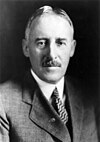
Disputed Quotes
Quotes attributed to Dwight D. Eisenhower that are questionable.
“The visual evidence and the verbal testimony of starvation, cruelty and bestiality were so overpowering as to leave me a bit sick. In one room, where they [there] were piled up twenty or thirty naked men, killed by starvation, George Patton would not even enter. He said that he would get sick if he did so. I made the visit [to Gotha] deliberately, in order to be in a position to give first-hand evidence of these things if ever, in the future, there develops a tendency to charge these allegations merely to "propaganda."”
About Dwight D. Eisenhower
Dwight David Eisenhower (14 October 1890 – 28 March 1969), also widely known by his nickname "Ike", was an American military officer and statesman who served as the 34th president of the United States from 1953 to 1961. During World War II, he served as Supreme Commander of the Allied Expeditionary Force in Europe, and achieved the rare five-star rank of General of the Army. He was responsible for planning and supervising the invasion of North Africa in Operation Torch in 1942–1943 and the successful invasion of Normandy in 1944–1945 from the Western Front.