Link Copied!
Desiderius Erasmus Quotes (1466-1536)
Philosopher, Theologian





About Desiderius Erasmus
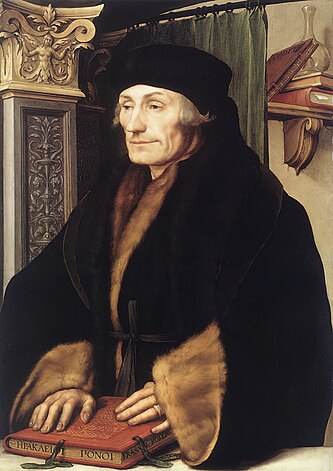
Desiderius Erasmus of Rotterdam (27 October 1466 – 12 July 1536) was a Dutch philosopher, humanist and theologian.
Best Desiderius Erasmus Quotes
Shortest
Earliest
Explore our curated collection of the most famous and impactful Desiderius Erasmus quotes.
“Bis dat, qui cito dat.”

“Wherever you encounter truth, look upon it as Christianity.”


“We must learn how to imitate Cicero from Cicero himself. Let us imitate him as he imitated others.”

“For what is life but a play in which everyone acts a part until the curtain comes down?”

“There is nothing I congratulate myself on more heartily than on never having joined a sect.”

“Most Christians are superstitious rather than pious, and except for the name of Christ differ hardly at all from superstitious pagans.”
“The worst evil is hardness of heart. Those who do not repent, who deliberately remain in their habits of sin, have the most to fear. p. 146”

“I feel that the entire spiritual life consists in this: That we gradually turn from those things whose appearance is deceptive to those things that are real. p. 63”

“In regione caecorum rex est luscus.
• Also in the same passage of the Adagia is a variant: Inter caecos regnat strabus (Among the blind, the squinter rules).”
• Also in the same passage of the Adagia is a variant: Inter caecos regnat strabus (Among the blind, the squinter rules).”

“Among the celestial bodies that are revolving over our heads, though the motions are not the same, and though the force is not equal, yet they move, and ever have moved, without clashing, and in perfect harmony.”
“Let the public good overcome all private and selfish regards of every kind and degree; though in truth, even private and selfish regards, and every man's own interest, will be best promoted by the preservation of peace.”
“Whatever you see in the more material part of yourself, learn to refer to God and to the invisible part of yourself. In that way, whatever offers itself to the senses will become for you an occasion for the practice of piety.”
“Finally, every man will become dear and pleasing to every other man; all will be beloved by all! and, what is still more desirable, beloved also by Christ; to become acceptable to whom is the highest felicity of human nature.”
“Ad Graecas literas totum animum applicui; statimque ut pecuniam accepero, Graecos primum autores, deinde vestes emam.
• Variant translation: When I get a little money I buy books; and if any is left I buy food and clothes.”
• Variant translation: When I get a little money I buy books; and if any is left I buy food and clothes.”

“Though I certainly deserve no ill treatment from mortals, yet if the insults and repulses I receive were attended with any advantage to them, I would content myself with lamenting in silence my own unmerited indignities and man's injustice.”
Desiderius Erasmus Quotes by Topic
Find exactly what you are looking for by browsing this categorized list of Desiderius Erasmus quotes by topic.
Desiderius Erasmus on Perception
“In the kingdom of the blind, the one-eyed man is king.”

Desiderius Erasmus on Reverence
Desiderius Erasmus on Libraries
Desiderius Erasmus on Syllogism
“They may attack me with an army of six hundred syllogisms; and if I do not recant, they will proclaim me a heretic.”

Desiderius Erasmus on Jupiter
Desiderius Erasmus on Knowledge
Desiderius Erasmus on Studying
Desiderius Erasmus on Intellectual
“Ask a wise man to dinner and he'll upset everyone by his gloomy silence or tiresome questions. Invite him to a dance and you'll have a camel prancing about. Haul him off to a public entertainment and his face will be enough to spoil the people's entertainment.”

Desiderius Erasmus on Pacifism
“If there is any human activity which should be approached with caution, or rather which should be avoided by all possible means, resisted and shunned, that activity is war, for there is nothing more wicked, more disastrous, more widely destructive, more persistently ingrained, more hateful, more unworthy in every respect of a man, not to say a Christian.”

Quotes About Desiderius Erasmus
Gain deeper perspective through quotes about Desiderius Erasmus from others.
David Attwell on Desiderius Erasmus 4 quotes
“Erasmus’s Moria … sees through the madness of those who see themselves as reasonable and self-possessed while in reality giving themselves over to rivalry.”
J. M. Coetzee on Desiderius Erasmus
“Erasmus dramatizes a well-established political position: that of the fool who claims license to criticize all and sundry without reprisal, since his madness defines him as not fully a person and therefore not a political being with political desires and ambitions. The Praise of Folly, therefore sketches the possibility of a position for the critic of the scene of political rivalry, a position not simply impartial between the rivals but also, by self-definition, off the stage of rivalry altogether.”

James Anthony Froude on Desiderius Erasmus 3 quotes
“Erasmus advises students to read only the best books on the subjects with which they are occupied. He cautions them against loading their memories with the errors of inferior writers which they will afterwards have to throw off and forget. The best description of the state of Europe in the age immediately preceding the Reformation will be found in the correspondence of Erasmus himself. I can promise my own readers that if they will accept Erasmus for a guide in that entangled period, they will not wander far out of the way.”

Francis Hackett on Desiderius Erasmus
“Meanwhile rational Europe, trying to keep inflammable passion and mad peasant blood within decent bounds, had lost its great spokesman in Erasmus. He died in April. The torch of good reason was for the moment dimmed. Two firebrands, still obscure, were planning the conquest of mankind for a Christ of their own making, each asking his followers to immolate their reason and to bind their will. In 1536 John Calvin published his Institutio. In the same year a Spanish Basque, to be known as Ignatius Loyola, was finishing the studies at Paris that underlay the Society of Jesus. Henry's 'moderation,' on the terms of his own dominance, would push half-evolved Europeans along the road of the modern state, while Calvin and Loyola, borrowing statecraft and rousing the lust of warfare with the breath of the Eternal, would stir in religion precisely the same appetite for earthly dominance. Beside them Erasmus might seem a feeble creature, sitting by his open fire with a glass of Burgundy in front of him. But Erasmus had made the New Testament his labour of love. He was not a hero, like Loyola or Calvin. He was not an 'emperor' as Henry now called himself. He was only a humanist. Beside him the Jesuits, affirming liberty and vowing obedience, or the Calvinists, affirming predestination and applying the scourge, recalled very ancient priesthoods and glorious savage instincts that cry from the caverns to be released even if they must carry a Bible in their hand. Yet the Galilean Jew could not have despised the humanist: if he had rested by the fire with Erasmus, this book of the New Testament on his knees, and a glass of Burgundy before him, perhaps he might have raised those sad eyes to see that truth and charity had lingered for an instant at Basle, finding an honest welcome there that the Word was still alive; that the arm of the law and the methods of torture, to which his own thin hands bore witness, were perhaps not the only ways to prize the divinity in man.”
Martin Luther on Desiderius Erasmus
“Here again you confuse and mix everything up in your usual way.”

Misattributed Quotes
Quotes mistakenly credited to Desiderius Erasmus
“Dulce bellum inexpertis.”
About Desiderius Erasmus
Desiderius Erasmus of Rotterdam (27 October 1466 – 12 July 1536) was a Dutch philosopher, humanist and theologian.