Link Copied!
Averroes Quotes (1126-1198)
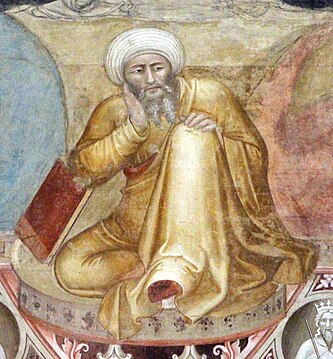

About Averroes
ʾAbū l-Walīd Muḥammad bin ʾAḥmad bin Rušd (14 April 1126 – 10 December 1198), known as Ibn Rushd, Latinized Averroës, was an Andalusian Muslim polymath, a great master of Aristotelian philosophy, Islamic philosophy, Islamic theology, Maliki law and jurisprudence, logic, psychology, politics and Arabic music theory, and the sciences of medicine, astronomy, geography, mathematics, physics and celestial mechanics.
Best Averroes Quotes
Shortest
Earliest
Explore our curated collection of the most famous and impactful Averroes quotes.
“Knowledge is the conformity of the object and the intellect.”

“The necessary connexion of movement and time is real and time is something the soul (dhihn) constructs in movement.”
“If teleological study of the world is philosophy, and if the Law commands such a study, then the Law commands philosophy.”


“The double meaning has been given to suit people's diverse intelligence. The apparent contradictions are meant to stimulate the learned to deeper study.”

“On the whole, a man who denies the existence of the effects arranged according to the causes in the question of arts, or whose wisdom cannot understand it, then he has no knowledge of the art of its Maker.”

“Philosophers do not claim that God does not know particulars; they rather claim that He does not know them the way humans do. God knows particulars as their Creator whereas humans know them as a privileged creations of God might know them.”
“The texts about the future life fall into, since demonstrative scholars do not agree whether to take them in their apparent meaning or interpret them allegorically. Either is permissible. But it is inexcusable to deny the fact of a future life altogether.”


“After logic we must proceed to philosophy proper. Here too we have to learn from our predecessors, just as in mathematics and law. Thus it is wrong to forbid the study of ancient philosophy. Harm from it is accidental, like harm from taking medicine, drinking water, or studying law.”
“To master this instrument the religious thinker must make a preliminary study of logic, just as the lawyer must study legal reasoning. This is no more heretical in the one case than in the other. And logic must be learned from the ancient masters, regardless of the fact that they were not Muslims.”

“Praise be to God with all due praise, and a prayer for Muhammad His chosen servant and apostle. The purpose of this treatise is to examine, from the standpoint of the study of the Law, whether the study of philosophy and logic is allowed by the Law, or prohibited, or commanded either by way of recommendation or as obligatory.”

“If we admit the existence of the prophetic mission, by putting the idea of possibility, which is in fact ignorance, in place of certainty, and make miracles a proof of the truth of man who claims to be a prophet it becomes necessary that they should not be used by a person, who says that they can be performed by others than prophets, as the Mutakallimun do.”
“This is one of the most intricate problems of religion. For if you look into the traditional arguments (Hadith) about this problem you will find them contradictory; such also being the case with arguments of reason. The contradiction in the arguments of the first kind is found in the Qur'an and the Hadith.”

“[In the introduction to his Middle Commentary on Aristotle's Topics, Averroes said] This art has three parts. The first part sets forth the speeches from which dialectical conversation is composed — i.e., its parts, and the parts of its parts on to its simplest components. This part is found in the first treatise on Aristotle's book.
The second part sets forth the topics from which syllogisms are drawn — syllogisms for affirming something or denying it with respect to every kind of problem occurring in this art. This is the next six treatises of Aristotle's book
The third part set forth how The third part sets forth how the questioner ought to question and the answerer answer. It also sets forth how many kinds of questions and answers there are. This is in the eighth treatise of Aristotle's book."”
Averroes Quotes by Topic
Find exactly what you are looking for by browsing this categorized list of Averroes quotes by topic.
Averroes on Teleology
“If teleological study of the world is philosophy, and if the Law commands such a study, then the Law commands philosophy.”
Averroes on Syllogism
“[In the introduction to his Middle Commentary on Aristotle's Topics, Averroes said] This art has three parts. The first part sets forth the speeches from which dialectical conversation is composed — i.e., its parts, and the parts of its parts on to its simplest components. This part is found in the first treatise on Aristotle's book. The second part sets forth the topics from which syllogisms are drawn — syllogisms for affirming something or denying it with respect to every kind of problem occurring in this art. This is the next six treatises of Aristotle's book. The third part set forth how the third part sets forth how the questioner ought to question and the answerer answer. It also sets forth how many kinds of questions and answers there are. This is in the eighth treatise of Aristotle's book.”

Quotes About Averroes
Gain deeper perspective through quotes about Averroes from others.
Duns Scotus on Averroes
“We speak of the matter [of this science] in the sense of its being what the science is about. This is called by some the subject of the science, but more properly it should be called its object, just as we say of a virtue that what it is about is its object, not its subject. As for the object of the science in this sense, we have indicated above that this science is about the transcendentals. And it was shown to be about the highest causes. But there are various opinions about which of these ought to be considered its proper object or subject. Therefore, we inquire about the first. Is the proper subject of metaphysics being as being, as Avicenna claims, or God and the Intelligences, as the Commentator, Averroes, assumes.”

Misattributed Quotes
Quotes mistakenly credited to Averroes
About Averroes
ʾAbū l-Walīd Muḥammad bin ʾAḥmad bin Rušd (14 April 1126 – 10 December 1198), known as Ibn Rushd, Latinized Averroës, was an Andalusian Muslim polymath, a great master of Aristotelian philosophy, Islamic philosophy, Islamic theology, Maliki law and jurisprudence, logic, psychology, politics and Arabic music theory, and the sciences of medicine, astronomy, geography, mathematics, physics and celestial mechanics.