Link Copied!
Aryabhata Quotes (476-550)
Mathematician
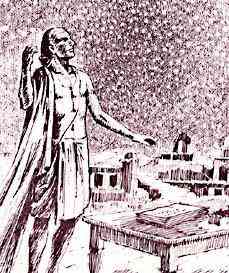
About Aryabhata
Aryabhata (Sanskrit: आर्यभट; IAST: Āryabhaṭa) or Aryabhata I (476–550 CE) was the first in the line of great mathematician-astronomers from the classical age of Indian mathematics and Indian astronomy. His works include the Āryabhaṭīya (499 CE, when he was 23 years old) and the Arya-siddhanta.
Best Aryabhata Quotes
Shortest
Earliest
Explore our curated collection of the most famous and impactful Aryabhata quotes.
“tribhujasya phalashariram samadalakoti bhujardhasamvargah”
“Translates to: for a triangle, the result of a perpendicular with the half-side is the area.”
“caturadhikam śatamaṣṭaguṇam dvāṣaṣṭistathā sahasrāṇām
ayutadvayaviṣkambhasyāsanno vṛttapariṇāhaḥ.”
ayutadvayaviṣkambhasyāsanno vṛttapariṇāhaḥ.”
“Translates to: Add four to 100, multiply by eight, and then add 62,000. By this rule the circumference of a circle with a diameter of 20,000 can be approached. Thus according to the rule ((4 + 100) × 8 + 62000)/20000 = 62832/20000 = 3.1416, which is accurate to five significant figures.”
“In Indian astronomy, the prime meridian is the great circle of the Earth passing through the north and south poles, Ujjayinī and Laṅkā, where Laṅkā was assumed to be on the Earth's equator.”

Quotes About Aryabhata
Gain deeper perspective through quotes about Aryabhata from others.
P Jha on Aryabhata
“His value of π is a very close approximation to the modern value and the most accurate among those of the ancients. There are reasons to believe that he devised a particular method for finding this value. It is shown with sufficient grounds that he himself used it, and several later Indian mathematicians and even the Arabs adopted it. The conjecture that Aryabhata's value of π is of Greek origin is critically examined and is found to be without foundation. He discovered this value independently and also realised that π is an irrational number. He had the Indian background, no doubt, but excelled all his predecessors in evaluating π. Thus the credit of discovering this exact value of π may be ascribed to the celebrated mathematician, Aryabhata I.”
Bhaskara I on Aryabhata
“He is the master who, after reaching the furthest shores and plumbing the inmost depths of the sea of ultimate knowledge of mathematics, kinematics and spherics, handed over the three sciences to the learned world.”
G Ifrah on Aryabhata
“... it is extremely likely that Aryabhata knew the sign for zero and the numerals of the place value system. This supposition is based on the following two facts: first, the invention of his alphabetical counting system would have been impossible without zero or the place-value system; secondly, he carries out calculations on square and cubic roots which are impossible if the numbers in question are not written according to the place-value system and zero.”
Roger Cooke in on Aryabhata
“He gave more elegant rules for the sum of the squares and cubes of an initial segment of the positive integers. The sixth part of the product of three quantities consisting of the number of terms, the number of terms plus one, and twice the number of terms plus one is the sum of the squares. The square of the sum of the series is the sum of the cubes.”
Florian Cajori in on Aryabhata
“His work, called Aryabhatiya, is composed of three parts, in only the first of which use is made of a special notation of numbers. It is an alphabetical system in which the twenty-five consonants represent 1-25, respectively; other letters stand for 30, 40, …., 100 etc. The other mathematical parts of Aryabhatiya consists of rules without examples. Another alphabetic system prevailed in Southern India, the numbers 1-19 being designated by consonants, etc.”

About Aryabhata
Aryabhata (Sanskrit: आर्यभट; IAST: Āryabhaṭa) or Aryabhata I (476–550 CE) was the first in the line of great mathematician-astronomers from the classical age of Indian mathematics and Indian astronomy. His works include the Āryabhaṭīya (499 CE, when he was 23 years old) and the Arya-siddhanta.