In: Arijit Roy The Enigma of Creation and Destruction, Author House, 28 October 2011, p. 27
• The irrationality of pi was proved by Lambert in Europe in the year 1761.
• The irrationality of pi was proved by Lambert in Europe in the year 1761.
“
Translates to: Add four to 100, multiply by eight, and then add 62,000. By this rule the circumference of a circle with a diameter of 20,000 can be approached. Thus according to the rule ((4 + 100) × 8 + 62000)/20000 = 62832/20000 = 3.1416, which is accurate to five significant figures.
— Aryabhata
What It Means
This is a placeholder explanation generated by the low-overhead model. It interprets "Translates to: Add four to 100, multiply by eight, and then add 62,000. By this rule the circumference of a circle with a diameter of 20,000 can be approached. Thus according to the rule ((4 + 100) × 8 + 62000)/20000 = 62832/20000 = 3.1416, which is accurate to five significant figures." in the context of "In: Arijit Roy The Enigma of Creation and Destruction, Author House, 28 October 2011, p. 27
• The irrationality of pi was proved by Lambert in Europe in the year 1761." to mean that wisdom is timeless.
Source: Wikiquote: "Aryabhata" (Quotes)
The 'What it means' explanation text was generated by Google Gemini Flash (accessed January 18, 2026). https://gemini.google.com/app
Tags
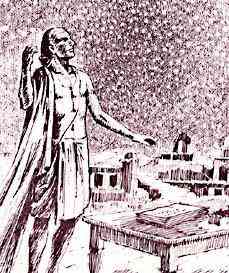
About Aryabhata
Aryabhata (Sanskrit: आर्यभट; IAST: Āryabhaṭa) or Aryabhata I (476–550 CE) was the first in the line of great mathematician-astronomers from the classical age of Indian mathematics and Indian astronomy. His works include the Āryabhaṭīya (499 CE, when he was 23 years old) and the Arya-siddhanta.
View all quotes →