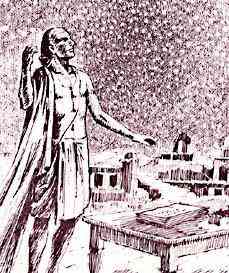
• Aryabhata is also known as Aryabhata I to distinguish him from the later mathematician of the same name who lived about 400 years later.
His value of π is a very close approximation to the modern value and the most accurate among those of the ancients. There are reasons to believe that he devised a particular method for finding this value. It is shown with sufficient grounds that he himself used it, and several later Indian mathematicians and even the Arabs adopted it. The conjecture that Aryabhata's value of π is of Greek origin is critically examined and is found to be without foundation. He discovered this value independently and also realised that π is an irrational number. He had the Indian background, no doubt, but excelled all his predecessors in evaluating π. Thus the credit of discovering this exact value of π may be ascribed to the celebrated mathematician, Aryabhata I.
What It Means
This is a placeholder explanation generated by the low-overhead model. It interprets "His value of π is a very close approximation to the modern value and the most accurate among those of the ancients. There are reasons to believe that he devised a particular method for finding this value. It is shown with sufficient grounds that he himself used it, and several later Indian mathematicians and even the Arabs adopted it. The conjecture that Aryabhata's value of π is of Greek origin is critically examined and is found to be without foundation. He discovered this value independently and also realised that π is an irrational number. He had the Indian background, no doubt, but excelled all his predecessors in evaluating π. Thus the credit of discovering this exact value of π may be ascribed to the celebrated mathematician, Aryabhata I." in the context of "P Jha, Aryabhata I and the value of π, Math. Ed. (Siwan) 16 (3) (1982), 54-59, quoted in: J J O'Connor and E F Robertson Aryabhata the Elder, School of Mathematics and Statistics University of St Andrews, Scotland
• Aryabhata is also known as Aryabhata I to distinguish him from the later mathematician of the same name who lived about 400 years later." to mean that wisdom is timeless.
Tags
About Aryabhata