






































































“Obit anus, abit onus.”
— Arthur Schopenhauer

Explore our curated collection of the most famous and impactful Arthur Schopenhauer quotes.
“My body and my will are one.”
“Intellect is invisible to the man who has none.”

“Zu unserer Besserung bedürfen wir eines Spiegels.”
“ Life is a business that does not cover the costs.”

“The word of man is the most durable of all material.”
“Meistens belehrt uns erst der Verlust über den Wert der Dinge.”Original / Translation (German)“Meistens belehrt uns erst der Verlust über den Wert der Dinge.”English: “Mostly it is loss which teaches us about the worth of things.”
“Die Wahrheit kann warten: denn sie hat ein langes Leben vor sich.”Original / Translation (German)“Die Wahrheit kann warten: denn sie hat ein langes Leben vor sich.”English: “The truth can wait, for she lives a long life.”
“... deshalb ich diese als die Metaphysik des Volkes bezeichnet habe.”Original / Translation (German)“... deshalb ich diese als die Metaphysik des Volkes bezeichnet habe.”English: “I have described religion as the metaphysics of the people.”
“Die Gegenwart eines Gedankens ist wie die Gegenwart einer Geliebten.”Original / Translation (German)“Die Gegenwart eines Gedankens ist wie die Gegenwart einer Geliebten.”English: “The presence of a thought is like the presence of a lover.”
“Wealth is like sea-water; the more we drink, the thirstier we become.”

“Der Mensch kann tun was er will; er kann aber nicht wollen was er will.”
“We forfeit three-fourths of ourselves in order to be like other people.”
“Alles Wollen entspringt aus Bedürfnis, also aus Mangel, also aus Leiden.”Original / Translation (German)“Welt und Mensch II, p. 230ff”English: “Alles Wollen entspringt aus Bedürfnis, also aus Mangel, also aus Leiden.”
“Alles, alles kann einer vergessen, nur nicht sich selbst, sein eigenes Wesen.”Original / Translation (German)“Alles, alles kann einer vergessen, nur nicht sich selbst, sein eigenes Wesen.”English: “One can forget everything, everything, only not oneself, one's own being.”
“There is no more mistaken path to happiness than worldliness, revelry, high life.”
“The fundament upon which all our knowledge and learning rests is the inexplicable.”

“Every man takes the limits of his own field of vision for the limits of the world.”

“Obstinacy is the result of the will forcing itself into the place of the intellect.”
“Talent hits a target no one else can hit; genius hits a target no one else can see.”Original / Translation (German)“Das Talent gleicht dem Schützen, der ein Ziel trifft, welches die Uebrigen nicht erreichen können; das Genie dem, der eines trifft, bis zu welchem sie nicht ein Mal zu sehn vermögen...”English: “Talent hits a target no one else can hit; genius hits a target no one else can see.”
“...this our world, which is so real, with all its suns and milky ways is—nothing.”

“Men are by nature merely indifferent to one another; but women are by nature enemies.”

“Christianity taught only what the whole of Asia knew already long before and even better.”

“Wirklich ist jedes Kind gewissermaßen ein Genie, und jedes Genie gewissermaßen ein Kind.”Original / Translation (German)“Wirklich ist jedes Kind gewissermaßen ein Genie, und jedes Genie gewissermaßen ein Kind.”English: “Every child is in a way a genius; and every genius is in a way a child.”
Find exactly what you are looking for by browsing this categorized list of Arthur Schopenhauer quotes by topic.
“Our susceptibility to pain is wellnigh infinite; but that to pleasure has narrow limits.”

“To the hope of immortality of the soul there is always added that of a “better world”; an indication that the present world is not worth much.”
“Great sufferings render lesser ones quite incapable of being felt, and conversely, in the absence of great sufferings even the smallest vexations and annoyances torment us, and put us in a bad mood.”
“The pleasure in this world, it has been said, outweighs the pain; or, at any rate, there is an even balance between the two. If the reader wishes to see shortly whether this statement is true, let him compare the respective feelings of two animals, one of which is engaged in eating the other.”
“If you try to imagine, as nearly as you can, what an amount of misery, pain and suffering of every kind the sun shines upon in its course, you will admit that it would be much better if, on the earth as little as on the moon, the sun were able to call forth the phenomena of life; and if, here as there, the surface were still in a crystalline state.”
“[I]n the simple and easily surveyed life of the brutes the emptiness and vanity of the struggle of the whole phenomenon is more easily grasped. The variety of the organisations, the ingenuity of the means, whereby each is adapted to its element and its prey contrasts here distinctly with the want of any lasting final aim; instead of which there presents itself only momentary comfort, fleeting pleasure conditioned by wants, much and long suffering, constant strife, bellum omnium [all war], each one both a hunter and hunted, pressure, want, need, and anxiety, shrieking and howling; and this goes on in secula seculorum [for eternity], or till once again the crust of the planet breaks.”
“To the one type, humanity is a non-ego; to the other, "myself once more."”
“The moral virtues, hence justice and philanthropy, if pure, spring, as I have shown, from the fact that the will-to-live, seeing through the principium individuationis, recognizes itself again in all its phenomena.”
“For just as in dreams, all the persons that appear to us are but the masked images of ourselves; so in the dream of our waking life, it is our own being which looks on us from out our neighbours' eyes, though this is not equally easy to discern. Nevertheless, tat tvam asi.”
“How shall a man be proud, when his conception is a crime, his birth a penalty, his life a labour, and death a necessity!”

“The woman's share in procreation is more guiltless than the man's; for he bestows upon the child its will, which is the first sin, and therefore the root of all evil; the woman, on the contrary, bestows its intellect, which is the pathway to redemption.”
“If children were brought into the world by an act of pure reason alone, would the human race continue to exist? Would not a man rather have so much compassion with the coming generation as to spare it the burden of existence, or at any rate not take it upon himself to impose that burden upon it in cold blood?”
“A man becomes a philosopher by reason of a certain perplexity, from which he seeks to free himself.”
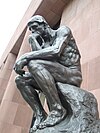
“To repeat abstractly, universally, and distinctly in concepts the whole inner nature of the world, and thus to deposit it as a reflected image in permanent concepts always ready for the faculty of reason, this and nothing else is philosophy.”
“It is the courage to make a clean breast of it in the face of every question that makes the philosopher. He must be like Sophocles’ Oedipus, who, seeking enlightenment concerning his terrible fate, pursues his indefatigable inquiry even though he divines that appalling horror awaits him in the answer. But most of us carry with us the Jocasta in our hearts, who begs Oedipus, for God’s sake, not to inquire further.”
Discover personal opinions Arthur Schopenhauer shared regarding contemporaries.
“[From Schopenhauer's assessments of other philosophers] Bruno and Spinoza are to be entirely excepted. Each stands by himself and alone; and they do not belong either to their age or to their part of the globe, which rewarded the one with death, and the other with persecution and ignominy. Their miserable existence and death in this Western world are like that of a tropical plant in Europe. The banks of the Ganges were their spiritual home ; there, they would have led a peaceful and honoured life among men of like mind.”

“The latter [Descartes] had sharply divided nature into mind and matter, i.e., thinking and extended substance, and had also placed God and the world in complete opposition to each other; Spinoza also, so long as he was a Cartesian, taught all that in his “Cogitatis Metaphysicis,” c. 12, i. I., 1665. Only in his later years did he see the fundamental falseness of that double dualism; and accordingly his own philosophy principally consists of the indirect abolition of these two antitheses. Yet partly to avoid injuring his teacher, partly in order to be less offensive, he gave it a positive appearance by means of a strictly dogmatic form, although its content is chiefly negative. His identification of the world with God has also this negative significance alone. For to call the world God is not to explain it: it remains a riddle under the one name as under the other. But these two negative truths had value for their age, as for every age in which there still are conscious or unconscious Cartesians.”
“...Since, in consequence of the Kantian criticism of all speculative theology, the philosophisers of Germany almost all threw themselves back upon Spinoza, so that the whole series of futile attempts known by the name of the post-Kantian philosophy are simply Spinozism tastelessly dressed up, veiled in all kinds of unintelligible language, and otherwise distorted, I wish, now that I have explained the relation of my philosophy to Pantheism in general, to point out its relation to Spinozism in particular. It stands, then, to Spinozism as the New Testament stands to the Old. What the Old Testament has in common with the New is the same God-Creator. Analogous to this, the world exists, with me as with Spinoza, by its inner power and through itself. But with Spinoza his substantia æterna, the inner nature of the world, which he himself calls God, is also, as regards its moral character and worth, Jehovah, the God-Creator, who applauds His own creation, and finds that all is very good, παντα καλα λιαν. Spinoza has deprived Him of nothing but personality. Thus, according to him also, the world and all in it is wholly excellent and as it ought to be: therefore man has nothing more to do than vivere, agere, suum Esse conservare ex fundamento proprium utile quærendi (Eth., iv. pr. 67); he is even to rejoice in his life as long as it lasts; entirely in accordance with Ecclesiastes ix. 7-10. In short, it is optimism: therefore its ethical side is weak, as in the Old Testament; nay, it is even false, and in part revolting. With me, on the other hand, the will, or the inner nature of the world, is by no means Jehovah, it is rather, as it were, the crucified Saviour, or the crucified thief, according as it resolves. Therefore my ethical teaching agrees with that of Christianity, completely and in its highest tendencies, and not less with that of Brahmanism and Buddhism. Spinoza could not get rid of the Jews; quo semel est imbuta recens servabit odorem. His contempt for the brutes, which, as mere things for our use, he also declares to be without rights, is thoroughly Jewish, and, in union with Pantheism, is at the same time absurd and detestable (Eth., iv., appendix, c. 27). With all this Spinoza remains a very great man. But in order to estimate his work correctly we must keep in view his relation to Descartes.”Original / Translation (Greek)“...Since, in consequence of the Kantian criticism of all speculative theology, the philosophisers of Germany almost all threw themselves back upon Spinoza, so that the whole series of futile attempts known by the name of the post-Kantian philosophy are simply Spinozism tastelessly dressed up, veiled in all kinds of unintelligible language, and otherwise distorted, I wish, now that I have explained the relation of my philosophy to Pantheism in general, to point out its relation to Spinozism in particular. It stands, then, to Spinozism as the New Testament stands to the Old. What the Old Testament has in common with the New is the same God-Creator. Analogous to this, the world exists, with me as with Spinoza, by its inner power and through itself. But with Spinoza his substantia æterna, the inner nature of the world, which he himself calls God, is also, as regards its moral character and worth, Jehovah, the God-Creator, who applauds His own creation, and finds that all is very good, παντα καλα λιαν. Spinoza has deprived Him of nothing but personality. Thus, according to him also, the world and all in it is wholly excellent and as it ought to be: therefore man has nothing more to do than vivere, agere, suum Esse conservare ex fundamento proprium utile quærendi (Eth., iv. pr. 67); he is even to rejoice in his life as long as it lasts; entirely in accordance with Ecclesiastes ix. 7-10. In short, it is optimism: therefore its ethical side is weak, as in the Old Testament; nay, it is even false, and in part revolting. With me, on the other hand, the will, or the inner nature of the world, is by no means Jehovah, it is rather, as it were, the crucified Saviour, or the crucified thief, according as it resolves. Therefore my ethical teaching agrees with that of Christianity, completely and in its highest tendencies, and not less with that of Brahmanism and Buddhism. Spinoza could not get rid of the Jews; quo semel est imbuta recens servabit odorem. His contempt for the brutes, which, as mere things for our use, he also declares to be without rights, is thoroughly Jewish, and, in union with Pantheism, is at the same time absurd and detestable (Eth., iv., appendix, c. 27). With all this Spinoza remains a very great man. But in order to estimate his work correctly we must keep in view his relation to Descartes.”English: “Arthur Schopenhauer, The World As Will And Idea, Vol. II (London: Trübner & Co., 1909) [Translated from the German by R. B. Haldane and J. Kemp]”
“In every page of David Hume, there is more to be learned than from Hegel's, Herbart's and Schleiermacher's complete philosophical works.”

“In every page of David Hume, there is more to be learned than from Hegel's, Herbart's and Schleiermacher's complete philosophical works.”

“Berkeley was... the first to treat the subjective starting-point really seriously and to demonstrate irrefutably its absolute necessity. He is the father of idealism.”

Gain deeper perspective through quotes about Arthur Schopenhauer from others.
“Who knew that if you merely represent the thought of Nietzsche or Schopenhauer in a fun way it would find such an audience? Some things, it seems, are always green.”
“The bold theories and opinions expressed in Schopenhauer's works differ widely with those of the majority of our orthodox scientists... Every new phenomenon which they find themselves unable to explain, is triturated, compounded into incense, and burned on the altar of the goddess who patronizes modern scientists. No one can better treat his subject than does Schopenhauer in his Parerga. In this work he discusses at length animal magnetism, clairvoyance, sympathetic cures, seership, magic, omens, ghost-seeing, and other spiritual matters. "All these manifestations," he says, "are branches of one and the same tree, and furnish us with irrefutable proofs of the existence of a chain of beings..." ”
“Keats, entirely a stranger to error, could believe that the nightingale enchanting him was the same one Ruth heard amid the alien corn of Bethlehem in Judah; Stevenson posits a single bird that consumes the centuries: "the nightingale that devours time." Schopenhauer — impassioned, lucid Schopenhauer — provides a reason: the pure corporeal immediacy in which animals live, oblivious to death and memory. He then adds, not without a smile: Whoever hears me assert that the grey cat playing just now in the yard is the same one that did jumps and tricks there five hundred years ago will think whatever he likes of me, but it is a stranger form of madness to imagine that the present-day cat is fundamentally an entirely different one.”

“In human freedom in the philosophical sense I am definitely a disbeliever. Everybody acts not only under external compulsion but also in accordance with inner necessity. Schopenhauer's saying, that "a man can do as he will, but not will as he will," has been an inspiration to me since my youth up, and a continual consolation and unfailing well-spring of patience in the face of the hardships of life, my own and others'. This feeling mercifully mitigates the sense of responsibility which so easily becomes paralyzing, and it prevents us from taking ourselves and other people too seriously; it conduces to a view of life in which humor, above all, has its due place.”

“Part of the cause of pessimism, in Schopenhauer and his contemporaries, lay in their romantic attitudes and expectations. Youth expects too much of the· world; pessimism is the morning after optimism, just as 1815 had to pay for 1789. The romantic exaltation and liberation of feeling, instinct and will, and the romantic contempt for intellect, restraint, and order, brought their natural penalties; for “the world,” as Horace Walpole said, “is a comedy for those who think, but a tragedy for those who feel.”… Is it true that ”he that increaseth knowledge increaseth sorrow,” and that it is the most highly organized beings that suffer most? Yes; but it is also true that the growth of knowledge increases joy as well as sorrow, and that the subtlest delights, as well as the keenest pains, are reserved for the developed soul. Voltaire rightly preferred the Brahmin’s ”unhappy” to the blissful ignorance of the peasant woman; we wish to experience life keenly and deeply, even at the cost of pain; we wish to venture into its innermost secrets, even at the cost of disillusionment… There are other difficulties, more technical and less vital, in this remarkable and stimulating philosophy. How can suicide ever occur in a world where the only real force is the will to live? How can the intellect, begotten and brought up as servant of the will, ever achieve independence and objectivity? Does genius lie in knowledge divorced from will, or does it contain, as its driving force” an immense power of will, even a large alloy of personal ambition and. conceit? Is madness connected with genius in general, or rather with only the “romantic” type of genius (Byron, Shelley, Poe, Heine, Swinburne, Strindberg, Dostoievski, etc.); and is not the “classic” and profounder type of genius exceptionally sound (Socrates, Plato, Spinoza, Bacon, Newton, Voltaire, Goethe, Darwin, Whitman, etc.)? What if the proper function of intellect and philosophy is not the denial of the will but the coordination of desires into a united and harmonious, will? What if “will” itself, except as the unified product of such coordination, is a mythical abstraction, as shadowy as “force”?…”