





























































“Evils draw men together.”
— Aristotle

Explore our curated collection of the most famous and impactful Aristotle quotes.
“Philosophy is the science of truth.”
“Nature does not do anything in vain.”

“Misfortune shows those who are not really friends.”
“For the things we have to learn before we can do, we learn by doing.”
“Knowledge of the fact differs from knowledge of the reason for the fact.”

“The third kind of life is the life of contemplation (Bk. 1, Chapter III)”

“While both are dear, Piety requires us to honor truth above our friends.”
“[I]t is impossible for motion to subsist without place, and void, and time.”

“The least initial deviation from the truth is multiplied later a thousandfold.”
“That body is heavier than another which, in an equal bulk, moves downward quicker.”
“μεταβολὴ δὲ πάντων γλυκύOriginal / Translation (Greek)“μεταβολὴ δὲ πάντων γλυκύ”English: “Book VII, 14”
• Change in all things is sweet.”

“[U]niversal is known according to reason, but that which is particular, according to sense...”

“The best friend is he that, when he wishes a person's good, wishes it for that person's own sake.”

“For the purposes of poetry a convincing impossibility is preferable to an unconvincing possibility.”

“Nature flies from the infinite, for the infinite is unending or imperfect, and Nature ever seeks an end.”
“Now the mass of mankind are plainly... choosing a life like that of brute animals... (Bk. 1, Chapter III)”
“It is simplicity that makes the uneducated more effective than the educated when addressing popular audiences.”

“Therefore only an utterly senseless person can fail to know that our characters are the result of our conduct.”
Find exactly what you are looking for by browsing this categorized list of Aristotle quotes by topic.
“If 'bounded by a surface' is the definition of body there cannot be an infinite body either intelligible or sensible.”
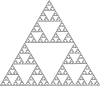
“The infinite turns out to be the contrary of what it is said to be. It is not what has nothing outside it that is infinite, but what always has something outside it.”
“Empedocles holds that the corporeal elements are four, while all the elements-including those which initiate movement-are six in number; whereas Anaxagoras agrees with Leucippus and Democritus that the elements are infinite.”
“Misfortune shows those who are not really friends.”

“To be able without hindrance to exercise his preeminent quality, whatever its nature, is real happiness.”

“Happiness, whether consisting in pleasure or virtue, or both, is more often found with those who are highly cultivated in their minds and in their character, and have only a moderate share of external goods, than among those who possess external goods to a useless extent but are deficient in higher qualities.”
“Justice is that virtue of the soul which is distributive according to desert.”

“But he who neither thinks for himself, nor lays to heart another's wisdom, this is a useless man.’''”
Discover personal opinions Aristotle shared regarding contemporaries.
“Haughtiness of women has been the ruin of many tyrannies.”

“The excellence of females in regard to person, is beauty and stature; in regard to the mind, temperance, and fondness for employment, without meanness.”
“Woman is more compassionate than man, more easily moved to tears, at the same time is more jealous, more querulous, more apt to scold and to strike. She is, furthermore, more prone to despondency and less hopeful than the man, more void of shame or self-respect, more false of speech, more deceptive, and of more retentive memory. She is also more wakeful, more shrinking, more difficult to rouse to action, and requires a smaller quantity of nutriment.”
“It is a part of probability that many improbable things will happen.”

“These thinkers seem to consider that number is the principle both as matter for things and as constituting their attributes and permanent states.”
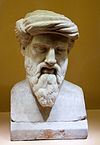
“They thought they found in numbers, more than in fire, earth, or water, many resemblances to things which are and become; thus such and such an attribute of numbers is justice, another is soul and mind, another is opportunity, and so on; and again they saw in numbers the attributes and ratios of the musical scales. Since, then, all other things seemed in their whole nature to be assimilated to numbers, while numbers seemed to be the first things in the whole of nature, they supposed the elements of numbers to be the elements of all things, and the whole heaven to be a musical scale and a number.”
Gain deeper perspective through quotes about Aristotle from others.
“I was very fortunate. I was curious and handicapped as a young person. And so I read everything I could get my hands on and I have a good memory. And I have a lot of energy. It's a blessing. So I continued to learn. I'm hungry for knowledge still. Not every young person is blessed or visited with that combination. So he or she desperately needs to go to a university and be introduced to some of the great ideas of humankind. One needs to worry over the question of "Why am I here, what am I doing here of all things in this place, this life?" One needs to know Aristotle and Plato. One needs it desperately. One must have Leopold and Pascal. Must! I mean desperately, if one is to be at ease anywhere. One should have read the African folk tale to see what the West African calls deep thinking. One must worry over ideas that if I come forward how far do we have to go before we meet? And when we meet will I go through you and you go through me and continue until we meet someone else? This is an African concept. Do we stay once we meet or do I actually go right through you and pass through you and continue on that road. Is that what life is? All this knowledge is available at universities and one is more likely to run into a great teacher at a university than one is at a pool hall. It just follows.”

“Once upon a time, Aristotle taught Alexander that he should restrain himself from frequently approaching his wife, who was very beautiful, lest he should impede his spirit from seeking the general good. Alexander acquiesed to him. The queen, when she perceived this and was upset, began to draw Aristotle to love her. Many times she crossed paths with him alone, with bare feet and disheveled hair, so that she might entice him. At last, being enticed, he began to solicit her carnally. She says, "This I will certainly not do, unless I see a sign of love, lest you be testing me. Therefore, come to my chamber crawling on hand and foot, in order to carry me like a horse. Then I'll know that you aren't deluding me." When he had consented to that condition, she secretly told the matter to Alexander, who lying in wait apprehended him carrying the queen. When Alexander wished to kill Aristotle, in order to excuse himself, Aristotle says, If thus it happened to me, an old man most wise, that I was deceived by a woman, you can see that I taught you well, that it could happen to you, a young man." Hearing that, the king spared him, and made progress in Aristotle's teachings.”
“Aristotle, notwithstanding that for political reasons of his own he maintained a prudent silence as to certain esoteric matters, expressed very clearly his opinion on the subject. It was his belief that human souls are emanations of God, that are finally re-absorbed into Divinity. (p. 13)”
“Robert [Grosseteste] became much interested in science and scientific method... He was conscious of the dual approach by means of induction and deduction (resolution and composition); i.e., from the empirical knowledge one proceeds to probable general principles, and from these as premises one them derives conclusions which constitute verifications or falsifications of the principles. This approach to science was not that far removed from Aristotle...”
“[Aristotle] totally misrepresents Plato's doctrine of "Ideas." ... It is also pertinent to inquire, what is the difference between the "formal cause" of Aristotle and the archetypal ideas of Plato? ... Yet Aristotle is forever congratulating himself that he alone has properly treated the "formal" and the "final cause"!”
Quotes attributed to Aristotle that are questionable.
“Happiness depends upon ourselves”Original / Translation (Greek)“An interpretative gloss of Aristotle's position in Nicomachean Ethics book 1 section 9, tacitly inserted by J. A. K. Thomson in his English translation The Ethics of Aristotle (1955). The original Greek at Book I 1099b.29, reads ὁμολογούμενα δὲ ταῦτ' ἂν εἴη καὶ τοῖς ἐν ἀρχῇ, which W. D. Ross translates fairly literally as [a]nd this will be found to agree with what we said at the outset. Thomson's much freer translation renders the same passage thus: [t]he conclusion that happiness depends upon ourselves is in harmony with what I said in the first of these lectures; the words "that happiness depends upon ourselves" were added by Thomson to clarify what "the conclusion" is, but they do not appear in the original Greek of Aristotle.See http://www.mikrosapoplous.gr/aristotle/nicom1b.htm#I9 for the original Greek and Ross's translation; Thomson's translation can be viewed on Google Books. Rackham's earlier English translation added a similar gloss, but averted confusion by confining it to a footnote.Rackham's translation of this passage is available here”English: “Happiness depends upon ourselves”
“It is the mark of an educated mind to be able to entertain a thought without accepting it.”
“Man is a goal-seeking animal. His life only has meaning if he is reaching out and striving for goals.”
“Amicus Plato, sed magis amica veritas.Original / Translation (Latin)“Amicus Plato, sed magis amica veritas.”English: “Plato is dear to me, but dearer still is truth.”
• Variant: Plato is my friend, but the truth is more my friend.”
Quotes mistakenly credited to Aristotle.
“Those who can, do, those who cannot, teach.”
“There is only one way to avoid criticism: do nothing, say nothing and be nothing.”
“The aim of art is to represent not the outward appearance of things, but their inward significance.”
“Suffering becomes beautiful when anyone bears great calamities with cheerfulness, not through insensibility but through greatness of mind.”Original / Translation (Greek)“ὅμως δὲ καὶ ἐν τούτοις διαλάμπει τὸ καλόν, ἐπειδὰν φέρῃ τις εὐκόλως πολλὰς καὶ μεγάλας ἀτυχίας, μὴ δι᾽ ἀναλγησίαν, ἀλλὰ γεννάδας ὢν καὶ μεγαλόψυχος. εἰ δ᾽ εἰσὶν αἱ ἐνέργειαι κύριαι τῆς ζωῆς, καθάπερ εἴπομεν, οὐδεὶς ἂν γένοιτο τῶν μακαρίων ἄθλιος”English: “Suffering becomes beautiful when anyone bears great calamities with cheerfulness, not through insensibility but through greatness of mind.”