Link Copied!
Adam Smith Quotes (1723-1790)
Philosopher, Author





























About Adam Smith
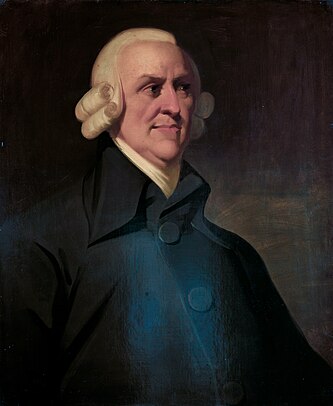
Adam Smith (16 June 1723 – 17 July 1790) was a Scottish-born economist and philosopher, widely considered the "father of modern economics".
Best Adam Smith Quotes
Shortest
Earliest
Explore our curated collection of the most famous and impactful Adam Smith quotes.

“We are delighted to find a person who values us as we value ourselves, and distinguishes us from the rest of mankind, with an attention not unlike that with which we distinguish ourselves.”
“The virtue of frugality lies in a middle between avarice and profusion, of which the one consists in an excess, the other in a defect of the proper attention to the objects of self–interest.”

“Every man is, no doubt, by nature, first and principally recommended to his own care; and as he is fitter to take care of himself than of any other person, it is fit and right that it should be so.”
“Poor David Hume is dying very fast, but with great cheerfulness and good humour and with more real resignation to the necessary course of things then any whining Christian ever dyed with pretended resignation to the will of God.”


“How selfish soever man may be supposed, there are evidently some principles in his nature, which interest him in the fortune of others, and render their happiness necessary to him, though he derives nothing from it except the pleasure of seeing it.”

“In this consists the difference between the character of a miser and that of a person of exact economy and assiduity. The one is anxious about small matters for their own sake; the other attends to them only in consequence of the scheme of life which he has laid down to himself.”
“Every faculty in one man is the measure by which he judges of the like faculty in another. I judge of your sight by my sight, of your ear by my ear, of your reason by my reason, of your resentment by my resentment, of your love by my love. I neither have, nor can have, any other way of judging about them.”

“In every part of the universe we observe means adjusted with the nicest artifice to the ends which they are intended to produce; and in the mechanism of a plant, or animal body, admire how every thing is contrived for advancing the two great purposes of nature, the support of the individual, and the propagation of the species.”
“This disposition to admire, and almost to worship, the rich and powerful, and to despise or, at least, neglect persons of poor and mean conditions, though necessary both to establish and to maintain the distinction of ranks and the order of society, is, at the same time, the great and most universal cause of the corruption of our moral sentiments.”
“When I endeavour to examine my own conduct, when I endeavour to pass sentence upon it, and either to approve or condemn it, it is evident that, in all such cases, I divide myself, as it were, into two persons; and that I, the examiner and judge, represent a different character from that other I, the person whose conduct is examined into and judged of.”
“The man who barely abstains from violating either the person, or the estate, or the reputation of his neighbours, has surely very little positive merit. He fulfils, however, all the rules of what is peculiarly called justice, and does every thing which his equals can with propriety force him to do, or which they can punish him for not doing. We may often fulfil all the rules of justice by sitting still and doing nothing.”

“The wise and virtuous man is at all times willing that his own private interests should be sacrificed to the public interest of his own particular society--that the interests of this order of society be sacrificed to the greater interest of the state. He should therefore he equally willing that all those inferior interests should be sacrificed to the greater society of all sensible and intelligent beings.”

“I perfectly agree with your Lordship too, that to crush the Industry of so great and so fine a province of the empire, in order to favour the monopoly of some particular towns in Scotland or England, is equally unjust and impolitic. The general opulence and improvement of Ireland might certainly, under proper management, afford much greater resources to the Government, than can ever be drawn from a few mercantile or manufacturing towns.”

“To desire you to read my book over and mark all the corrections you would wish me to make...would oblige me greatly: I know how much I shall be benefitted and I shall at the same time preserve the pretious right of private judgement for the sake of which our forefathers kicked out the Pope and the Pretender. I believe you to be much more infalliable than the Pope, but as I am a Protestant my conscience makes me scruple to submit to any unscriptural authority.”

“Every man, as the Stoics used to say, is first and principally recommended to his own care; and every man is certainly, in every respect, fitter and abler to take care of himself than of any other person. Every man feels his own pleasures and his own pains more sensibly than those of other people. The former are the original sensations; the latter the reflected or sympathetic images of those sensations. The former may be said to be the substance; the latter the shadow.”

“The administration of the great system of the universe, however, the care of the universal happiness of all rational and sensible beings, is the business of God and not of man. To man is allotted a much humbler department, but one much more suitable to the weakness of his powers, and to the narrowness of his comprehension; the care of his own happiness, of that of his family, his friends, his country: that he is occupied in contemplating the more sublime, can never be an excuse for his neglecting the more humble department.”

“There is not a negro from the coast of Africa who does not, in this respect, possess a degree of magnanimity which the soul of his sordid master is too often scarce capable of conceiving. Fortune never exerted more cruelly her empire over mankind, than when she subjected those nations of heroes to the refuse of the jails of Europe, to wretches who possess the virtues neither of the countries which they come from, nor of those which they go to, and whose levity, brutality, and baseness, so justly expose them to the contempt of the vanquished.”

“Society and conversation, therefore, are the most powerful remedies for restoring the mind to its tranquillity, if, at any time, it has unfortunately lost it; as well as the best preservatives of that equal and happy temper, which is so necessary to self-satisfaction and enjoyment. Men of retirement and speculation, who are apt to sit brooding at home over either grief or resentment, though they may often have more humanity, more generosity, and a nicer sense of honour, yet seldom possess that equality of temper which is so common among men of the world.”
“The qualities most useful to ourselves are, first of all, superior reason and understanding, by which we are capable of discerning the remote consequences of all our actions, and of foreseeing the advantage or detriment which is likely to result from them: and secondly, self-command, by which we are enabled to abstain from present pleasure or to endure present pain, in order to obtain a greater pleasure or to avoid a greater pain in some future time. In the union of those two qualities consists the virtue of prudence, of all the virtues that which is most useful to the individual”

“How many people ruin themselves by laying out money on trinkets of frivolous utility? What pleases these lovers of toys is not so much the utility, as the aptness of the machines which are fitted to promote it. All their pockets are stuffed with little conveniences. They contrive new pockets, unknown in the clothes of other people, in order to carry a greater number. They walk about loaded with a multitude of baubles, in weight and sometimes in value not inferior to an ordinary Jew's-box, some of which may sometimes be of some little use, but all of which might at all times be very well spared, and of which the whole utility is certainly not worth the fatigue of bearing the burden.”
“When the happiness or misery of others depends in any respect upon our conduct, we dare not, as self–love might suggest to us, prefer the interest of one to that of many. The man within immediately calls to us, that we value ourselves too much and other people too little, and that, by doing so, we render ourselves the proper object of the contempt and indignation of our brethren. Neither is this sentiment confined to men of extraordinary magnanimity and virtue. It is deeply impressed upon every tolerably good soldier, who feels that he would become the scorn of his companions, if he could be supposed capable of shrinking from danger, or of hesitating, either to expose or to throw away his life, when the good of the service required it.”
“The great source of both the misery and disorders of human life, seems to arise from over-rating the difference between one permanent situation and another. Avarice over-rates the difference between poverty and riches: ambition, that between a private and a public station: vain-glory, that between obscurity and extensive reputation. The person under the influence of any of those extravagant passions, is not only miserable in his actual situation, but is often disposed to disturb the peace of society, in order to arrive at that which he so foolishly admires. The slightest observation, however, might satisfy him, that, in all the ordinary situations of human life, a well-disposed mind may be equally calm, equally cheerful, and equally contented. Some of those situations may, no doubt, deserve to be preferred to others: but none of them can deserve to be pursued with that passionate ardour which drives us to violate the rules either of prudence or of justice; or to corrupt the future tranquillity of our minds, either by shame from the remembrance of our own folly, or by remorse from the horror of our own injustice.”
“The man of system, on the contrary, is apt to be very wise in his own conceit; and is often so enamoured with the supposed beauty of his own ideal plan of government, that he cannot suffer the smallest deviation from any part of it. He goes on to establish it completely and in all its parts, without any regard either to the great interests, or to the strong prejudices which may oppose it. He seems to imagine that he can arrange the different members of a great society with as much ease as the hand arranges the different pieces upon a chess-board. He does not consider that the pieces upon the chess-board have no other principle of motion besides that which the hand impresses upon them; but that, in the great chess-board of human society, every single piece has a principle of motion of its own, altogether different from that which the legislature might choose to impress upon it. If those two principles coincide and act in the same direction, the game of human society will go on easily and harmoniously, and is very likely to be happy and successful. If they are opposite or different, the game will go on miserably, and the society must be at all times in the highest degree of disorder.”

“In the languor of disease and the weariness of old age, the pleasures of the vain and empty distinctions of greatness disappear. To one, in this situation, they are no longer capable of recommending those toilsome pursuits in which they had formerly engaged him. In his heart he curses ambition, and vainly regrets the ease and the indolence of youth, pleasures which are fled for ever, and which he has foolishly sacrificed for what, when he has got it, can afford him no real satisfaction. In this miserable aspect does greatness appear to every man when reduced either by spleen or disease to observe with attention his own situation, and to consider what it is that is really wanting to his happiness. Power and riches appear then to be, what they are, enormous and operose machines contrived to produce a few trifling conveniencies to the body, consisting of springs the most nice and delicate, which must be kept in order with the most anxious attention, and which, in spite of all our care, are ready every moment to burst into pieces, and to crush in their ruins their unfortunate possessor. ...
But though this splenetic philosophy, which in time of sickness or low spirits is familiar to every man, thus entirely depreciates those great objects of human desire, when in better health and in better humour, we never fail to regard them under a more agreeable aspect. Our imagination, which in pain and sorrow seems to be confined and cooped up within our own persons, in times of ease and prosperity expands itself to every thing around us. We are then charmed with the beauty of that accommodation which reigns in the palaces and economy of the great; and admire how every thing is adapted to promote their ease, to prevent their wants, to gratify their wishes, and to amuse and entertain their most frivolous desires. If we consider the real satisfaction which all these things are capable of affording, by itself and separated from the beauty of that arrangement which is fitted to promote it, it will always appear in the highest degree contemptible and trifling. But we rarely view it in this abstract and philosophical light. We naturally confound it, in our imagination with the order, the regular and harmonious movement of the system, the machine or economy by means of which it is produced. The pleasures of wealth and greatness, when considered in this complex view, strike the imagination as something grand, and beautiful, and noble, of which the attainment is well worth all the toil and anxiety which we are so apt to bestow upon it.
And it is well that nature imposes upon us in this manner. It is this deception which rouses and keeps in continual motion the industry of mankind.”
But though this splenetic philosophy, which in time of sickness or low spirits is familiar to every man, thus entirely depreciates those great objects of human desire, when in better health and in better humour, we never fail to regard them under a more agreeable aspect. Our imagination, which in pain and sorrow seems to be confined and cooped up within our own persons, in times of ease and prosperity expands itself to every thing around us. We are then charmed with the beauty of that accommodation which reigns in the palaces and economy of the great; and admire how every thing is adapted to promote their ease, to prevent their wants, to gratify their wishes, and to amuse and entertain their most frivolous desires. If we consider the real satisfaction which all these things are capable of affording, by itself and separated from the beauty of that arrangement which is fitted to promote it, it will always appear in the highest degree contemptible and trifling. But we rarely view it in this abstract and philosophical light. We naturally confound it, in our imagination with the order, the regular and harmonious movement of the system, the machine or economy by means of which it is produced. The pleasures of wealth and greatness, when considered in this complex view, strike the imagination as something grand, and beautiful, and noble, of which the attainment is well worth all the toil and anxiety which we are so apt to bestow upon it.
And it is well that nature imposes upon us in this manner. It is this deception which rouses and keeps in continual motion the industry of mankind.”
“Let us suppose that the great empire of China, with all its myriads of inhabitants, was suddenly swallowed up by an earthquake, and let us consider how a man of humanity in Europe, who had no sort of connection with that part of the world, would be affected upon receiving intelligence of this dreadful calamity. He would, I imagine, first of all, express very strongly his sorrow for the misfortune of that unhappy people, he would make many melancholy reflections upon the precariousness of human life, and the vanity of all the labours of man, which could thus be annihilated in a moment. He would too, perhaps, if he was a man of speculation, enter into many reasonings concerning the effects which this disaster might produce upon the commerce of Europe, and the trade and business of the world in general. And when all this fine philosophy was over, when all these humane sentiments had been once fairly expressed, he would pursue his business or his pleasure, take his repose or his diversion, with the same ease and tranquillity, as if no such accident had happened. The most frivolous disaster which could befall himself would occasion a more real disturbance. If he was to lose his little finger to-morrow, he would not sleep to-night; but, provided he never saw them, he will snore with the most profound security over the ruin of a hundred millions of his brethren, and the destruction of that immense multitude seems plainly an object less interesting to him, than this paltry misfortune of his own. To prevent, therefore, this paltry misfortune to himself, would a man of humanity be willing to sacrifice the lives of a hundred millions of his brethren, provided he had never seen them? Human nature startles with horror at the thought, and the world, in its greatest depravity and corruption, never produced such a villain as could be capable of entertaining it. But what makes this difference? When our passive feelings are almost always so sordid and so selfish, how comes it that our active principles should often be so generous and so noble? When we are always so much more deeply affected by whatever concerns ourselves, than by whatever concerns other men; what is it which prompts the generous, upon all occasions, and the mean upon many, to sacrifice their own interests to the greater interests of others? It is not the soft power of humanity, it is not that feeble spark of benevolence which Nature has lighted up in the human heart, that is thus capable of counteracting the strongest impulses of self-love. It is a stronger power, a more forcible motive, which exerts itself upon such occasions. It is reason, principle, conscience, the inhabitant of the breast, the man within, the great judge and arbiter of our conduct.”
Adam Smith Quotes by Topic
Find exactly what you are looking for by browsing this categorized list of Adam Smith quotes by topic.
Adam Smith on Division of labor 4 quotes
“The greatest improvement in the productive powers of labour, and the greatest part of skill, dexterity, and judgment with which it is any where directed, or applied, seem to have been the effects of the division of labor.”
Adam Smith on Capital 3 quotes
“No fixed capital can yield any revenue but by means of a circulating capital.”

Adam Smith on Merchant 3 quotes
“A merchant, it has been said very properly, is not necessarily the citizen of any particular country.”
Adam Smith on Management 2 quotes
“In the long-run the workman may be as necessary to his master as his master is to him, but the necessity is not so immediate.”
Adam Smith on Productive forces 2 quotes
“The greatest improvement in the productive powers of labour, and the greatest part of skill, dexterity, and judgment with which it is any where directed, or applied, seem to have been the effects of the division of labour.”

What Adam Smith Said About Others
Discover personal opinions Adam Smith shared regarding contemporaries.
Adam Smith on Tibullus
“The elegant, the tender, and the passionate Tibullus.”
Adam Smith on William Pitt the Younger
“The firmness, propriety and prudence of every part of your young friends conduct must, as long as it is remembered, place him very high in the estimation of every wise and thinking man in the Kingdom.”

Adam Smith on David Hume
“Upon the whole, I have always considered him, both in his lifetime and since his death, as approaching as nearly to the idea of a perfectly wise and virtuous man, as perhaps the nature of human frailty will permit.”

Adam Smith on Thomas Robert Malthus
“The liberal reward of labour, as it is to the effect of increasing wealth, so it is the cause of increasing population. To complain of it, is to lament over the necessary effect and cause of the greatest public prosperity.”

Adam Smith on Edward Gibbon
“I have ten thousand apologies to make, for not having long ago returned you my best thanks for the very agreeable present you made me of the three last volumes of your History. I cannot express to you the pleasure it gives me to find, that by the universal assent of every man of taste and learning, whom I either know or correspond with, it sets you at the very head of the whole literary tribe at present existing in Europe.”

Quotes About Adam Smith
Gain deeper perspective through quotes about Adam Smith from others.
Lord Acton on Adam Smith 2 quotes
“We are forced, in equity, to share the government with the working class by considerations which were made supreme by the awakening of political economy. Adam Smith set up two propositions—that contracts ought to be free between capital and labour, and that labour is the source, he sometimes says the only source, of wealth. If the last sentence, in its exclusive form, was true, it was difficult to resist the conclusion that the class on which national prosperity depends ought to control the wealth it supplies, that is, ought to govern instead of the useless unproductive class, and that the class which earns the increment ought to enjoy it. That is the foreign effect of Adam Smith—French Revolution and Socialism.”
Robert Bisset on Adam Smith
“Mr. Burke talked in very high terms of Dr. Adam Smith; praised the clearness and depth of his understanding, his profound and extensive learning, and the vast accession that had accrued to British literature and philosophy from these exertions, and described his heart as being equally good with his head and his manners as peculiarly pleasing. Mr. Smith, he said, told him, after they had conversed on subjects of political economy, that he was the only man, who, without communication, thought on these topics exactly as he did.”
Kenneth Boulding on Adam Smith

James M. Buchanan on Adam Smith
“[T]he simple fact is, of course, that in normal trade all parties gain; there exist mutual gains from trade. The great contribution of Adam Smith lay in his popularization of this simple point, but the full import of this conception for democratic political theory does not seem to have yet been appreciated.”

Edmund Burke on Adam Smith
“An excellent digest of all that is valuable in former Oeconomical writers with many valuable corrective Observations.”















About Adam Smith
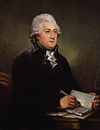
Adam Smith (16 June 1723 – 17 July 1790) was a Scottish-born economist and philosopher, widely considered the "father of modern economics".