Link Copied!
Padmasambhava Quotes (0-)
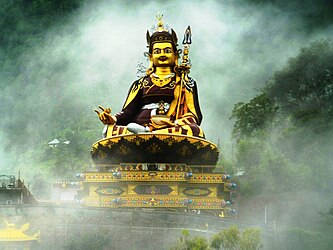
About Padmasambhava
Padmasambhava also known as Guru Rinpoche, was an 8th-century Buddhist master from India. He is widely venerated as a "second Buddha" by adherents of Tibetan Buddhism.
Best Padmasambhava Quotes
Shortest
Earliest
Explore our curated collection of the most famous and impactful Padmasambhava quotes.
“My father is the wisdom of spontaneous awareness.
My mother is the Ever-Excellent Lady, the space of all things.
...I sustain myself by consuming the concepts of duality.
My purpose is the act of killing disturbing emotions.”
My mother is the Ever-Excellent Lady, the space of all things.
...I sustain myself by consuming the concepts of duality.
My purpose is the act of killing disturbing emotions.”
“If one does not recognize the Dasein as one’s own face, But were to search for it for aeons, one would merely become disheartened. If self-originatedness is not separated from its prop, It is (like a) hermit with his hut becoming destroyed by an avalanche. If one does not understand that (Dasein) can (unlike a totality) neither be summed up (by its parts) nor be taken apart(by separating its parts), But (expects to) find it somewhere else (than in one’s self), one is on the wrong track.”
“If a person’s vision, imaginative cultivation of the vision, and the enactment of this vision (as his life style) is grounded, (This person) does not become the playground for spiritual death; But as long as he is not grounded, He will be the playground for the eighteen kinds of spiritual death. When vision falters and becomes ungrounded the subject-object dichotomy with its five poisons of emotional pollution arises. When the imaginative cultivation of the vision becomes ungrounded and falters Two kinds of spiritual death, depression and ebullience, arise. When the enactment of the vision (as a person’s life style) becomes ungrounded and falters, Seven kinds of spiritual death affect the enactment. When vision, imaginative cultivation of the vision, and the enactment of the vision (as the person’s life style) become ungrounded The four kinds of spiritual death affecting his dignity arise; Thus, when (a person) is ungrounded He becomes the playground for (all kinds of) spiritual death. Even if there is (Being’s) self-originated originary awareness present in such a person. This person is like a prince walking among commoners.”

Quotes About Padmasambhava
Gain deeper perspective through quotes about Padmasambhava from others.
Who is Padmasambhava?, Anam Thubten Rinpoche on Padmasambhava
“Padmasambhava... is loved and revered as a legendary figure in Tibet, just as Bodhidharma is in China, Korea, and Japan. There are two major versions of his life story: in the teachings of the tertons, or treasure revealers, he is a mahasiddha and tantrika with many dimensions; someone who cannot easily be defined or pigeonholed. He is more than a monk, yet he cannot be regarded as a layperson. His iconography depicts his core nature and the nuances of his being more than words can describe. He wears yellow monastic robes, royal coats, earrings, holds skull cups, and has long hair hanging to his shoulders. These images can give an immediate sense of inner liberation and an entire nonverbal teaching on the true Dharma that is complete, vast, deep, and beyond the bondage of the limits intellectual comprehension.”
Lakes, Caves, And Monasteries: A Day In Rewalsar on Padmasambhava
“The myth of Guru Padmasambhava is known to every Himalayan Buddhist and Buddhist enthusiast... As the myth explains, Mandarva, the Princess of Mandi, on the arrival of Guru Padmasambhava, immersed herself in his teachings such that she embarked on everyday journeys to the cave in which he resided. However, the King of Mandi, her father, could not acknowledge this and immediately sent soldiers to the cave. As the soldiers entered, they saw both of them in some form of meditation pose, and proceeded to kill them in a fire, as per the King’s instruction. But the power of meditation made Guru Padmsambhava realize the conspiracy, and he vanished from the site, leaving behind the sacred lake in its wake. This myth has variations, but a sure fact was that the powers of Guru Padmasambhava were recognised, and celebrated over the centuries to follow.”
About Padmasambhava
Padmasambhava also known as Guru Rinpoche, was an 8th-century Buddhist master from India. He is widely venerated as a "second Buddha" by adherents of Tibetan Buddhism.