Link Copied!
James Comey Quotes (1960-)
Director
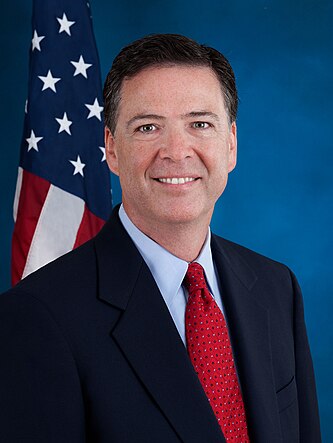

About James Comey
James Brien Comey, Jr. (born 14 December 1960) is a former director of the American Federal Bureau of Investigation, also known as the FBI.
Best James Comey Quotes
Shortest
Earliest
Explore our curated collection of the most famous and impactful James Comey quotes.
“I have been registered Republican for most of my adult life. Not registered any longer.”
“One reason we cannot forget our law enforcement legacy is that the people we serve and protect cannot forget it, either. So we must talk about our history. It is a hard truth that lives on.”
“Unfortunately, in places like Ferguson and New York City, and in some communities across this nation, there is a disconnect between police agencies and many citizens—predominantly in communities of color.”
“We simply must find ways to see each other more clearly. And part of that has to involve collecting and sharing better information about encounters between police and citizens, especially violent encounters.”
“Given Georgetown’s remarkable history, and that of President Healy, this struck me as an appropriate place to talk about the difficult relationship between law enforcement and the communities we are sworn to serve and protect.”
“I come from a law enforcement family. My grandfather, William J. Comey, was a police officer. Pop Comey is one of my heroes. I have a picture of him on my wall in my office at the FBI, reminding me of the legacy I’ve inherited and that I must honor.”
“If they take the time to do that, what they will see are officers who are human, who are overwhelmingly doing the right thing for the right reasons, and who are too often operating in communities—and facing challenges—most of us choose to drive around.”
“Over the next 40 years, he rose to lead that department. Pop was the tall, strong, silent type, quiet and dignified, and passionate about the rule of law. Back during Prohibition, he heard that bootleggers were running beer through fire hoses between Yonkers and the Bronx.”

“We simply must speak to each other honestly about all these hard truths. In the words of Dr. King, 'We must learn to live together as brothers or we will all perish together as fools'.”
“But despite this selfless service—of these two officers and countless others like them across the country—in some American communities, people view the police not as allies, but as antagonists, and think of them not with respect or gratitude, but with suspicion and distrust.”
“We must work—in the words of New York City Police Commissioner Bill Bratton—to really see each other. Perhaps the reason we struggle as a nation is because we’ve come to see only what we represent, at face value, instead of who we are. We simply must see the people we serve.”
“But if we can’t help our latent biases, we can help our behavior in response to those instinctive reactions, which is why we work to design systems and processes that overcome that very human part of us all. Although the research may be unsettling, it is what we do next that matters most.”

“The Irish had tough times, but little compares to the experience on our soil of black Americans. That experience should be part of every American’s consciousness, and law enforcement’s role in that experience—including in recent times—must be remembered. It is our cultural inheritance.”

“Twenty years ago, Bed-Stuy was shorthand for a kind of chaos and disorder in which good people had no freedom to walk, shop, play, or just sit on the front steps and talk. It was too dangerous. But today, no more, thanks to the work of those who chose lives of service and danger to help others.”
“How can we address concerns about 'use of force', how can we address concerns about officer-involved shootings if we do not have a reliable grasp on the demographics and circumstances of those incidents? We simply must improve the way we collect and analyze data to see the true nature of what’s happening in all of our communities.”
“I am descended from Irish immigrants. A century ago, the Irish knew well how American society—and law enforcement—viewed them: as drunks, ruffians, and criminals. Law enforcement’s biased view of the Irish lives on in the nickname we still use for the vehicles we use to transport groups of prisoners. It is, after all, the “paddy wagon.””

“Likewise, police officers on patrol in our nation’s cities often work in environments where a hugely disproportionate percentage of street crime is committed by young men of color. Something happens to people of good will working in that environment. After years of police work, officers often can’t help but be influenced by the cynicism they feel.”

“The first step to understanding what is really going on in our communities and in our country is to gather more and better data related to those we arrest, those we confront for breaking the law and jeopardizing public safety, and those who confront us. “Data” seems a dry and boring word but, without it, we cannot understand our world and make it better.”
“The FBI tracks and publishes the number of 'justifiable homicides' reported by police departments. But, again, reporting by police departments is voluntary and not all departments participate. That means we cannot fully track the number of incidents in which force is used by police, or against police, including non-fatal encounters, which are not reported at all.”
“He was the child of immigrants. When he was in the sixth grade, his father was killed in an industrial accident in New York. Because he was the oldest, he had to drop out of school so that he could go to work to support his mom and younger siblings. He could never afford to return to school, but when he was old enough, he joined the Yonkers, New York, Police Department.”
“I worry that this incredibly important and incredibly difficult conversation about race and policing has become focused entirely on the nature and character of law enforcement officers, when it should also be about something much harder to discuss. Debating the nature of policing is very important, but I worry that it has become an excuse, at times, to avoid doing something harder.”
“Thank you, President DeGioia. And good morning, ladies and gentlemen. Thank you for inviting me to Georgetown University. I am honored to be here. I wanted to meet with you today, as President DeGioia said, to share my thoughts on the relationship between law enforcement and the diverse communities we serve and protect. Like a lot of things in life, that relationship is complicated. Relationships often are.”

“I recently listened to a thoughtful big city police chief express his frustration with that lack of reliable data. He said he didn’t know whether the Ferguson police shot one person a week, one a year, or one a century, and that in the absence of good data, “all we get are ideological thunderbolts, when what we need are ideological agnostics who use information to try to solve problems.” He’s right.”
“Let me start by sharing some of my own hard truths. First, all of us in law enforcement must be honest enough to acknowledge that much of our history is not pretty. At many points in American history, law enforcement enforced the status quo, a status quo that was often brutally unfair to disfavored groups. It was unfair to the Healy siblings and to countless others like them. It was unfair to too many people.”

“Without complete and accurate data, we are left with 'ideological thunderbolts'. And that helps spark unrest and distrust and does not help us get better. Because we must get better, I intend for the FBI to be a leader in urging departments around this country to give us the facts we need for an informed discussion, the facts all of us need, to help us make sound policy and sound decisions with that information.”

James Comey Quotes by Topic
Find exactly what you are looking for by browsing this categorized list of James Comey quotes by topic.
James Comey on Federal Bureau of Investigation
“There is a reason that I require all new agents and analysts to study the FBI's interaction with Dr. Martin Luther King, Jr., and to visit his memorial in Washington as part of their training. And there is a reason I keep on my desk a copy of Attorney General Robert Kennedy's approval of J. Edgar Hoover's request to wiretap Dr. King. It is a single page. The entire application is five sentences long, it is without fact or substance, and is predicated on the naked assertion that there is "communist influence in the racial situation." The reason I do those things is to ensure that we remember our mistakes and that we learn from them.”

What James Comey Said About Others
Discover personal opinions James Comey shared regarding contemporaries.
James Comey on Martin Luther King Jr.
“There is a reason that I require all new agents and analysts to study the FBI's interaction with Dr. Martin Luther King, Jr., and to visit his memorial in Washington as part of their training. And there is a reason I keep on my desk a copy of Attorney General Robert Kennedy's approval of J. Edgar Hoover's request to wiretap Dr. King. It is a single page. The entire application is five sentences long, it is without fact or substance, and is predicated on the naked assertion that there is "communist influence in the racial situation." The reason I do those things is to ensure that we remember our mistakes and that we learn from them.”

About James Comey
James Brien Comey, Jr. (born 14 December 1960) is a former director of the American Federal Bureau of Investigation, also known as the FBI.