Link Copied!
Paul von Hindenburg Quotes (1847-1934)
President, Politician


About Paul von Hindenburg
Paul von Hindenburg (2 October 1847 - 2 August 1934) was a Prussian-German field marshal, statesman, and politician. He was the second and final president of the Weimar Republic.
Best Paul von Hindenburg Quotes
Shortest
Earliest
Explore our curated collection of the most famous and impactful Paul von Hindenburg quotes.
“I need them for the manoeuvring of my left wing in the next war.”
Unsourced — Primary work/page citation not yet verified in the QuotesCosmos archive. Per our Unnamed Sources & Verification Policy, quotes without confirmed primary editions are explicitly marked Unsourced while under editorial review.
“In the Great War ledger, the page on which the Russian losses were written has been torn out. No one knows the figure. Five or eight Million?”
Unsourced — Primary work/page citation not yet verified in the QuotesCosmos archive. Per our Unnamed Sources & Verification Policy, quotes without confirmed primary editions are explicitly marked Unsourced while under editorial review.
“You cannot wage war with sentimentality. The more ruthlessly war is conducted, the more merciful is it in fact, for it finishes the war the sooner.”
Unsourced — Primary work/page citation not yet verified in the QuotesCosmos archive. Per our Unnamed Sources & Verification Policy, quotes without confirmed primary editions are explicitly marked Unsourced while under editorial review.
“I have always been a Monarchist. In sentiment I still am. Now it is too late for me to change. But it is not for me to say that the new way is not the better way, the right way. So it may prove to be.”
Unsourced — Primary work/page citation not yet verified in the QuotesCosmos archive. Per our Unnamed Sources & Verification Policy, quotes without confirmed primary editions are explicitly marked Unsourced while under editorial review.
“All we know is that, sometimes, in our battles with the Russians, we had to remove the mounds of enemy corpses from before our trenches, in order to get a clear field of fire against fresh assaulting waves.”
Unsourced — Primary work/page citation not yet verified in the QuotesCosmos archive. Per our Unnamed Sources & Verification Policy, quotes without confirmed primary editions are explicitly marked Unsourced while under editorial review.
“Fundamentally, Britain is responsible for the war. She was jealous. British business men wanted this war. It is a British business war. ... We have no dislike for France, nor Russia. We think highly of the French. But Britain! We hate Britain!”
Unsourced — Primary work/page citation not yet verified in the QuotesCosmos archive. Per our Unnamed Sources & Verification Policy, quotes without confirmed primary editions are explicitly marked Unsourced while under editorial review.
“Interview of 1929, as quoted in "Nations are greatly concerned over death of German President" in Berkeley Daily Gazette (1 August 1934)
• Variant translation:”
• Variant translation:”

Unsourced — Primary work/page citation not yet verified in the QuotesCosmos archive. Per our Unnamed Sources & Verification Policy, quotes without confirmed primary editions are explicitly marked Unsourced while under editorial review.
“You are all young men and you have played to me the “March of Entry into Paris” well. But I hope that one day you will be playing this military march where you should, at the same spot where I was in 1870.”
Unsourced — Primary work/page citation not yet verified in the QuotesCosmos archive. Per our Unnamed Sources & Verification Policy, quotes without confirmed primary editions are explicitly marked Unsourced while under editorial review.
Unsourced — Primary work/page citation not yet verified in the QuotesCosmos archive. Per our Unnamed Sources & Verification Policy, quotes without confirmed primary editions are explicitly marked Unsourced while under editorial review.
“In the middle of August I did not consider that the time had come for us to despair of a successful conclusion of the war. In spite of certain distressing but isolated occurrences in the last battle, I certainly hoped that the Army would be in a position to continue to hold out. I fully realised what the homeland had already borne in the way of sacrifices and privations and what they would possibly still have to bear.”
Unsourced — Primary work/page citation not yet verified in the QuotesCosmos archive. Per our Unnamed Sources & Verification Policy, quotes without confirmed primary editions are explicitly marked Unsourced while under editorial review.
“Prosperity can come through peace alone. The German people are in favor of all possible means to make war impossible. I have seen three wars. A man who has seen three wars never will wish another war. He must be a friend of peace.
But I am not a pacifist. All my impressions of war are so bad that I could be for it only under the sternest necessity — the necessity of fighting Bolshevism or of defending one's country.”
But I am not a pacifist. All my impressions of war are so bad that I could be for it only under the sternest necessity — the necessity of fighting Bolshevism or of defending one's country.”
Unsourced — Primary work/page citation not yet verified in the QuotesCosmos archive. Per our Unnamed Sources & Verification Policy, quotes without confirmed primary editions are explicitly marked Unsourced while under editorial review.
“An English general has said, with justice: ‘The German Army was stabbed in the back.’ No blame is to be attached to the sound core of the Army. Its performances call, like that of the officer corps, for our equal admiration. It is perfectly plain on whom the blame rests. If any further proof were necessary to show it, it is to be found in the statement made by the British general and in the utter amazement of our enemies at their victory.”
Unsourced — Primary work/page citation not yet verified in the QuotesCosmos archive. Per our Unnamed Sources & Verification Policy, quotes without confirmed primary editions are explicitly marked Unsourced while under editorial review.
“In case of a resumption of hostilities we are militarily in a position to reconquer, in the east, the province of Posen and to defend our frontier. In the west, we cannot, in view of the numerical superiority of the Entente and its ability to surround us on both flanks, count on repelling successfully a determined attack of our enemies. A favorable outcome of our operations is therefore very doubtful, but as a soldier I would rather perish in honor than sign a humiliating peace.”
Unsourced — Primary work/page citation not yet verified in the QuotesCosmos archive. Per our Unnamed Sources & Verification Policy, quotes without confirmed primary editions are explicitly marked Unsourced while under editorial review.
“If I address the following lines to you, I do so because I am credibly informed that you, like myself, as a true German, love your fatherland before everything, putting aside personal opinions and wishes, as I have had to do in order to help my country in its hour of need. In this spirit I have joined forces with you to rescue our people from a threatening collapse. ... The fate of the German people has been laid in your hands. Upon your determination it will depend whether the German Reich acquires a new impetus. I am ready, and behind me stand the whole Army, to support you unreservedly. We all know that after this lamentable upshot of the war, the reconstruction of the realm can only be effected upon new foundations and in new forms.”
Unsourced — Primary work/page citation not yet verified in the QuotesCosmos archive. Per our Unnamed Sources & Verification Policy, quotes without confirmed primary editions are explicitly marked Unsourced while under editorial review.
“I was never able to understand how it was that here and there the welfare of the Fatherland had to be sacrificed to mere petty party interests, and from the point of view of political conviction felt myself most at home in the shade of that tree which was firmly rooted in the ethico-political soil of the epoch of our great and venerable Emperor. That epoch, with what I regarded as its wonderful glories, seemed to have become part of me, and I adhered firmly to its ideals and principles. The course of events in the present war have hardly been of a kind to make me particularly enthusiastic about the developments of later times. A powerful, self-contained State in Bismarck's sense was the world in which I preferred my thoughts to move. Discipline and hard work within the Fatherland seemed to me better than cosmopolitan imaginings. Moreover, I fail to see that any citizen has rights on whom equal duties are not imposed.”
Unsourced — Primary work/page citation not yet verified in the QuotesCosmos archive. Per our Unnamed Sources & Verification Policy, quotes without confirmed primary editions are explicitly marked Unsourced while under editorial review.
“I thank Providence for allowing me, in the evening of my life, to see the hour of recuperation. I thank all those who, with selfless patriotism, have collaborated in Germany’s resurgence. My Chancellor Adolf Hitler and his movement have made a decisive step towards the great goal of bringing the German people together to an inner unity above all differences of rank and class. I know that much remains to be done and I wish with all my heart that, behind the act of national resurgence and national coalescence, there should be an act of conciliation comprising the entire German Fatherland. ... I say farewell to my German people in the firm hope that that for which I longed in the year 1919 and which by a slow maturing process led to 30 January 1933, will mature to the complete fulfilment and consummation of the historic mission of our people. In this firm faith in the future of the Fatherland I am content to close my eyes!”
Unsourced — Primary work/page citation not yet verified in the QuotesCosmos archive. Per our Unnamed Sources & Verification Policy, quotes without confirmed primary editions are explicitly marked Unsourced while under editorial review.
“In consequence of the disaster on the Macedonian front, with its attendant weakening of the reserves of the West front, and in consequence of the impossibility of replacing the great losses sustained in the recent encounters, there is now, humanly speaking, no longer any possibility of our being able to impose peace on the enemy. Our opponents are constantly receiving reinforcements; the old elements of our Army still hold together, and may still offer some resistance to renewed attacks of the enemy, but our situation is becoming very precarious, and may at any moment place the Army Command under the necessity of taking a comprehensive decision. In these circumstances, it is imperative to cease the struggle in order to save the German people and our allies from unnecessary sacrifices. Every day's loss in this respect costs the lives of thousands of German soldiers.”
Unsourced — Primary work/page citation not yet verified in the QuotesCosmos archive. Per our Unnamed Sources & Verification Policy, quotes without confirmed primary editions are explicitly marked Unsourced while under editorial review.
“Recently, a whole series of cases has been reported to me in which judges, lawyers, and officials of the Judiciary who are disabled war veterans and whose record in office is flawless, have been forcibly sent on leave, and are later to be dismissed for the sole reason that they are of Jewish descent.
It is quite intolerable for me personally…that Jewish officials who were disabled in the war should suffer such treatment, [especially] as, with the express approval of the government, I addressed a Proclamation to the German people on the day of the national uprising, March 21st, in which I bowed in reverence before the dead of the war and remembered in gratitude the bereaved families of the war dead, the disabled, and my old comrades at the front.
I am certain, Mr. Chancellor, that you share this human feeling, and request you, most cordially and urgently, to look into this matter yourself, and to see to it that there is some uniform arrangement for all branches of the public service in Germany.
As far as my own feelings are concerned, officials, judges, teachers and lawyers who are war invalids, fought at the front, are sons of war dead, or themselves lost sons in the war should remain in their positions unless an individual case gives reason for different treatment. If they were worthy of fighting for Germany and bleeding for Germany, then they must also be considered worthy of continuing to serve the Fatherland in their professions.”
Unsourced — Primary work/page citation not yet verified in the QuotesCosmos archive. Per our Unnamed Sources & Verification Policy, quotes without confirmed primary editions are explicitly marked Unsourced while under editorial review.
Paul von Hindenburg Quotes by Topic
Find exactly what you are looking for by browsing this categorized list of Paul von Hindenburg quotes by topic.
Paul von Hindenburg on German Empire
“I was never able to understand how it was that here and there the welfare of the Fatherland had to be sacrificed to mere petty party interests, and from the point of view of political conviction felt myself most at home in the shade of that tree which was firmly rooted in the ethico-political soil of the epoch of our great and venerable Emperor. That epoch, with what I regarded as its wonderful glories, seemed to have become part of me, and I adhered firmly to its ideals and principles. The course of events in the present war have hardly been of a kind to make me particularly enthusiastic about the developments of later times. A powerful, self-contained State in Bismarck's sense was the world in which I preferred my thoughts to move. Discipline and hard work within the Fatherland seemed to me better than cosmopolitan imaginings. Moreover, I fail to see that any citizen has rights on whom equal duties are not imposed.”

Unsourced — Primary work/page citation not yet verified in the QuotesCosmos archive. Per our Unnamed Sources & Verification Policy, quotes without confirmed primary editions are explicitly marked Unsourced while under editorial review.
Quotes About Paul von Hindenburg
Gain deeper perspective through quotes about Paul von Hindenburg from others.
Theobald von Bethmann-Hollweg on Paul von Hindenburg
“The name Hindenburg is the terror of our enemies and electrifies our army and our people, who have boundless faith in him.”

Unsourced — Primary work/page citation not yet verified in the QuotesCosmos archive. Per our Unnamed Sources & Verification Policy, quotes without confirmed primary editions are explicitly marked Unsourced while under editorial review.
Arnold Brecht on Paul von Hindenburg 2 quotes
“Criticism of Hindenburg, Papen, and Schleicher cannot, therefore, be justly based on the accusation that they intentionally brought Hitler to total power, but it must be limited to the charge that their dilettante methods resulted in bringing about precisely what they had wanted to avoid. It is not evil intent but political folly that they may be reproached for—the imprudence of political dilettantes let loose on Germany at Germany’s expense, combined with breach of the Constitution, with weakness of character in critical situations, and with a more than average self-confidence, in Papen’s case based on a strange mixture of piety and personal vanity.”
Unsourced — Primary work/page citation not yet verified in the QuotesCosmos archive. Per our Unnamed Sources & Verification Policy, quotes without confirmed primary editions are explicitly marked Unsourced while under editorial review.
Michael Burleigh on Paul von Hindenburg
“Four points about the election of Hindenburg are worth stressing. First, there was a close correlation between the electorate which voted for Hindenburg in 1925 and those who supported the National Socialists in September 1930 and July 1932. Second, both the election and Hindenburg Day took on counter-symbolic importance, underlining the fact that the ‘Reds’ were no longer masters of the streets, but could be challenged and defeated, not least by the Stahlhelm, with its sizable following of workers. Third, rightist activism had no consolidated political home, since the conservative nationalists and right liberals could not co-operate with each other, their leaders – Stresemann and Hindenburg – being personally antagonistic. And finally, although Hindenburg promised to uphold the constitution, his election meant a return to influence, often exercised through backstairs channels, of the armed forces and major landowners, for the new President was very much one of their own. Germany’s anti-democratic elites were back in business.”
Unsourced — Primary work/page citation not yet verified in the QuotesCosmos archive. Per our Unnamed Sources & Verification Policy, quotes without confirmed primary editions are explicitly marked Unsourced while under editorial review.
Winston Churchill on Paul von Hindenburg
“The victors imposed upon the Germans all the long-sought ideals of the liberal nations of the West. They were relieved from the burden of compulsory military service and from the need of keeping up heavy armaments. The enormous American loans were presently pressed upon them, though they had no credit. A democratic constitution, in accordance with all the latest improvements, was established at Weimar. Emperors having been driven out, nonentities were elected. Beneath this flimsy fabric raged the passions of the mighty, defeated, but substantially uninjured German nation. The prejudice of the Americans against monarchy, which Mr. Lloyd George made no attempt to counteract, had made it clear to the beaten Empire that it would have better treatment from the Allies as a republic than as a monarchy. Wise policy would have crowned and fortified the Weimar Republic with a constitutional sovereign in the person of an infant grandson of the Kaiser, under a council of regency. Instead, a gaping void was opened in the national life of the German people. All the strong elements, military and feudal, which might have rallied to a constitutional monarchy and for its sake respected and sustained the new democratic and parliamentary processes, were for the time being unhinged. The Weimar Republic, with all its liberal trappings and blessings, was regarded as an imposition of the enemy. It could not hold the loyalties or the imagination of the German people. For a spell they sought to cling as in desperation to the aged Marshal Hindenburg. Thereafter mighty forces were adrift; the void was open, and into that void after a pause there strode a maniac of ferocious genius, the repository and expression of the most virulent hatreds that have ever corroded the human breast – Corporal Hitler.”

Unsourced — Primary work/page citation not yet verified in the QuotesCosmos archive. Per our Unnamed Sources & Verification Policy, quotes without confirmed primary editions are explicitly marked Unsourced while under editorial review.
Richard J. Evans on Paul von Hindenburg 2 quotes
“These achievements made the reputation of Hindenburg as a virtually invincible general. A cult of the hero quickly developed around him, and his massive, stolid presence seemed to provide an element of stability amid the changing fortunes of the war. But he was in fact a man of limited political vision and ability. He acted in many ways as a front for his energetic subordinate Ludendorff, whose ideas about the conduct of the war were far more radical and ruthless than his own. The pair's triumphs in the East contrasted sharply with the stalemate in the West, where within a few months of the outbreak of war, some eight million troops were facing each other along 450 miles of trenches from the North Sea to the Swiss border, unable to penetrate to a meaningful degree into the enemy lines.”

Unsourced — Primary work/page citation not yet verified in the QuotesCosmos archive. Per our Unnamed Sources & Verification Policy, quotes without confirmed primary editions are explicitly marked Unsourced while under editorial review.





About Paul von Hindenburg
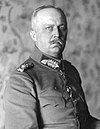
Paul von Hindenburg (2 October 1847 - 2 August 1934) was a Prussian-German field marshal, statesman, and politician. He was the second and final president of the Weimar Republic.