Link Copied!
Bill Haywood Quotes (1869-1928)
Leader
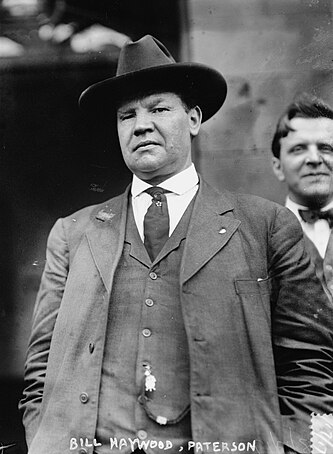
About Bill Haywood
William Dudley "Big Bill" Haywood (February 4, 1869 – May 18, 1928) was a prominent figure in American radical unionism as a leader of the Western Federation of Miners (WFM) and later as a founding member and leader of the Industrial Workers of the World (IWW).
Best Bill Haywood Quotes
Shortest
Earliest
Explore our curated collection of the most famous and impactful Bill Haywood quotes.
“The capitalist has no heart, but harpoon him in the pocketbook and you will draw blood.”
“Sabotage means to push back, pull out or break off the fangs of Capitalism.”


“The bandage will remain on the eyes of Justice as long as the Capitalist has the cut, shuffle, and deal.”

“Tonight I am going to speak on the class struggle and I am going to make it so plain that even a lawyer can understand it.”
Bill Haywood Quotes by Topic
Find exactly what you are looking for by browsing this categorized list of Bill Haywood quotes by topic.

Quotes About Bill Haywood
Gain deeper perspective through quotes about Bill Haywood from others.
Eugene Debs on Bill Haywood
“Moyer and Haywood are our comrades, staunch and true, and if we do not stand by them to the shedding of the last drop of blood in our veins, we are disgraced forever and deserve the fate of cringing cowards. We are not responsible for the issue. It is not of our seeking. It has been forced upon us; and for the very reason that we deprecate violence and abhor bloodshed we cannot desert our comrades and allow them to be put to death. If they can be murdered without cause so can we, and so will we be dealt with at the pleasure of these tyrants. They have driven us to the wall and now let us rally our forces and face them and fight. If they attempt to murder Moyer, Haywood and their brothers, a million revolutionists, at least will meet them with guns. They have done their best and their worst to crush and enslave us. Their politicians have betrayed us, their courts have thrown us into jail without trial and their soldiers have shot our comrades dead in their tracks. The worm turns at last, and so does the worker.”
Elizabeth Gurley Flynn on Bill Haywood 4 quotes
“This is the agitator's work, this continual activity. And we lay awake many nights trying to think of something more we could give them to do. I remember one night in Lawrence none of us slept. The strike spirit was in danger of waning for lack of action. And I remember Bill Haywood said finally, "Let's get a picket line out in Essex street. Get every striker to put a little red ribbon on and walk up and down and show that the strike is not broken." A few days later the suggestion was carried out, and when they got out of their homes and saw this great body that they were, they had renewed strength and renewed energy which carried them along for many weeks more in the strike.”

Kim Kelly on Bill Haywood
“William "Big Bill" Haywood, the WFM's secretary-treasurer, began working in an Idaho silver mine at the age of nine; as an adult, he was one of the most fearsome and effective union organizers in America, a strapping frontier socialist with a missing eye and a booming, powerful voice that carried throughout the nation's union halls and picket lines. He went on to help cofound the IWW, lead influential strikes in the Northeast (including the 1912 Lawrence Textile Strike), fight for the eight-hour workday, and later flee the country for Russia after decades of state persecution, but his time with the WFM is what first honed his radical sensibilities and his fervent belief in industrial unionism, the necessity of organizing the entire working class into "One Big Union."”
Meridel Le Sueur "The Ancient People on Bill Haywood
“Bill Haywood, the one-eyed giant of the miners, hid out there. He talked to us and paced back and forth in the little wooden rooms. He was out on bail and he told us how you had to fight your weakness to be a fighter for the working class. He said he liked to drink and sometimes went on a spree, lurching in and out of saloons, brawling, taking on enemies, and reciting poetry. And then he would hole up and discipline himself for the working class, his class, and study Darwin and Morgan and London and Marx. Above all, he loved Shakespeare and would recite whole scenes. Sometimes, he said, he strengthened himself by fasts. Haywood said his first school was with the miners. Each one would have a book and they would pass them around, and there was always a student, a scholar, among them who went around teaching. From such a scholar he first heard the slogan "an injury to one is a injury to all." He told how he had first been impressed by the Haymarket martyrs. He felt that a great light shone from them. He seemed to me to have grown out of the mines and the gloom and terror like some giant plant, fed by the lives of the miners. He would tell about their maiming toil and about the color of the lead miners, a deathly ashen gray, for they were dying of lead poisoning. He mourned them all and fought for them all. I had never before seen a man like that.”
Rose Pesotta on Bill Haywood
“In the brief span of its life, the IWW produced men who became internationally known and whose names were torches of inspiration in many lands. Most of them paid a high price for their fame, some with their lives...Bill Haywood, out of prison on bail while his war-time conviction was being appealed, was persuaded by New York Communists that world revolution was just around the corner and that he was needed in it. He skipped bail and fled to Russia, only to be relegated to the sidelines, and to die there a broken man.”


About Bill Haywood
William Dudley "Big Bill" Haywood (February 4, 1869 – May 18, 1928) was a prominent figure in American radical unionism as a leader of the Western Federation of Miners (WFM) and later as a founding member and leader of the Industrial Workers of the World (IWW).